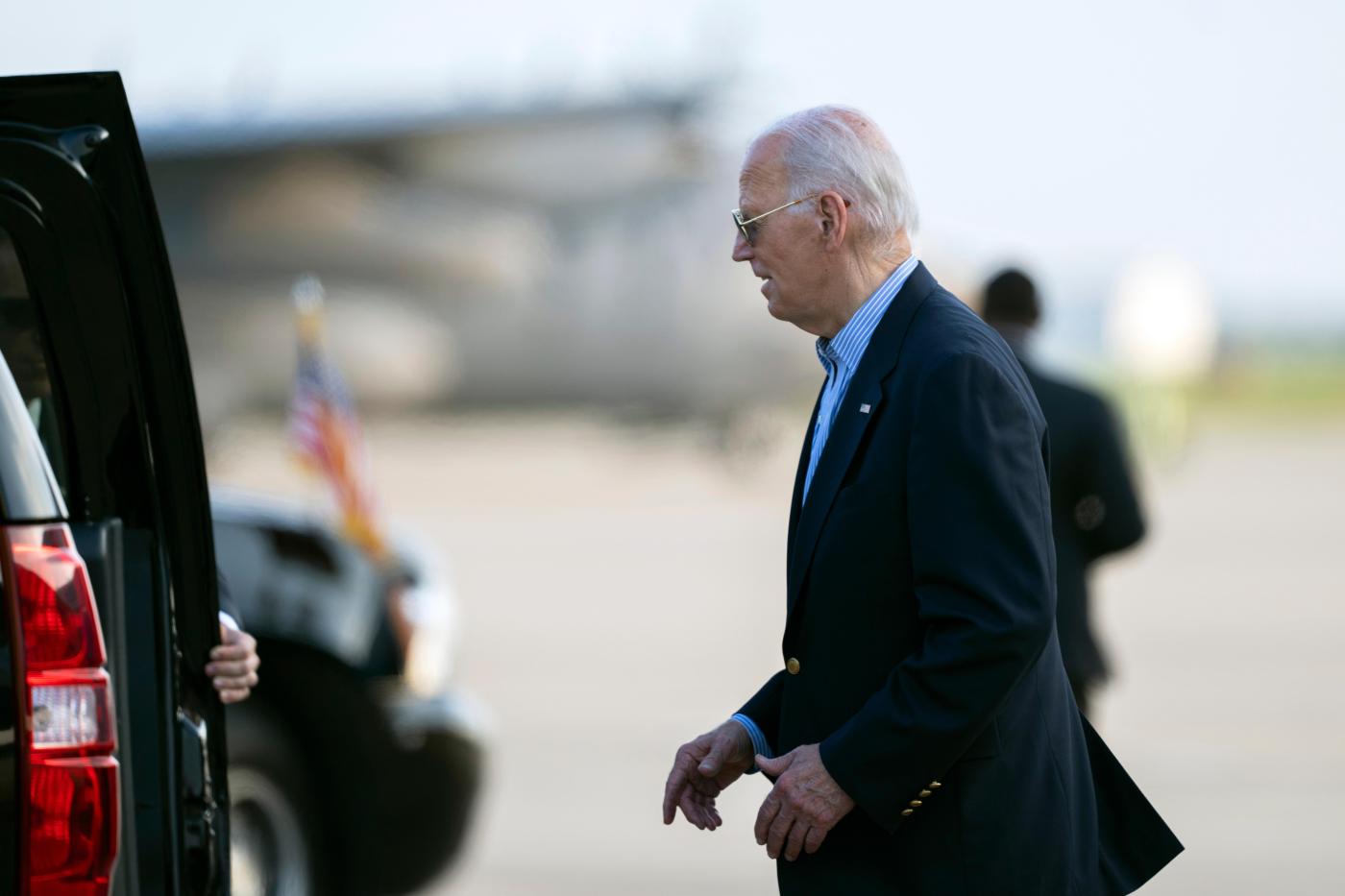
President Biden scrambles to save his reelection with a trip to Wisconsin and a network TV interview

posted in: Politics | 0

By COLLEEN LONG and SEUNG MIN KIM

WASHINGTON (AP) — President Joe Biden is fighting to save his endangered reelection effort Friday as he holds a rally and sits down for a network television interview in a pivotal battleground state, with his every answer sure to be scrutinized for evidence of his competency and fitness to run for office.

It could be a watershed moment for Biden, who is under pressure to bow out of the campaign after his disastrous debate performance against Republican Donald Trump ignited concern that the 81-year-old Democrat is not up for the job for another four years.

The interview with ABC’s George Stephanopoulos, being taped after a campaign rally in Madison, Wisconsin, is expected to be intensive and probing, and two people familiar with the president’s efforts said he had been preparing aggressively. They spoke on condition of anonymity to discuss internal planning.

There was broad agreement that Biden cannot afford to have another “bad day,” which is how he wrote off his debate flop. It was not clear that even a so-so performance would be enough to satisfy concerns about his fitness to serve.

While private angst among Democratic lawmakers, donors and strategists is running deep after Biden’s damaging debate performance, most in the party have held public fire as they wait to see if the president can restore some confidence with his weekend travel schedule and his handling of the Stephanopoulos interview. It will air in full on ABC on Friday night.

Biden’s reelection campaign is pushing ahead with aggressive plans despite the uncertainty. It plans to pair his in-person events with a fresh $50 million ad campaign this month meant to capitalize on high viewership moments like the Summer Olympics that begin in Paris on July 26.

Biden, Vice President Kamala Harris, first lady Jill Biden and second gentleman Doug Emhoff are scheduled to travel to every battleground state this month, while organizers are planning to knock on more than 3 million doors in July and August to do personal outreach to voters in a new $17 million effort.

Biden himself is scheduled to campaign in Pennsylvania on Sunday. He will also travel to southwestern states, including Nevada, after hosting the NATO summit in Washington next week, the campaign said Friday. He’ll also continue to focus his travel on the so-called “blue wall” states –- Wisconsin, Pennsylvania and Michigan — that have been critical for him in the past.

In a strategy memo released Friday morning, the campaign also specifically emphasized that the Biden would participate in “frequent off-the-cuff moments” –- once a hallmark of the gregarious, glad-handling politician’s career that have nonetheless dwindled throughout his presidency.

For Biden, every moment now is critical to restoring the lost confidence stemming from his shaky performance in Atlanta last week. Yet the president continued to make slipups that did not help that effort.

During an interview with WURD radio in Philadelphia that aired Thursday, Biden tripped up and said “I’m proud to be, as I said, the first vice president, the first Black woman to serve with a Black president” – scrambling some of his often-used lines about his pride in serving with the first Black president and choosing the first Black woman to be vice president.

Such verbal glitches are not out of the ordinary for Biden but are getting magnified attention in this environment.

In a hastily organized gathering with more than 20 Democratic governors Wednesday evening, Biden acknowledged that he needs to get more sleep and limit evening events so he can be rested for the job, according to three people granted anonymity to speak about the private meeting. California Gov. Gavin Newsom later told reporters in Holland, Michigan, that Biden’s remark about limiting events after 8 p.m. was said in jest, noting that he said it “with a smile on his face.”

Newsom said no one in the room was “sugar-coating” the reality of last week’s debate.

“You watched the physiology. You saw everything about it. It was the breathing, it was the physical, the whole thing,” Newsom said at a subsequent event in Holland.

He said Biden asked all the governors for advice, and he told the president to focus more on discussing the future.

“It’s one thing to talk about the past. It’s one thing to talk about the list of accomplishments, but what’s the compelling vision? What are we fighting for? What’s this election all about?” he said.

Biden is expected to use his rally in Madison to tick through his favorite talking points as he works to defeat Trump, touching on safeguarding democracy, the economy, and “our rights and freedoms,” according to his campaign.

Wisconsin officials including Democratic Gov. Tony Evers, U.S. Rep. Mark Pocan and the state party chair, Ben Wikler, will speak. Notably, Sen. Tammy Baldwin, who is running for reelection in one of the more critical races for Senate control this year, will be elsewhere.

___

Associated Press writer Joey Cappelletti in Saugatuck, Michigan, contributed to this report.

Wisconsin Supreme Court changes course, will allow expanded use of ballot drop boxes this fall

posted in: Society | 0

MADISON, Wis. — The Wisconsin Supreme Court ruled Friday that officials can place ballot drop boxes around their communities in this fall’s elections, overturning its own ruling two years ago limiting their use in the presidential swing state.

The court limited the use of drop boxes in July 2022, ruling then that they could be placed only in local election clerks’ offices and no one other than the voter could return a ballot in person.

Conservatives controlled the court at that time, but Janet Protasiewicz’s election victory in April 2023 flipped the court to liberal control. Seeing an opening, Priorities USA, a progressive voter mobilization group, asked the court in February to revisit the decision.

At least 29 other states allow for absentee ballot drop boxes, according to the U.S. Vote Foundation, and expanded use in Wisconsin could have major implications in the presidential race.

Wisconsin again figures to be a crucial swing state after President Joe Biden barely won it in 2020 and Donald Trump narrowly took it in 2016. Democrats believe that making it easier to vote absentee will boost turnout for their side.

The justices announced in March they would review the ban on drop boxes but wouldn’t consider any other parts of the case. The move drew the ire of the court’s conservatives, who accused the liberals of trying to give Democrats an advantage this fall. Democratic Gov. Tony Evers in April urged the court to again allow drop boxes.

The court ruled 4-3 on Friday that drop boxes can be utilized in any location.

Justice Ann Walsh Bradley, one of the court’s four liberal justices, wrote for the majority that placing a ballot in a drop box set up and maintained by a local election clerk is no different than giving the ballot to the clerk, regardless of the box’s location. Local clerks have great discretion in how they administer elections and that extends to using and locating drop boxes, she added.

“Our decision today does not force or require that any municipal clerks use drop boxes,” Bradley wrote. “It merely acknowledges what (state law) has always meant: that clerks may lawfully utilize secure drop boxes in an exercise of their statutorily-conferred discretion.”

All three conservative justices dissented. Justice Rebecca Bradley wrote that the liberals are simply trying to advance their political agenda and criticized them for ignoring the precedent set by the 2022 ruling.

“The majority in this case overrules (the 2022 decision) not because it is legally erroneous, but because the majority finds it politically inconvenient,” Bradley wrote. “The majority’s activism marks another triumph of political power over legal principle in this court.”

The popularity of absentee voting exploded during the pandemic in 2020, with more than 40% of all voters casting mail ballots, a record high. At least 500 drop boxes were set up in more than 430 communities for the election that year, including more than a dozen each in Madison and Milwaukee — the state’s two most heavily Democratic cities.

Trump and Republicans have alleged that drop boxes facilitated cheating, even though they offered no evidence. Democrats, election officials and some Republicans argued the boxes are secure and an Associated Press survey of state election officials across the U.S. revealed no cases of fraud, vandalism or theft that could have affected the results in 2020.

Republicans who control the Wisconsin Legislature intervened in the case, arguing that the justices should leave the 2022 ruling alone. Their attorney, Misha Tseytlin, didn’t immediately respond to an email seeking comment Friday.

Matt Fisher, a spokesperson for the state Republican Party, called the decision a “setback.”

“This latest attempt by leftist justices to placate their far-left backers will not go unanswered by voters,” he said in a statement.

Dane County Clerk Scott McDonell, who administers elections in the state’s most Democratic county, called drop boxes a “common sense tool.” He said they make the election process more convenient and easier for rural and disabled voters and help reduce that number of ballots that arrive after election day too late to be counted.

“Having drop boxes in place for the 2024 elections in August and November will encourage civic participation in our democracy,” McDonell said in a statement.

Related Articles

Elections |


Matt Poppleton tapped to be head of Wild Rivers Conservancy

Elections |


Woman, 81, sentenced to life in prison in cold case love triangle murder in western Wisconsin

Elections |


Wisconsin Supreme Court to consider whether 175-year-old law bans abortion

Elections |


Lake Superior lighthouse back on the market after deal falls through

Elections |


Seeking an antidote to gun violence, a St. Paul church will help turn firearms into gardening tools

Kansas’ top court rejects 2 anti-abortion laws, bolstering a state right to abortion access

posted in: Society | 0

TOPEKA, Kan. — Kansas’ highest court on Friday struck down state laws regulating abortion providers more strictly than other health care professionals and a ban on a common second-trimester procedure, reaffirming its stance that the state constitution protects abortion access.

“We stand by our conclusion that section 1 of the Kansas Constitution Bill of Rights protects a fundamental right to personal autonomy, which includes a pregnant person’s right to terminate a pregnancy,” Justice Eric Rosen wrote for the majority in overturning the ban on a certain type of dilation and evacuation, also known as D&E.

In striking down the law on clinic regulations, the panel found that the state had failed to meet “its evidentiary burden to show the Challenged Laws further its interests in protection of maternal health and regulation of the medical profession as it relates to maternal health.”

The Kansas Supreme Court’s 5-1 rulings in two separate cases signal that the state’s Republican-controlled Legislature faces stricter limits on regulating abortion than GOP lawmakers thought and suggests other restrictions could fall. Lawsuits in lower state courts already are challenging restrictions on medication abortions, a ban on doctors using teleconferences to meet with patients, rules for what doctors must tell patients before an abortion and a requirement that patients wait 24 hours after receiving information about a procedure to terminate their pregnancies.

Justice K.J. Wall did not participate in either ruling on Friday while Justice Caleb Stegall was the lone dissenter.

In his dissenting opinion in the clinic regulations case, Stegall said the majority’s actions will damage the court’s legitimacy “for years to come.” He said that the declaration that the state constitution protects a right to bodily autonomy could affect a “massive swath” of health and safety regulations outside abortion, including licensing requirements for barbers.

“Surely the government does not have a compelling interest in who trims my beard?” Stegall wrote. “Let the lawsuits commence in this new target-rich environment. The majority has — perhaps unwittingly — put the entire administrative state on the chopping block of strict scrutiny.”

Stegall, who was appointed by conservative Republican Gov. Sam Brownback, is widely regarded as the court’s most conservative member.

Kansas’ top court declared in a 2019 decision that abortion access is a matter of bodily autonomy and a “fundamental” right under the state constitution. Voters in August 2022 also decisively rejected a proposed amendment that would have explicitly declared abortion not a fundamental right and allowed state lawmakers to greatly restrict or ban it.

Lawyers for the state had urged the justices to walk back the 2019 ruling and uphold the two laws, which hadn’t yet been enforced because of the legal battles over them. The state’s solicitor general, appointed by Republican Attorney General Kris Kobach, had argued the 2022 vote didn’t matter in determining whether the laws could stand.

The court disagreed and handed abortion-rights supporters a big legal victory.

Kansas has become an outlier among states with Republican-controlled Legislatures since the U.S. Supreme Court issued its Dobbs decision in June 2022, allowing states to ban abortion completely. That’s led to an influx of patients from states with more restrictive laws, particularly Oklahoma and Texas. The Guttmacher Institute, which supports abortion rights, projected last month that about 20,000 abortions were performed in Kansas in 2023 or 152% more than in 2020.

Kansas doesn’t ban most abortions until the 22nd week of pregnancy, but it requires minors obtain the written consent of their parents or a guardian. Other requirements, including the 24-hour waiting period and what a provider must tell patients, have been put on hold. A lower court is considering a challenge to them by providers.

Abortion opponents argued ahead of the August 2022 vote that failing to change the state constitution would doom long-standing restrictions enacted under past GOP governors. Kansas saw a flurry of new restrictions under former Republican Gov. Sam Brownback from 2011 through 2018.

The health and safety rules aimed specifically at abortion providers were enacted in 2011. Supporters said they would protect women’s health — though there was no evidence provided then documenting that such rules in other states led to better health outcomes. Providers said the real goal was to force them out of business.

The ban on a certain type of D&E procedure performed during the second trimester was the first of its kind when it was enacted in 2015.

According to state health department statistics, about 600 D&E procedures were done in Kansas in 2022, accounting for 5% of the state’s total abortions. About 88% of the state’s abortions occurred in the first trimester. The state has yet to release statistics for 2023.

The procedure ban would have forced providers to use alternative methods that the Center for Reproductive Rights, an abortion-rights advocacy group, has said are riskier for the patient and more expensive.

The 2019 ruling came in the early stages of the lawsuit over the 2015 ban. The justices kept the law on hold but sent the case back to the trial court to examine the ban further. A trial judge said the law could not stand.

Three of the court’s seven justices joined the court since the 2019 decision. All three were appointed by Democratic Gov. Laura Kelly, a strong abortion-rights supporter, but one of the three — Wall — removed himself from the cases.

Bret Stephens: What would a better Israeli prime minister do?

posted in: Society | 0

A better Israeli prime minister than Benjamin Netanyahu would immediately hold an election. Israelis deserve a government they believe can bring them out of crisis, not one that got them into this crisis. If that government is still led by Netanyahu, at least he would have an honest mandate, and dissenting Israelis would have fewer reasons to protest him. It would also give the prime minister more authority over a military that seems to think that it can openly oppose the views of its civilian masters.

A better Israeli prime minister would declare the following policy on a Palestinian state: Israel’s government will work toward one that looks like Costa Rica or the United Arab Emirates. It will oppose and obstruct one that is likely to look like Yemen or Afghanistan. If the character of a Palestinian state would be moderate, not militant, committed to the prosperity of its people, not to the destruction of its neighbors, then the likelihood of its creation would be far greater.

A better Israeli prime minister would create long-term safe zones within the Gaza Strip — at least while Israel remains in the territory — for women, children, the elderly and the sick. These would be monitored and financed by the U.S. Agency for International Development and its European counterparts; open to foreign journalists; and well provided with food, shelter and medicine. The zones would alleviate humanitarian distress, put fewer civilians in harm’s way, end the constant displacement of Palestinians from one part of the territory to another, simplify Israel’s efforts to strike terrorists, and deprive Hamas of some of its frequent propaganda victories in the battle of images.

A better Israeli prime minister would offer a postwar vision for Gaza: no Israeli occupation of any part of the territory in exchange for a 10-year Arab mandate for Gaza. It would be led by Arab states that have diplomatic relations with Israel, preferably including Saudi Arabia, with the goal of providing Palestinians with security and governance while ensuring that Hamas does not remain in power. Norway, Ireland, Spain and other governments that recognize Palestinian statehood should put their money where their mouths are by providing reconstruction assistance. If it succeeds, it can become a model for the West Bank.

A better Israeli prime minister would offer safe passage out of Gaza to Qatar for all Hamas fighters and leaders in exchange for the release of all remaining Israeli hostages, living and dead. Yahya Sinwar and the other masterminds of Oct. 7 can be brought to justice later. But Israel should strike no deal that effectively legitimizes Hamas’ continued grip on power.

A better Israeli prime minister would never accept ministers who aren’t qualified for their jobs, above all in a time of war. Itamar Ben-Gvir, the minister of national security, never served in the military. Bezalel Smotrich, the minister of finance, has no background in finance. Elections may bring right-wing rabble-rousers to power, but elections don’t require the prime minister to keep them in positions where they damage the national interest.

A better Israeli prime minister would set a clear deadline for the full implementation of U.N. Resolution 1701 of 2006, which requires Hezbollah to retreat behind the Litani River, several miles north of Lebanon’s border with Israel. The deadline would call attention to Hezbollah’s violations of the resolution, give Israel greater justification to go to war in the north if the deadline isn’t met and offer more reason for the United States to lend its full support for the effort.

A better Israeli prime minister would not be planning to deliver a speech to Congress when the war in Lebanon could erupt at any moment. He would not give a speech that would mainly serve to highlight America’s partisan divisions over support for Israel. Rather than antagonizing Democratic Party leaders and liberal Americans, he would work to repair strained ties with them by emphasizing that Israel remains the only country in the Middle East where progressive values are respected. And he would never air differences with the American president in public, at least not while Israel remains dependent on U.S. munitions. (He could also ask the president to return the courtesy.)

A better Israeli prime minister would oppose government stipends and subsidies for religious students who refuse enlistment orders. Those who contribute the least to Israel’s security and material well-being should expect to receive the least from those who give the most.

A better Israeli prime minister would articulate the real stakes in this war — not a war of Israel against Hamas, but a multifront campaign against an “Axis of Resistance” that includes not just Hezbollah and the Houthis but also their masters in Iran and its allies in Russia, Syria, China and North Korea. In other words, the fighting we see in Gaza isn’t a regional war between Jews against Muslims. It’s a battle in a long global struggle between the free and unfree worlds.

A better Israeli prime minister would do this and more. Israel’s crises will abate when it gets one.

Bret Stephens writes a column for the New York Times.

Related Articles

Opinion |


Stephen L. Carter: Debit card fees get a deserved hit from the Supreme Court

Opinion |


Noah Feldman: Supreme Court just expanded the imperial presidency

Opinion |


Mihir Sharma: The world’s climate leaders need better data

Opinion |


Lisa Jarvis: Game-changing HIV shot can’t get to high-risk groups fast enough

Opinion |


Stephen L. Carter: Trump might not wind up liking the Supreme Court’s immunity decision