A day after losing Kyle Anderson to Golden State, Minnesota agreed to terms with another veteran with playmaking chops to potentially take his place.
The Timberwolves and forward Joe Ingles have agreed to a one-year deal, a source confirmed to the Pioneer Press. ESPN first reported the deal.
Ingles — who will be 37 years old by the start of next season — is a smart veteran who’s capable of running an offense if needed and also knocks down the deep ball at a high clip.
The 6-foot-9 forward is a 41 percent 3-point shooter for his career on 4.2 attempts per game. He had a slightly diminished role last season in Orlando — with his minute load dipping to 17 per game — but he did shoot 44 percent from three for the Magic.
The second-unit playmaking will likely be something Wolves coach Chris Finch relies upon. It was one of the main reasons Finch adored Anderson. Ingles isn’t nearly the defender Anderson is, but he’s a far superior shooter, which was a much-have addition for Minnesota this offseason as opponents continue to bog down the paint against Anthony Edwards.
Ingles also comes with the benefit of significant experience with Minnesota’s existing veterans. He played with Mike Conley and Rudy Gobert for numerous years in Utah, joining them for multiple playoff runs. Ingles knows how to successfully utilize Gobert’s abilities to enhance the overall offense.
And while Rob Dillingham — who the team moved up to No. 8 in last month’s NBA Draft to select — is in the team’s immediate plans as a scoring punch off the bench, Ingles can potentially take some ballhandling and playmaking duties off the 19-year-old’s shoulders as he acclimates to the NBA.
The game — which is kind of like playing air hockey while standing atop the table; also, you’re in cyberspace — is one of dozens featured here at the Electric Playhouse, a high-tech new attraction that opened in June at the Forum Shops at Caesars, where nearly nearly surface pulses with visuals so brightly colored and enveloping, it feels like our eyeballs have been swallowed by a herd of hungry rainbows.
The 10,000-square-foot venue, which bills itself as “a social gaming destination,” is designed to be a bridge between digital and physical realms, one that poses the question: Instead of merely playing a video game, wouldn’t it be more fun to inhabit one?
“You can get lost in a video game — they’re just so immersive,” notes Brandon Garrett, Electric Playhouse’s CEO and co-founder. “And so to me, as a parent, what better way to convince my kids to get off an iPad or off the screen than to say, ‘Why don’t we just literally, physically step into that world?’ ”
People play light hockey by kicking light projections with their feet at Electric Playhouse, a new high-tech social gaming place opening soon at The Forum Shops at Caesars on June 14, 2024, in Las Vegas. (L.E. Baskow/Las Vegas Review-Journal/TNS)
The outdoor space overlooking the Strip at Electric Playhouse, a new high-tech social gaming place opening soon at The Forum Shops at Caesars on June 14, 2024, in Las Vegas. (L.E. Baskow/Las Vegas Review-Journal/TNS)
Co-Founder and Senior Design Programmer Luke Balaoro, left, with CEO/Co-Founder Brandon Garrett speak at Electric Playhouse, a new high-tech social gaming place opening soon at The Forum Shops at Caesars on June 14, 2024, in Las Vegas. (L.E. Baskow/Las Vegas Review-Journal/TNS)
Think of it as a VR experience without the goofy headset.
That’s kind of what it feels like navigating the Electric Playhouse, which is posited on state-of-the-art body-mapping technology utilizing around 110 projectors and 50 sensors throughout the venue.
“What we’ve done is installed a series of sensors throughout the entire facility that basically tracks your motion and creates what we call a point cloud,” Garrett explains. “It’s basically an avatar of yourself. And so you become a player in a video game world.”
As you move through the place, the walls, floors and tables react to your movements with 360-degree projection-mapping following your every step.
“I’ve been wandering all over the Strip, seeing a bunch of pre-rendered content,” notes Luke Balaoro, Electric Playhouse’s senior software architect and co-founder. “What’s really cool — and what differentiates us — is our real-time rendering. We’re taking in a lot of sensor data, we’re processing it, and we’re making it react to people, making games out of it.”
The gaming layout is divided among numerous “pods,” designed for one to two players who can choose from around 12 different games that range from “Crystalius,” where alien spaceships are targeted, to “Paint Pong,” where you create your own artwork.
Then there’s the larger arena area, where we play “Light Hockey,” and which can accommodate around two dozen players.
Guests pay by the hour and have access to all the games, which are created in-house in order to maintain a fresh, ever-growing selection.
“We build everything,” Garrett says. “And so, as we’re adding to the library, every time you come back it could be a completely different experience. It’s one physical footprint, but almost an infinite amount of experiences that we can pack into this facility.”
Projections of colorful cords cover the floor and walls at Electric Playhouse, a new high-tech social gaming place opening soon at The Forum Shops at Caesars on June 14, 2024, in Las Vegas. (L.E. Baskow/Las Vegas Review-Journal/TNS)
CEO/Co-Founder Brandon Garrett stands in a game pod being calibrated at Electric Playhouse, a new high-tech social gaming place opening soon at The Forum Shops at Caesars on June 14, 2024, in Las Vegas. (L.E. Baskow/Las Vegas Review-Journal/TNS)
Financial Controller Patricia Garrett sets up an electronic reader board near the entrance at Electric Playhouse, a new high-tech social gaming place opening soon at The Forum Shops at Caesars on June 14, 2024, in Las Vegas. (L.E. Baskow/Las Vegas Review-Journal/TNS)
The tables and walls flutter with butterflies, swarm with cartoon bugs and pulse with ocean waves, as if we’re plunging through some aquatic depths in the desert, somehow.
We’re in one of three party rooms at the Electric Playhouse, which are designed to host everything from birthday celebrations to corporate events to ticketed dining experiences (the Electric Playhouse’s culinary program is set to debut this summer).
“The magic here is the tabletop itself is actually interactive,” Garrett explains with a swoop of the hand, making the aforementioned bugs scatter.
This is the Electric Playhouse’s second location, having been launched in Albuquerque, New Mexico, in early 2020, just six weeks before the pandemic hit.
“For us, Vegas just made sense,” Garrett says of the company’s westward expansion, “because we’re trying to build our own brand, and what better place to do that than the world stage in Vegas?”
There are some unique-to-the-market flourishes here, namely an outdoor balcony offering killer views of the Strip and a new twist on an old staple: the Vegas wedding.
“We see huge opportunity for weddings within this space,” Garrett says. “You want to get married in the clouds or some total fantasy thing and make it a true destination?”
In the meantime, there are more games to build, more “Light Hockey” goals to be scored.
“There’s just so many ways we can kind of continue to bridge this physical/digital realm,” Garrett says. “I feel like a kid in a candy store every day. I mean, we’re constantly like, ‘Oh, my God, we can do that?’”
After an NHL season that ends short of a Stanley Cup — and especially one that finished short of the postseason — a coaching staff has to take a hard, cold look at what went wrong.
Certainly that applies to the Minnesota Wild, and it wasn’t hard to find defects, after the team missed the postseason for just the second time in 12 seasons. And while a series of injuries to key players that almost became farce might have defined the team’s 2023-24 season, it wasn’t all about bad luck.
“You’re looking for different ways to make your team better,” head coach John Hynes said this week, “and one of those ways that we felt, obviously, was penalty killing.”
Eight of the 10 teams with the worst penalty kills last season missed the playoffs, and the two that made it to the postseason — Toronto and the New York Islanders — were bounced in the first round. The Wild had one of the NHL’s worst, their 74.5 percent success rate worse than everyone except the Islanders (71.5) and Anaheim (72.4).
To that end, the Wild announced two offseason moves this week, signing winger Yakov Trenin to a four-year, $14 million free-agent deal, and adding former Islanders head coach Jack Capuano to the coaching staff.
“Jack is very, very passionate about the PK,” Wild general manager Bill Guerin said. “He’s always had a good track record with it. So, we’re looking to definitely improve in that aspect.”
You can add Jake Middleton’s four-year, $17.4 million contract extension to that plan. He was already under contract for next season, but will be part of the team that Guerin hopes will enter its prime over the next several seasons.
On a team that lost Jared Spurgeon, Jonas Brodin and Marcus Foligno for long stretches — then traded away Connor Dewar and Brandon Duhaime — Middleton was the most consistent penalty killer last season, leading the team in blocks (161), and was third in hits (148 hits).
Hynes said Monday that Capuano, a colleague on international coaching staffs, will run the defense and work with Patrick Dwyer on reconstructing a penalty kill that gave up 67 power-play goals last season, second only to Anaheim’s 91. Trenin, another big body at 6-foot-2, 200 pounds, averaged 150.5 shorthanded minutes the past two seasons.
“He’s definitely going to help in that department,” Guerin said of Trenin. “It’s something that he’s very good at. We did not have a good year last year on the PK.”
To get better next season, Guerin is, of course, relying on something out of anyone’s control. Injuries threw a wrench into everything last season, and there is no guarantee they won’t happen again. In fact, in the NHL, the season without major injury losses, for any amount of time, is rare.
And then there is the uncertainty surrounding players such as Marcus Johansson and Freddy Gaudreau, who plain underperformed in 2023-24, combining for 16 goals and 29 points in a combined 144 games. You can add mercurial forward Ryan Hartman to that wish list.
Hartman was pretty good last season — 21 goals, 45 points and a plus-4 in 74 games. But when he signed Hartman to a three-year, $12 million extension last fall, Guerin was hoping for more from a skilled player who had career highs of 34 goals and 65 points in 2021-22.
The Wild believe improving the penalty kill is something mostly in their control. They want the Wild to regain the identity of being a heavy team that is hard to play against in all situations. Regardless of the composition of a PK unit, Hynes said, “There’s got to be a mindset on the penalty kill.”
Guerin and Hynes are even thinking of moving talented forward Matt Boldy into the mix. He played some PK for Team USA in international play this spring under head coach Hynes.
“With how dynamic the power plays are, nothing’s ever static. So, you’ve gotta have guys that can make reads and have experience doing it,” Hynes said. “Trenin’s certainly a guy that is a very good penalty killer. So, I think when you have guys that can do it, and then you coach it the right way, it should be a significant improvement for us.”
After playing against Trenin in the Central Division the past few seasons, Middleton is sold on Trenin.
“I think it’s a great signing,” he said. “He is hard to play against. He forechecks like an animal. He finishes every check. Great penalty kill. … I’ve never been on the power play, but I’ve watched him kill penalties. Good at that. I think it’s a good pickup.”
JELLICO, Tenn. — In March 2021, this town of about 2,000 residents in the hills of east Tennessee lost its hospital, a 54-bed acute care facility. Campbell County, where Jellico is located, ranks 90th of Tennessee’s 95 counties in health outcomes and has a poverty rate almost double the national average, so losing its health care cornerstone sent ripple effects through the region.
“Oh, my word,” said Tawnya Brock, a health care quality manager and a Jellico resident. “That hospital was not only the health care lifeline to this community. Economically and socially, it was the center of the community.”
Since 2010, 149 rural hospitals in the United States have either closed or stopped providing in-patient care, according to the Cecil G. Sheps Center for Health Services Research at the University of North Carolina. Tennessee has recorded the second-most closures of any state, with 15, and the most closures per capita. Texas has the highest number of rural hospital closures, with 25.
Each time a hospital closes there are health care and economic ripples across a community. When Jellico Medical Center closed, some 300 jobs went with it. Restaurants and other small businesses in Jellico also have gone under, said Brock, who is a member of the Rural Health Association of Tennessee’s legislative committee. And the town must contend with the empty husk of a hospital.
Dozens of small communities are grappling with what to do with hospitals that have closed. Sheps Center researchers have found that while a closure negatively affects the local economy, those effects can be softened if the building is converted to another type of health care facility.
In Jellico, the town owns the building that housed the medical center, and Mayor Sandy Terry said it is in decent condition. But the last operator, Indiana-based Boa Vida Healthcare, holds the license to operate a medical facility there and has yet to announce its plans for the building, leaving Jellico in limbo. Terry said local officials are talking with health care providers that have expressed interest in reopening the hospital. That’s their preferred option. Jellico does not have a Plan B.
McKenzie Regional Hospital found new life after it closed in 2018. Baptist Memorial Health Care, which operates a hospital in nearby Huntingdon, bought the assets and donated the building to the town of McKenzie. Cachengo, a technology company, took over the space. Jill Holland, McKenzie’s former mayor, believes the town can become a technology hub. “It’s opening a lot of doors of opportunity for the youth in the community,” Holland says. (Taylor Sisk/KFF Health News/TNS)
Sandy Terry, the mayor of Jellico, Tennessee, says local officials are talking with entities that have expressed interest in reopening the Jellico Medical Center, which closed in March 2021. (Taylor Sisk/KFF Health News/TNS)
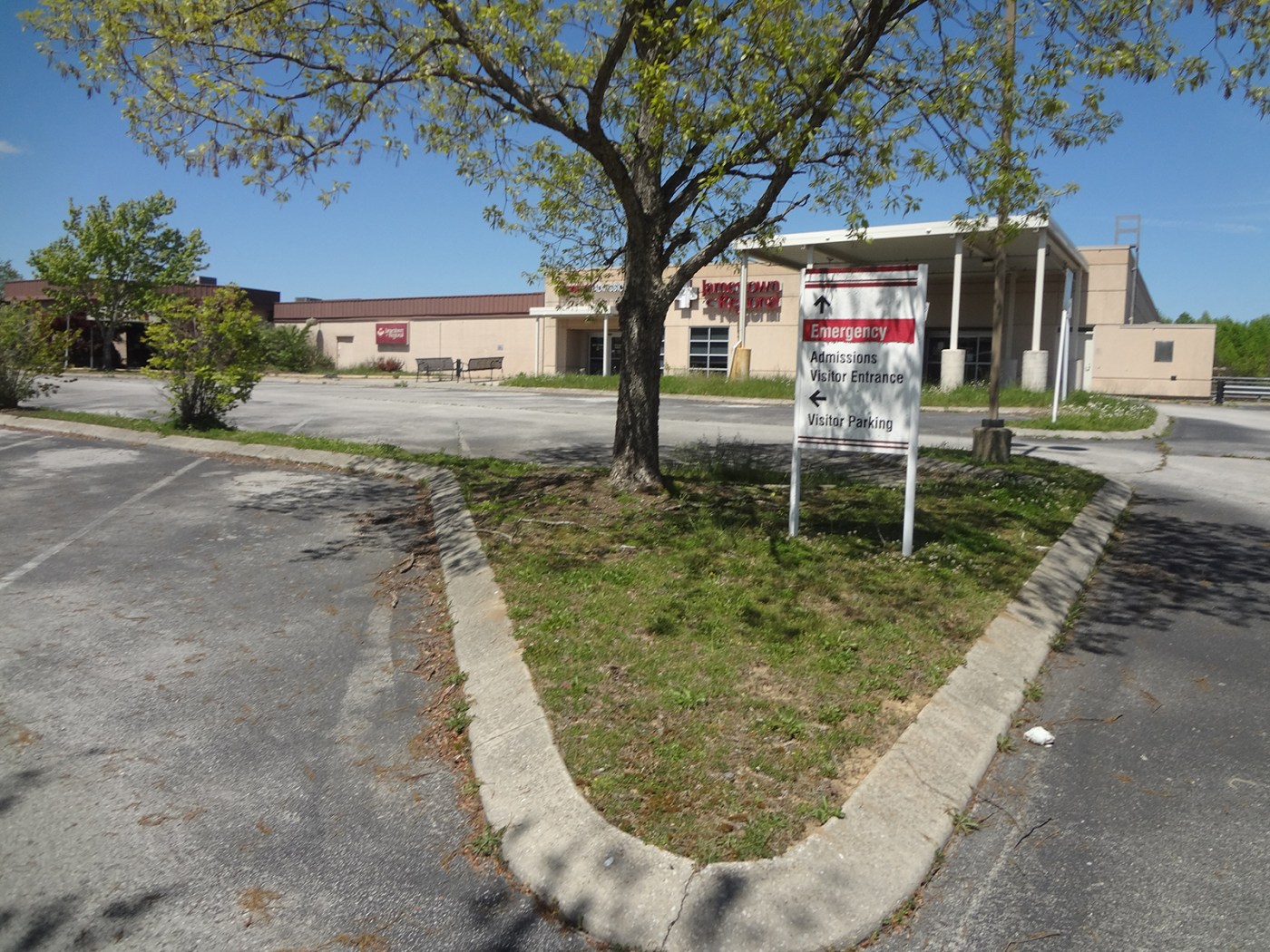
In June 2019, Florida-based Rennova Health suddenly shuttered the Jamestown Regional Medical Center in Fentress County, Tennessee. County Executive Jimmy Johnson says Rennova’s exit from Jamestown was so abrupt that “the beds were all made up perfectly” and IV stands and wheelchairs sat in the halls. (Taylor Sisk/KFF Health News/TNS)
“We’re just in hopes that maybe someone will take it over,” Terry said. Meanwhile, the nearest emergency rooms are a half-hour drive away in LaFollette, Tennessee, and across the state line in Corbin, Kentucky.
An hour and a half away in Fentress County, the building that once housed Jamestown Regional Medical Center has been empty since June 2019, when Florida-based Rennova Health — which also previously operated Jellico Medical Center — locked it up.
County Executive Jimmy Johnson said Rennova’s exit from Jamestown was so abrupt that “the beds were all made up perfectly” and IV stands and wheelchairs sat in the halls. About 150 jobs evaporated when the center closed.
Rennova still owed Fentress County $207,000 in taxes, Johnson said, and in April the property was put up for auction. A local business owner purchased it for $220,000. But Rennova was granted a year to reacquire the building for what it owed in back taxes, plus interest, and did so within a few days.
Abandoned hospital buildings dot the map in central and east Tennessee. But in the western part of the state, two communities found uses for their empty buildings, albeit not in reopening hospitals.
Somerville, about an hour east of Memphis, lost its hospital, Methodist Fayette, in 2015. Its parent company, Methodist Le Bonheur Healthcare, donated the building to the town and threw in $250,000. The building is now a satellite campus for the University of Tennessee-Martin.
The conversion was pushed along by the town leveraging other funding. Bob Turner, Somerville’s city administrator, said both the town and the county matched Methodist’s quarter-million dollars toward the renovation. In its first year in Somerville, the university raised another $125,000. Tennessee’s governor then matched that $875,000 in his state budget.
Somerville is now in the seventh year of a 10-year agreement with the university, which rents the building from the town.
“We have a building, an asset, that’s probably worth $15 million,” Turner said. “It’s a four-year university right here in the heart of Fayette County.”
Mendi Donnelly, Somerville’s community development director, said the county is still in desperate need of a hospital, but “we’re thrilled that we were able to make lemonade out of our lemons.”
Ninety miles to the northeast, in rural Carroll County, Tennessee, another shuttered hospital found new life.
The closing of McKenzie Regional Hospital in 2018 was a blow to the local economy. But Baptist Memorial Health Care, which operates a hospital in nearby Huntingdon, bought the assets — including the building, land, equipment, and ambulance service — and subsequently donated the building to the town of McKenzie.
Cachengo, a technology company, ultimately took over the space. Because of hospitals’ electrical infrastructure, the site was a perfect fit for a business like his, said Ash Young, Cachengo’s chief executive. Young said Cachengo is now looking into repurposing abandoned hospitals across the country.
Jill Holland, McKenzie’s former mayor and a local-government and special-projects coordinator for the Southwest Tennessee Development District, believes the town can become a technology hub.
“It’s opening a lot of doors of opportunity for the youth in the community,” Holland said.
Back in Jamestown, the vacant hospital is “deteriorating,” said Johnson, the county executive. “It could have been used to save lives.” Rennova did not respond to a request for comment.
The US will pay Moderna $176 million to develop an mRNA pandemic flu vaccine
The University of Tennessee Medical Center opened a freestanding emergency room elsewhere in Jamestown, sparing residents a half-hour drive to the closest ER. Johnson believes the old hospital building could serve the community as housing for those who are homeless or as a facility to treat substance use disorder.
Brock, the health care quality manager, thinks things will get better in Jellico, but the community has had its hopes dashed more than once.
Brock believes a freestanding emergency room could be a viable solution. She urges her community to be responsive to “a new day” in rural health in America, one in which a hospital must focus on its community’s most urgent needs and be realistic about what that hospital can provide.
“Maybe it is just the emergency room, a sustainable emergency room, where you could hold patients for a period of time and then transfer them,” Brock said. “And then you build upon that.”
She added, “There are options out there.”
(KFF Health News is a national newsroom that produces in-depth journalism about health issues and is one of the core operating programs of KFF — the independent source for health policy research, polling and journalism.)