Editor’s Note: This story—produced in collaboration between palabra, a multimedia initiative of the National Association of Hispanic Journalists, and the Texas Observer—was translated from Spanish by Lygia Navarro.
I met Coyote 1 outside the airport in Managua, Nicaragua. Even though coyotes already use one- or two-syllable aliases, I’m calling him that for my own safety. After weeks of talking on WhatsApp before I left Cuba, we’d already arranged everything. He knew I’d be wearing a white t-shirt and gray Nikes. And he’d seen my face. In the lucrative human smuggling trade, coyotes are the bosses. They control a web of guides and subcontractors who provide different services. Every country, a new coyote.
In his car, counting the wad of $1,200 I’d just handed him, Coyote 1 warned: “You don’t have to pay again until Guatemala.” I started to hide the rest of my money under the insole of my shoe. I’d saved for years for part of it and borrowed the rest. “You’ll get your feet wet,” he said, smiling. “Find another hiding place.” He gave me a local SIM card, loaded me into a silver Toyota sedan, and I never saw him again.
The next seven hours involved highway driving to Jalapa, a city in northern Nicaragua near the Honduran border. It was October 1, 2022, and I was en route to becoming one of the nearly 30,000 Cubans who crossed the southern border into the United States that same month.
I drifted off, woke up, and it was already nighttime. There were houses, then everything turned into countryside. Houses. Countryside. The farther we got from Managua, the more poverty there was. I prayed the whole journey would be this smooth. Then I fell asleep again. I got woken up to change cars. I fell out of the car, a zombie, at 10:27 p.m. The new driver showed me my own face on his cell phone. “Never go with anyone who doesn’t have your photo,” he advised. I was pressed into the back seat, amid who knows how many others. The stereo alternated between trap music and narcocorridos.
Ever the journalist, I took notes about everything in my phone. Some other migrants looked calm. Not me. I’d already visited Miami and pretty much understood how capitalism works. In 2019, I was invited to a journalism event, and everyone in Cuba urged me to defect on that trip. But a glimpse of America’s usurious economy made me feel so small. I went back home to Havana, where State Security (the Cuban military organization tasked with counterintelligence and repression) cornered and threatened me so intensely that I felt forced to leave.
It’s not like I was actually a threat. As a reporter for nonstate media, I thrived on spending weeks in the field looking for stories, interviewing people, and reporting on others’ lives. But the Cuban government had declared war on all independent journalism. And it got to the point where I feared leaving home, afraid I’d be followed by plainclothes state agents.
So I fled. Destination: Dallas, where my father lives. I became a man without a country, and I was as terrified of setting foot in the United States as I was of not surviving the trip.
Arm outstretched searching for a cell signal, the Cuban video-called his girlfriend. He pointed the camera at the landscape in Jalapa: mountains in every direction. “Those trees, do you see them? That’s Honduras over there.”
After a long day of travel, I joined seven other Cubans fenced inside a jungle safehouse. I awaited my departure signal, and the Cuban from the video call awaited his. In 36 years of life, his only plane flight was the one from Havana to Managua. He was anxious to get to Miami.
I didn’t need to ask why. We’d both been injected with the idea that utopia begins with “U” for United States. The paradise where all dreams come true: sports cars, $100 bills, supreme laws, Captain America. On the other side, Cuba, primitive, in crisis for decades, designed to trap you in an asphyxiating cycle. Bread, transportation, electricity, internet, optimism—whatever, in Cuba there is none. But you need it, and breaking your back to acquire it devours your life.
As the 36-year-old Cuban finished his travel preparations, he’d become convinced that if he didn’t leave, he’d sink. At that time, September 2022, Hurricane Ian slammed into western Cuba with sustained winds of over 124 miles per hour. The local press reported three deaths and the loss of crops, roofs, and more. His breaking point came courtesy of the National Electric System, which collapsed and plunged the island into darkness. People were banging out their frustrations on pans. “You could hear the pots from the airport,” he said.
A year prior, massive protests had exploded for the first time in the six decades of Fidel Castro’s revolution. The country was paralyzed. The people demanded freedom and food. The military took to the streets.
Once the explosion was controlled, every time people heard sirens, they peeked through their window blinds to see if the government was cracking down on a new protest. That’s how we lived. One felt the constant boiling up of conspiracies, hunger, and exhaustion in the endless lines in stores, the endless lines at bus stops, the endless lines in hospital emergency rooms. A miserable torpor in whispers. Most people remained focused on staying alive: Speak quietly, keep your head down.
Then, suddenly, everyone was leaving. It seemed like the party leaders and military strongmen would end up governing only each other.
Why Nicaragua? Because in November 2021, just after Cuba’s protests, Nicaraguan President Daniel Ortega’s government approved open visas for Cubans. The price for Havana-to-Managua flights skyrocketed, and the phrase “going to see the volcanoes,” a reference to the Central American nation’s iconic mountains, became a synonym for exodus.
Anyone with family abroad, something to sell, or a moneylender, flew to Managua to undertake the 2,500-mile escape to the United States. Everyone in Cuba must know at least one person who went to “see the volcanoes.” In fiscal year 2019, only around 21,500 Cubans entered the United States via the Mexican border. But following the Nicaraguan open visa policy, the number exploded to almost 225,000 in 2022.
Since the Cold War, the U.S. government has afforded Cuban immigrants certain advantages. The Cuban Adjustment Act, on the books since 1966, permits Cubans admitted into the States to receive a green card after one year. For other immigrants, this process is more arduous or impossible.
In the first few decades following the Cuban Revolution, any Cuban who reached U.S. territorial waters was admitted into the country. This compelled many to risk crossing the Florida Straits. Between 1959 and 1995, an estimated 100,000 Cubans died in the attempt. In 1995, the United States implemented the “wet foot, dry foot” policy, which required Cubans to reach land before being admitted.
In 2017, then-President Barack Obama ended “wet foot, dry foot,” exposing arriving Cubans to deportations just like other migrants. Yet many of us still take that risk, partly because Cubans can still apply for expedited green cards if we avoid removal.
Between 2021 and 2023, 4.1 percent of Cuba’s population emigrated to the United States. One in every 25. It was a stampede.
I didn’t see the 36-year-old Cuban or anyone in his group again.
Don’t get attached to anyone. You don’t know who’s going to leave first, nor by what route, nor if you’ll ever see them again. And obey your coyote.
The third day of the trip, as dawn broke, I was led out of the house in Japala with some Ecuadorians, jumping over puddles resembling rusted bathtubs, stepping carefully onto rocks, roots, or anything more stable than precarious mud created by interminable rains.
I focused on an Ecuadorian woman and man with three small children. The mother was thin and carried a baby on her back. Wading through those narrow, zigzagging trails was so difficult that I didn’t think she’d make it. The man, equally skinny, toted a toddler on his shoulders, as well as a massive backpack. They looked like a long-married couple. Yet, I found out, they’d only just met. The third child was around 7 years old and dragged a suitcase double his weight.
I tried to take notes and walk without losing speed. A steep curve nearly knocked me down. Left behind in a jungle like that, not even the latest CSI techniques could have identified my cadaver.
One of the perilous river crossings along the way (Jesús Jank Curbelo)
“Thank God for this beautiful weather,” said a radio announcer at 6:40 a.m. I had no idea what country we were in.
The stash house had holes instead of doors and windows. It held a radio, a dirt floor, and the board on blocks where we sat. Some people removed their shoes. The baby cried. Our guide counted Honduran lempira bills for a toll to use the trails. I had heartburn. I hadn’t taken a shit in three days. “This is private land,” the building’s owner said. “Here, we care for migrants. But out there, it’s another story.”
I sensed my sweat drying. It felt like we’d been sitting there for years. “One of the bikers’ axle casing got damaged,” the guide explained. “But it shouldn’t take long.”
The bikers were a group of toughs with acne and combs in their pockets. One pushed his sunglasses onto his forehead, asking: “How much do you weigh?”
“I don’t know… 200 pounds?” I replied. He laughed: “You’re going to sink my motorcycle.”
I had my knapsack on my back and, in my hands, the suitcases of my fellow migrants. The mother tied her baby to her chest, and the man held the 7-year-old in front of him and the 2-year-old hanging off one knee like a sidecar.
The Serpento 150 motorcycles turned at superspeed on tire-width precipices. A roller coaster without seat belts, triple the adrenaline. Below, the palm trees resembled bonsais. “Are we in Honduras now?” I asked.
“Honduras,” the biker confirmed, leaning toward the fuel tank like a professional racer. “This town is called La Esperanza Abajo [Hope Below].”
He told me he made two or three trips a week, for 500 lempiras (about $20) each. Half went to gas, the other half to his 1-year-old son. He asked for a tip. “Did you see about the accident a few days ago? They overloaded the boat and it sank. Several migrants died.”
Then he said I’d have to cross the same river where that accident occurred.
The water rose to our waists. Quickly. And I didn’t know how to swim.
The boat rattled along. It was a dirty, rustic little motorized thing. I reached my hand out to the 7-year-old. His mother had tried boarding with the baby, but the helmsman insisted she’d have to take another boat. We crossed in silence, without moving, to avoid destabilizing the boat.
I climbed out and, from the shore, focused on the river. Serene and gray, around 110 yards wide. “Did you hear about the accident?” asked a cowboy I’ll call Coyote 2. “Three drowned.”
In front of a mangrove, he took a group photo, as if for a birthday party portrait. He also photographed our passports, which were needed for safe-conduct documents in Honduras. Then he loaded us into a pickup bed. Again, I offered my hand to the boy. He reached for his mother, who’d arrived on another boat.
I knew that women migrants risk exploitation and sexual abuse as an additional price for the trip. Rapes—of women and of children—are so common that some prepare for the journey with long-acting contraceptive injections. Amnesty International reports that as many as six in 10 women and girl migrants experience sexual violence. Often, the assailants are state agents: police, military, or migration officials.
I watched the Ecuadorian mother take her son’s hand. I hoped that nothing bad would happen to them.
The Danlí bus terminal, in southern Honduras, was a foul-smelling, labyrinthine torment. It was 10 a.m. on our third day in Central America. We wandered and asked the first person we saw where the migrant buses were.
“Are you with Coyote 2?” the person asked. The smugglers’ scheduling was impressive. He gave us our documents. Our group merged with 35 other travelers. Every so often, we were shifted to a different bus. Six or seven times. A police officer: “I’m going to need you to raise your hands when I say your nationality.” From Cuba, almost all of us. “Ecuador,” the rest. “Venezuela,” no one. “Haiti,” zero. “Nicaragua,” zip. He jotted something down. “Have a good trip.”
We were let off at a vacant wasteland. Next to a bus, a Christian sisterhood handed out provisions. I helped. My water was almost gone and maybe I could earn an extra bottle that way. I’d seen the family members raise their hands back when the cop said “Ecuador.” But when I returned to the bus, they were gone.
Seriously, don’t get attached to anyone.
On the fourth day, I met Coyote 3 at an idyllic hotel near the Guatemalan border. He brought me canned food “for the road.”
At 10 p.m., about 80 of us were arranged in three lines. Divided by coyote, with colored plastic bracelets placed on our wrists. Six at a time, we were sent to taxis parked on the street. “Turn off your phones so you won’t call attention,” the driver requested, crossing himself, and we shot off at 60 miles an hour.
Traveling squeezed no longer bothered me. Without knowing my fellow passengers, or coordinating it, we took turns being the ones who had to sit underneath with others on our laps and being the ones sitting on laps with our necks pressed into the car ceiling. And, for a privileged bit, riding shotgun. Women and men, all jumbled together, we moved in and out of those spots without stopping—a living puzzle.
The taxi drivers were connected too. They shared WhatsApp audio memos and texted in a group chat they’d called “.” The lead driver wrote: “Operation defeated.” And others texted that they, too, had survived. The “operations” were military checkpoints manned by soldiers with long guns and armored jeeps.
“Everything’s fine with the local cops,” our driver said. “The gringos are the problem, because they send their own cops to crack down. Those don’t accept bribes.”
Near 2 a.m. on the fifth day, the taxis scattered. Our driver turned off the highway and slipped into an alley. The police had extorted money from the lead car in an unplanned roadblock, he explained. Now the entire caravan had to hide. “No one wants to risk having their cash taken. Not you, not us,” he said, turning off the engine and reclining his seat. “Don’t make any noise—because of the dogs. The neighbors might call the cops.”
Finally, we were able to move again, and hours later we got out of the taxi on a dirt road. Three school buses waited. “Let’s go! Let’s go! We’re late.” Around 8 in the morning, we took off for the Mexican border.
Our driver’s assistant hung outside. “When I tell you to duck, crouch really far down… Now!” We rolled up like armadillos to hide. I snuck a look over the window ledge. We passed coconut plantations, a bridge, minimarts, and a checkpoint with about 20 soldiers standing at attention. We did this six or seven more times. For the last one, we didn’t have to duck: “What’s up, buddy?” the assistant said to a Guatemalan soldier, camouflaging money with a handshake.
They let us out at a construction site in northern Guatemala and separated us by groups according to our bracelet color. Inventory: 98. Then a fisherman took me across the river, from Guatemala to Mexico, in a log raft atop truck tires, pushing against the riverbed with an oar. Like in Venice.
On the other side, Chiapas. “AMLO Mexican pride” graffiti. The transition surprised me. Coming from an island, the only transitions I was accustomed to were those of accents between provinces. Here, the two sides of the line had distinct accents, cultures, histories, traditions. In a matter of meters, I could feel it.
A 20-something tattooed guy picked me up on his motorcycle. At 75 miles an hour, we buzzed past corn fields and banana orchards. From afar, he saw something suspicious, U-turned, hit the gas, then struck a pothole, lifting us 3 feet in the air. The weight of my backpack pulled me down and, somehow, magically righted us. “Didn’t you see it?” the driver yelled. “They were in a caravan.” The police.
That night, in a Chiapas safehouse, I chatted with my mattress neighbors: one in his 30s and the other not yet 18. In 15 minutes, they were family, though I never knew their names. I called them Ecuador and Guate. I was Cuba (until other Cubans arrived and I became Havana—the rest were from Santiago).
Ecuador told me he worked construction. A cousin in New York had loaned him the cash for the trip. He had three kids. He’d told them and his wife that a job had come up near Colombia; he’d call them when he arrived to explain. Guate didn’t say much. He spoke less than me.
The room: dark and cold. The TV, on without an image. A white bulb lighting up the wall. A man entered, shouting: “We have to go! Hurry the fuck up!”
The truck driver who picked us up handed me a roll of Mexican pesos secured with a rubber band. “As soon as you get in the next truck, give this to the guy.” He dialed a number on his cell phone. “I’m sending you the dough. It’ll come from… What’s your name?… A box named Jesús.” I imagined box was another way of saying package. In the end, that’s what we were.
He drove for a silent hour between trucks equally as large and terrifying. In another truck were Guate and Ecuador. It was 8 p.m. when we stopped on a gloomy highway. “Here’s where you get out.”
On the street, I froze for a few seconds, then ran, covering my head as if missiles fell all around me, toward the only light on the horizon: a gas station. Amid the gas pumps, a cop car like a reptile—hunting. The trucks had left, and I slowed to walk as calmly as possible. We migrants feel the constant, mind-bending stress of traveling illegally. If they capture you, you could end up in jail or deported. I entered a motel next to the gas station. Hidden. Fearful.
An old man in a security guard uniform appeared. “You can’t be here.” But instead of kicking me out, he provided refuge in his office. I peeked out the window. Another convoy of trucks arrived, and I ran without knowing if they were part of the smuggling operation.
“Jesús?” A truck driver asked, requesting the roll of peso bills. He was traveling with his wife; it was his first time. As a truck driver, he didn’t do half badly, but his earnings were never enough. He knew he could make more in el norte but never wanted to leave. He didn’t believe he was harming anyone by transporting migrants. He chainsmoked and checked his mirrors. His terror was obvious. Every so often, he’d open a curtain that divided the cabin from the rear to ask if we were OK, then close it up again.
Crossing southern Mexico the following day—the sixth of my journey—the police stopped us. I awoke but feigned sleep. The cop’s flashlight in my face, my eyes pressed shut. The truck driver offered him a thousand pesos (around $60).
“A grand won’t do it.”
“No?” I half opened my eyes and silently prayed: Our Father…
“A thousand more.” Thy Will Be Done…
“I don’t have that much.” The cop handcuffed the driver. Forgive Us Our Trespasses… “Fine, 2,000.”
“Ok, nothing happened here. Don’t snitch or there’ll be trouble.” Amen.
Thirty-one tense hours of driving. The driver said he’d paid more in bribes than he was going to earn. I gave him 100 pesos for a pack of Marlboros. His wife, mute, on the verge of weeping, as we left the pair behind.
We walked alongside a bridge on a narrow grass path above a ravine, gauging our steps and white-knuckling the handrail. With an OXXO gas station ahead, just like Coyote 4 had explained, we struggled down the ravine, ran across the highway, and piled into a car. The driver confirmed our faces matched the ones in his photos. Ecuador sat up front. Guate with me.
Mexico City, not yet 5 a.m., in a safehouse. “No sharing the location,” said a woman working at the house, explaining her boss had ordered her to confiscate phones. The rules: zero noise, no smoking inside, don’t go on the porch. To make sure, she locked us inside and put away the key.
As everyone slept, cramped and without enough blankets, I showered and sat on the toilet for the first time in a week. My thighs burned, indented from my underwear’s elastic. I had no idea when I last changed them.
At 9 in the morning, “Get up!” shouted the boss, the invincible tyrant of the house’s regime. The woman brought out a tray of tortillas and beans. Just then, eight Cubans from Santiago arrived, bringing such joy and raucousness that the boss ordered them to shut up. There, we were ghosts. We were only allowed to leave one trace: a useless piece of money from each person’s useless country for a collection of bills taped to the door.
The Santiagueros had already been in transit for 40 days. The last 12 in Tapachula, Mexico, because their coyote had disappeared with their payment and without leaving SIM cards for their phones. Their families had no idea where to send money. Sleeping in parks and panhandling, they wandered as beggars until they found other Cubans who connected them to Coyote 4. “You all have had it easy,” said a particularly hairy Cuban.
“You all are blessed,” responded Ecuador. “All you have to do is turn yourselves in at the border and they let you go. The gringos are nice to Cubans. Guate and I have to enter through a tunnel and run so they can’t catch us.” A competition of misfortunes.
In 2022, even with the Cuban Adjustment Act, Cuban migrants still had to navigate a slew of documents at the U.S. border. With one, you could enter the country with a temporary permit. With others, you either had to deal with immigration court appearances or risk deportation. (This process has changed: Migrants arriving without official permission in 2024 are supposed to register using an app called CBP One and wait their turn in Mexico to request asylum.)
Ecuador and Guate, meanwhile, might have to live without papers for their whole lives in the United States.
In Mexico City, I threw out half my clothes and filled my backpack with snacks. On the neckline of the white t-shirt I’d wear when I turned myself in, I wrote my dad’s phone number and Dallas address just in case they took everything else at the border, including my memory. At midnight on the seventh day, the boss showed up and took away a Santiaguero couple. Elderly folks. They exited crying. For the rest of us, the boss provided an account number to which we were to transfer $4,000, the cost of crossing from central to northern Mexico. To him, we represented nearly $45,000 in that one room.
The trade smuggling Latin Americans to the United States generates between $3.7 and $4.2 billion per year, according to the United Nations Office on Drugs and Crime. But the price fluctuates. One report cited an average of $5,000 per migrant. I paid nearly double that.
It was the morning of the seventh day. We were in a truck, 16 people in a seat for three, one on top of another. Darkness. Curtains shut. A dull tedium, since the first thing the driver did was take our phones. It was rank to breathe the air others expelled.
Next to me, three weak children stared at the wall. They looked like triplets, about 4 years old. As they sat atop their mother, she tried to caress them as far as her hand could reach. They had already been there when we boarded the truck. A bit later: “Men, if you will, move on back,” the driver said.
I’d seen too many movie scenes in which the investigator opens the truck trailer and finds a bunch of frozen, half-dead migrants. “Give us a phone, in case something happens,” Ecuador pleaded. The driver grabbed one at random and gave it to us. An icy breeze seeped through the ventilation ducts, keeping us on the verge of hypothermia. I had a jacket and two t-shirts left. I put them all on.
The trailer measured about 50 feet long. A tiny shred of light entered through a hole in the floor, which, after hours inside, we peed through.
“I’ve got work lined up in Tampa,” the hairy Cuban said. “My uncle has a garage there and hooked me up.” In Santiago, he’d been a mechanic. Piece by piece, he’d built a car, which he’d used to travel to Havana to resell plantains and avocados, which he could get cheaper in the countryside. That’s how he’d made enough money to leave.
Ecuador wanted to try roofing. But he’d take whatever he could get. He wanted his wife and kids to live like royalty—even though he’d probably never see them again. Then there was me, the journalist. Thirty-one years old with mediocre English. All I knew how to do was write in Spanish. What was waiting for me in Texas? Getting used to being undocumented for the first year until my permanent residency arrived. Never-ending shifts in a fast-food joint. Sleeping during the day because I’d almost always end work at 3 a.m. Counting how many cents are in a minute and learning that time really is money. A new life. Right then, in that truck, I felt so lost.
The truck driver called. We were nearing an X-ray checkpoint. He’d told us we’d have to lay down completely still, without breathing, to trick the machine. By some miracle, we made it.
In the border state of Nuevo León, we were locked inside a safehouse for three days. We couldn’t even go into the yard. Bored. Alert. Discussed news of deaths in the Rio Grande. We guessed whether we’d cross the border through the river or the desert. Each route was dangerous. In 2022, the International Organization for Migration tallied 686 deaths and disappearances on that border.
One morning when we awoke, I couldn’t find Ecuador. Or Guate. In the room where they’d been, the beds were made, as if they hadn’t slept there. Their Mexican phone lines were dead. I still have no idea what became of them.
On the 10th day, the coyote’s employees brought the rest of us out by car, two by two. Our last guides built a pyre on the bank of the Rio Grande and threw in our clothes and other nonessentials. “You’re not going to need any of this over there, anyway,” one said. We watched as the night burned. In a plastic bag, I’d stashed my phone, a $10 bill, and my Cuban ID card. I’d already sent my passport ahead to the United States with a Mexican guide for $100. The rest of my things, backpack included, went into the fire.
Crossing the river requires agility. The people who planned for us calculated the moment in which the river would be lowest, with a calm current. We entered in a line with a guide ahead of us. The water rose to our waists. Quickly. And I didn’t know how to swim.
For 20 minutes, I focused on balancing, placing one foot in front of the other. On not letting myself be swept away. A month earlier, nine migrants had died trying to cross the Rio Grande near Eagle Pass, near where I crossed. Due to rain, the river had risen two feet in a day. Two months earlier, a 5-year-old Guatemalan girl had drowned after rushing water tore her from her mother’s arms. I tried not to think about them.
On the other side, amid the weeds, some people changed into dry clothes. I was wearing all I had. Soaked. We walked alongside a fence, then followed a path through the brush for a couple of hours until the authorities found us. The day dawned. I’d been on the road for 11 days. The border guards at Eagle Pass arranged us by country of origin. All around, I saw ragged people, exhausted faces.
In a prison-style bus, we were taken to a freezing immigration processing center everyone called la hielera. On a form, I printed my father’s address and other information and joined a line where officials checked us in, leaving us with just our pants and t-shirts. An officer ordered me to hand over my shoelaces, saying, “They’re wet.” He threw them out, I imagine to avoid me using them as some sort of weapon.
I stood in another line to have my fingerprints taken and my shipwrecked face photographed for the only document I’d possess in the United States for a substantial time. Then, it was on to the men’s cell. Two days there. No watch. No sense of time. Through a transparent door, I could see the officers. A portapotty inside the cell. So many mattresses on the floor that there was no room for our shoes. I snuggled up under a disposable blanket, but I couldn’t stand the cold. I could only tell if it was day or night by looking through a tiny hole in the roof.
I was called to give a sample of my saliva. A year and a half later, I’d find out it was to get my DNA to send to the FBI. In that moment, I thought only of getting out of there.
Inside, the migrants around me seemed happy, laughing and chatting, impatient to be freed. That frigid hamster cage was—finally—the United States, after all. And outside, surely, everything would be better.
Jesús Jank Curbelo is a Cuban writer and journalist. He has collaborated with Latin American press outlets such as Cosecha Roja, Caretas, and the Centro de Periodismo Investigativo. He has also published a novel, Los Perros.
Lygia Navarro is an award-winning disabled journalist working in narrative audio and print. She has reported from across Latin America as well as on Latine stories in the United States and Europe. Lygia is an editor with palabra, a translator, and an Uproot Project Environmental Justice Fellowship mentor. She helped edit as well as translate this story.
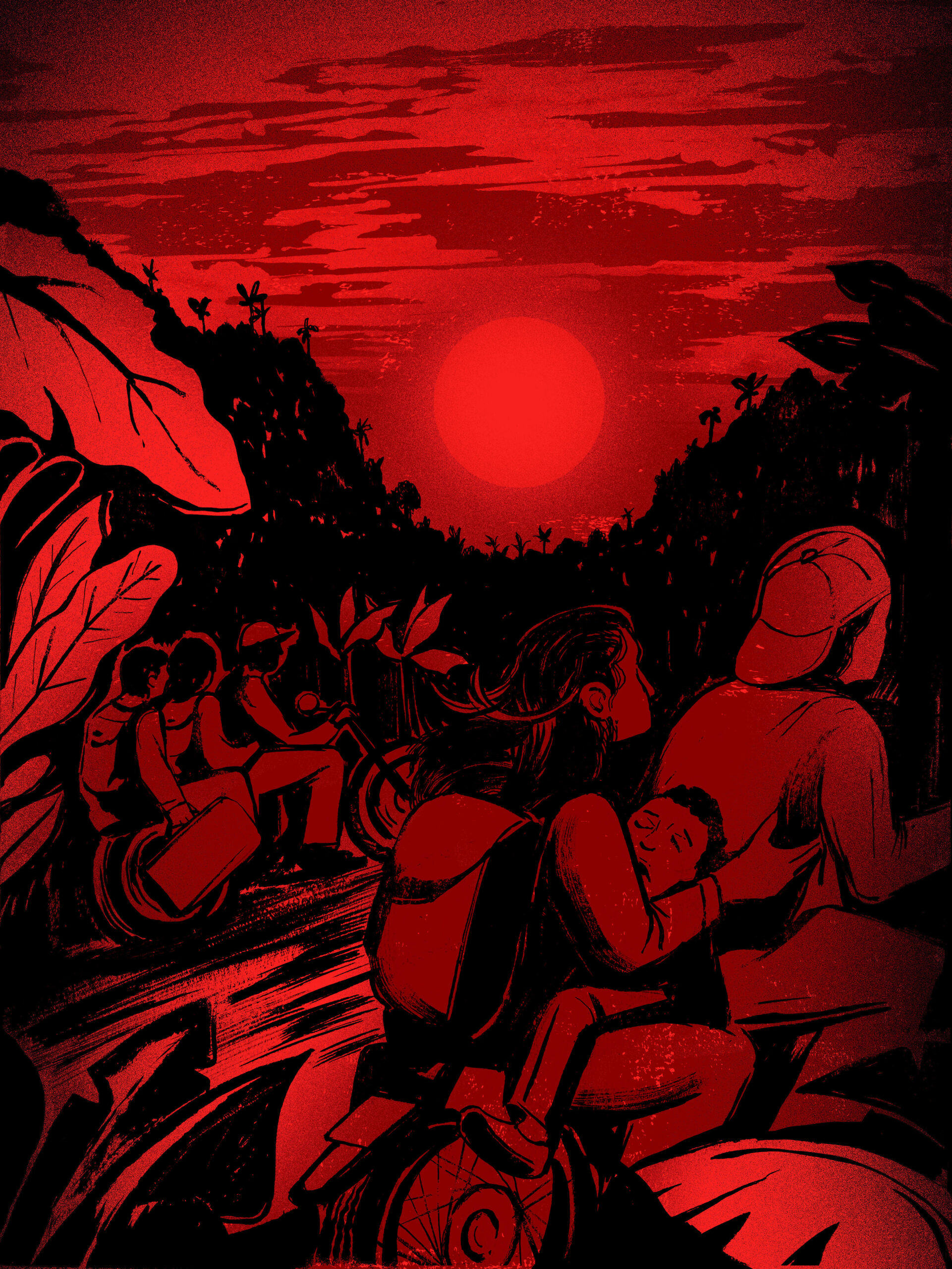
Edel Rodriguez is a Cuban-American artist who has exhibited internationally. Born in Havana, Rodriguez and his family boarded a boat in 1980 and left for Miami during the Mariel boatlift. Socialist propaganda, western advertising, island culture, and contemporary city life are all aspects of his life that continue to inform his work. He has created over a hundred newspaper, magazine, and book covers. His artwork has received numerous awards from The Art Director’s Club and The Society of Illustrators in New York City.