St. Paul: Third Street/Kellogg Bridge reconstruction to get underway as elected officials mark the occasion

posted in: Society | 0

The Third Street/Kellogg Bridge in downtown St. Paul is closed to traffic for three years as a new span is built.

St. Paul Mayor Melvin Carter and other elected officials marked the occasion with a press conference Monday, to highlight the work that went into getting the project started.

“As we get underway with this three year project, I do have one other thing to say — downtown St. Paul remains open for business. I encourage you to explore a new route into downtown and support our local businesses,” Carter said.

Also on hand were federal, state and local officials including U.S. Sen. Amy Klobuchar, U.S. Sen. Tina Smith, U.S. Rep. Betty McCollum, state Sen. Sandy Pappas, state Rep. Maria Isa Perez-Vega and Rena Moran, a Ramsey County commissioner.

“It’s a bridge that binds … It’s appropriate for what it’s going to do (which is) connecting all of St. Paul, and I am so excited to be here,” McCollum said.

Detours

The bridge officially closed Monday with Kellogg Boulevard from Broadway Street to Mounds Boulevard being shut down.

The $91 million price tag for the new city-owned bridge will include $80 million in state bonds, $7 million in federal funds and $4 million in local funding.

Crews from St. Paul Public Works prepare the Kellogg Boulevard/3rd Street Bridge for replacement in St. Paul on Monday, July 29, 2024. The $91 million project will replace the bridge, deemed structurally deficient, that connects downtown St. Paul and the East Side. Now closed, the bridge will be removed in several parts, with replacement of the bridge expected to take three years. (Devanie Andre / Pioneer Press)

During construction, traffic will be detoured to East Seventh Street. Pedestrian and bike routes will be detoured north on Mounds Boulevard to East Seventh Street and south on Mounds Boulevard to Commercial Street and Fourth Street.

The Union Depot, which serves as a transit hub for Amtrak, interstate bus services and the Green Line light-rail corridor, will remain accessible from the Lowertown area.

Demolition is expected to begin this year, making room for a new foundation and substructure expected to be in place by the end of 2025. After that, beams and decks, and then railings and lighting, will be added into 2027. The new bridge is scheduled to come online by that summer, according to city officials.

Outdated structure

Approximately 10 years ago the project came about after city engineers dived deeper into the federal design standards for the bridge. They found that the bridge needed to be replaced due to cracks along the support beams and outdated design standards. After analyzing and comparing the bridge to updated standards, for crack repairs, the Third Street/Kellogg Bridge was deemed “structurally deficient” and “functionally obsolete.”

The new bridge will have two vehicle lanes going in both directions, taller concrete beams and bike and pedestrian trails on each side, which are protected by barriers.

Images of Lowertown, wild rice and a river, a smallmouth bass, an eagle and Dayton’s Bluff will be depicted on the custom railing for the bridge. On the pier columns, the Lakota symbol “Kapemni” — a symbol for intertwining and balance in the universe — will be etched into the concrete.

“This is going to be well-worth the wait, St. Paul … It’s going to be a game changer for anyone who drives or walks or bikes between the East Side and downtown St. Paul,” Klobuchar said.

For more information on the project, go to stpaul.gov.

Related Articles

Local News |


Minneapolis carjacking and shooting suspect charged with fleeing St. Paul police, hitting house

Local News |


Q&A: Suzanne Kelly, new CEO of Minnesota Council of Churches, wants to build a faith community ‘that makes people feel whole’

Local News |


Barry Manilow is playing St. Paul for the final time, and this time he actually means it

Local News |


Jim Scheibel: We need staffing requirements for nursing homes. Don’t block the way, Congress

Local News |


Letters: We need another presidential debate. Here’s how it should work

Athletes with local connections competing in the 2024 Olympic Games

posted in: News | 0

MEN’S BASKETBALL

Nickeil Alexander-Walker, Canada

Anthony Edwards, USA

Rudy Gobert. France

Joe Ingles, Australia

Nuni Omot, South Sudan

WOMEN’S BASKETBALL

Napheesa Collier, Canada

Cheryl Reeve, coach, USA

Alanna Smith, Australia

WOMEN’S BMX CYCLING

Alise Willoughby

WOMEN’S DIVING

Sarah Bacon, 3-meter springboard, 3-meter synchronized

MEN’S GOLF

Erik Van Rooyen

MEN’S GYMNASTICS

Shane Wiskus, alternate

WOMEN’S GYMNASTICS

Suni Lee, multiple events

Ava Stewart, Canada

SAILING

Lara Dallman-Weiss, 470 dinghy

MEN’S SOCCER

Michael Boxall, New Zealand

TAEKWONDO

Alasan Ann

MEN’S TRACK AND FIELD

Devin Augustine, 100

Kenny Bednarek, 100, 200, 4×100 relay

Joseph Fahnbulleh, 200, 4×100 relay

Emmanuel Matadi, 100, 4×100 relay

Payton Otterdahl, shot put

Jabez Reeves, 4×100 relay

Akeem Sirleaf, 4×100 relay

Matthew Wilkinson, steeplechase

WOMEN’S TRACK AND FIELD

Denisha Cartwright, 100 hurdles

Dakotah Lindwurm, marathon

MEN’S SWIMMING

Bar Soloveychik, 4×200 relay

WOMEN’S SWIMMING

Regan Smith, 100 backstroke, 200 backstroke, medley relays

WOMEN’S VOLLEYBALL

Airi Miyabe, Japan

Jordan Thompson, USA

Ever see a star explode? You’re about to get a chance very soon

posted in: Society | 0

Noah Haggerty | (TNS) Los Angeles Times

Every clear night for the last three weeks, Bob Stephens has pointed his home telescope at the same two stars in hopes of witnessing one of the most violent events in the universe — a nova explosion a hundred thousand times brighter than the sun.

The eruption, which scientists say could happen any day now, has excited the interest of major observatories worldwide, and it promises to advance our understanding of turbulent binary star systems.

Yet for all the high-tech observational power that NASA and other scientific institutions can muster, astrophysicists are relying on countless amateur astronomers like Stephens to spot the explosion first.

The reason? It’s just too costly to keep their equipment focused on the same subject for months at a time.

“I think everyone will look at it while it happens, but sitting there just looking at it isn’t going to make it happen,” said Tom Meneghini, the director of telescope operations and executive director emeritus at the Mt. Wilson Observatory. “It’s like a watched pot,” he joked.

The star is so far away that it takes 3,000 years for its light to reach the Earth, meaning the explosion occurred before the last of the Egyptian pyramids were built. It will appear about as bright as the North Star for just a few days before fading into the darkness.

Once it’s spotted, some of the most advanced observatories on Earth and in space will join in watching, including NASA’s James Webb Space Telescope.

“A lot of people are eagerly waiting to spot the new jewel in the crown,” said Mansi Kasliwal, the Caltech astronomy professor who is planning to use the Palomar Observatory in northeast San Diego County to observe the event. The nova will erupt in the Corona Borealis, or Northern Crown, constellation.

T Coronae Borealis, also called the Blaze Star, is actually two stars — a hot, dense white dwarf, and a cooler red giant.

The dwarf star, which ran out of fuel long ago and collapsed to roughly the size of Earth, has been siphoning hydrogen gas from its larger neighbor for about a human lifetime.

This stolen gas has accumulated in a disk around the dwarf like a hot, messy version of Saturn’s rings. Soon, the disk will grow so heavy that it will become violent and unwieldy, and inevitably, explode like a thermonuclear bomb.

Neither star is destroyed however, and the process repeats itself roughly every 80 years.

This time around, there’s an army of enthusiasts like Stephens ready to sound the alarm when the star goes nova.

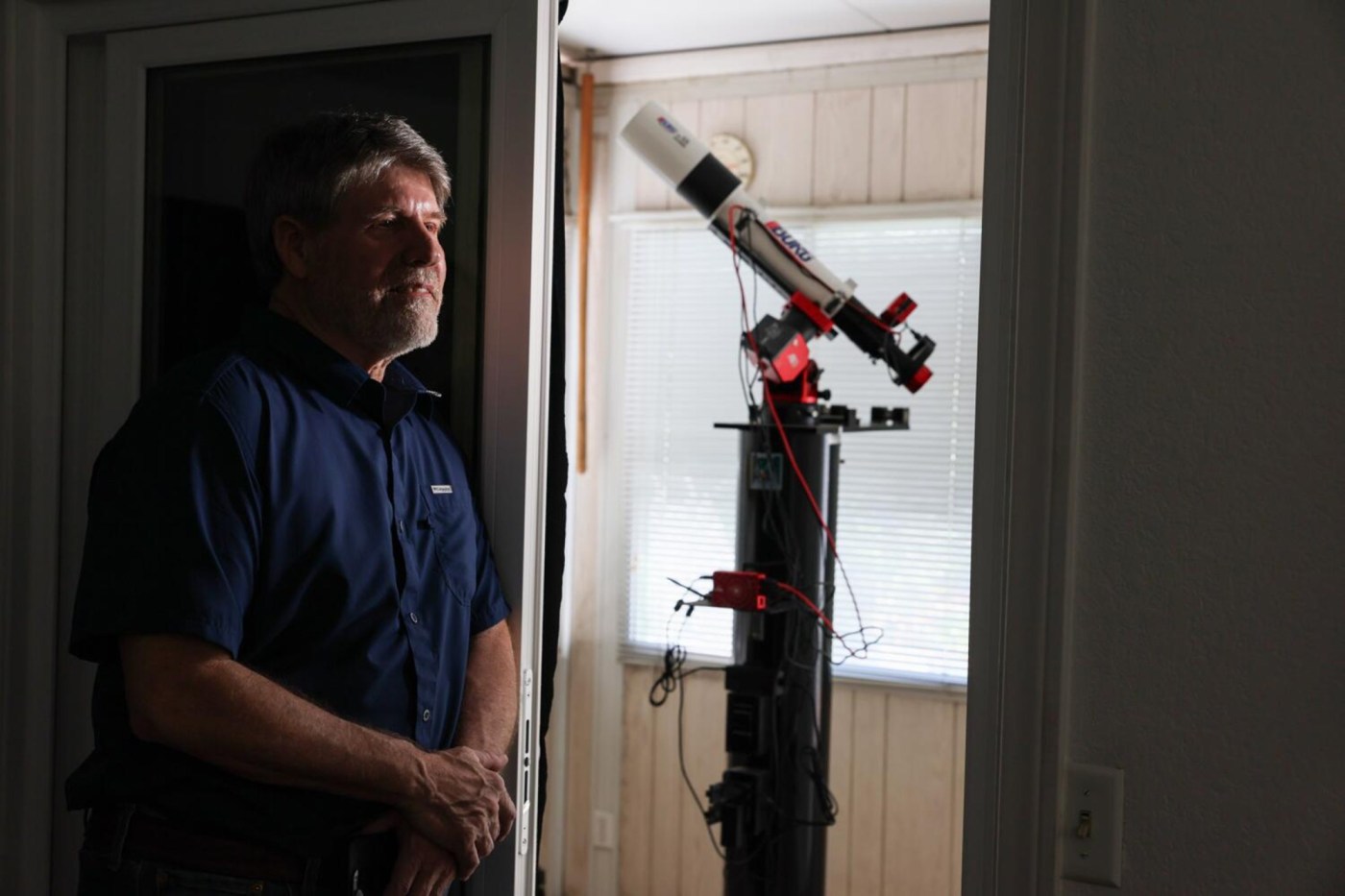
Far from mere hobbyists, a number of these amateur observers have published their own scientific research. Stephens even built his own observatory as an addition to his house in Rancho Cucamonga.

“The city thinks it’s a sunroom,” Stephens said. After the inspector stopped by, he removed the screws securing the roof, allowing him to roll it off to reveal the clear sky to his telescope.

Every night, he turns on the telescope and spends more than an hour taking data, which he later posts to an online community of amateur astronomers who monitor the star almost nonstop.

Major observatories simply cannot keep such constant watch. Hundreds of scientists compete for time to look at a wide range of astronomical targets every night. For them, keeping these telescopes glued to the Blaze Star is a waste of valuable observation time.

Estimates on when the nova will occur vary, but most astrophysicists agree it will happen before the end of the year, and likely by the end of August.

Once it blows, there are a few alert systems set up to notify amateurs and professionals. Some observatories have even programmed their telescopes to autonomously ditch their current observation plan and look at the star when the notification comes in, Stephens said.

Major observatories also face another complication. Many of their telescopes are designed to look at the faintest and dimmest targets, but the Blaze Star nova will be anything but faint. Pointing these telescopes at the nova would overwhelm sensors, resulting in a washed-out, overexposed picture.

That’s why Palomar Observatory, Caltech’s research station in north San Diego County, isn’t using its iconic 16-foot-wide Hale telescope under its massive white dome. Instead, it’s using a much smaller telescope, called Gattini-IR, located in a small unsuspecting brick building about a quarter mile down the road.

Once the nova happens, Gattini-IR will go from observing the Blaze Star every couple nights to every couple hours.

Scientists say they still have a lot to learn about novas. For example, physicists are still unsure why some erupt every decade while others likely don’t for millennia.

Some researchers suspect that novas like the Blaze Star could be precursors to supernovas. These explosions — billions of times brighter than the sun — destroy the star, often leaving behind a black hole. Supernovas are also a useful tool for astronomers to measure distance.

Studying similar events has already led to discoveries, however.

Recently, scientists determined that novas tend to fling material into space at faster speeds than what would be predicted based on the intensity of the explosion.

“We want to understand the physics of novae, so having a nova that’s as close as T Coronae Borelias, which will hopefully be very well studied by all telescopes … we can get a very full picture,” said Caltech professor Kasliwal.

Some of that understanding will be due in part to amateur astronomers.

Thanks to the rapid development of telescopes, amateurs are working with technology that professionals didn’t have just 20 years ago, let alone 80, said Forrest Sims, an amateur astronomer from Apache Junction, Ariz., who is also observing the star every clear night.

And the amateurs can achieve better coverage than the big telescopes because “we typically have complete control over when and where we can point [our telescopes],” said Sims. “A professional may have to write a grant to get a half hour or two hours time on a big telescope.”

That allows them to collect a lot of data. And with hundreds in the community observing from around the world, they can achieve almost continuous coverage of the Blaze Star. Many, including Sims and Stephens, post their data to the American Assn. of Variable Star Observers website, allowing everyone to use the data.

Stephens remembers reading a journal article from a professional who managed to observe five asteroids over two years. “I thought, I could do that in a month,” Stephens said. He went on to publish a paper with 10 observations.

One professor was so shocked by the number Stephens was able to see that she reached out and agreed to fly to Puerto Rico for an asteroid conference just to meet him. They ended up working together — Stephens had the telescopes; she had the connections in the field.

Today, amateur astronomers’ work is getting so sophisticated, many in the field have a hard time calling them amateurs.

“We call ourselves ‘small telescope scientists,’ ” said Sims. “It sounds more fun, and in some respects, professionals — and not even grudgingly — will admit that the work we’re doing is often professional caliber.”

___

©2024 Los Angeles Times. Visit at latimes.com. Distributed by Tribune Content Agency, LLC.

What to watch at the Paris Olympics on Tuesday, July 30

posted in: News | 0

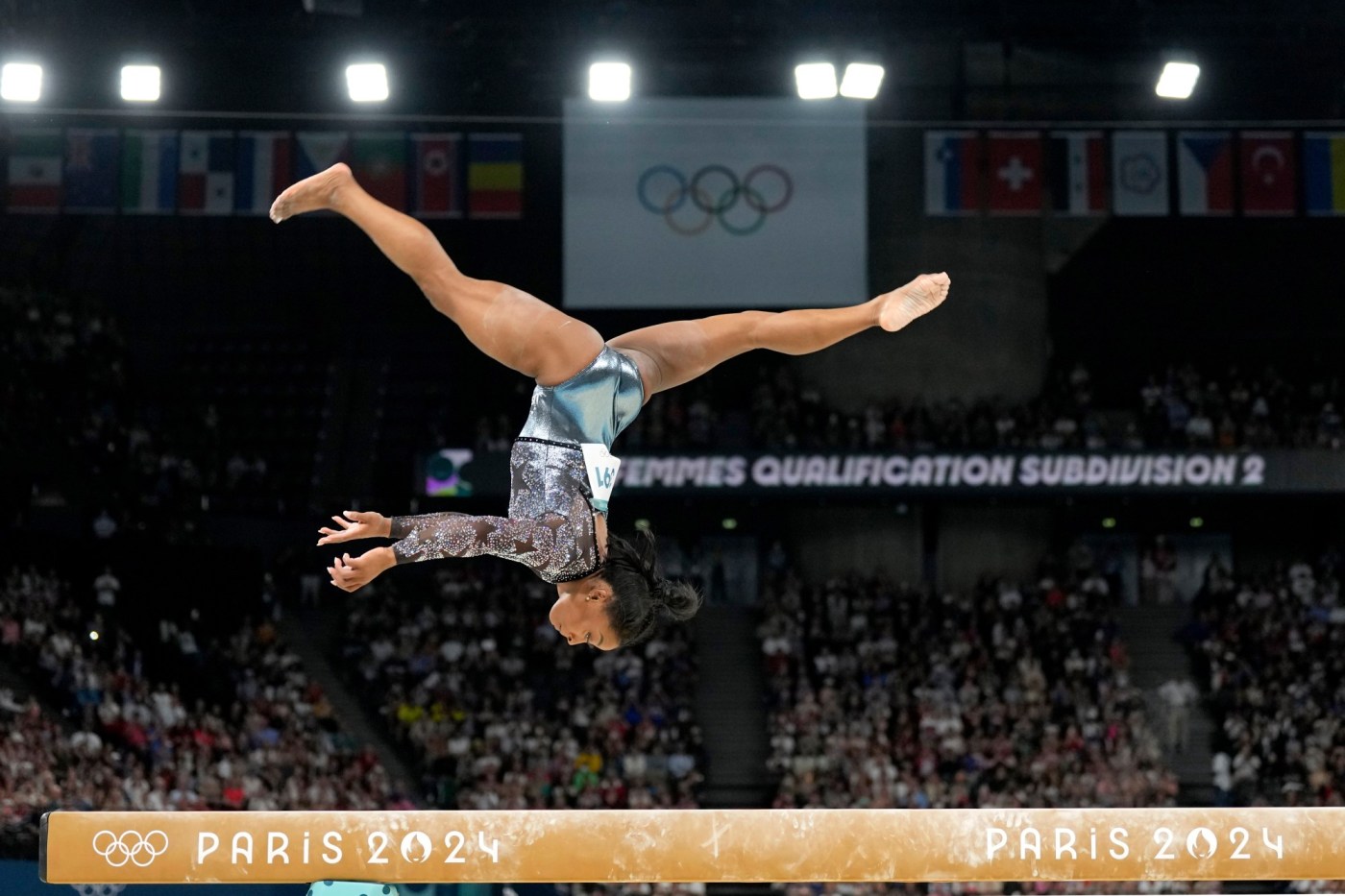
Simone Biles leads the U.S. women into the gymnastics team final as part of an action-packed slate Tuesday at the 2024 Paris Olympics.

Here is a guide of what to look out for:

Biles in gymnastics team final despite injury

The 27-year-old Biles is in the lineup to compete in all four events of the team final despite a calf injury. Biles tweaked her left calf while warming up for floor exercise during qualifying on Sunday. She still topped the all-around with the highest scores on floor and vault.

Simone Biles of United States, has her ankle taped after competing on the uneven bars during a women’s artistic gymnastics qualification round at Bercy Arena at the 2024 Summer Olympics, Sunday, July 28, 2024, in Paris, France. (AP Photo/Charlie Riedel)

Competition begins at 6:15 p.m. CEST (12:15 p.m. EST) at Bercy Arena. The Americans are favored to win gold after finishing runner-up to Russia in 2021.

Biles’ teammate Jordan Chiles also will compete in all four events. Chiles finished fourth in the all-around during qualifying behind Biles, Brazil’s Rebeca Andrade and 2020 Olympic champion Sunisa Lee.

U.S. women start defense of 3×3 basketball title

The U.S. women begin defense of their 2021 Olympic title in 3×3 basketball when the competition begins Tuesday. Dearica Hamby and Rhyne Howard of the WNBA join Hailey Van Lith, a college basketball player at Texas Christian University, and former WNBA player Cierra Burdick on the team. They will face Germany at 5:30 p.m. CEST (11 a.m. EST) at La Concorde.

Later, the U.S. 3×3 men’s team will take on Serbia. The U.S. men did not qualify for the Olympics in 2021.

Katie Ledecky back in pool, swimming finals continue

Ledecky is back in the pool to compete in the women’s 1,500-meter freestyle, one of her signature events. The qualifying heats start at 11:44 a.m. CEST (5:44 a.m. EST) at Paris La Defense Arena. Ledecky is the world and Olympic record holder in the event and is a favorite to defend her 2021 title.

Gold medalist Ariarne Titmus, of Australia, middle, stands with silver medalist Summer McIntosh, of Canada, right, and bronze medalist Katie Ledecky, of the United States, after winning the women’s 400-meters freestyle final the at the 2024 Summer Olympics, Saturday, July 27, 2024, in Nanterre, France. (AP Photo/Petr David Josek)

The women’s 100 backstroke final will take place at 8:56 p.m. CEST (2:56 p.m. EST). That’ll be followed by the men’s 800 free final. Ireland’s Daniel Wiffen qualified in first place in the heats at 7:41.53.

The last swimming final Tuesday is the men’s 4×200 free relay at 10:01 p.m. CEST (4 p.m. EST).

Related Articles

Olympics |


Paris Olympics: Here’s what’s on TV on Tuesday, July 30

Olympics |


A record 191 openly LGBTQ+ athletes are competing in the 2024 Olympics

Olympics |


Here’s a look at the uniqueness of the Paris 2024 Olympic medals

Olympics |


Simone Biles to compete on all four events at Olympic team finals despite calf injury

Olympics |


Simone Biles’ husband, Jonathan Owens, will watch her at the Olympics. Why has he drawn criticism?

Gold in women’s rugby sevens

The gold and bronze medal matches for women’s rugby sevens add to the excitement of Tuesday’s slate. The bronze match at Stade de France will start at 7 p.m. CEST (1 p.m. EST), followed by the gold medal match at 7:45 p.m.

New Zealand, the defending champion, was set to take on China in a quarterfinal Monday night. Britain and the United States were to begin their quarterfinal match Monday at 9:30 p.m. CEST (3:30 p.m. EST). And Tokyo runner-up France was scheduled to face Canada at 10 p.m.