‘Keeping baby bottoms covered’: Diaper Bank of Minnesota grows to meet family needs

posted in: News | 0

When Christi Krautbauer was pregnant with her now 9-year-old son, she and her husband had to cut corners to provide diapers for their newborn.

The situation made her ask, “What would we do if we couldn’t buy diapers?” In 2014, a year after giving birth, Krautbauer got involved with the Diaper Bank of Minnesota and is now the chair of the board of directors for the organization, helping families struggling to afford diapers fill the need.

“We’re really focused on making sure there’s an awareness that diaper need exists,” Krautbauer said.

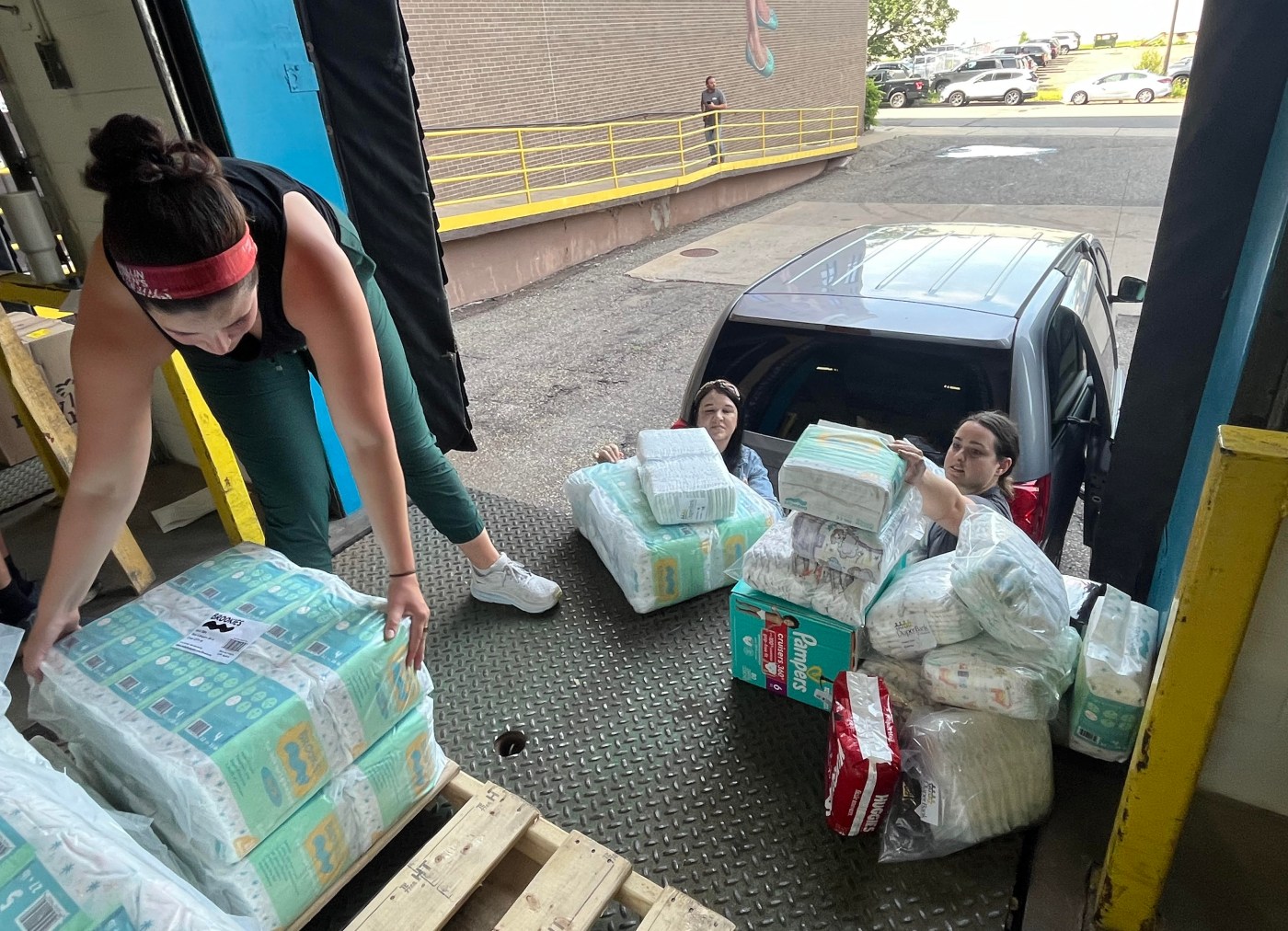
On Monday, volunteers loaded wooden pallets with diapers ranging in sizes from preemie to pull ups at a St. Paul warehouse for the Diaper Bank of Minnesota’s diaper distribution event. In 2010 the organization donated 350,000 diapers and this year it is expecting to give away more than 2 million.

As the numbers continue to grow, sometimes the bank has an overflow of diapers. Diaper distribution events such as Monday’s allow the bank to provide Twin Cities organizations outside of their 35 partner organizations with diapers to distribute to families in need.

“The need never stops, and to know that we can fill it is really rewarding,” volunteer chair Amanda Charles said.

State funding boost

While the organization receives funding and diaper supplies from individual and corporate donations as well as community grants, last year the Minnesota Legislature awarded more than $1 million to the Diaper Bank. More money meant that more diapers could be purchased and a larger warehouse would be necessary. They recently moved from a storage unit in Roseville into a warehouse in the Wycliff building in St. Paul’s Creative Enterprise Zone.

They also began seeking new partnerships with organizations beyond the Twin Cities.

“We find ourselves in a position where we have more diapers than we’re able to distribute to our partners alone,” executive director Deirdre Kanzer said, “and we know that the need is out there.”

The Diaper Bank of Minnesota has national partnerships with The National Diaper Bank Network and Baby 2 Baby, which allows them to purchase diapers from large corporations at a discounted rate. Companies like Huggies will also donate extra diapers to the nonprofit when available.

Other ways the organization receives diapers are from community hosted diaper drives, which people often have during events like baby showers or within faith led groups. Krautbauer encourages anyone interested in supporting the initiative to host their own diaper drive.

“As you spread the word, people want to help,” Krautbauer said.

Basic needs

According to the National Diaper Bank Network, one in two families struggles with diaper need. That’s close to 125,000 Minnesota children who are diaper insecure.

Krautbauer said that with the diaper need, larger issues should be addressed like providing social safety networks to help families meet basic needs and increase funding for social services like Women Infants and Children. She said people are often surprised when she tells them that WIC and food stamps don’t pay for diapers.

Related Articles

Local News |


St. Paul: Third Street/Kellogg Bridge reconstruction to get underway as elected officials mark the occasion

Local News |


Q&A: Suzanne Kelly, new CEO of Minnesota Council of Churches, wants to build a faith community ‘that makes people feel whole’

Local News |


Through new self-guided audio play series, Hidden Herald tells imaginative stories of what downtown St. Paul is — and could become

Local News |


Avian influenza concerns mean new policies for lactating cattle at Minnesota State Fair

Local News |


State health department confirms three more measles cases in metro, including Ramsey County

“Often diaper need goes hand-in-hand with food insecurity,” Krautbauer said. “If you’re trying to decide how to spread that budget, if we can solve this need, your family also now has a little bit more resources available for food or other basic needs.”

With Monday’s distribution event more than 225 families in Minnesota will receive diapers for their children, helping fulfill the organization’s mission of “keeping baby bottoms covered.”

It’s volunteers who do the physical labor to help distribute diapers to organizations, who then give them to families. Krautbauer said the bank is always looking for more volunteers.

“It’s just a very warm place to volunteer,” volunteer Kristy Mazurek, of Coon Rapids, said.

To find out how to volunteer, donate and more, visit www.diaperbankmn.org.

Lakeville’s Regan Smith cruises into 100 backstroke final with top semifinal time

posted in: News | 0

Lakeville’s Regan Smith entered the 100 backstroke at the Olympics as the event’s world record holder and, thus, the swimmer to beat.

That remains true through the event semifinals, though her “rival” is directly in her rearview mirror.

After coasting through the heats in the morning with a time of 58.45 seconds Monday in Paris, Smith cranked it up a notch in the semifinals, touching the wall in 57.97 seconds to win her semifinal. That was the top time in the round, two-hundredths of a second faster than Australia’s Kaylee McKeown.

McKeown is the defending Olympic gold medalist in the event, while Smith claimed bronze in 2021. The two have traded the world record back and forth over the years, with Smith regaining the mark at the Olympic Trials, when she turned in a time of 57.13 seconds.

McKeown edged Smith for gold at the 2023 World Championships.

Smith’s U.S. teammate, Katharine Berkoff, had the third-fastest time in the semifinals, finishing behind only McKeown in her semifinal with a time of 58.27 seconds. Finishing in second in Smith’s semifinal was Canadian Kylie Masse, who claimed the silver in this event in 2021.

Smith is in search of her first Olympic gold medal. The 100 backstroke final is set for 1:56 p.m. CDT on Tuesday. It’s Smith’s first final of the Paris Games, with relay swims, the 200 backstroke and the 200 butterfly still to come later this week.

Man buys 11 Rochester billboards thanking Mayo Clinic for treating his late wife

posted in: News | 0

ROCHESTER — “Thank you Mayo Clinic & Staff for the Wonderful Care.”

It’s a simple message but also a prominent one, as it’s printed on a large, south-facing billboard at the intersection of 4th Ave. SW and Broadway Ave. in downtown Rochester.

The words — in white text set against a purple background — accompany an image of Julia Reagan, whose name is also on the billboard. Identical messages are displayed on four other static billboards in the city, as well as six electronic ones.

The Rochester billboards are among hundreds of “in memory” tributes up across the U.S. for Julia Reagan, who died on June 12 at 81. Her husband Bill Reagan is the owner and founder of Reagan Outdoor Advertising, the company that owns roughly 90% of Rochester’s billboards, said Jeremy Gunderson, general manager of Reagan’s Rochester office.

The “thank you” messages for Mayo Clinic have been up for about a month and are scheduled to come down in the near future, Gunderson said.

Reagan Outdoor Advertising moved into the Rochester market in 2019. At that time, Bill Reagan told the Post Bulletin that he had been “coming to Mayo Clinic and Rochester for annual check-ups for 16 years. … We really enjoy the community.”

“They have always received their health treatments and check-ups at Mayo,” Gunderson said of the Reagans.

In 2023, Bill Reagan purchased the Guest House Inn & Suites — now the Med City Inn & Suites — and the attached Famous Dave’s Bar-B-Que building along Civic Center Drive for $4.25 million, the Post Bulletin reported.

In total, Reagan Outdoor Advertising has devoted 300 of its billboards across the country to Julia Reagan’s memory, according to KSL NewsRadio in Salt Lake City, Utah, the place the Reagans called home.

“I kissed her goodnight the night before, but I never really had a chance to say goodbye to her,” Bill Reagan told KSL. “And so now she’s right on the board so I can say goodbye every time I see one.”

Bill and Julia met in 1965 and eloped three weeks later, according to Julia’s obituary. At the time, Julia was pursuing her Ph.D. at the University of Utah and Bill was in law school. By the time the couple completed their advanced degrees, they had two children — and they would go on to have two more. Julia was a traveler, a sports fan and an active community member through organizations such as the National Council of Jewish Women, Women’s Legislative Council and Assistance League.

Related Articles

Local News |


St. Paul: Third Street/Kellogg Bridge reconstruction to get underway as elected officials mark the occasion

Local News |


Q&A: Suzanne Kelly, new CEO of Minnesota Council of Churches, wants to build a faith community ‘that makes people feel whole’

Local News |


Through new self-guided audio play series, Hidden Herald tells imaginative stories of what downtown St. Paul is — and could become

Local News |


Avian influenza concerns mean new policies for lactating cattle at Minnesota State Fair

Local News |


State health department confirms three more measles cases in metro, including Ramsey County

Russia is relying on unwitting Americans to spread election disinformation, US officials say

posted in: Society | 0

By DAVID KLEPPER

WASHINGTON (AP) — The Kremlin is turning to unwitting Americans and commercial public relations firms in Russia to spread disinformation about the U.S. presidential race, top intelligence officials said Monday, detailing the latest efforts by America’s adversaries to shape public opinion ahead of the 2024 election.

The warning comes after a tumultuous few weeks in U.S. politics that have prompted Russia, Iran and China to revise their propaganda playbook rapidly. What hasn’t changed, intelligence officials said, is their determination to seed the internet with false and incendiary claims about American democracy to undermine faith in the election.

“The American public should know that content that they read online — especially on social media — could be foreign propaganda, even if it appears to be coming from fellow Americans or originating in the United States,” said an official from the Office of the Director of National Intelligence who briefed reporters on condition of anonymity under rules set by the office of the director.

Russia continues to pose the greatest threat when it comes to election disinformation, authorities said, while there are indications that Iran is expanding its efforts and China is proceeding cautiously when it comes to 2024.

Groups linked to the Kremlin are increasingly hiring marketing and communications firms located within Russia as both a way to outsource the work of creating campaigns and as a way to hide their tracks, the officials said during the briefing with reporters.

Two such firms were the subject of new U.S. sanctions announced in March. Authorities say the two Russian companies created fake websites and social media profiles to spread Kremlin disinformation.

The disinformation can focus on the candidates or voting, or on issues that are already the subject of debates in the U.S., such as immigration, crime or the war in Gaza.

The ultimate goal, however, is to get Americans to spread Russian disinformation without questioning its origin. People are far more likely to trust and repost information that they believe is coming from a domestic source, officials said. Fake websites designed to mimic U.S. news outlets and AI-generated social media profiles are just two methods.

“Foreign influence actors are getting better at hiding their hand, and getting Americans to do it,” said the official, who spoke alongside officials from the FBI and the Department of Homeland Security.

In one measure of the threat, officials tracking foreign disinformation say they have issued twice the number of warnings to political candidates, government leaders, election offices and others targeted by foreign groups so far in the 2024 election cycle than they did in the 2022 cycle.

Officials won’t disclose how many warnings were issued, or who received them, but said the significant uptick reflects heightened interest in the presidential race by America’s adversaries as well as improved efforts by the government to identify and warn of such threats.

The warnings are given so the targets can take steps to protect themselves and set the record straight if necessary.

Russia and other countries are also quickly pivoting to exploit some of the recent developments in the presidential race, including the attempted assassination of former President Donald Trump as well as President Joe Biden’s decision to drop out of the race in favor of Vice President Kamala Harris.

Following the attack on Trump, for instance, Russian disinformation agencies quickly amplified claims that Democratic rhetoric led to the shooting, or even baseless conspiracy theories suggesting that Biden or the Ukrainian government orchestrated the attempt.

“These pro-Russian voices sought to tie the assassination attempt with Russia’s continuing war against Ukraine,” concluded the Atlantic Council’s Digital Forensics Research Lab, which tracks Russian disinformation.

Intelligence officials have in the past determined that Russian propaganda appeared designed to support Trump, and officials said Monday they have not changed that assessment.

Eroding support for Ukraine remains a top objective of Russian disinformation, and Trump has praised Russian President Vladimir Putin in the past and is seen as less supportive of NATO.

While China mounted a sprawling disinformation campaign before Taiwan’s recent election, the nation has shown much more caution when it comes to the U.S. Beijing may use disinformation to target congressional races or other down-ballot contests in which a candidate has voiced strong opinions on China. But China isn’t expected to try to influence the presidential race, the officials said Monday.

Iran, however, has taken a more aggressive posture. Director of National Intelligence Avril Haines said earlier this month that the Iranian government has covertly supported American protests over Israel’s war against Hamas in Gaza. Groups linked to Iran have posed as online activists, encouraged protests and have provided financial support to some protest groups, Haines said.

Iran opposes candidates likely to increase tension with Tehran, officials said. That description fits Trump, whose administration ended a nuclear deal with Iran, reimposed sanctions and ordered the killing of a top Iranian general.