Windstar Cruises’ guests can now spend the night on Marlon Brando’s private island

posted in: News | 0

Sarah Kuta | (TNS) TravelPulse

Thinking of cruising around French Polynesia with Windstar Cruises? Now, you can add on a stay at Marlon Brando’s private island after your sailing.

Windstar Cruises is launching a new offering in partnership with Pacific Beachcomber, a company that operates seven hotels in French Polynesia. One of those properties is The Brando, a private island eco-resort on the atoll of Tetiaroa with 35 private villas, white sand beaches and a 5-mile-wide lagoon.

Through the collaboration, Windstar guests can now book a two-night stay at The Brando after sailing aboard the Star Breeze, which recently replaced Wind Spirit and doubled the small-ship line’s capacity in the region.

The luxury post-cruise add-on will be available for booking starting May 1. It’s only open to guests staying in Star Breeze’s top suites: the owner’s suites, as well as the Broadmoor and Sea Island suites.

After sailing around French Polynesia with Windstar, guests will disembark the ship in Papeete. Then, they’ll board a small plane for the 20-minute flight to The Brando. While there, they’ll enjoy daily excursions, spa treatments, beach equipment and more. Then, they’ll be flown back to Papeete. Rates start at $6,900 per person based on double occupancy.

“This collaboration not only further enhances our commitment to providing unparalleled luxury and most romantic experiences for our guests in French Polynesia, but also allows us to extend the Windstar experience seamlessly from sea to land, providing our guests with exceptional hospitality throughout their journey,” says Christopher Prelog, president of Windstar Cruises.

The late American actor first purchased the atoll in the 1960s. In 1999, he asked his friend Richard Bailey, chairman of Pacific Beachcomber, to help him develop the property into a resort. Together, the two men began drawing up plans for a luxurious but environmentally friendly haven.

Brando died in 2004, but his family gave Bailey permission to carry the late actor’s vision forward. In 2014, that plan finally came to fruition when The Brando opened to the public. Since then, it’s been a hot spot for celebrities, with guests ranging from Barack and Michelle Obama to Britney Spears and Leonardo DiCaprio.

Since February, Windstar has offered Pacific Beachcomber’s InterContinental Tahiti Resort & Spa in Papeete for pre- and post-cruise stays. During their sailing, Windstar guests can also book a one-night stay in an overwater bungalow at Pacific Beachcomber’s Intercontinental Bora Bora Le Moana as a shore excursion.

“We are delighted to extend a warm invitation to Windstar Cruises’ guests to discover our secluded island havens, including The Brando, an eco-resort unlike any other nestled in the heart of French Polynesia,” says Bailey. “Together, we aim to deeply immerse our guests in the vibrant Polynesian culture and the untouched splendor of our natural surroundings.”

_________

©2024 Northstar Travel Media, LLC. Visit at travelpulse.com. Distributed by Tribune Content Agency, LLC.

Hudson’s new city administrator comes with Wisconsin local government experience

posted in: News | 0

Brentt Michalek, city administrator in Park Falls, Wis., has been hired to be city administrator in Hudson, Wis.

Michalek, 52, will start June 3.

Brentt Michalek (Courtesy photo)

Michalek said he was excited to help the Hudson City Council achieve its goals. “The city has a lot of immediate activities happening with the pressures of the urbanizing area,” he said. “I work at the will of the council.”

Michalek said he plans to help the council set a strategic plan for the city as soon as he starts on the job. “I think that will help the city look toward the future a good 10 to 20 years and see where they want to go,” he said. “It gives direction and priority to the city’s spending and things like that.”

Michalek has been city administrator of Park Falls, about three hours northeast of Hudson, since 2019. He also has been a member of the Chequamegon School Board since 2021; his term expires in April.

“I was asked to run for school board three years ago,” he said. “It was a discussion I had with my board and our city attorney, who drafted an opinion. The council unanimously approved on the condition that on issues where the city and school board would be in negotiations, I could not partake in school board activities.”

Grew up in Green Bay

Prior to taking the job in Park Falls, Michalek worked as the permitting manager for Network Real Estate in Green Bay, Wis., and director of conservation, planning and zoning for Sauk County, Wis. He also served as director of planning, zoning and construction resources for Emmet County, Mich.

Michalek, who grew up in Green Bay, has a master’s degree in environmental science and policy from the University of Wisconsin-Green Bay and a bachelor’s degree in regional analysis (urban and regional economic theory) planning, with a minor in mathematics, from the same school. He also has achieved all but dissertation status toward his doctorate in geography from University of Wisconsin-Milwaukee; his thesis was on the urbanizing of land and its effect on groundwater, he said.

Michalek and his wife, Sara, have two children: Lauren, 16, and Derek, 13.

More than 35 candidates applied to be city administrator. The four other finalists were:

Kristina Handt, interim city administrator in Forest Lake and former city administrator in Lake Elmo and Scandia and former village administrator of Village of Luck, Wis.
Renae Fry, former city administrator in North Branch, and former administrative coordinator in Sauk County, Wis.
Ryan Heise, city manager in Saugatuck, Mich., and former village administrator in Egg Harbor and former director of operations in Lakewood Ranch
William McCabe, city administrator in St. Augusta, Minn., and former city administrator of St. Charles, Minn., and former city administrator of Red Lake Falls.

Former city administrator Aaron Reeves left in November to be deputy director of public works in Boulder County, Colo. Reeves had served as city administrator since September 2019.

Mike Johnson, who serves as assistant city administrator and community development director, has been serving as interim administrator since Reeve’s departure.

Is he spelling his name right?

Now, what’s the deal with the spelling of Michalek’s first name, Brentt?

“I think it’s the correct way to spell it,” he said. “It was my parents’ choice. … My mother just liked the way it balanced out. She always thought it should have two ‘t’s.

“It happens all the time that people leave the ‘t’ off. When I respond, I just accidentally leave out the last letter of their name.”

Related Articles

Local News |


Jury convicts former Milwaukee election official of obtaining fake absentee ballots

Local News |


Governor signs bills creating electric vehicle charging station network across Wisconsin

Local News |


Wisconsin GOP leader calls the Trump supporters trying to oust him ‘whack jobs and morons’

Local News |


Wisconsin state boys basketball: Top-ranked Milwaukee St. Thomas More pulls away from Prescott in second half

Local News |


Missing Washington County woman found dead in Wisconsin state park

Hawaii hike: Big Island slopes, sand and incredible sandwiches — and mai tais

posted in: News | 0

So, you’re driving through some hilly, jungly roads for a while, sometimes zig-zagging at slow speeds, because you’re not a maniac, when you come to a dead end. There’s a wallet-sized parking lot where you finally, with some maneuvering, get your two cents’ in, and you’re a bit frustrated with that — grumble, grumble. And then you reach the Pololū overlook.

Wow.

The view from the Pololū lookout, up on the north end of the Big Island of Hawaii, is a sweeping vista, and every step down its steep trail introduces you to an entire family of exceptional views.

But first, let’s talk about green. There’s green, and then there’s Hawaii green, a riot of greenesses. The great greens seen all over the island greet you on the Pololū trail too; they make you want to bring some lava home to start your own garden.

The rugged Pololu Trail on the Big Island of Hawaii offers stunning view after stunning view. (Courtesy Alice Bourget)

Related Articles

Travel |


Windstar Cruises’ guests can now spend the night on Marlon Brando’s private island

Travel |


Springtime in Georgia: Go for the Masters, stay for Augusta

Travel |


Hawaii Travel: 21 fantastic poke bars and markets — and a poke festival this June

Travel |


Sound Advice: USB charger an ideal travel accessory

Travel |


Driving to Mexico? Make sure you have the right car insurance

Take multiple stops along the trail down to inhale those blissful beach vistas — and those emerald foliage views and those swaying-palm views. Though the trek down is but a half-mile, on days when the trail is slick, you might catch yourself gasping and grabbing green limbs to steady the way.

The acute angle of the Pololū land was shaped by the Kohala volcano, which cut a series of valleys into the high cliffs, Pololū Valley among them. Get to the valley floor — you won’t hurry, because it’s steep —and there’s a peaceful, mini-forest walk to the rocky beach, as lovely at ground level as it is high above. Pololū has a black-sand beach, but we arrived after a series of storms, so the shore was swept and then strewn with rocks and fallen trees, good to sit on and gaze at the inviting, albeit rough, ocean.

The trail down to the rocky beach of the Pololu Valley is about a half mile down. It feels much longer on the way back up. (Courtesy Alice Bourget)

Truly ambitious (read “crazed”) strollers might continue hiking up into the mountains — there are trails — and up and down to the other Kohala valleys beyond, but we’d hiked Pololū before and knew that though it was a half-mile down, it was, magically, 30 miles up. (Popular remarks heard on the way up from fellow hikers: “Ooof,” “Wow!” and “Man!” The hike is called the Awini trail, which looks suspiciously like “whiny.”)

Going down, you risk becoming Humpty-Dumpty. Going up, you’re The Little Engine That Could. But it bears repeating: Any exertion at Pololū is worth it. The sea-eating cliffs, the dramatic beach vistas, the hillside greens — it’s a meal for the senses.

Speaking of meals, you might have sparked your appetite zipping down and up Pololū. Now’s the time to ask what’s for lunch. Head back on Highway 270 to Hawi, the small town you passed through on the way to those views. Hawi (pronounced “ha-vee”) might be the quintessential Hawaiian small town. Years ago, my girlfriend Alice and I house-sat there for seven weeks and delighted in its warmth and appeal. Unfortunately, the pandemic hit some local businesses hard, but lucky for all, Bamboo survived and still thrives.

A century ago, Bamboo housed sugar cane plantation workers on the Big Island of Hawaii. Today, it’s a restaurant. (Courtesy Tom Bentley)

Bamboo the restaurant was once Bamboo the hotel, housing sugar-cane plantation workers more than 100 years ago. Then it changed clothes and was a dry-goods and grocer, and finally, a restaurant.

Bamboo wears its history well—walk in, and you’ll be bathed in color. There’s a near-theatrical feeling to the place, but it’s not forced. There is art everywhere and a profusion of bright hues. If the paintings, wall hangings and flamboyant, ceiling-hung umbrellas aren’t enough for your eyes, pop up to the gallery above and browse the work of local artists, from serving platters carved from local woods to striking ocean-themed paintings. There’s a gift shop at restaurant level too.

Bamboo may have begun life as a Hawaiian hotel a century ago, but these days its colorful restaurant makes tasty mai tais and other island fare. (Courtesy Alice Bourget)

Dazzling as all these artworks are, your principal mission is food. Well, perhaps drink too, since Bamboo makes hardy mai tais available for the thirsty. Our table of four lunched a bunch, one with a Hawaiian barbecue pork sandwich, another with grilled fresh ahi on organic greens. Alice and I both said “aloha” to the Aloha Vietnam sandwich, which planted that day’s ahi catch on Hawaiian sweet bread, joined with sweet and sour Asian coleslaw, fine fries and a Thai sweet chili aioli both sweet and savory.

Everything is served with a side of good cheer from the servers to restaurant owner Joan Channon, who stopped by the table to wish us well. Or maybe to get a bite of my great sandwich — I was protective. We all shared some white chocolate passion fruit cheesecake and dark chocolate mousse torte. I’d like to say we shared because we are noble and bountiful, but we were also glowingly full from the main courses, and dessert lit the final candle of goodness.

Do cruise the main drag of Hawi, which has lots of other small shops and businesses. If you’re there on a Saturday, they have a fun farmers market with farm goods, prepared foods and local crafts. And if you have a sweet tooth that won’t quit after Bamboo, they sell local Tropical Dreams ice cream in the shop across from the restaurant, which is OK … if by “OK” you mean fabulous.

By the way, if you still hunger for another hike and lunch on the beautiful Big Island, consider the Kilauea Iki trail in Volcanoes National Park. It’s a 3.3-mile walk, first on an overlook trail through those astonishing, almost primeval Hawaii greens, then down to the otherworldly crater for a hike across the blasted and crumpled lavascape, and then back up through the overgrowth.

Magical. Eat lunch at the historic Volcano House and consider yourself blessed.

If you go

Pololū Overlook and Beach Trail:  About 8 miles past Hawi in North Kohala, look for the end of Highway 270. The road dead-ends at the overlook, which has a very small parking lot, sometimes overseen by rangers and volunteers, who often have to help drivers turn around. There are also roadside parking spots that you can pull into before you hit the lot.

Bamboo Restaurant: Open for lunch from 11:30 a.m. to 2 p.m. Tuesday-Sunday and for dinner from 6 to 8:30 p.m. Thursday-Saturday at 55-3415 Akoni Pule Highway in Hawi; www.bamboorestauranthawaii.com.

Fearing political violence, more states ban guns at polling places

posted in: News | 0

Matt Vasilogambros | (TNS) Stateline.org

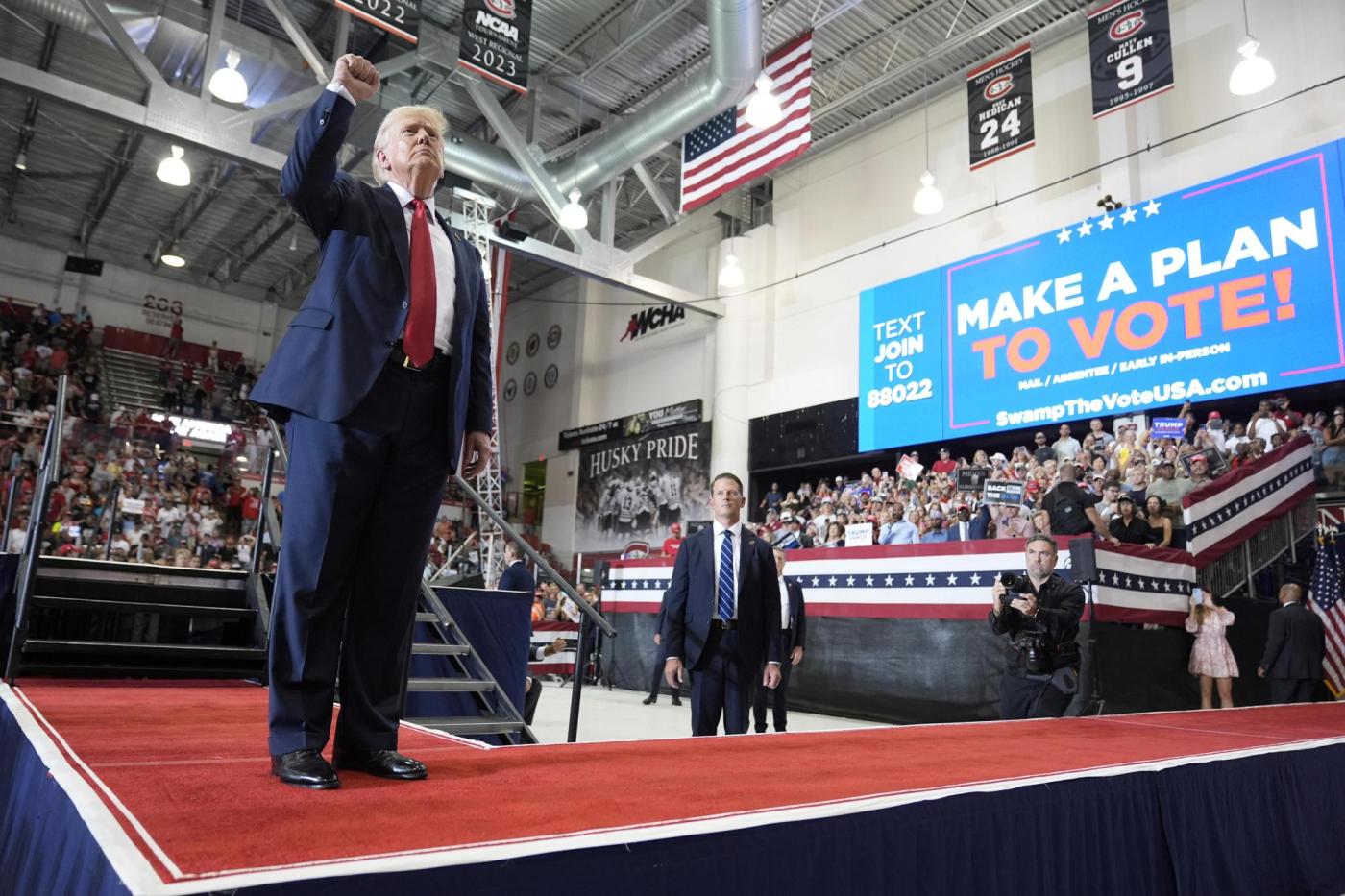
Facing increased threats to election workers and superheated political rhetoric from former President Donald Trump and his supporters, more states are considering firearm bans at polling places and ballot drop boxes ahead of November’s presidential election.

This month, New Mexico became the latest state to restrict guns where people vote or hand in ballots, joining at least 21 other states with similar laws — some banning either open or concealed carry but most banning both.

Nine of those prohibitions were enacted in the past two years, as states have sought to prevent voter intimidation or even violence at the polls driven by Trump’s false claims of election rigging. At least six states are debating bills that would ban firearms at polling places or expand existing bans to include more locations.

The New Mexico measure, which was supported entirely by Democrats, applies to within 100 feet of polling places and 50 feet of ballot drop boxes. People who violate the law are subject to a petty misdemeanor charge that could result in six months in jail.

“Our national climate is increasingly polarized,” said Democratic state Rep. Reena Szczepanski, one of the bill’s sponsors. “Anything we can do to turn the temperature down and allow for the safe operation of our very basic democratic right, voting, is critical.”

She told Stateline that she and her co-sponsors were inspired to introduce the legislation after concerned Santa Fe poll workers, who faced harassment by people openly carrying firearms during the 2020 presidential election, reached out to them.

The bill carved out an exception for people with concealed carry permits and members of law enforcement. Still, every Republican in the New Mexico legislature opposed the measure; many said they worried that gun owners might get charged with a crime for accidentally bringing their firearm to the polling place.

“We have a lot of real crime problems in this state,” said House Minority Floor Leader Ryan Lane, a Republican, during a House Judiciary Committee hearing last month. “It’s puzzling to me why we’re making this a priority.”

But over the past several years, national voting rights and gun violence prevention advocates have been sounding the alarm over increased threats around elections, pointing to ballooning disinformation, looser gun laws, record firearm sales and vigilantism at polling locations and ballot tabulation centers.

National surveys show that election officials have left the field in droves because of the threats they’re facing, and many who remain in their posts are concerned for their safety.

Add in aggressive rhetoric from Trump, the presumptive Republican presidential nominee, and it becomes “a storm” that makes it essential for states to pass laws that prohibit guns at polling places, said Robyn Sanders, a Democracy Program counsel for the Brennan Center for Justice, a voting rights group based at the New York University School of Law.

“Our democracy has come under new and unnerving pressure based on the emergence of the election denial movement, disinformation and false narratives about the integrity of our elections,” said Sanders, who co-authored a September report on how to protect elections from gun violence. The report was a partnership between the Brennan Center and the Giffords Law Center to Prevent Gun Violence.

“The presence of guns in these places presents a risk of violence,” she added.

Increased threat environment

Over the past four years, threats have gone beyond voicemails, emails or social media posts. Armed vigilantes have harassed voters at ballot drop boxes and shown up outside vote tabulation centers. Other people reportedly have shot at local election officials.

While several states have enacted laws in recent years criminalizing threats to election officials, some states want to take it a step further through gun restrictions.

This year, primarily Democratic lawmakers in Connecticut, Illinois, Massachusetts, Michigan Pennsylvania, Vermont and Virginia have introduced legislation that would ban most firearms in or near polling places or other election-related places. Most of these bills remain in committee.

Some of the states have seen political violence in recent years, including Pennsylvania, where a man tried to go into a Harrisburg polling place in November with a firearm and acted threateningly, confronting voters and pointing an unloaded gun at an unoccupied police cruiser.

bill in Virginia to ban firearms at polling places got through the state legislature on a party-line vote this month, but Republican Gov. Glenn Youngkin has not yet acted on the legislation. His press office did not respond to a request for more information.

Two Democratic-backed bills in Michigan seek to ban most firearms at or within 100 feet of polling places, and ballot drop boxes and clerks’ offices during the 40 days before an election. They have passed the state Senate but await votes in the House.

Democratic state Rep. Penelope Tsernoglou, the sponsor of one of those bills, told Stateline she expects the legislation to pass in April, after special elections fill two vacant seats.

“We want to make sure that we’re able to attract the needed election workers, and that they feel safe doing those jobs,” she said. “Sadly, we’re seeing more and more gun violence throughout our state and our nation. And I strongly believe that everyone should feel safe when they’re voting.”

But these bills are “good for headlines and nothing else,” said GOP state Sen. Jim Runestad in a statement on the Senate Republicans’ website.

“When one considers the sheer number of drop boxes placed throughout larger communities, like in the city of Detroit, these places could be nearly impossible to avoid,” he wrote, referring to gun owners.

One of his proposed amendments that failed would have exempted gun owners carrying guns for non-election-related business, such as going into a store near a ballot drop box.

In 2020, Democratic Secretary of State Jocelyn Benson attempted to ban firearms within 100 feet of polling places, clerks’ offices and absentee ballot counting centers. But Michigan courts blocked her effort, finding she didn’t have the authority.

Michigan was one of many states where election officials faced violent threats during the 2020 presidential election. Last month, a man pleaded guilty to federal charges for threatening the life of former Rochester Hills Clerk Tina Barton, saying she deserved a “throat to the knife.”

There is broad bipartisan support among voters to ban firearms at polling places. According to a 2022 poll of more than 1,000 adults commissioned by the Global Project Against Hate and Extremism, nearly 80% of Democrats and more than half of Republicans and independents polled thought guns should be banned at polling places. Overall, 63% of adults surveyed supported a ban.

But that cross-party support has not translated to state legislatures.

Where are the bans?

Democratic-controlled states have spearheaded the effort to ban firearms at polling places in recent years, with only a handful of Republican lawmakers joining Democrats to pass the bills in some states.

In 2022, Colorado, New Jersey, New York and Washington state passed firearm restrictions at polling places. In 2023, California, Delaware, Hawaii and Maryland joined the list.

Nevada’s majority-Democratic legislature passed a similar ban last year, but Republican Gov. Joe Lombardo vetoed it. He said the measure would have infringed on the constitutional rights of Nevadans.

Maryland’s ban is facing a legal challenge from gun rights groups and activists who argue such bans infringe on Second Amendment protections and are ineffective.

“It’s a solution looking for a problem,” said Andi Turner, a spokesperson for the Maryland State Rifle and Pistol Association, which is part of the lawsuit challenging the law. “We don’t have people threatening at polling places or going and shooting up election workers. I don’t see why this needs to be a thing.”

The states that had polling place firearm bans prior to the 2020 presidential election now have Republican-controlled legislatures: Arizona, Florida, Georgia, Louisiana, South Carolina and Texas.

Georgia’s ban dates back to 1870, and in 1874 the state Supreme Court wrote that having a firearm at a polling place “is a thing so improper in itself, so shocking to all sense of propriety, so wholly useless and full of evil, that it would be strange if the framers of the constitution have used words broad enough to give it a constitutional guarantee.”

More Republican-led states should consider firearm prohibitions at polling places, said Jessie Ojeda, the guns and democracy attorney fellow at the Giffords Law Center, and one of the co-authors of the joint Brennan and Giffords report.

Gun safety advocates such as Ojeda see an opening for these laws, even after the U.S. Supreme Court’s 2022 decision that widened the definition of protected firearm access. While the court struck down New York’s law that prohibited firearms in public, it did leave open the potential for bans in “sensitive places,” specifically noting polling places.

“We need to take action before 2024,” said Ojeda. “We have a growing number of incidents when firearms are thankfully not being used to shoot people, but they are being used to intimidate and deter voters and election officials from doing their job.”

Stateline is part of States Newsroom, a national nonprofit news organization focused on state policy.