Fringe review: ‘Secrets Under the Christmas Tree’ is a wholesome comedy with a — mostly — satisfying ‘whodunit’ mystery

posted in: News | 0

Worth considering

In Brandon M. Prosek’s and J. Scott Sibley’s “Secrets Under the Christmas Tree: A Deedee Wallaby Mystery,” scandalous secrets are brought to light at a Christmas party while guests are suddenly slammed with having to solve a “whodunit” mystery. Although the cast is comedic and chaotic, they don’t shy away from showing the realistic emotion behind disjointed family relationships nor the beauty of unique family dynamics. The plot will leave viewers guessing until the end, but it feels repetitive at times, and the final twist doesn’t pack the punch it’s supposed to.

Presented by Deft Pictures at Open Eye Theatre; 1:00 p.m. Aug. 3, 7:00 p.m. Aug. 7, 10:00 p.m. Aug. 9, 8:30 p.m. Aug. 11 (with ASL translation)

Still trying to decide what to see? Check out all our Fringe reviews at twincities.com/tag/fringe-festival, with each show rated on a scale of Must See, Worth Considering, Could Be Worse or You Can Skip.

The Minnesota Fringe Festival is presenting more than 100 hourlong stage acts from Aug. 1–11 around Minneapolis. Visit MinnesotaFringe.org for ticket and show information.

Related Articles

Theater |


‘Minnesota Fringe is a gateway to the performing arts’: A Q&A with Fringe Festival executive director Dawn Bentley

Theater |


How To Fringe: Your guide to the 2024 Minnesota Fringe Festival, running Aug. 1–11

Fringe Review: ‘Pursuit of Happiness’ lacks what’s best about Bollywood

posted in: News | 0

Could be worse

Bringing Bollywood back to the Fringe is a welcome idea, as stage musicals in the style of colorful, high-energy, dance-filled films from India resulted in three of the most popular shows of last decade’s Fringes. The genre requires disciplined dancing, engaging acting and eye-candy costuming, but only the latter is found in this Indian travelogue with minimal story attached, for which the cast of 43 and tech crew all seem woefully under-rehearsed. But kudos to the kids who best execute choreographer Renu G. Kumar’s hybrid of classical Indian dance and hip-hop. “Pursuit of Happiness” will likely grow considerably slicker by Fringe’s end.

Presented by RGK Dance Academy at the Southern Theater; 4 p.m. Aug. 4, 8:30 p.m. Aug. 5, 10 p.m. Aug. 10, 7 p.m. Aug. 11

Still trying to decide what to see? Check out all our Fringe reviews at twincities.com/tag/fringe-festival, with each show rated on a scale of Must See, Worth Considering, Could Be Worse or You Can Skip.

The Minnesota Fringe Festival is presenting more than 100 hourlong stage acts from Aug. 1–11 around Minneapolis. Visit MinnesotaFringe.org for ticket and show information.

Related Articles

Theater |


‘Minnesota Fringe is a gateway to the performing arts’: A Q&A with Fringe Festival executive director Dawn Bentley

Theater |


How To Fringe: Your guide to the 2024 Minnesota Fringe Festival, running Aug. 1–11

Movie review: ‘Harold and the Purple Crayon’ draws a perplexing adaptation

posted in: News | 0

The sheer existence of this live-action adaptation of the classic children’s book “Harold and the Purple Crayon” inspires a number of questions on a purely basic level. Who is this for? The book by Crockett Jensen, published in 1955, is aimed at ages 3 and up, but the film, starring an almost entirely adult cast, skews older. But the premise still feels too thin and juvenile to grab audiences of any age. So, where, when and specifically what algorithm decided this film would be a lucrative endeavor? Mostly, why is this happening and how are we supposed to reckon with it, critically?

So here I am taking out my own purple crayon, attempting to magic a coherent review of this profoundly odd and off-putting film into existence. Hopefully something worthwhile will emerge from these scribblings.

Directed by “Ice Age,” “Rio” and “Ferdinand” director Carlos Saldanha, written by David Guion and Michael Handelman, the approach here to adapting the beloved book is a somewhat curious one. We know the story, and the iconography: a toddler in a onesie who uses his imagination and a purple crayon to make his world more exciting. In the film, our protagonist is now an adult Harold (Zachary Levi), who still lives in his 2D world with his friends that he drew, Moose (Lil Rel Howery) and Porcupine (Tanya Reynolds). Despite being in his mid-40s, he’s still quite childlike, and overly attached to his only parental figure, “the narrator” (voiced by Alfred Molina) whom he calls the “Old Man.” When one day the Old Man’s voice goes away, Harold draws himself a door to the real world in order to find him.

Why the decision was made to feature a 40-something Harold is beyond my pay grade, though it likely has to do with Levi’s willingness — or desire — to star as a childlike man, as he has done previously in both “Shazam” films. His version of Harold is a cross between Tom Hanks in “Big,” and another children’s book icon, Amelia Bedelia. Harold obviously knows nothing of “the real world,” including irony, idioms or brands, and like Amelia, he takes everything literally, which is a problem when he’s wielding a crayon that can draw anything into existence.

Perhaps it was cute for a 32-year-old Tom Hanks to play a 12-year-old boy, or even for Levi to slip into teenage boy mode in “Shazam” (the first one at least). But there’s something deeply strange about his performance of Harold, grinning and mugging with childlike wonder in a way that can only be read as disingenuous.

For some reason, when they transfer into the real world, Moose and Porcupine become human, but I wouldn’t want to start asking questions to which there can’t be any good answers, so we’ll leave it at that. The trio cause light havoc, glomming onto a single mom, Terry (Zooey Deschanel) and her son Mel (Benjamin Bottani). Harold, Moose and Porcupine need help finding the “Old Man,” and then they get involved with Terry’s issues too (dead husband, dead-end job, wildly imaginative kid, lecherous librarian).

Things are looking so, so dire in the world of “Harold and the Purple Crayon” (for me, specifically), and then a savior arises out of nowhere. It is the East, and Jemaine Clement is the sun. He is here to save (or salvage what he can of) this film. Clement plays “Library Gary,” a writer of romantasy fiction, who has a crush on Terry.

Even though his pompous author character is a bit close to his role in the 2009 comedy “Gentleman Broncos,” Clement proves to be a breath of fresh air and a decent adversary. If Harold uses his crayon to pull planes and pies out of thin air, Gary has far more nefarious (and horny) intentions, using the crayon to summon up his fantasy world, complete with powerful magical staffs, a floor made of lava and scantily clad maidens.

It’s only when Clement brings his flair that this film has anything worth paying attention to, because he’s the dash of acid that tempers this otherwise totally saccharine and sappy story about embracing imagination. Gary adds a much-needed dose of friction to the whole endeavor, and Clement seems to be having fun, which is more than can be said for Deschanel, who brings a sort of “running lines” energy to her barely there performance. The less we focus on what Levi, Howery and Reynolds are doing, the better.

The only actor committed to the heart of “Harold and the Purple Crayon” is Bottani, because, of course, children more often sincerely buy into the transformative power of imagination. So why they decided to make this movie about adults is one of the more befuddling questions that plagues this movie, among many, many others.

‘Harold and the Purple Crayon’

1 star (out of 4)

MPA rating: PG (for mild action and thematic elements)

Running time: 1:32

How to watch: In theaters

Related Articles

Movies & TV |


What to watch: ‘Deadpool & Wolverine’ might have just saved Marvel Cinematic Universe

Movies & TV |


Review: A re-imagined ‘Time Bandits’ takes viewers on a delightful historical adventure

Movies & TV |


Movie review: ‘Dìdi’ captures fleeting moment of growing up

Movies & TV |


Movie review: ‘Deadpool & Wolverine’ full of sound and fury, signifying nothing

Movies & TV |


‘Twisters’ review: Sequel delivers big thrills and nice character moments

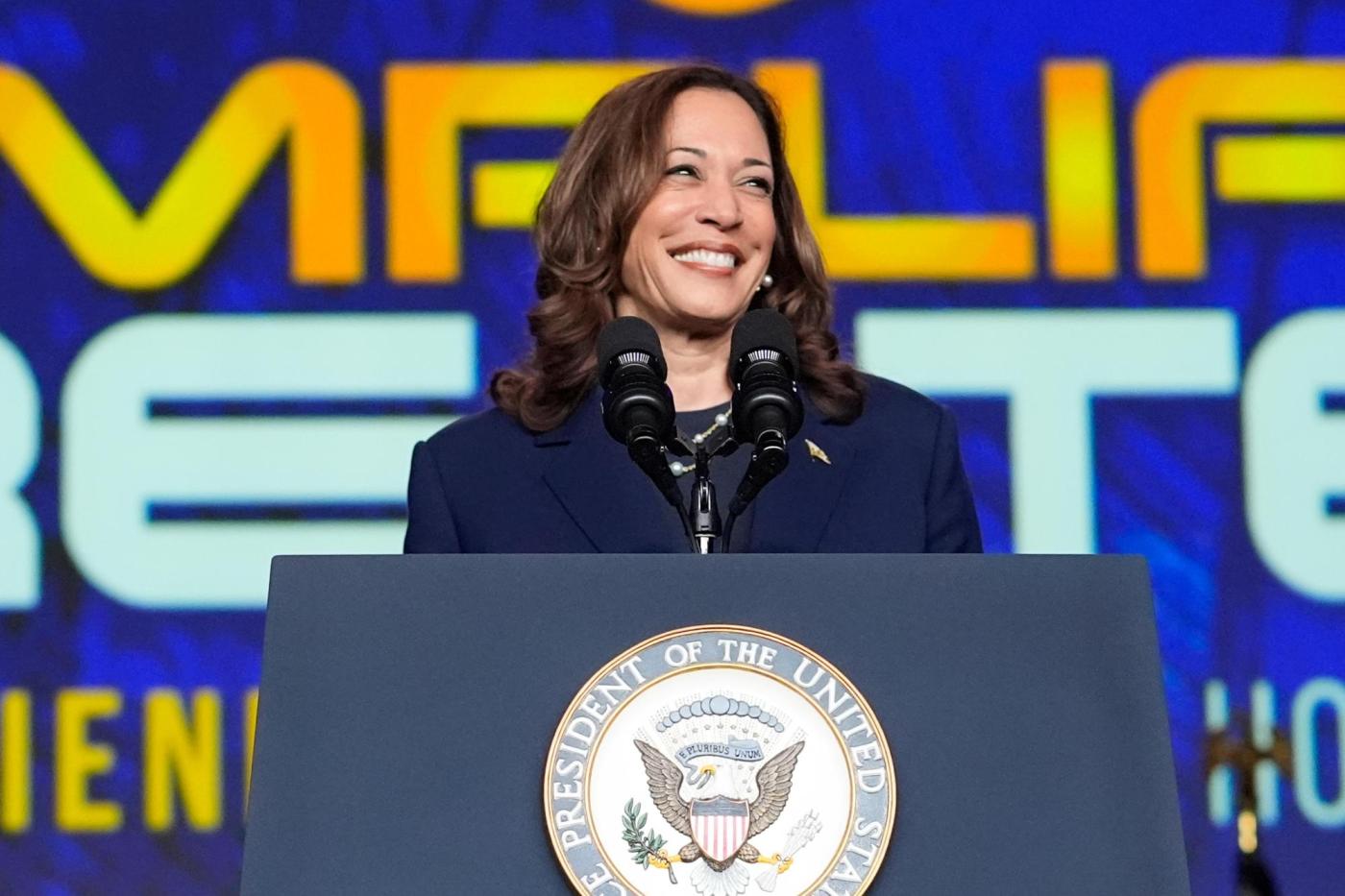
Mary Ellen Klas: Kamala Harris has work to do and more women to convince

posted in: Politics | 0

In the 48 hours after President Joe Biden dropped out of the presidential race and endorsed Vice President Kamala Harris, she did something every working woman in America can relate to: She put her multi-tasking superpowers to work and got a big job done in little time.

But Harris’ impressive launch will not be enough to bring to her side the suburban women who could swing this election. Most didn’t like either Donald Trump or Joe Biden and many were ready to stay home or go third-party. Harris needs to make the case why that’s a bad idea by courting them on the issues they care about: the cost of living, threats to democracy, reproductive rights and immigration.

A week ago, sitting in a hoodie from her alma mater, Howard University, Harris got off to quite a start. In 10 hours, she made over 100 calls, lining up endorsements, locking in delegates, and getting commitments from donors. She persuaded the Biden campaign staff to stay on board and work for her. She called potential running mates. And she sewed up support so quickly that she effectively iced out any challenge to her nomination.

Supporters have now galvanized behind Harris with a level of enthusiasm that could become the new force field in this unprecedented election year. But to capitalize on it, Harris is going to need every one of her get-it-done skills to keep momentum building for the next 100 days and demonstrate that she can win in swing states. Like Hillary Clinton in 2016, Harris could win the popular vote but lose the race in the Electoral College.

That’s how Trump won the presidency that year — in part due to support from white women voters. Many were college-educated and live in the suburbs.

Now, many of these same women are angry at Trump for appointing three justices who voted to overturn Roe v. Wade, taking away their right to legal abortions in many states. They are disgusted with his misogyny, narcissism, name-calling and constant grievances — not to mention his civil conviction on sexual abuse charges and his criminal conviction in New York on 34 felony charges. And they’re fed up with the Republican Party for allowing itself to become the cult of his personality.

Many of these white, suburban women drifted away from Trump in 2020. In 2022, animated by the loss of reproductive rights, they gave Democrats a boost in the midterm elections. And in 2023, many gravitated to Nikki Haley as the sane alternative. But after she caved to the MAGA machine, there was nowhere for them to go — because they were also disappointed in Biden, with his diminished ability to counter Trump’s lies and barbs, his lackluster presence on the campaign stage, and his reluctance to step down and pass the baton to a younger leader.

“I don’t think those women would have voted for Donald Trump, but they might have just stayed home,” Debbie Walsh, director of the Center for American Women and Politics at Rutgers University told me.

White women are among the most divided voting blocs in America. But in recent years, according to KFF Polling, suburban women are “more akin to a microcosm of the U.S. as they shift younger, and more racially and ethnically diverse,” which has given Democrats an advantage.

Will suburban women land with Harris this year? That remains to be seen — but the early momentum is promising.

Harris brings an empathetic ear and pragmatic policies to women and families concerned about their futures. She has vowed to halt the march of Christian Nationalist authoritarians who want to take women back to a time of less freedom, but she will also need to assure women that she will protect the parental controls that the right has successfully persuaded them they are losing. And for both women and supportive dads with daughters, she promises to sign legislation to restore women’s lost right to their reproductive health.

“Do we want a future where our daughters have fewer rights than our grandmothers, where their bodies are state property, their voices silenced, their opportunities erased?” asks Tara Setmayer, former Republican operative and now co-founder of The Seneca Project, a bipartisan super-PAC dedicated to mobilizing moderate women voters in swing states.

The sentiment was echoed in a series of video calls with hundreds of thousands of supporters last week. It began with a Sunday video call with Black women leaders that raised more than $1.5 million and had more than 40,000 participants. Another call on Monday night with Black men raised $1.4 million. On Thursday, more than 164,000 white women broke Zoom’s attendance record and raised $2 million. More calls are scheduled this week.

It’s a stunning measure of enthusiasm given Harris’ shotgun start to her campaign, and it’s a signal that her presence at the top of the ticket allows many women to breathe a sigh of relief. But to sustain the excitement, she is going to have to manage her message carefully, especially in the crucial swing states.

To win their support, Harris will have to emphasize that reproductive health is not a partisan issue. She should have answers for voters who continue to be worried about rising household costs and childcare — a top issue for all women voters. She will need to go on the offensive with a plan to seal the border and reform the immigration system — a top issue for independents and anti-Trump Republican voters. And she and her surrogates are going to have to aggressively respond to the misogynistic and racist attacks coming from the Trump campaign to shield her from letting their narrative prevail.

Not all polls measure suburban women the same, but the early polls now show mixed results for Harris among non-urban women. According to the HarrisX/Forbes poll, Harris leads Trump by 12 percentage points with suburban women (52% to 40%), compared to Biden’s 3-percentage point lead before he dropped out. An NPR/PBS News/Marist poll finds that Trump leads Harris 47% to 42% with small city/suburban women voters, but many more are now undecided and rethinking their choice — 11%, compared to 2% in their last poll.

The energy around Harris is not just excitement for her and a smooth, well orchestrated launch — it’s also excitement about having a talented and successful woman in the driver’s seat. Many women have been fed up with a list of roadblocks for a very long time, including the glass ceiling, under-representation in the corridors of power and unequal burden-sharing at home, just to name a few. Harris is an overdue release valve. If she succeeds, she could become the first of many things: the first Indian American elected to the presidency, the first female president, — and the first candidate in the nation’s history to take a campaign from start to finish in 108 days.

Mary Ellen Klas is a politics and policy columnist for Bloomberg Opinion. A former capital bureau chief for the Miami Herald, she has covered politics and government for more than three decades.

Related Articles

Opinion |


Sheldon Jacobson: Who will pay for the Crowdstrike outage?

Opinion |


Daniel DePetris: Venezuela’s strongman president, Nicolás Maduro, steals another election

Opinion |


Thomas Friedman: Democrats could regret calling Trump and his supporters ‘weird’

Opinion |


Kathryn Anne Edwards: Women are America’s working class now

Opinion |


Juan Pablo Spinetto: Venezuela needs its neighbors’ help more than ever