Bigos Management reopens former downtown St. Paul YMCA to 1,500 tenants as ‘Lowertown Skyrec’

posted in: News | 0

A multi-story YMCA opened just off downtown St. Paul’s Galtier Plaza in the mid-1980s, drawing scores of patrons to its half-Olympic size swimming pool and skyway-level entrances. After serving two generations of visitors, the fitness and foot traffic came to a halt in 2020, when the pandemic temporarily shuttered gyms.

The downtown Y never reopened, a victim to COVID-19, decreased patronage in the era of remote work and the nonprofit’s reshuffled priorities. Bigos Management, which acquired Galtier/Cray Plaza for roughly $5 million in 2019, has drawn up and revisited plans for repositioning the former office building that once housed the Cray supercomputer company at least twice throughout the pandemic. For now, the seven floors of commercial space sit quiet, the last office tenant having vacated the property last fall.

The exception is the former YMCA gym, which still draws members from the five residential Bigos properties downtown, four of which ring Mears Park.

Access to the recently-refurbished “Lowertown Skyrec” — Lowertownskyrec.com — is a free perk to tenants of the neighboring Galtier Towers Apartments, Mears Park Place, the Historic Lowertown Lofts, the newly-acquired Cosmopolitan Apartments and the Kellogg Square building a few blocks away.

“I’ve had numerous residents go, ‘I didn’t even know this was here,’” said Nicholas Geng, a facilities manager with Bigos Management. “They absolutely love it.”

‘Events return to Mears Park’

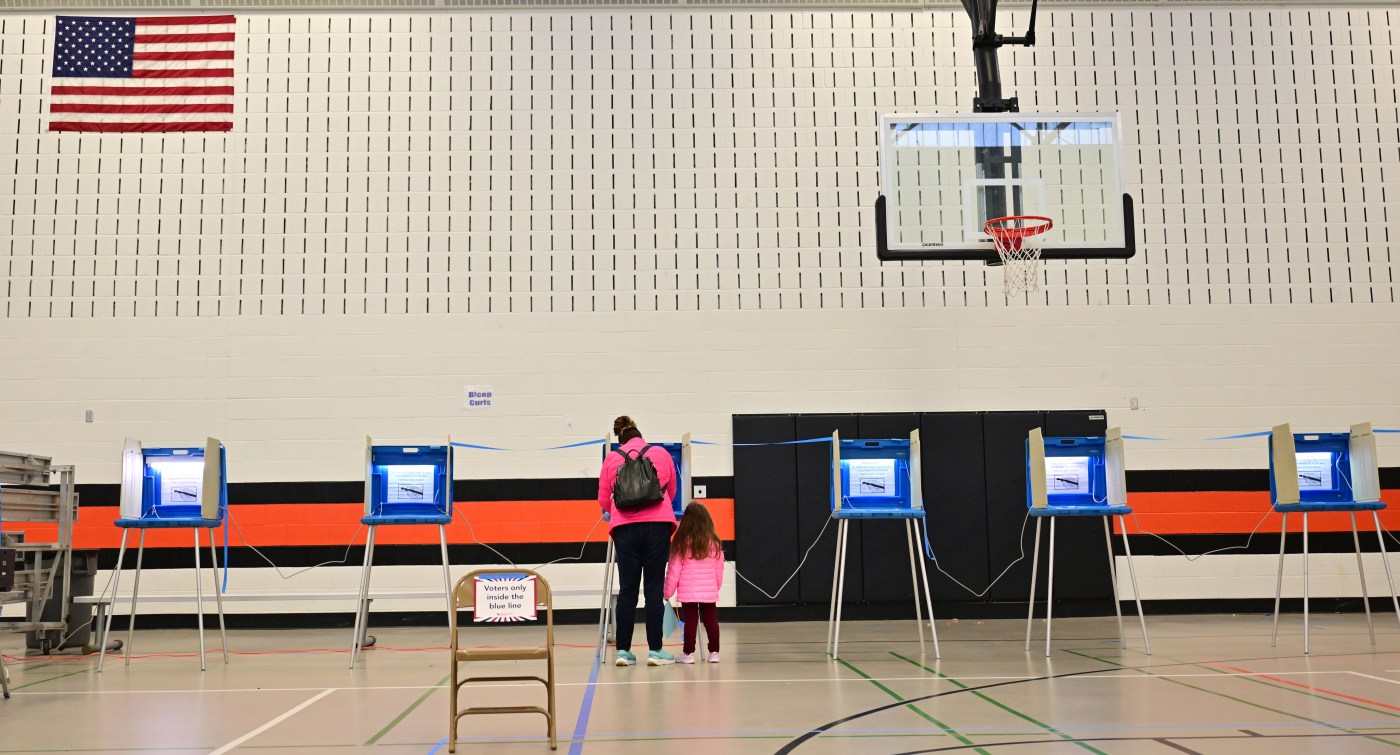
The dumbbells and weight machines have been cleared out, but the former YMCA’s swimming pool, walking track, two full basketball courts, five pickleball courts and men’s and women’s locker room saunas reopened on three levels last November as a private facility available exclusively to the 1,500 tenants of the downtown Bigos properties.

The YMCA’s former skyway footprint is gone, likely destined to become housing, but a hot tub, volleyball court, family activity rooms, foosball tables and a roomy crafts room/maker’s space now line the floors above.

“When he’s shooting his hoops, I can do my workout,” said Rey Row, a single-mother to 13-year-old Isaac, pointing to the elevated walking track overlooking the basketball courts on Tuesday afternoon. “We shoot hoops or go swimming or play foosball.”

The Lowertown Skyrec spans 50,000 square feet of activity space across its three floors. The space “sat vacant until we started renovations this summer, but we bought it in October 2021,” said Stephanie Simmons, a property manager with Bigos Management who used to live in the Galtier Towers. “I had a lot of hurt watching what we’ve gone through with COVID and the unrest, and it’s been great seeing things come back as events return to Mears Park.”

Bill Hanley, a longtime Lowertown resident, called the uptick in skyway-level foot traffic each morning long overdue and much appreciated.

“It’s spectacular,” he said. “Those of us who are not Bigos residents who are in adjoining buildings are lobbying for some inclusion.”

‘Ready for it not to be empty’

Simmons said after multiple revisions, Bigos Management is likely to move forward next year with converting the vacant Galtier Plaza into seven levels of housing adjoining the residential Sibley and Jackson Street high-rise towers of the Galtier Towers Apartments. Cray, the supercomputer company, served as the office building’s anchor tenant from 2009 until 2017, when it relocated to Bloomington.

Cray Plaza’s few remaining commercial tenants soon scattered, with the last of them — the U.S. Department of Health and Human Services’ Office of the Inspector General — moving out last September.

“We’re ready for it to not be empty,” Simmons said.

In late January, Bigos Management acquired the 258-unit Cosmopolitan Apartments in Lowertown from a Boston-based ownership group for $34 million, a relative bargain. According to Ramsey County property tax records, the eight-story building carries an estimated market value this year of $45 million.

The building, which is located at 250 Sixth St. and dates to 1915, last sold in 2008 for $24 million.

Related Articles

Local News |


Metal band Korn to hit St. Paul’s Xcel Energy Center on 30th anniversary tour

Local News |


St. Paul, Met Council seek developers for land around downtown Central Station

Local News |


St. Paul Saints’ new menu items for 2024 include gigantic hot dog, sundae

Local News |


Choo Choo Bob’s Train Store returning to St. Paul, with a new home in Union Depot

Local News |


Redesigning the State Capitol Mall in 10 ‘Bold Moves’

Settlement reached in lawsuit between Disney and Florida Gov. Ron DeSantis’ allies

posted in: Society | 0

By MIKE SCHNEIDER (Associated Press)

ORLANDO, Fla. (AP) — Allies of Gov. Ron DeSantis and Disney reached a settlement agreement Wednesday in a state court fight over how Walt Disney World is developed in the future following the takeover of the theme park resort’s government by the Florida governor.

In a meeting, the members of the board of the Central Florida Tourism Oversight District approved the settlement agreement, ending almost two years of litigation that was sparked by DeSantis’ takeover of the district from Disney supporters following the company’s opposition to Florida’s so-called “Don’t Say Gay” law.

The 2022 law bans classroom lessons on sexual orientation and gender identity in early grades and was championed by the Republican governor, who used Disney as a punching bag in speeches until he suspended his presidential campaign this year.

The district provides municipal services such as firefighting, planning and mosquito control, among other things, and was controlled by Disney supporters for most of its five decades.

Jeff Vahle, president of Walt Disney World Resort, said in a statement Wednesday that the company was pleased a settlement had been reached.

“This agreement opens a new chapter of constructive engagement with the new leadership of the district and serves the interests of all parties by enabling significant continued investment and the creation of thousands of direct and indirect jobs and economic opportunity in the state,” Vahle said.

As punishment for Disney’s opposition to the law, DeSantis took over the governing district through legislation passed by the Republican-controlled Florida Legislature and appointed a new board of supervisors. Disney sued DeSantis and his appointees, claiming the company’s free speech rights were violated for speaking out against the legislation. A federal judge dismissed that lawsuit in January.

Before control of the district changed hands from Disney allies to DeSantis appointees early last year, the Disney supporters on its board signed agreements with Disney shifting control over design and construction at Disney World to the company. The new DeSantis appointees claimed the “eleventh-hour deals” neutered their powers and the district sued the company in state court in Orlando to have the contracts voided.

Disney filed counterclaims that include asking the state court to declare the agreements valid and enforceable.

Under the terms of Wednesday’s settlement agreement, Disney lets stand a determination by the board of DeSantis-appointees that the comprehensive plan approved by the Disney supporters before the takeover are null and void. Disney also agrees that a development agreement and restrictive covenants passed before the takeover are also not valid, according to the settlement terms.

Instead, a comprehensive plan from 2020 will be used with the new board able to make changes to it, and the agreement suggests Disney and the new board will negotiate a new development agreement in the near future.

___

Follow Mike Schneider on X, formerly known as Twitter: @MikeSchneiderAP.

F.D. Flam: The U.S. needs a non-partisan 9/11 Commission for COVID

posted in: Society | 0

During the third week of March 2020, with little public debate and less warning, Americans were told to stay in their homes indefinitely as COVID cases climbed. There were only a few days between bland reassurances and lockdown orders — just enough time to go panic shopping for toilet paper.

The first pandemic year represents a crisis distinct from the period after vaccines became widely available. Congress should establish something like the 9/11 Commission — independent and bipartisan — to reexamine why our early response was so disruptive and yet so ineffective. A report issued in time for next year’s anniversary of the start of the pandemic might identify weaknesses in the country’s general ability to deal with the next crisis, whatever that entails.

Some eye-opening analyses covering that first year have recently appeared in “Lessons From the COVID War,” by a panel of scientists and policy experts, and “The Big Fail: What the Pandemic Revealed About Who America Protects and Who It Leaves Behind,” by journalists Joe Nocera and Bethany McLean. But an official bipartisan treatment would have a big impact on our polarized nation.

Such a commission should first address why our elected leaders and expert agencies didn’t warn the public sooner. There was strong evidence by early February 2020 that this disease had already spread far beyond Wuhan, China, that it could travel invisibly through mild cases, and that the oldest people were at highest risk.

Some fair warning could have helped people take voluntary measures to avoid infection and prepare for disruption. But for much of January and February we got false reassurance. Even when Nancy Messonnier of the Centers for Disease Control and Prevention said on Feb. 25 that the virus might cause ” severe” disruption, CDC deputy director Anne Schuchat pushed back, saying “our efforts at containment have worked.” It wasn’t until mid-March that the White House declared COVID a national emergency.

The delays in issuing clear warnings were part of a perverse disregard for the effects of time in a crisis. When protective measures began mattered. So did the timing of lifting or changing those measures. People can better stick with sacrifices that have a specific duration and a realistic goal.

Waiting to issue warnings and directives until after the disease was widespread meant more deaths — and the need for more extreme measures to get the same level of mitigation. And it isn’t hindsight bias to say that extreme measures such as shutting schools, businesses and public events would have been less harmful if done for two or three weeks rather than months.

The scenes of people dying in hospital corridors in Italy made it seem necessary to take drastic measures in the U.S. to “flatten the curve” of infection, but there was no scientific case for trying to eradicate an already widespread virus by keeping extreme measures in place long term.

A COVID commission could also look at what government, employers and communities might have done to prevent deaths among essential workers and their families. While Americans saw limited improvements in paid sick leave policy, the situation called for more. Essential workers who were at risk or lived with people in fragile health should have been able to opt out of work — their jobs taken over temporarily by the many healthy, younger Americans who were unafraid and whose mental health might have improved with the chance to contribute rather than stay cooped up alone.

And a special investigation could also help puncture the thin excuse that U.S. leaders made bad decisions because of a lack of data on a novel virus. Even in those early days of 2020, we had enough information to act more rationally. By early April, there was already growing evidence that the virus was spreading primarily indoors through airborne transmission and there was very little risk outdoors.

Blunt closures of businesses, schools, beaches and parks threw that knowledge out the window — and they didn’t represent scientific consensus. Michael Osterholm, director of the Center for Infectious Disease Research and Policy in Minnesota, co-wrote a Washington Post op-ed published on March 21, 2020, warning that indefinite, sweeping lockdowns were not the best course of action for saving lives:

“The best alternative will probably entail letting those at low risk for serious disease continue to work, keep business and manufacturing operating, and ‘run’ society, while at the same time advising higher-risk individuals to protect themselves through physical distancing and ramping up our health-care capacity as aggressively as possible.”

A targeted strategy could have harnessed what scientists had discerned about who was at the most risk of dying and which kinds of work were riskiest.

Osterholm stood by this view when I spoke to him this month. (And to give credit where it’s due, he was the first to get me thinking about a 9/11 Commission for COVID.) He reminded me that he favored short-duration measures to slow the rate of spread and keep hospitals from being overwhelmed. And he was concerned that long-term lockdowns would increase the death toll among “essential workers,” many of whom had health conditions that put them at elevated risk, or lived in crowded housing with elderly relatives. His worries came true.

Lockdowns caused homes to become more crowded — with college students moving in with families, school-age kids at home and others spending much more time in their houses or apartments. Epidemiologists have confirmed that hours of household exposure caused many more cases than exposures of less than 30 minutes. Again, time matters.

A COVID commission should also measure the lasting impact of these early fumbles. After vaccines were introduced, the U.S. started to see many more deaths than other comparably wealthy countries. We had lower vaccine uptake in part because the public-health community had lost the people’s trust during that first year.

The justification for blunt, long-term restrictions was the assumption that more people would die as a result of more targeted measures. But that needs close examination — it’s also possible that those policies made the situation here much worse and deadlier than it had to be.

Lots of countries made mistakes as COVID spread around the world. The only way to learn from them is to give them a hard, nonpartisan look.

F.D. Flam is a Bloomberg Opinion columnist covering science. She is host of the “Follow the Science” podcast.

Related Articles

Opinion |


Letters: In Cobb case, was deadly force authorized?

Opinion |


Lisa Jarvis: Biden’s $12 billion for women’s health should be just a start

Opinion |


Adam Minter: March Madness as we know it faces extinction

Opinion |


Murphy, Sperling: How a California climate win could end up destroying rainforests — and what to do about it

Opinion |


David French: America’s most overlooked political divide is also its most revealing

Matthew Yglesias: To fix Social Security? Ham-handedness, left or right, isn’t the answer

posted in: News | 0

It’s budget season in Washington, which means the politicians are delivering their annual warnings about the looming Social Security crisis. How big of a crisis — and how close it looms — is largely within their control, and there are basically three proposals to address it: one from House Republicans, one from President Joe Biden, and one from former President Donald Trump.

Trump’s plan is so bad that Republicans decided to attribute it to Biden instead. The budget proposal from the House’s Republican Study Committee, released earlier this month, points out that if no changes are made, the Social Security trust fund will be exhausted by 2032. “Ignoring this fact, as the Biden Administration and Congressional Democrats have, will lead to the largest across-the-board cuts to current Social Security retirement beneficiaries in history,” its report reads.

This is a valid point. But “do nothing and let massive automatic benefit cuts occur” is in fact Trump’s position on Social Security, not Biden’s. The Biden administration released a Social Security plan earlier this month that would restore solvency to the trust fund by raising taxes on people who earn more than $400,000 a year.

As for House Republicans? Their plan calls for raising the retirement age “to account for increases in life expectancy.” They realize this is risky — the Biden administration has already pounced on it — which may explain their attempt to sow confusion by pretending their nominee’s plan is actually the other guy’s.

Painful changes needed, but …

Nonetheless, the plan from the Republican Study Committee, which represents almost 80% of the party’s House membership, is worth taking seriously. And in the universe of possible benefit cuts, the GOP preference for a higher retirement age is one of the worst possible options. It’s essentially a benefit cut that targets people with below-average life expectancy. Social Security needs painful changes, but it’s a strangely regressive choice to make them at such a cost to a group that’s poorer than average.

Progress on life expectancy has been very uneven across U.S. society. Educated Americans are living much longer than we used to, but those without bachelor’s degrees are not. Contemporary Republicans like to cast themselves as champions of the working class, but they haven’t updated their policy playbook on major issues accordingly.

Beyond the specific class skew, meanwhile, there’s just something peculiar and cruel about singling out people in poor health for benefit cuts.

On average, the rich are in better shape than the poor. But there are exceptions. And almost everyone would trade money for better health and longer life if they had the opportunity. Increasing the retirement age essentially singles out the very worse-off class of elderly people — and makes them worse off.

Then there is the already-regressive nature of Social Security: The richer you are, the larger your monthly benefit check. Liberals generally admire Social Security for being a “universal” program rather than a means-tested one, providing a guarantee of dignified retirement to all Americans without a lot of elaborate administrative rigamarole. But most people’s understanding of a universal program is something like a public library or a bus — a service available on equal terms to everyone. Social Security is not like that. It pays larger benefit checks to higher-income people who paid more taxes during their working life.

The theoretical rationale here is that Social Security is supposed to be a kind of mandatory insurance program with a pension-like structure of payments and payouts.

In reality, though, Social Security is redistributive — those who pay higher taxes receive higher benefits, but not in proportion to what they pay. The point of the Democrats’ tax-raising plan is to make the program more redistributive.

But precisely because the existing benefit structure is skewed to the rich, you can achieve the Democratic goal of making the program more redistributive — and the Republican goal of cutting spending — by simply making the program flatter. Take the current 80th percentile of benefits (or 60th or 40th or whatever number you want to compromise on), and make it the maximum benefit. That creates a spending cut that targets not exactly rich people, but at least non-poor people. And because more affluent people live longer, reducing an affluent person’s monthly check does more for the Treasury than cutting spending on the poor.

A tax cut for those who keep working?

All this said, the idea of raising the retirement age is not completely without merit. In fact, the research shows that retirement itself is something of a mixed blessing.

There are clearly people who, due to their physical condition or the nature of their work, benefit from the opportunity to retire earlier rather than later. On average, however, retiring seems to lead to worse physical and mental health due to a reduction in activity and social connectedness.

Beyond the narrow budgetary questions of retirement programs, there is clearly a large economic benefit to having able-bodied people work rather than not, even if they are in their 60s or 70s. Rather than cut benefits for those who want to retire, America might consider cutting taxes on people who choose to continue working past retirement age. At the very least, the government shouldn’t actively discourage the elderly from participating in the labor market.

The main health benefits of continued work seem to accrue with part-time hours — it’s avoiding total inactivity, in other words — and for many people that may be the ideal situation. Part-time work gives the able-bodied elderly a continued connection to coworkers and a role in the national economy, while also generating additional free time to spend with grandchildren or on hobbies. The U.S. should consider creating an active labor market program oriented toward connecting sixty- and seventy-something people with part-time job opportunities.

Smaller tax increases, more careful cuts

It may be boring to say that Republicans want to cut benefits and Democrats want to raise taxes, and that the best solution is some kind of bipartisan compromise that does a mix of the two. But realistically, the optimal policy probably involves tax increases smaller than Biden proposes paired with spending cuts more careful than Republicans suggest.

At least both parties agree — one explicitly, one implicitly — that there is no place in this debate for Trump’s reckless indifference.

Matthew Yglesias is a columnist for Bloomberg Opinion. A co-founder of and former columnist for Vox, he writes the Slow Boring blog and newsletter. He is author of “One Billion Americans.”

Related Articles

Opinion |


Letters: In Cobb case, was deadly force authorized?

Opinion |


Lisa Jarvis: Biden’s $12 billion for women’s health should be just a start

Opinion |


Adam Minter: March Madness as we know it faces extinction

Opinion |


Murphy, Sperling: How a California climate win could end up destroying rainforests — and what to do about it

Opinion |


David French: America’s most overlooked political divide is also its most revealing