The US is sending $125 million in new military aid to Ukraine, officials say

posted in: News | 0

By LOLITA C. BALDOR and MATTHEW LEE

WASHINGTON (AP) — The Biden administration will send about $125 million in new military aid to Ukraine, U.S. officials said Thursday, even as Washington works to get a better understanding of Kyiv’s incursion into Russia and how it advances the broader battlefield goals more than two years into the war.

U.S. officials said the latest package of aid includes air defense missiles, munitions for High Mobility Artillery Rocket Systems (HIMARS), Javelins and an array of other anti-armor missiles, counter-drone and counter-electronic warfare systems and equipment, 155mm and 105mm artillery ammunition, vehicles and other equipment.

The officials spoke on condition of anonymity because the aid has not been publicly announced. The formal announcement could come as soon as Friday, which is the eve of Ukraine’s Independence Day.

The weapons are being provided through presidential drawdown authority, which means they are taken from Pentagon stockpiles and can be delivered more quickly.

The aid comes as Ukrainian forces continue to broaden their surprise offensive into Russia, where officials say they have taken about 100 square kilometers (62 square miles) of territory around Kursk. Russian troops, meanwhile, are making gains in the east, around the Ukrainian city of Pokrovsk, a critical logistics hub.

Pentagon officials have said repeatedly that the U.S. has been talking with Ukrainian leaders to get a better assessment of their longer-term goals for the Kursk operation, particularly as they see Russia advancing near Pokrovsk.

If Pokrovsk falls, the defeat would imperil Ukraine’s defenses and bring Russia closer to its stated aim of capturing the Donetsk region. Russian soldiers are now just 10 kilometers (6.2 miles) away.

Asked about the Kursk operation, Pentagon spokeswoman Sabrina Singh said Thursday that “we are still working with Ukraine on how that fits into their strategic objectives on the battlefield itself.”

The U.S., she said, understands that Ukraine wants to build a buffer zone along the border, but the administration still has more questions about how it furthers Ukraine’s broader war effort.

Ukrainian President Volodymyr Zelenskyy made his first visit Thursday to the border area where his forces launched the offensive on Aug. 6. He said Kyiv’s military had taken control of another Russian village and captured more prisoners of war.

The latest package of aid brings the total amount of U.S. security assistance to Ukraine to more than $55.7 billion since Russia’s invasion in February 2022.

Celebrations abound for hot-hitting Twins catcher Christian Vázquez

posted in: News | 0

As Christian Vázquez made his way into the visitor’s clubhouse last Thursday at Globe Life Field in Arlington, Texas, bat in hand, a seven-person Puerto Rican band played jubilant music.

The live band was just one part of an elaborate surprise for Vázquez, arranged by his wife Gaby, to honor the veteran for his 10 years of major league service time, a milestone that less than 10 percent of players in Major League Baseball history have reached. Vázquez and his teammates quickly got in the groove, dancing to the music as they toasted his accomplishment.

There’s a lot to celebrate right now in Christian Vázquez’s world. He had a birthday on Wednesday, turning 34, he and Gaby are set to welcome their third child to this world next month, and he’s completely turned his season around at the plate after a difficult first few months to begin the year.

“Whatever he’s doing, he looks great,” Twins manager Rocco Baldelli said. “And we’ll take it. He’s helping us score runs. Coming from where he is in the lineup, that’s huge. And, he’s never wavered defensively at any point.”

While he always has been an asset behind the plate, Vázquez’s offensive start to the season couldn’t have been much worse. Through the first three months of the season, he was hitting .181 with a .207 on-base percentage and .252 slugging percentage. He had just seven extra-base hits through the end of June.

Behind the scenes, he was putting in plenty of work — assistant hitting coach Derek Shomon referred to him as a “known tinkerer” — searching for results that didn’t come for quite some time.

“(There was) definitely for sure frustration, for sure frustration. Pissed off at me, and I’m pissed off at him and we’re getting into it, and that’s what happens with adult males in a high-stress industry,” Shomon said. “In Major League Baseball, you’ve got to perform, and so he was definitely frustrated because he knew he could perform better. He knew he was better than what he was showing.”

Finally, at long last, the duo found something that worked. They made a tweak with his upper body and they also simplified his cage routine. Where his routine used to be upwards of near a half an hour, now it might be under 10 minutes.

“It (is) in and out in a couple swings and I feel the feeling that I’m feeling right now. and that’s it,” Vázquez said.

Once they simplified things, Shomon said, things started to click. It translated into game performance, where the catcher started to turn his season around in early July.

He knew it was working when he started to see the results.

“The first week of July, I was consistent every game,” Vázquez said.

Since that point, Vázquez is hitting .338 with a .365 on-base percentage and .575 slugging percentage. He has five home runs among his 27 hits in those 26 games.

One of those hits was a pinch-hit, two-run single that lifted the Twins to an eighth-inning lead on Tuesday night after they had surrendered their advantage a half inning earlier. It was a huge moment for him, though the Twins eventually lost the game to the San Diego Padres.

It’s rewarding for Vázquez, of course, but also for Shomon, who put in so many hours with him in the cage trying to help him turn things around.

“We, as coaches, I think at times feel their struggle more than they do and want it so bad for them, especially when you see things trending in the right direction in all areas leading up until game time,” Shomon said. “You’re just hoping and wanting it to carry over, especially when you’re making an adjustment. … (I’m) elated, right, and more so just happy with how consistent he has been.”

It’s been nearly two months of consistency now for the veteran catcher, who has moved past the frustration of the early season into the celebratory days of August.

“It was hard,” Vázquez said. “It was hard obviously because I was trying to help the team on both sides and it was not working, but now it feels good.”

Related Articles

Minnesota Twins |


Twins break out the bats in win over Padres

Minnesota Twins |


Ryan Jeffers becomes just fourth Twins catcher to reach this milestone

Minnesota Twins |


Second bullpen blowup in three days sends Twins to loss in San Diego

Minnesota Twins |


Saints’ Morris is latest prospect in Twins’ arms race

Minnesota Twins |


Carlos Correa, Byron Buxton progressing but no timeline for injured Twins stars

Sudden fame for Tim Walz’s son focuses attention on challenges of people with learning disabilities

posted in: Politics | 0

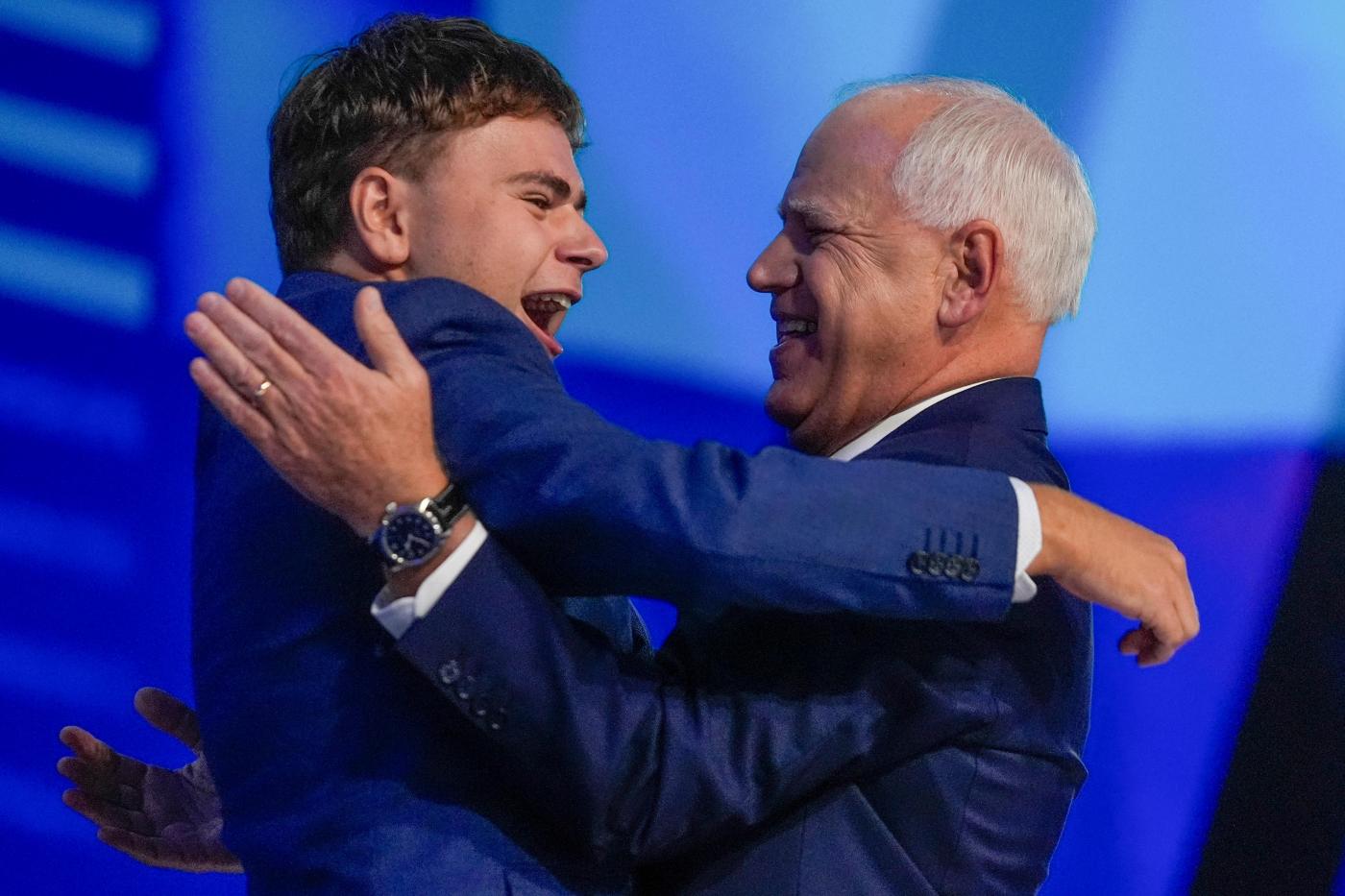
MINNEAPOLIS — An unexpected highlight of the Democratic National Convention on Night Three was an outburst of pride from the son of vice presidential candidate Tim Walz.

“That’s my dad!” 17-year-old Gus Walz could be seen exclaiming Wednesday night. He stood, tears streaming down his face, and pointed to his father, the governor of Minnesota, who accepted the party nomination for vice president.

Gus wept through much of the 16-minute speech, and took the stage with his family afterward, wrapping his dad in a tight bear hug, burying his face in his shoulder.

The high school senior’s joy quickly went viral. He was still trending Thursday on X, the social media platform formerly known as Twitter. And his newfound fame is focusing attention on the challenges of people with learning disabilities. His parents recently revealed to People magazine that Gus has ADHD, an anxiety disorder and something called a non-verbal learning disorder. Searches on Google have spiked since Thursday night this week for the disorder and for the teen’s name.

There’s no standard definition for non-verbal learning disorder. It doesn’t mean people with it can’t talk. But according to the NVLD Project at Columbia University, people with it “struggle with a range of conditions that include social and spatial disabilities. Often they are marginalized and isolated; consequently, they can experience social barriers throughout their lives.”

There has long been tension between Washington and local school districts over federal funding of special education. Federal law requires schools to provide special education services, but doesn’t come close to covering the costs. When passed in 1975, the Individuals with Disabilities Education Act (IDEA) committed the federal government to paying 40% of the average per-pupil expenditure for special education. But currently it’s more like 13%.

That’s one reason the Democratic Party platform adopted at the convention this week says, “We support fully funding IDEA to prioritize students with disabilities and the special educator workforce.” This year’s Republican Party platform doesn’t mention special education. But dozens of national education groups have long called for fully funding the costs that IDEA imposes on local schools.

The actual prospects for more money under a Harris-Walz administration are unclear. Much would depend on the future federal budget picture and the composition of the next Congress. And platforms aren’t binding on candidates.

But Walz as governor has approved large increases in education funding, including special education. The two-year budget he signed in 2024 included a 6% increase in per-pupil funding for local schools, and it indexes future funding to inflation. It also included a large boost in state support for special education to help fill the gap in federal funding.

Securing full funding for special education on the national level is the “number one public policy priority” of the National Association of State Directors of Special Education, said John Eisenberg, the group’s executive director. The association calls the federal act “first and foremost a civil rights law, meant to protect the right of students with disabilities to be educated in the nation’s public schools.”

While bills to mandate full funding have attracted bipartisan support over the years, they’ve failed to become law.

Governor Walz, a former social studies teacher, and first lady Gwen Walz, a former English teacher, revealed Gus’ learning issues in a statement to People magazine that was published this week.

“When our youngest Gus was growing up, it became increasingly clear that he was different from his classmates,” they said. “Gus preferred video games and spending more time by himself.” They went on to say, “When he was becoming a teenager, we learned that Gus has a non-verbal learning disorder in addition to an anxiety disorder and ADHD, conditions that millions of Americans also have.”

The Walzes told People that it took time to figure out how to set Gus up for future success, “but what became so immediately clear to us was that Gus’ condition is not a setback — it’s his secret power.”

They also said he’s “brilliant, hyper-aware of details that many of us pass by, and above all else, he’s an excellent son.” They didn’t go into detail about how his condition has affected his life, however, and the Walz campaign did not immediately respond to a request for comment Thursday. They have previously noted that Gus got his driver’s license last fall.

Related Articles

National News |


DNC in Chicago: What happened Wednesday — and what’s coming Thursday

National News |


Other voices: Harris needs to fill in the blanks for undecided voters

National News |


Democrats conclude their convention Thursday with their new standard bearer, Kamala Harris

National News |


‘That’s my dad!’: Gus Walz tearfully cheers on his father as he accepts Democratic VP nomination

National News |


Robert Burgess: The Harris economic agenda has two gems worth mining

Associated Press reporter Heather Hollingsworth contributed to this story from Mission, Kansas.

The politics holding back Medicaid expansion in some Southern states

posted in: News | 0

Drew Hawkins, Gulf States Newsroom | (TNS) KFF Health News

For Roderick Givens, a radiation oncologist, the expansion of Medicaid isn’t just a policy issue. He practices medicine in a rural area in the Mississippi Delta and he sees daily how Medicaid coverage could help his uninsured patients.

“I can’t tell you the number of patients who I see who come in with advanced disease, who have full-time jobs,” Givens said. “They haven’t seen a physician in years. They can’t afford it. They don’t have coverage.”

This spring, the Mississippi Legislature considered but ultimately failed to expand Medicaid, which would have extended coverage to around 200,000 low-income residents. Mississippi is one of 10 states that haven’t expanded Medicaid, the state and federal health insurance program for people with low incomes or disabilities.

Seven of those states are in the South. But as more conservative-leaning states like North Carolina adopt it, the drumbeat of support, as one Southern state lawmaker put it, grows louder.

Advocates for expanding Medicaid say opposition is largely being driven by political polarization, rather than cost concerns.

Givens, who is also chair of the board of trustees for the Mississippi State Medical Association, which supports Medicaid expansion, said the federal government would pay for the vast majority of it and that most Mississippians support it. “Why does that not translate when it comes to policy?” Givens asked. “It’s called the stupidity of politics. Period.”

Givens pointed to Arkansas as a potential model for Mississippi because the state has similar demographics and expansion has been in place there for a decade. “Look at what has worked for them and what needs to be tweaked,” he said. “For me, that’s just common sense.”

In states that have not expanded Medicaid, hundreds of thousands of people fall into the “coverage gap,” meaning they earn too much to qualify for Medicaid but are not eligible for subsidies to help pay for private insurance. Those in the coverage gap also can’t afford premiums and other out-of-pocket expenses on employer-sponsored insurance even if they are eligible.

The coverage gap is not an issue in states that have expanded Medicaid. In those states, a single person making up to 138% of the poverty level, or about $20,000 a year, can get on Medicaid. Someone making more than that can get subsidies for private health insurance.

For the first time in Mississippi, both the state Senate and House of Representatives proposed expanding Medicaid during the legislative session that ended in May. In the end, the efforts fizzled at the last minute.

Had the proposed bills succeeded, some 74,000 Mississippians who are stuck in the coverage gap would have gained access to Medicaid.

The House speaker, Jason White, a Republican who supports expansion, acknowledged the political hurdles. “It’s President Obama’s signature piece of legislation. It’s known as Obamacare,” White said. “So, there are a lot of political dynamics centered around it that probably never allowed it to get off the ground.”

White said this year was different because of increased support from the business community.

“I kidded some of my fellow Republicans. I said, ‘Come for the savings, if you will, and then you can stay for the salvation and the good things that it does to improve people’s lives,’” White said. “If you can’t get there because it’s the right or compassionate thing to do to help these individuals, get there because it makes sense from a business standpoint.”

In neighboring Alabama, politics also thwarted attempts to provide more health care this year. Although the state legislature didn’t vote on any direct expansion bills, there was an attempt to include expansion language in a bill about casino gambling — specifically, a provision to allocate some gambling profits to rural health systems.

Ultimately, the Alabama bill was stripped down, and the funding for rural health was removed.

If Alabama expanded Medicaid, at least 174,000 more people would be covered, according to KFF. But the connection to Obamacare remains a stumbling block in Alabama’s Republican-dominated state legislature.

“Just the partisan nature of this is definitely a problem,” said Regina Wagner, an assistant professor of political science at the University of Alabama. Wagner said that most Alabama voters support expansion and that other states have adopted the programs after mounting public pressure.

“A lot of rural voters are Republicans. And so your own constituents are being hit by this and you’re not addressing it,” she said. “If the pressure gets high enough and sentiment shifts, maybe that’s going to be enough to push them.”

The main disagreement in the Mississippi Legislature revolved around work requirements — recipients would have to show they were working part-time or in school.

White said many of his Republican colleagues view extending health coverage through Medicaid as “some form of welfare, some form of giveaway, some form of expanding government.”

Opponents of Medicaid expansion in Alabama are also concerned about potential impacts on the workforce of what they call free health care.

“If you open up this federal subsidized program for hundreds of thousands of people, then it could actually hurt that labor participation rate, give them another reason not to go to work, to stay at home,” said Justin Bogie, senior director of fiscal policy at the Alabama Policy Institute, a research group that says it is committed to limited government.

The federal Centers for Medicare & Medicaid Services, or CMS, would have to issue a waiver to allow an expansion plan with a work requirement — something the Biden administration hasn’t done for any state.

This spring, Mississippi came close to a compromise bill that included a work requirement, something that needs a CMS waiver. Had the bill passed and CMS denied the waiver, expansion still would not have taken effect, and the state would have had to apply for the waiver from CMS every year, hoping for approval under a future — potentially more conservative — presidential administration.

That’s what happened in Georgia. In 2020, the Trump administration approved a waiver for a work requirement as part of a limited expansion effort. CMS later rescinded the waiver under the Biden administration, leading to a lawsuit. A federal judge ruled in favor of Georgia, reinstating the work requirement provisions.

However, only about 2,300 people are enrolled — which is fewer than half of 1% of the more than 430,000 uninsured Georgia adults who could gain access if Medicaid were fully expanded, according to KFF. The state’s alternative expansion plan has cost taxpayers at least $26 million, according to KFF, with nearly all of it going to administrative and consulting fees, not medical care for low-income residents.

As public support for expansion continues to grow in holdout states, North Carolina, the most recent Southern state to pass Medicaid expansion, may offer a glimpse of the future. Since its adoption last year, more than 600,000 people have become eligible.

“But it still took a long time,” said Robin Rudowitz, a vice president and director of the Program on Medicaid and the Uninsured at KFF, a health information nonprofit that includes KFF Health News. “It took the governor who continually supported expansion, and the legislature finally came to endorse and pass the expansion.”

Rudowitz said the fiscal incentive under the American Rescue Plan Act played a role in moving the needle in North Carolina and could help ignite debate in other holdout states. But ultimately, she said, the reasons the Affordable Care Act was established continue to be the strongest motivators.

“Without expansion, there are more people who are uninsured. Hospitals and other providers are not able to get reimbursement because individuals are uninsured,” Rudowitz said. “Those are the underlying issues that existed pre-ACA and continue to exist, particularly in states that haven’t adopted expansion.”

____

This article is from a partnership that includes the Gulf States Newsroom , NPR , and KFF Health News.

___

(KFF Health News is a national newsroom that produces in-depth journalism about health issues and is one of the core operating programs of KFF — the independent source for health policy research, polling and journalism.)

©2024 KFF Health News. Distributed by Tribune Content Agency, LLC.