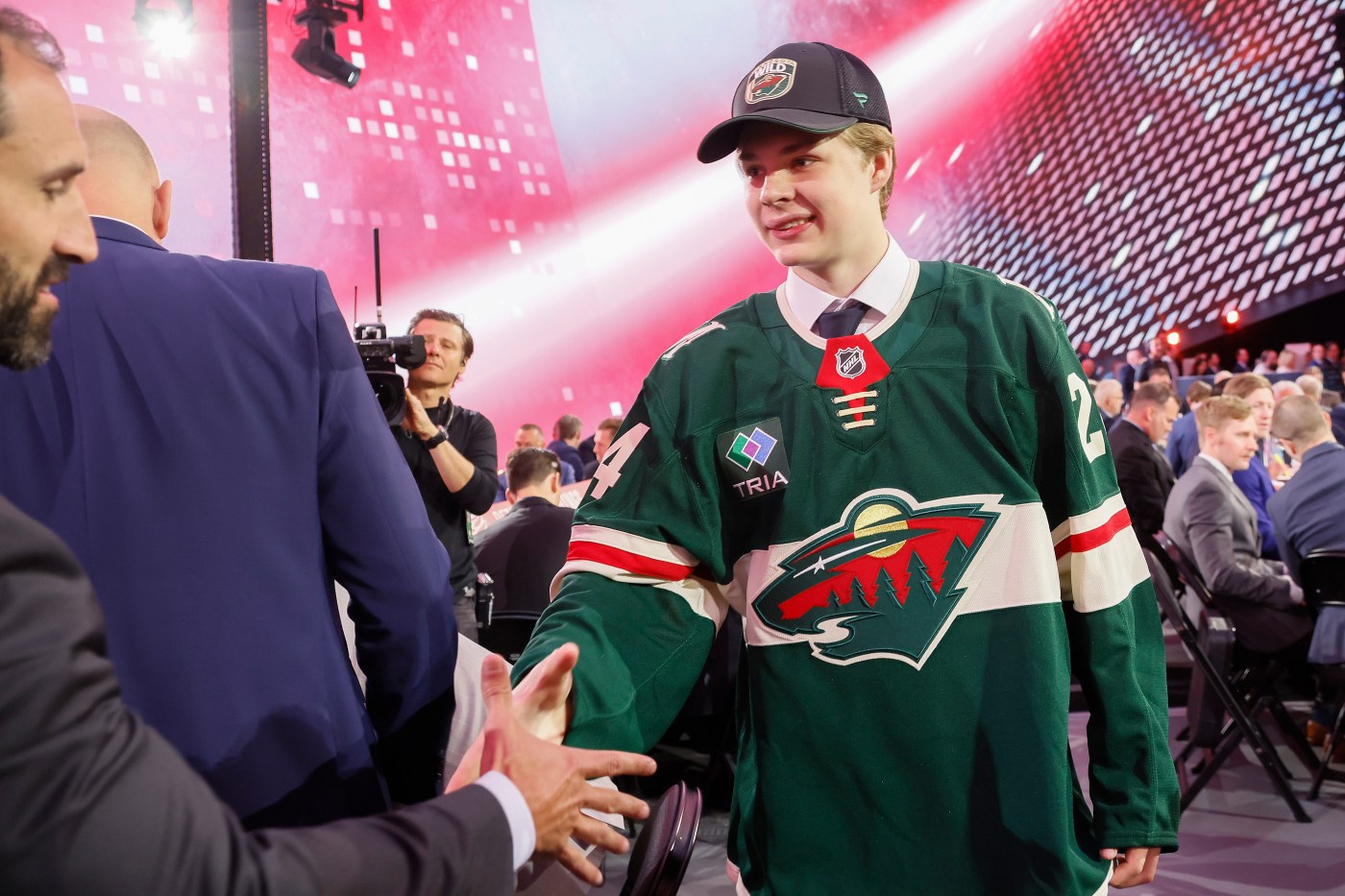
Wild second-round pick Ryder Ritchie comfortable in first prospect camp

posted in: News | 0

Ryder Ritchie is beginning his quest for an NHL job this week, joining the Wild’s prospects for three days of practices leading to this weekend’s fourth annual Tom Kurvers Prospect Showcase in St. Louis.

Minnesota’s second-round pick in June’s amateur draft just turned 18 on Aug. 3 and is a reedy 6-foot-1, 175 pounds. Traded to Medicine Hat of the WHL, he’s expected in Alberta this fall, where he joins a team stacked with NHL prospects expected to make a run at winning the major juniors’ heaviest league.

But Ritchie isn’t intimidated by the company he has this week at TRIA Rink in downtown St. Paul, where he was reunited with a few dozen of the Wild’s best prospects two months after his first NHL development camp.

“I feel comfortable here, I feel confident,” he said after a Wednesday morning practice. “I’m looking forward to it.”

The son of former NHL wing Byron Ritchie, Ryder missed nearly two months of his second season with Prince George with a lower-body injury last winter but still finished with 19 goals and 25 assists in 47 games. In May, he scored four goals and eight points for Canada at the IIHF junior world championships.

The Wild used the 45th overall pick on Ritchie on June 29, and with first-round pick Zeev Buium headed back to the University of Denver this fall, he’s the highest 2024 pick in camp.

Playing in the WHL, he said, has prepared him for his next step.

“You’re used to getting hit, you’re used to playing against big, strong guys,” Ritchie said. “I mean, I was 16 at the time playing against a lot of 20-year-olds, so that was kind of part of it. But I think it helps coming up here, because I’m playing against some 25-year-olds. That part of it helps.”

Barring an injury, there isn’t a sure-fire opening for a prospect on the Wild’s NHL roster this fall, maybe a third-line forward job. Training camp begins next Thursday, and Riley Heidt and Hunter Haight — former third-round draft picks coming off of monster CHL seasons — are the likeliest candidates already in St. Paul this week.

The group will practice again Thursday and Friday before flying Saturday morning to St. Louis, where they will play against prospects the Chicago Blackhawks at 6 p.m. Saturday, then the Blues prospects at 3 p.m. Sunday.

“It’s going to be cool playing for the Minnesota Wild, per se, putting on that jersey with all the other prospects,” he said. “It’s a moment I’m really looking forward to, and I can’t wait to showcase myself and compete out there.”

Tom Kurvers Prospect Showcase

At Centene Community Ice Center in Maryland Heights, Mo. All practice sessions and games will be free and open to the public.

Friday: Blues prospects practice, 10:30 a.m.; Blackhawks prospects practice, 11:30 a.m.; Blues vs. Blackhawks, 7 p.m.

Saturday: Blues prospects practice, 10:30 a.m.; Blackhawks prospects practice, 11:30 a.m.*; Blackhawks vs. Wild, 6 p.m.

Sunday: Wild prospects practice, 8:30 a.m.; Blues prospects practice, 9:30 a.m.; Blues vs. Wild, 3 p.m.


Twins help create special moment for Jax family

posted in: News | 0

In the minutes leading up to first pitch Wednesday night, a flyover featuring a quartet of F-35 Lightning IIs from the 421st Fighter Squadron based at the Hill Air Force Base in Utah emerged from behind the left-field scoreboard and zipped over Target Field.

Capt. Parker Jax — a younger brother of Twins pitcher Griffin Jax — and his wife Capt. Chandler Jax were among the pilots involved. The flyover completed, Capt. Carson Jax, Parker’s twin, took the mound to throw out a first pitch caught by Griffin.

The Jaxes’ parents were in attendance, in addition to a host of other family members. Griffin Jax, himself a captain in the Air Force Reserve, estimated it’s been a few years since his whole family has been able to get together, so Wednesday’s reunion at Target Field carried some extra significance.

The idea, Griffin believes, came about during spring training when he mentioned it to Twins senior vice president of communications and public affairs Dustin Morse. The original idea was to have it occur before a playoff game, but the Air Force needed a guaranteed date to plan around, so that idea was scrapped.

It was too close to Opening Day — another day that features a flyover — to execute, so they settled on Wednesday’s game as part of the Twins’ Sept. 11 remembrance ceremony.

While the Jax brothers had a grandfather who served in Vietnam for a “couple weeks,” Griffin said there was no other family military experience until he was recruited by the Air Force Academy out of high school. The Jax family lived about an hour north of the academy’s Colorado Springs campus, which helped lead the boys there, as well.

“They’re a lot smarter than I am so they took it a lot more seriously,” Griffin Jax said. “They knew baseball probably wasn’t going to be in their cards for any career so they knew going there that it was going to be a real possibility to fly, and they took advantage of it.”

On Wednesday, it all came together perfectly, making for a memorable day for the Jax family.

“It’s just going to be really special,” Griffin said before the game.

Margot, Vázquez back

You can’t keep Christian Vázquez out of the lineup for too long, manager Rocco Baldelli found out. Vázquez was placed on the paternity list earlier this week after welcoming his third son with his wife, Gaby, on Monday.

Initially, Baldelli said, Vázquez was not planning on taking a day off, but the manager told the catcher he was “not welcome” at the ballpark Monday.

“We know that the moment and the time you spend with those family on those really important days what that’s like, the emotion that’s associated with it,” Baldelli said. “So ultimately, he ended up taking two days, which I’m really glad he did.”

Vázquez was back on the active roster Wednesday, as was outfielder Manuel Margot, who had missed the past 10 games with a right groin strain. Margot participated in live batting practice along with injured teammates Carlos Correa, Byron Buxton and Max Kepler, after which the Twins activated Margot from the injured list.

“He’s another guy, he’s very difficult to keep off the field and keep out of the lineup,” Baldelli said. “There are times where he certainly should not be playing and he’s like, ‘I’m good, just put me out there.’”

The Twins optioned catcher Jair Camargo and utilityman Michael Helman to Triple-A St. Paul to make room on the roster for the duo.

Briefly

The Twins will have Thursday off before returning to the field on Friday to face the Cincinnati Reds. Bailey Ober, Simeon Woods Richardson and David Festa are lined up for that series.

For Harris and Trump, facial expressions did much of the talking during presidential debate

posted in: Politics | 0

By The Associated Press

WASHINGTON (AP) — Kamala Harris and Donald Trump said as much with their faces as they did with their words during Tuesday’s debate.

With their microphones muted unless it was their turn to speak, according to the debate rules, body language took on outsized importance for Harris and Trump.

Harris in particular leaned into the nonverbal communication, keenly aware that her every reaction was being broadcast to the world, “speaking” to the audience even while Trump ostensibly had the floor. Networks showed a split screen with both candidates for most of the debate.

At various points she looked amused or befuddled by whatever Trump was saying, as if w ordlessly saying he was lying. A few times she dramatically put her fingers under her chin, eyes wide, head tilted. Other times she laughed.

Trump sometimes scowled, sometimes smiled curtly. His eyes flashed anger or annoyance, perhaps even boredom at times. He rarely looked at Harris while she spoke, instead pointing his face forward toward the cameras or ABC News moderators.

When the candidates did have the floor, Trump and Harris both gesticulated with their hands, mannerisms that are by now familiar to Americans who’ve spent a lot of time watching them.

F.D. Flam: Too many emails? Tame your inbox by thinking like a monkey

posted in: News | 0

If you’re confronting an endless string of unread emails after a long weekend or summer vacation, try thinking of responding as a game. A status game.

Since reading the 2012 book “Games Primates Play,” by University of Chicago behavioral scientist Dario Maestripieri, I’ve never looked at my inbox the same way. Email, writes Maestripieri, is governed by the rules of dominance hierarchy, which is central to the games we social primates are wired to play.

Monkeys spend a great deal of energy establishing who stands where in the social hierarchy — who has access to the best food and the most attractive mates, and who picks mites out of whose fur. Humans also put hierarchy at the heart of much of what we do, whether at home, at work or online.

The book popped into my mind last week when I read an article in the Wall Street Journal about the dreaded post-summer-vacation email pileup. Some people were trying to head off the deluge with bluntness. As one autoresponse put it, “I am out of the office having way more fun than communicating with you … I will likely forget to email you back.” But readers instinctively picked up on the status imbalance inherent in these tactics in the comments section, complaining that they were not so high in the pecking order that they could afford to put up an in-your-face autoreply or ignore email requests from colleagues, clients or customers.

And indeed, there’s always an uneven burden when it comes to email. The sender wants something from the recipient; the status of the recipient relative to the sender dictates whether and for how long such a request can be ignored.

Usually, the person who wants something must spend more time on the exchange. That’s because they’re likely lower-status primates. When I email experts asking to interview them, I tend to spend more time crafting my notes to high-level professors than to post-doctoral fellows hungry for publicity.

After one such (successful!) exchange, Maestripieri told me that email makes everyone more approachable, so people in positions of power are inevitably going to get more requests for help from the less powerful. So the burden to impress is on the sender. “There’s a certain effort and care that goes into writing an email for a higher-status person,” he said.

Related Articles

Opinion |


Errors in Deloitte-run Medicaid systems can cost millions and take years to fix

Opinion |


What is the coolest product made in Minnesota? It’s up to you to decide.

Opinion |


Tyler Cowen: AI culture will be weirder than we can yet imagine

Opinion |


Biden says rural electrification and internet improvements underscore ‘American comeback’

Opinion |


Apple AirTags are helping cops catch thieves. Here’s how you can protect yourself

In his book, he uses an example from his everyday life: requests from students. While part of his job is to teach those students, the burden is still on them to impress him — to write carefully, without typos. He, on the other hand, has plenty of leeway in when he writes back, and can dash off a response in seconds if that’s his preference.

For me, the inbox dread comes from self-recrimination over a flood of self-imposed spam: newsletters and Substack posts and other things I wish I’d found time to read. It’s hard to toss out things of potential value.

If, after sorting these out, you’re still left with an overwhelming inbox of requests and entreaties, keep in mind most of these come from lower-ranked primates. One need not spend more than a moment skimming the request and deciding whether it’s beneficial or reasonable and writing a quick reply.

It takes more effort to manage emails from someone above us in the hierarchy. Maestripieri says it’s problematic if you’re getting barraged by a micromanaging boss you can’t afford to ignore. Then the problem isn’t your inbox — it’s your job.

But emails from higher-status primates aren’t always a nuisance. Sometimes they’re opportunities. If it’s Taylor Swift who wants you to be her interior decorator or financial adviser, you might not mind so much if she’s a little too imposing, because the rewards could be substantial.

The trickiest emails are those where the status relationship is unclear. Consider an independent consultant dealing with requests from clients or customers. Or two colleagues trying to resolve a dispute. Who’s in charge? In those cases, it helps if you’re high in extraversion, said Maestripieri. Then whatever conflicts arise can be offset by the enjoyment extraverts get from interacting with people.

Frustration with too many emails usually arises, we assume, because they take more time than we have. But the real problem is usually that they’re lower-status correspondents asking for more time than we think they deserve. They’re going to test what they can get away with — that’s part of the game.

The good news is that, while other primates tend to bite and claw at each other under such circumstances, we can potentially deploy other ways to work out conflict — like humor, a great tool to deflect tension.

We can also look at the game from outside. We can’t opt out completely; no social primates can. But it’s more fun to play when we see it for what it is.

F.D. Flam is a Bloomberg Opinion columnist covering science. She is host of the “Follow the Science” podcast.