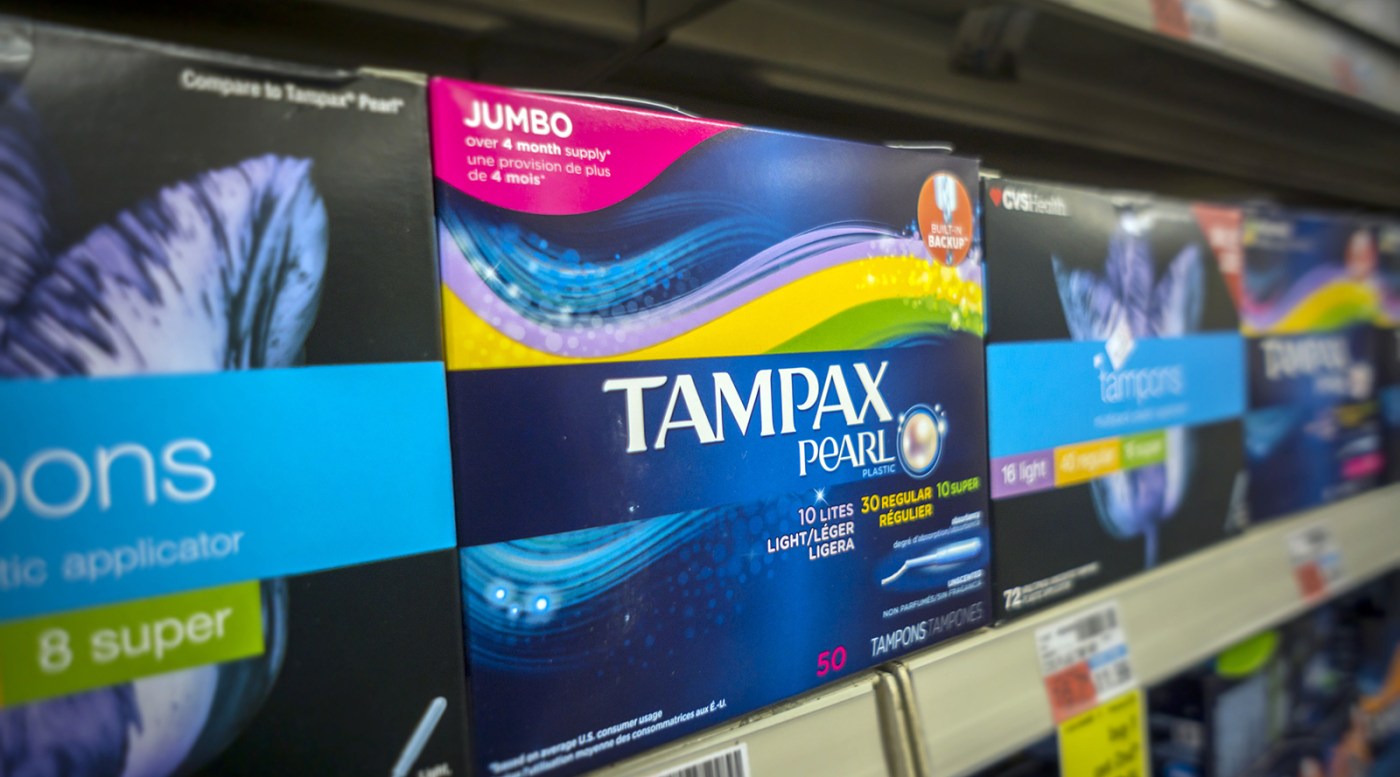
Study finds toxic metals in tampons: FDA launches investigation

posted in: News | 0

Helena Oliviero | The Atlanta Journal-Constitution (TNS)

The Food and Drug Administration announced it has started a research project examining the possible effects of toxic metals in tampons, sparking concerns about products used by millions of women in the U.S.

A recent study found a variety of metals — including mercury, arsenic and lead — in more than a dozen brands of tampons.

The FDA said the study will help better understand the potential impact and whether the metals are causing harm to women. The need to understand this is of critical importance: Up to 80% of girls and women who menstruate use tampons for nearly a week every month for decades of their lives.

The FDA said Tuesday while the study, led by a UC Berkeley researcher and published in July, found metals in some tampons, the study “did not test whether metals are released from tampons when used.”

“It also did not test for metals being released, absorbed into the vaginal lining, and getting into the bloodstream during tampon use. The FDA has therefore commissioned an independent literature review and initiated an internal bench laboratory study to evaluate metals in tampons,” the FDA said in a statement.

One of the key questions will be determining how much, if any, of the metals leach out of the tampons and are absorbed by the body.

The recent study, published in the journal Environment International, evaluated levels of 16 metals in tampons: arsenic, barium, calcium, cadmium, cobalt, chromium, copper, iron, manganese, mercury, nickel, lead, selenium, strontium, vanadium and zinc. They looked at 30 tampons from 14 different brands sold in the U.S. and Europe. They included organic and nonorganic tampons, name brands and generic store brands.

The brands tested were not named in the report, but researchers found metals were present in all types of tampons studied. Lead concentrations were higher in nonorganic tampons but arsenic was higher in organic tampons.

Researchers noted more investigation is needed to better understand the risk posed to women.

The findings are particularly concerning because the vagina has a higher potential for chemical absorption than skin elsewhere on the body, and can result in systemwide exposure. Chronic exposure to metals have been found to increase the risk of a wide variety of health woes including heart disease, dementia, infertility, diabetes and cancer. In addition, metals can harm maternal health and fetal development.

Given the potential for a major health concern, it’s an area of surprisingly little research.

Lead author Jenni A. Shearston, a postdoctoral scholar at the UC Berkeley School of Public Health and UC Berkeley’s Department of Environmental Science, Policy, & Management said she thought her research was the first to measure metals in tampons.

Researchers noted metals could make their way into tampons a number of ways: The cotton material could have absorbed the metals from water, air, soil, through a nearby contaminant (for example, if a cotton field was near a lead smelter) or some might be added intentionally during manufacturing as part of a pigment, whitener, antibacterial agent or some other production process.

After the study was released Dr. Cherie Hill, an Emory Healthcare gynecologist and obstetrician told The Atlanta Journal-Constitution she was very surprised to learn these findings were only coming to light now.

Related Articles

Health |


The best cleaning caddies for organizing your supplies

Health |


ACA enrollment platforms suspended over alleged foreign access to consumer data

Health |


US uninsured rate was stable in 2023, even as states’ Medicaid purge began

Health |


More women had their tubes tied after Roe v. Wade was overturned

Health |


Errors in Deloitte-run Medicaid systems can cost millions and take years to fix

“We’ve heard about heavy metals in other sources like water and clothing, and I was just like, ‘Why wouldn’t we have looked at tampons previously?’” she said.

Hill said she doesn’t think women should “throw out all of their tampons,” but there were some alarming findings in the study that could give some women pause about the continued use of tampons. She said more research is critically needed to know the impact.

“We need to know what is going into our bodies and we need to know how that will impact our health,” she said.

“The paper talks about lead present in all of (the tampons) and we don’t know if there’s a safe level of lead that should ever be in your body,” she said. “Some people may say ‘Because I don’t know the impact, I want to avoid it.’”

But even alternatives, including silicone menstrual cups and period underwear, have questions about their safety and more research is needed on those products too, she said. Many brands of menstrual pads contain elevated levels of chemicals linked to developmental and reproductive harm, according to a 2019 study in the journal Reproductive Toxicology.

Concerns about tampons go back decades. In 1980 scientists confirmed concerns that super-absorbent tampons were associated with toxic shock syndrome.

The FDA didn’t give a timeline to release its findings.

©2024 The Atlanta Journal-Constitution. Visit at ajc.com. Distributed by Tribune Content Agency, LLC.

Thanks to Reddit, a new diagnosis is bubbling up across the nation

posted in: News | 0

Rae Ellen Bichell | KFF Health News (TNS)

In a video posted to Reddit this summer, Lucie Rosenthal’s face starts focused and uncertain, looking intently into the camera, before it happens.

She releases a succinct, croak-like belch.

Then, it’s wide-eyed surprise, followed by rollicking laughter. “I got it!” the Denver resident says after what was her second burp ever.

“It’s really rocking my mind that I am fully introducing a new bodily function at 26 years old,” Rosenthal later told KFF Health News while working remotely, because, as great as the burping was, it was now happening uncontrollably. “Sorry, excuse me. Oh, my god. That was a burp. Did you hear it?”

Rosenthal is among more than a thousand people who have received a procedure to help them burp since 2019 when an Illinois doctor first reported the steps of the intervention in a medical journal.

The inability to belch can cause bloating, pain, gurgling in the neck and chest, and excessive flatulence as built-up air seeks an alternate exit route. One Reddit user described the gurgling sound as an “alien trying to escape me,” and pain like a heart attack that goes away with a fart.

The procedure has spread, primarily thanks to increasingly loud rumblings in the bowels of Reddit. Membership in a subreddit for people with or interested in the condition has ballooned to about 31,000 people, to become one of the platform’s larger groups.

Since 2019, the condition has had an official name: retrograde cricopharyngeus dysfunction, also known as “abelchia” or “no-burp syndrome.” The syndrome is caused by a quirk in the muscle that acts as the gatekeeper to the esophagus, the roughly 10-inch-long muscular tube that moves food between the throat and the stomach.

The procedure to fix it involves a doctor injecting 50 to 100 units of Botox — more than twice the amount often used to smooth forehead wrinkles — into the upper cricopharyngeal muscle.

Michael King, the physician who treated Rosenthal, said he hadn’t heard of the disorder until 2020, when a teenager, armed with a list of academic papers found on Reddit, asked him to do the procedure.

It wasn’t a stretch. King, a laryngologist with Peak ENT and Voice Center, had been injecting Botox in the same muscle to treat people having a hard time swallowing after a stroke.

Now he’s among doctors from Norway to Thailand listed on the subreddit, r/noburp, as offering the procedure. Other doctors, commenters have noted, have occasionally laughed at them or made them feel they were being melodramatic.

To be fair, doctors and researchers don’t understand why the same muscle that lets food move down won’t let air move up.

“It’s very odd,” King said.

Related Articles

Health |


The best cleaning caddies for organizing your supplies

Health |


ACA enrollment platforms suspended over alleged foreign access to consumer data

Health |


US uninsured rate was stable in 2023, even as states’ Medicaid purge began

Health |


More women had their tubes tied after Roe v. Wade was overturned

Health |


Errors in Deloitte-run Medicaid systems can cost millions and take years to fix

Doctors also aren’t sure why many patients keep burping long after the Botox wears off after a few months. Robert Bastian, a laryngologist outside of Chicago, named the condition and came up with the procedure. He estimates he and his colleagues have treated about 1,800 people, charging about $4,000 a pop.

“We hear that in Southern California it’s $25,000, in Seattle $16,000, in New York City $25,000,” Bastian said.

Because insurance companies viewed Botox charges as a “red flag,” he said, his patients now pay $650 to cover the medication so it can be excluded from the insurance claims.

The pioneering patient is Daryl Moody, a car technician who has worked at the same Toyota dealership in Houston for half his life. The 34-year-old said that by 2015 he had become “desperate” for relief. The bloating and gurgling wasn’t just a painful shadow over his day; it was cramping his new hobby: skydiving.

“I hadn’t done anything fun or interesting with my life,” he said.

That is, until he tried skydiving. But as he gained altitude on the way up, his stomach would inflate like a bag of chips on a flight.

“I went to 10 doctors,” he said. “Nobody seemed to believe me that this problem even existed.”

Then he stumbled upon a YouTube video by Bastian describing how Botox injections can fix some throat conditions. Moody asked if Bastian could try it to cure his burping problem. Bastian agreed.

Moody’s insurance considered it “experimental and unnecessary,” he recalled, so he had to pay about $2,700 out-of-pocket.

“This is honestly going to change everything,” he posted on his Facebook page in December 2015, about his trip to Illinois.

The year after his procedure, Moody helped break a national record for participating in the largest group of people to skydive together while wearing wingsuits, those getups that turn people into flying squirrels. He has jumped about 400 times now.

People have been plagued by this issue for at least a few millennia. Two thousand years ago, the Roman philosopher Pliny the Elder described a man named Pomponius who could not belch. And 840 years ago, Johannes de Hauvilla included the tidbit in a poem, writing, “The steaming face of Pomponius could find no relief by belching.”

It took a few more centuries for clinical examples to pop up. In the 1980s, a few case reports in the U.S. described people who couldn’t burp and had no memory of vomiting. One woman, doctors wrote, was “unable to voluntarily belch along with her childhood friends when this was a popular game.”

The patients were in a great deal of pain, though doctors couldn’t find anything wrong with their anatomy. But the doctors confirmed using a method called manometry that patients’ upper esophageal sphincters simply would not relax — not after a meal of a sandwich, glass of milk, and candy bar, nor after doctors used a catheter to squirt several ounces of air beneath the stubborn valve.

André Smout, a gastroenterologist at the University of Amsterdam in the Netherlands, said he read those reports when they came out.

“But we never saw the condition, so we didn’t believe that it existed in real life,” he said.

Smout’s doubts persisted until he and colleagues studied a small group of patients a few years ago. The researchers gave eight patients with a reported inability to burp a “belch provocation” in the form of carbonated water, and used pressure sensors to observe how their throats moved. Indeed, the air stayed trapped. A Botox injection resolved their problems by giving them the ability to burp, or, to use an academic term, eructate.

“We had to admit that it really existed,” Smout said.

He wrote this summer in Current Opinion in Gastroenterology that the syndrome “may not be as rare as thought hitherto.” He credits Reddit with alerting patients and medical professionals to its existence.

But he wonders how often the treatment might cause a placebo effect. He pointed to studies finding that with conditions such as irritable bowel syndrome, 40% or more of patients who receive placebo treatment feel their symptoms improve. Awareness is also growing about “cyberchondria,” when people search desperately online for answers to their ailments — putting them at risk of unnecessary treatment or further distress.

In Denver, Rosenthal, the new burper, is open to the idea that the placebo effect could be at play for her. But even if that’s the case, she feels much better.

“I felt perpetual nausea, and that has subsided a lot since I got the procedure done,” she said. So has the bloating and stomach pain. She can drink a beer at happy hour and not feel ill.

She’s pleased insurance covered the procedure, and she’s getting a handle on the involuntary burping. She cannot, however, burp the alphabet.

“Not yet,” she said.

(KFF Health News is a national newsroom that produces in-depth journalism about health issues and is one of the core operating programs of KFF — the independent source for health policy research, polling and journalism.)

©2024 KFF Health News. Distributed by Tribune Content Agency, LLC.
High Adderall doses tied to increased psychosis, mania risk: study

posted in: Society | 0

People who are taking high doses of Adderall face an increased risk for developing psychosis or mania, according to a new Mass General Brigham study.

The researchers from McLean Hospital, a psychiatric teaching hospital, found that high doses of the prescription amphetamine were linked to a five-fold elevated risk of new-onset psychosis or mania.

The psychosis and mania risk was highest in those taking 30 mg or more of dextroamphetamine, which corresponds to 40 mg of Adderall.

“Stimulant medications don’t have an upper dose limit on their labels, and our results show that it is clear that dose is a factor in psychosis risk and should be a chief consideration when prescribing stimulants,” said lead study author Lauren Moran, a pharmacoepidemiology researcher at McLean Hospital.

Moran said the study was motivated by her past clinical observations as an inpatient psychiatrist. She and her McLean colleagues regularly saw patients experiencing first episodes of psychosis, and their medical records revealed they were prescribed high doses of stimulants by their doctors.

The researchers looked at nearly 15 years of emergency department admissions across Mass General Brigham hospitals.

Among people who take prescription amphetamine, 81% of cases of psychosis or mania could have been eliminated if they were not on the high dose, the scientists found.

“This is a rare but serious side effect that should be monitored by both patients and their doctors whenever these medications are prescribed,” Moran said.

While a significant dose-related risk increase was seen in patients taking high doses of amphetamine, no significant increase was seen with methylphenidate (Ritalin) use.

Moran said the findings shouldn’t create alarm, but should lead to extra caution when these medications are prescribed — especially for those who have risk factors for psychosis and mania.

“There’s limited evidence that prescription amphetamines are more effective in high doses,” Moran said. “Physicians should consider other medications our study found to be less risky, especially if a patient is at high risk for psychosis or mania.”

Related Articles

Health |


The best cleaning caddies for organizing your supplies

Health |


ACA enrollment platforms suspended over alleged foreign access to consumer data

Health |


US uninsured rate was stable in 2023, even as states’ Medicaid purge began

Health |


More women had their tubes tied after Roe v. Wade was overturned

Health |


Errors in Deloitte-run Medicaid systems can cost millions and take years to fix

Researchers reviewed electronic health records of Mass General Brigham patient encounters between 2005 and 2019, focusing on adults aged 16 to 35, the typical age of onset for psychosis and schizophrenia.

All patients were admitted to McLean Hospital following referrals from other hospitals in the Mass General Brigham healthcare system.

The researchers identified 1,374 cases of individuals presenting with first-episode psychosis or mania, compared to 2,748 control patients with a psychiatric hospitalization for other conditions like depression or anxiety.

They conducted a comparison analysis of stimulant use over the preceding month, and accounted for other factors, including substance use, in order to isolate the effects of stimulants.

The scientists found that among people who take prescription amphetamine, 81% of cases of psychosis or mania could have been eliminated if they were not on the high dose.

Prescribing rates for stimulants that treat attention-deficit/hyperactivity disorder (ADHD) have increased significantly over the past decade, with some of the largest increases reported during the COVID pandemic.

3 side gigs for full-time working moms

posted in: Society | 0

By Elizabeth Ayoola | NerdWallet

There are endless listicles online about how to make extra income while working full time, but how many of those options are realistic for busy moms? As master multi-taskers short on time, moms often need flexibility if they’re going to take on a side gig.

Sometimes a hobby, passion or skill you do effortlessly can make you extra money. Other times, you may need to acquire certain skills to make extra cash. Four full-time working moms — including myself — share gigs that fall into both categories.

Writing

Resume writing is one way Tonnesha Edmond, owner of Pretty Resumes and a mother to two kids in Lawrenceville, Georgia, makes extra income. Additionally, Edmond provides services like job application assistance and business proposals to clients.

“I’ve always been a great writer, so my family and friends would come to me to help them with their resume and I’ve always been a great researcher,” she says. “So even if I wasn’t super familiar with the job they were going after, I knew how to do the research so I could put together a resume that will actually help them get the job.”

Edmond started monetizing her skill over four years ago when her son was in the NICU for the first eight months of his life. She now juggles full-time employment and her side gig.

How much can you earn through resume writing? Edmond charges $175 per resume and offers packages with add-ons to increase her earnings. A perk of this gig is that her time commitment is only around 10 hours a week.

Edmond says that listing her business on Google has helped improve her visibility and attracted more clients.

Like Edmond, I have a natural knack for writing, and was able to turn that into a side hustle. I have gotten clients by sending out cold emails to entrepreneurs I think could benefit from the services I offer, then setting up consultations to gauge their needs. With online publications, I simply send story pitches to editors.

Teaching English

Megan Holley, a mom of two in Fulshear, Texas, has been making extra money since 2018 by teaching students English online. Holley’s first teaching gig was with a company called EF Education First, but she currently teaches with LingoAce. Holley says she enjoys teaching English as a side gig because of the flexibility it offers. She typically teaches during late evenings or early mornings.

“I can kinda choose my own schedule, which is nice,” she says. “I really do actually enjoy teaching so that’s also part of it.”

In terms of earning potential, at LingoAce you can make base pay of $14 an hour as an ESL teacher and up to $30 an hour as a math teacher. However, you will likely need to get a certification if you plan to teach. Companies may require certifications such as Teaching English as a Foreign Language (TEFL) or Teaching English to Speakers of Other Languages (TESOL).

The main challenge Holley mentions is acquiring enough students to get the amount of pay you want.

“The more you teach with the company, the more reviews you get and the more people you get saying that they liked your teaching style, then the more students you might get,” she says.

Reselling items online

If you’ve been avoiding decluttering, earning income from your clutter might be a good incentive to tackle it. Keola Harry sells items on Mercari, an international online marketplace for extra income. Harry, who is based in Atlanta, finds time to do this when she’s not working full time and raising two young children.

“So that’s me just reselling everything in my house that I thought at one point in my life I loved and I had to have it, and then I bought it,” Harry says. The working mom resells trendy baby items and furniture collecting dust around her home. She says the baby items are snatched up by buyers the fastest.

Harry makes around $600 a month reselling items in her home. This year alone, she’s made over $3,000. It’s also worth mentioning that Mercari may be an attractive platform because it doesn’t charge a seller fee.

Harry began the gig to bring in additional income during the pandemic after her husband got laid off. What started out as a form of extra income to create financial stability has turned into her rainy day fund.

In a bid to maximize her side gig income, Harry places the money she makes into a high-yield savings account to earn interest.

“That’s one big perk of having that extra money coming in with the side hustle is that you can put it somewhere, like a high-yield savings account and just watch it grow a little,” she says.

Elizabeth Ayoola writes for NerdWallet. Email: eayoola@nerdwallet.com.