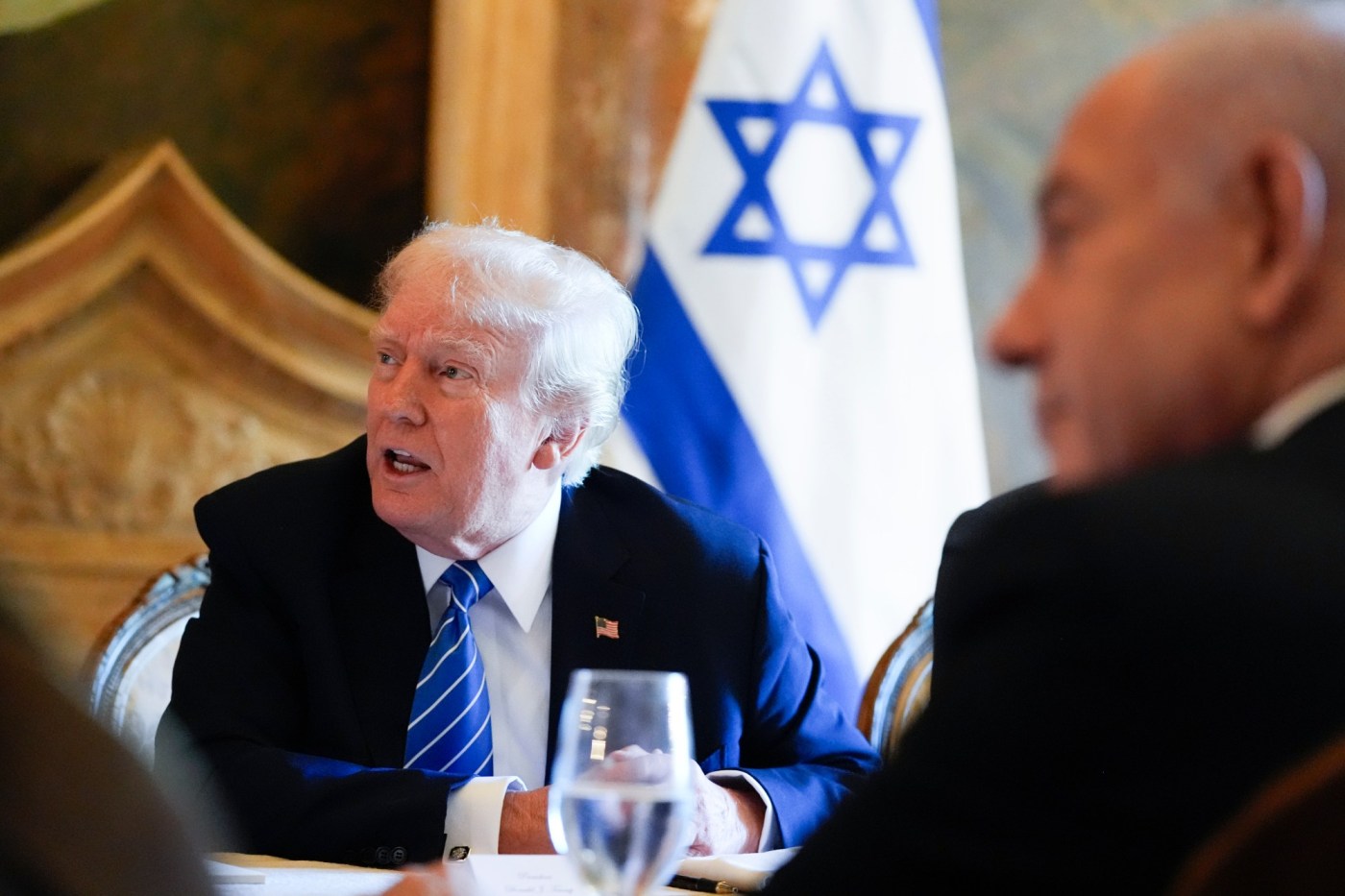
If President Joe Biden and Vice President Kamala Harris needed any reminder that Benjamin Netanyahu is not their friend, not America’s friend and, most shamefully, not the friend of the Israeli hostages in the Gaza Strip, the murder by Hamas of six Israeli souls while Netanyahu dragged out negotiations should make that clear. Netanyahu has one interest: his own immediate political survival, even if it undermines Israel’s long-term survival.
Madam Vice President, have no doubt, this will lead him to do things in the next two months that could seriously harm your election chances and strengthen Donald Trump’s. Be afraid.
Meanwhile, Mr. President, please, please tell me that Netanyahu has not played you for a fool. You have had repeated conversations with him, each followed by your optimistic predictions about an imminent cease-fire in Gaza — and then he tells his followers something else.
Netanyahu is one reason that I coined this rule about Middle East reporting: In Washington, officials tell you the truth in private and lie in public. In the Middle East, officials lie to you in private and tell the truth in public. Never trust what they say to you in private — especially Netanyahu. Listen only to what they say in public to their own people in their own languages.
Whispering lies
In his phone calls, Netanyahu has been whispering to America’s leaders in English that he is interested in a cease-fire and a hostage deal and is considering the necessary precursors for what I call the Biden Doctrine. But as soon as he hangs up, in Hebrew, he says things to his base that expressly contradict the Biden Doctrine, because it threatens the Bibi Doctrine.
Related Articles
Marc Champion: Netanyahu’s conflicts of interest are hurting Israel
Patrick A. McLaughlin: Most, least-regulated states reveal need to get off autopilot
Trudy Rubin: Netanyahu’s betrayal of remaining hostages could drag U.S. into a regional Mideast war
Clive Crook: Harris should reflect on what liberalism means
Noah Feldman: New Trump charges expose the Supreme Court’s failings
So, what is the Biden Doctrine, and what is the Bibi Doctrine, and why do they matter?
The Biden administration has built an impressive set of regional alliances with partners stretching from Japan, South Korea and the Philippines in the Asia Pacific region to India and the Persian Gulf, up to NATO in Europe. They are security and economic coalitions, designed to counter Russia in Europe, contain China in the Pacific and isolate Iran in the Middle East.
Alas, though, a keystone for all these alliances — meant to connect Asia, the Middle East and Europe — was Biden’s proposed defense alliance with Saudi Arabia. The key to getting such a deal through Congress would be Saudi Arabia agreeing to normalize relations with Israel. And the key to getting the Saudis to do that would be Netanyahu agreeing to discuss — just discuss — the possibility of a two-state solution with the Palestinians one day.
Since the Israel-Hamas war started in October, the Biden team has been wisely trying to meld the Biden Doctrine with a Gaza cease-fire and hostage deal, by stressing the significant advantages for both Israel and America: It could lead to a permanent cease-fire in Gaza, bring about the return of the hostages and give the exhausted Israeli standing army and reserve force a much-needed break, since a Gaza cease-fire would almost certainly compel Hezbollah to cease firing from Lebanon as well. If Israel then would agree to open talks with the Palestinian Authority on a two-state solution, it would pave the way for normalization of relations between Israel and Saudi Arabia — a huge strategic asset for Israel — and create conditions for the United Arab Emirates, Morocco and Egypt to send peacekeeping troops to Gaza in partnership with an upgraded Palestinian Authority, so Israel would not need a permanent occupation there and Hamas would be replaced by a legitimate, moderate Palestinian government — Hamas’ nightmare.
In one move, Biden has been telling Netanyahu, Israel could find sustainable Arab partners for a secure pathway out of Gaza and find Arab allies for the regional alliance it needs to counter Iran’s regional alliance of Hamas, Hezbollah, Houthis and Iraqi militias. Biden’s point: Israel’s security today has to be seen in a much wider context than just who patrols the Gaza border.
But the Biden Doctrine ran directly into the Bibi Doctrine, which centers on doing everything possible to avoid any political process with the Palestinians that may require a territorial compromise in the West Bank that would break Netanyahu’s political alliance with the Israeli far right.
Undermining a peace process
To that end, Bibi has made sure for years that Palestinians remain divided and unable to have a unified position. He ensured that Hamas remained a viable governing entity in Gaza by, among other things, arranging for Qatar to send Hamas more than $1 billion for humanitarian aid, fuel and government salaries from 2012 to 2018. At the same time, Netanyahu did everything he could to discredit and humiliate the Palestinian Authority and its president, Mahmoud Abbas, who has recognized Israel, embraced the Oslo peace process and partnered with Israel’s security services to try to keep the peace in the West Bank for nearly three decades.
Netanyahu’s survival doctrine became even more important after he was indicted in 2019 on charges of fraud, bribery and breach of trust. Now he must stay in power to stay out of prison, if convicted. (American readers, does this have a familiar ring?)
Therefore, when Netanyahu won reelection by a razor-thin margin in 2022, he was ready to climb into bed with the worst of the worst in Israeli politics to form a governing coalition that would keep him in power. I am talking about a group of radical Jewish supremacists whom a former Israeli Mossad chief called “horrible racists” and “a lot worse” than the Ku Klux Klan.
These Jewish supremacists agreed to let Netanyahu be prime minister as long as he retained permanent Israeli military control over the West Bank and, after Oct. 7, over Gaza as well. They effectively told Bibi that if he ever agreed to Biden’s U.S.-Saudi-Israel-Palestinian Authority deal — or agreed to an immediate cease-fire for the return of Israeli hostages and the release of Palestinian prisoners in Israeli jails — they would topple his government. Because those things would be precursors for implementing the Biden Doctrine and a possible territorial compromise one day in the West Bank.
Netanyahu got the message. He declared that he would end the war in Gaza after Israel achieved “total victory,” but never defined exactly what that would mean and who would govern Gaza in its wake. By establishing such an unattainable goal in Gaza — the Israeli military has been occupying the West Bank for 57 years and, as the daily clashes demonstrate, has not achieved “total victory” over Hamas militants there — Bibi set things up so he alone can decide when the war in Gaza is over.
Which will be when it suits his political survival needs. That is certainly not today.
The whole thing is a fraud
On Monday, Netanyahu declared that he is ready to sacrifice any cease-fire with Hamas and hostage return if it means Israel has to give in to the Hamas demand that Israel vacate its military outposts on the 8.7-mile-long Philadelphi Corridor along the Gaza-Egypt border, long used by Hamas to smuggle in weapons but which the Israeli military did not think important enough to even occupy for the first seven months of the war.
Israeli generals have consistently told Netanyahu there are many alternative effective means for controlling the corridor now and that supporting Israeli troops marooned out there would be difficult and dangerous. And they could retake it any time they need. Staying there is already causing huge problems with the Egyptians, too.
No matter: Netanyahu publicly declared Monday that the corridor “is central, it determines all of our future.”
The whole thing is a fraud.
As Haaretz military correspondent Amos Harel explained, what is really going on is that Bibi’s right-wing allies dream of resettling Gaza, while “Netanyahu, under cover of security interests, is mainly protecting his political position. He is fighting for the integrity of his governing coalition, which might crack if a deal is approved.”
Which is why Israel’s defense minister, Yoav Gallant — the only honest, courageous person in Netanyahu’s Cabinet — reportedly told the prime minister and his right-wing sycophants that their vote last Thursday to “prioritize the Philadelphi Corridor at the cost of the lives of the hostages is a moral disgrace.”
Now back to America’s presidential election.
Harris, bound
Netanyahu clearly knows that he has Harris in a bind. If he continues the war in Gaza until “total victory,” with more civilian casualties, he will force Harris either to publicly criticize him and lose Jewish votes or bite her tongue and lose Arab and Muslim American votes in the key state of Michigan. As Harris will likely find it hard to do either, this will make her look weak to both American Jews and American Arabs.
Based on my reporting and all my years watching Netanyahu, I would not be surprised if he actually escalates in Gaza between now and Election Day to make life difficult for the Democrats running for office. (The murderous Islamo-Fascist leader of Hamas, Yahya Sinwar, also wants to see the war continue because it is tearing Israel apart and isolating America in the region.)
Netanyahu may do this because, I believe, he wants Trump to win and he wants to be able to tell Trump that he helped him win. Netanyahu knows that many in the rising generation of Democrats are hostile to Israel — or at least to the Israel he is creating.
Then, if Trump wins, I would not be shocked if Bibi declares that his “total victory” in Gaza has been achieved, agrees to some cease-fire to get back any hostages still alive, mumbles a few words about Palestinian statehood in the far-off, distant future to get the Saudi-Israel normalization deal and tells his craziest far-right partners to get lost while he runs for reelection without them. His likely platform: I brought total victory in Gaza and, with Trump, forged a historic opening between Israel and Saudi Arabia.
Netanyahu wins. Trump wins. Israel loses. Gaza will still be boiling, of course. Israeli troops will still be occupying it. Israel will be more of a pariah state than ever, with more and more talented Israelis leaving for jobs abroad, but Bibi will have another term — and that is all that counts.
(If Harris wins, Bibi knows he just needs to snap his fingers and the pro-Israel lobby in Washington — AIPAC — and Republicans in Congress will protect him from any blowback.)
Then, one day down the road, I fully expect that Bibi will organize a ceremony to honor his “dear friend of many years, President Joe Biden.” It will be a new settlement in Gaza, called, in Hebrew, Givat Yosef. In English: “Joe’s Hill.”
Thomas Friedman writes a column for the New York Times.