Today in History: September 27, Christine Blasey Ford accuses Supreme Court nominee Brett Kavanaugh of sexual assault

posted in: News | 0

Today is Friday, Sept. 27, the 271st day of 2024. There are 95 days left in the year.

Today in history:

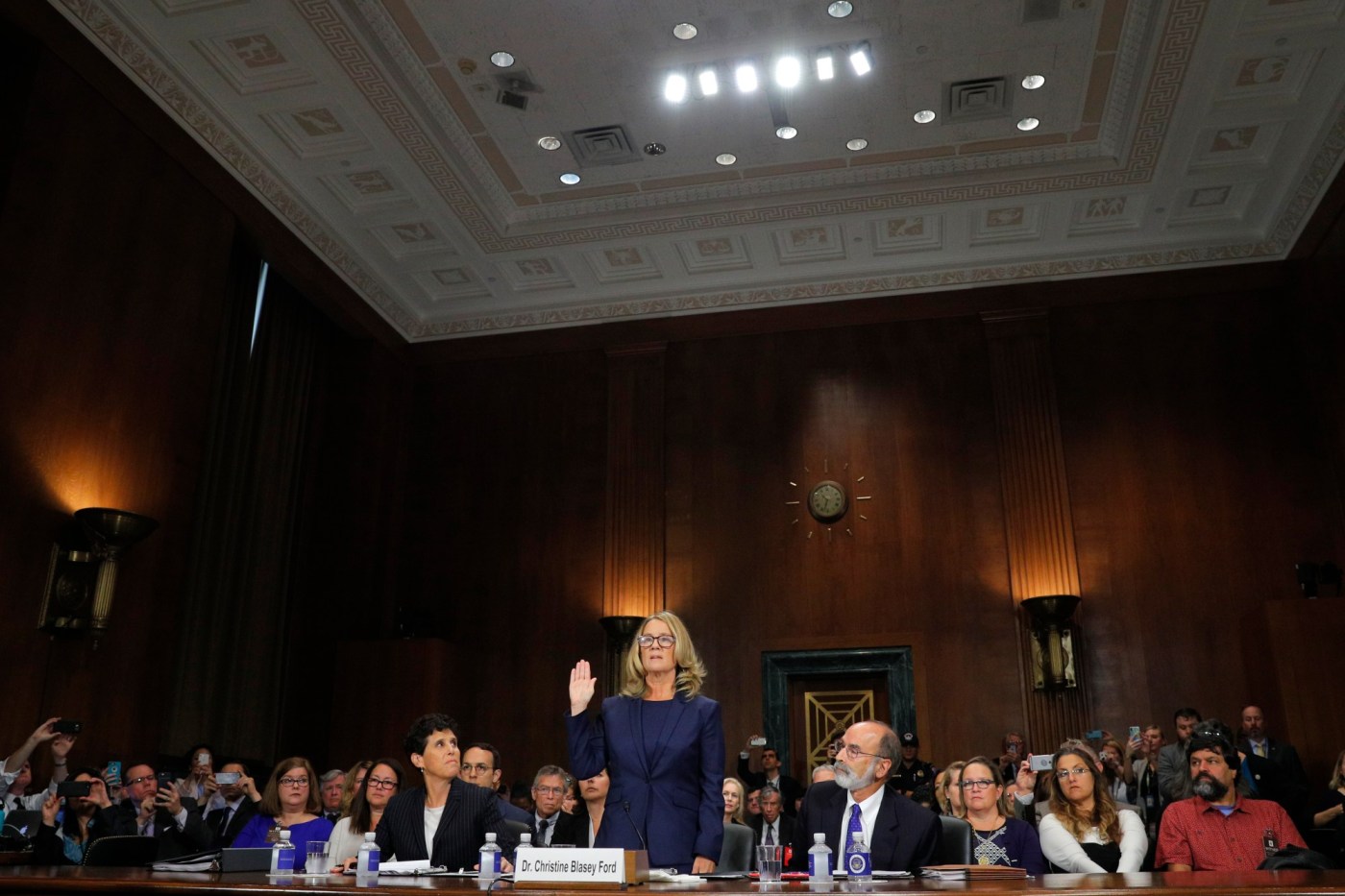
On Sept. 27, 2018, during a day-long hearing by the Senate Judiciary Committee, Christine Blasey Ford said she was “100 percent” certain that she was sexually assaulted by Supreme Court nominee Brett Kavanaugh when they were teenagers, and Kavanaugh then told senators that he was “100 percent certain” he had done no such thing.

Also on this date:

In 1779, John Adams was named by Congress to negotiate the Revolutionary War’s peace terms with Britain.

Related Articles


Today in History: September 26, Kennedy-Nixon face off in TV debate


Today in History: September 25, Bill Cosby sentenced in sexual assault case


Today in History: September 24, Protesting NFL players take a knee


Today in History: September 23, Tiger Woods wins 80th PGA Tour victory after back surgeries


Today in History: September 22, Lincoln issues preliminary Emancipation Proclamation

In 1903, a Southern Railway mail train derailed near Danville, Virginia, killing 11; the accident inspired the famous ballad, “Wreck of the Old 97.”

In 1939, Warsaw, Poland, surrendered after weeks of resistance to invading forces from Nazi Germany and the Soviet Union during World War II.

In 1940, Germany, Italy and Japan signed the Tripartite Pact, formally allying the World War II Axis powers.

In 1964, the government publicly released the report of the Warren Commission, which concluded that Lee Harvey Oswald had acted alone in assassinating President John F. Kennedy.

In 1979, Congress gave its final approval to forming the U.S. Department of Education.

In 1991, President George H.W. Bush announced in a nationally broadcast address that he was eliminating all U.S. battlefield nuclear weapons and called on the Soviet Union to match the gesture.

In 1994, more than 350 Republican congressional candidates gathered on the steps of the U.S. Capitol to sign the “Contract with America,” a 10-point platform they pledged to enact if voters sent a GOP majority to the House.

In 1996, in Afghanistan, the Taliban, a band of former seminary students, drove the government of President Burhanuddin Rabbani out of Kabul, captured the capital and executed former leader Najibullah.

In 2013, President Barack Obama and Iranian President Hassan Rouhani spoke by telephone, the first conversation between American and Iranian leaders in more than 30 years.

In 2021, R&B singer R. Kelly was convicted in a sex trafficking trial in New York, after decades of avoiding criminal responsibility for numerous allegations of misconduct with young women and children.

Today’s Birthdays:

Musician Randy Bachman (Bachman-Turner Overdrive) is 81.
Actor Liz Torres is 77.
Baseball Hall of Famer Mike Schmidt is 75.
Singer and actor Shaun Cassidy is 66.
Comedian Marc Maron is 61.
Actor Gwyneth Paltrow is 52.
Actor Indira Varma is 51.
Musician-actor Carrie Brownstein is 50.
Actor Anna Camp is 42.
Rapper Lil Wayne is 42.
Musician Avril Lavigne (AV’-rihl la-VEEN’) is 40.
Tennis player Simona Halep is 33.
Actor Jenna Ortega is 22.

Trudy Rubin: Will Biden seize last chance for tougher policy on Gaza deal and Ukraine victory?

posted in: Politics | 0

President Joe Biden’s farewell speech to the United Nations General Assembly was clearly not the speech he wanted to deliver.

He had hoped to announce the beginning of a cease-fire in Gaza in return for the release of Israeli hostages. That, in turn, could have halted the tit-for-tat fighting between Israel and Iran’s Lebanese proxy militia, Hezbollah, which claims it is firing across the Lebanese-Israeli border to support Hamas.

Instead, negotiations for such a deal are deadlocked, and Israel has newly plunged into a major cyber and air attack on Hezbollah that could draw in Iran and the United States. At the same time, the other major conflict roiling global stability — Russia’s aggressive war in Ukraine — has come to a critical juncture.

Biden’s speechwriters had to shift gears, with the president stressing his trademark optimism about the potential for resolving these conflicts — along with the pressing new threats from climate and world-changing new technologies like artificial intelligence — if nations work together.

But there was no escaping the fact that a negative outcome in Gaza and Ukraine will shred what remains of the U.N.’s tattered relevance to resolving conflicts — and will undermine the security of the United States.

Let me state up front that Biden’s foreign policy flaws pale beside those of Donald Trump on both issues. Trump’s unswerving support for Israel seems less tied to its security than to the evangelical votes it brings him — as well as to the Jewish votes he grossly demands (with antisemitic language) as a matter of gratitude. And were Trump reelected, he’d quickly hand Ukraine over to Vladimir Putin.

But back to Biden at the United Nations.

There was no point in his repeating forlorn hopes for a cease-fire/hostage deal without changing the U.S. approach toward Israel. Prime Minister Benjamin Netanyahu clearly opposes a deal, and constantly undermined the U.S., Egyptian, and Qatari negotiating teams, leaving Hamas free to reject any bargain.

Now that the Israel-Hezbollah conflict is dangerously expanding, a new approach to the Gaza war is vital but was tellingly missing from Biden’s message. A new U.N. approach is vital, as well.

Related Articles

Opinion |


Thomas Friedman: What should Israel do?

Opinion |


David J. Bobb: Do they even teach civics anymore?

Opinion |


Trudy Rubin: Joe Biden’s foreign policy legacy will go through Ukraine

Opinion |


Paul Krugman: Trump and Vance learned nothing from Obamacare

Opinion |


David French: MAGA wants transgression, and this is what comes with it

The U.N. has failed Israel badly when it comes to Lebanon. Iran has armed proxy militias in the Mideast, including the Hezbollah militia, which now possesses an estimated 150,000 missiles.

Yet, the United Nations Security Council has proven utterly unable to enforce its 2006 Resolution 1701, which demanded Hezbollah pull back from the Israeli border to the Litani River, creating an 18-mile buffer zone to keep northern Israel safe. Hezbollah has refused, and the Lebanese government and army are far too weak to challenge them. U.N. peacekeepers are at the militia’s mercy.

The result has been a disaster for northern Israel. After Hamas attacked on Oct. 7, Hezbollah joined the fight and drove tens of thousands of Israelis from their homes in northern Israeli cities and towns. Nearly 70,000 are still living in makeshift housing.

Israel’s military attack on Hezbollah may hold it temporarily at bay, but it won’t end its threat for the long term. Only a diplomatic deal — fulfilling Resolution 1701, creating a buffer zone, and backed by Arab nations and Security Council sanctions against Tehran — might force Iran to control its proxies.

However, no such progress is possible without parallel movement on Gaza. The Arab world, including states that have peace treaties with Israel, is aghast at the horrific Palestinian civilian suffering in the Gaza Strip, where most of the population is displaced and living without adequate food, sanitation, or shelter. Meantime, violent Israeli settlers are attacking West Bank villages, and far-right cabinet ministers call for Israel’s annexation of the West Bank and Gaza.

Down that road lies an endless cycle of violence between Israelis and Palestinians locked into one state, and the death of any prospects for the two-state solution Biden called for at the United Nations. That path also threatens Israel’s peace treaties with Jordan and Egypt.

There must be another way that combines a humane solution in Gaza with Arab support to rein in Hezbollah and Tehran. More than half the Israeli population, along with military and intelligence officials, want a cease-fire-for-hostages deal.

But that would require Biden to finally exert far more U.S. pressure on Netanyahu, including U.S. support for tough U.N. resolutions against whichever party refuses the Gaza deal — plus U.S. arms cuts for Israel if needed. It would also require strong U.N. and Western pressure on Iran.

No sign of such a policy shift was heard from Biden on Tuesday. Netanyahu is trying to outflank him and waiting for a Trump victory. But the president still has three months more in office to change course.

Similarly, a Biden shift is vital to obtaining a just peace for Ukraine. So is a significant U.N. role.

The most basic principle of the world body, enshrined in its charter, prohibits the use of force against the territorial integrity or sovereignty of any state.

Russia, which sits on the Security Council, has massively defied that principle by invading a peaceful neighbor, trying to annex at least 20% of its territory, and committing heinous war crimes. Ukrainian President Volodymyr Zelensky — who will meet with Biden on Thursday — rightly insists that any peace talks be based on the principles of the charter, not on Putin’s claim that Ukraine bows to his imperial right to take Ukrainian land as a basis for peace.

Here again, the relevance of the U.N. will be defined by whether it defends the principle on which it was created — the post-World War II effort to prevent dictators from expanding their territory by force. In a just world, the U.N. General Assembly would suspend Russia. And no Security Council reform, as is being discussed this week, will have meaning if Moscow retains a veto.

In his speech, Biden asked the right questions: “Will we apply and strengthen the core tenets of the international system, including the U.N. charter … as we seek to … deter new threats? Or will we allow those universal principles to be trampled?

“How we answer these questions in this moment will reverberate for generations.”

Yet, his foreign policy legacy will be defined by how he defends the principle of no gains through force. The immediate test: whether he gives Zelensky a green light to use U.S. long-range missiles to hit aerodromes and weapons depots inside Russia. This moment is critical for Ukraine.

If Biden refuses, he will have permitted a dictator to violate the basic principle required to maintain world order. And his U.N. speech will be recalled as a coda for a president who possessed all the right foreign policy instincts but failed to nail down the outcomes before he stepped down

Trudy Rubin is a columnist and editorial-board member for The Philadelphia Inquirer, P.O. Box 8263, Philadelphia, Pa. 19101. Her email address is trubin@phillynews.com
Bret Stephens: Hezbollah is everyone’s problem

posted in: News | 0

In 2006, Hezbollah launched a guerrilla raid into Israel. It led to a 34-day war that devastated Lebanon, traumatized Israel, and concluded with a U.N. resolution that was supposed to disarm the terrorist militia and keep its forces far from the border.

The resolution did neither.

Instead, a combination of international wishful thinking and the willfulness of Hezbollah’s patrons in Iran have brought us to where we are now — the cusp of a conflict that could dwarf the scale of fighting in the Gaza Strip. Can a full-blown war be avoided? Hard to say. Can the lessons of 2006 lead to a better outcome this time? That’s the important question.

First lesson: Tactical brilliance is not a substitute for sound strategy.

In 2006, the Israeli air force, operating on excellent intelligence, was able to knock out many of Hezbollah’s longer-range rockets — often hidden in homes — by the second night of the war. The strike surely helped spare scores, if not hundreds, of Israeli lives.

But Israel had little idea of how to fight the war after that, other than through a bombing campaign whose ferocity generated acute diplomatic pressure for the war to end, along with a belated Israeli ground incursion that got badly mauled by Hezbollah. Does Israel have a better plan today?

Second lesson: Hezbollah is not Israel’s main enemy. Iran is.

Or, to borrow a metaphor from former Israeli Prime Minister Naftali Bennett, Tehran, Iran’s capital, is the head of the octopus, and Hezbollah — like Hamas in Gaza or the Houthis in Yemen — is merely one of its tentacles. By going to war with Hezbollah, Israel risks exhausting itself in a secondary fight.

That doesn’t mean that Israel can afford to ignore Hezbollah; its arsenal of 120,000 to 200,000 missiles and rockets poses a dire and direct threat to the Israeli home front. But the only way in which Israel restores its deterrence is by imposing costs directly on Hezbollah’s masters. Tehran, not Beirut, is the real center of gravity in this fight.

Third lesson: Do not make an enemy of the Lebanese people.

Except in its Shiite strongholds, polling by the Arab Barometer shows, Hezbollah is unpopular among most Lebanese. With good reason: The group has hijacked their country, murdered their most beloved leaders, turned much of the country into a target and devoted its resources to building a vast military infrastructure even as the national economy has collapsed.

Related Articles

Opinion |


Thomas Friedman: What should Israel do?

Opinion |


David J. Bobb: Do they even teach civics anymore?

Opinion |


Trudy Rubin: Joe Biden’s foreign policy legacy will go through Ukraine

Opinion |


Paul Krugman: Trump and Vance learned nothing from Obamacare

Opinion |


David French: MAGA wants transgression, and this is what comes with it

Israel can’t hope to turn Lebanon into any kind of ally — that fantasy died with the Syrian-backed assassination of Bashir Gemayel, Lebanon’s Israel-aligned president-elect, in 1982. But it should not repeat the 2006 mistake of trying to create deterrence through demonstrations of brute force. The kind of targeted strikes demonstrated by last week’s pager attacks are vastly more effective in erasing Hezbollah’s aura of invincibility.

Fourth lesson: Keep the U.N. out of it.

In theory, the Security Council’s Resolution 1701, which ended the 2006 war, empowered a U.N. peacekeeping force to prevent Hezbollah from placing its forces close to the Israeli border. In reality, the U.N. peacekeepers did nothing of the sort, at a cost of billions to U.S. taxpayers.

If the United States or Europeans want to create a buffer area between Israel and Hezbollah, they should deploy their own troops under a NATO flag or perhaps invite Arab states to send forces. Otherwise, the reestablishment of the Israeli-controlled security zone in southern Lebanon that existed from 1985 to 2000 might, for all the long-term problems it presents, be the least-bad alternative.

Fifth lesson: The proper role for the United States in the crisis is not to seek a diplomatic solution. It’s to help Israel win.

Until al-Qaida’s attacks Sept. 11, 2001, no terrorist group had murdered more Americans than Hezbollah. Israel’s strike last week in Beirut, which killed Hezbollah commander Ibrahim Akil, avenged the 1983 attacks there on the U.S. Embassy and Marine barracks, in which 258 Americans perished. Hezbollah later went on to murder and starve untold numbers of Syrians by helping Bashar Assad in the bloody suppression of his own people.

Those crimes should neither be forgotten nor forgiven. Nor can it be in the interests of the West for a terrorist group with burgeoning ties to the Kremlin to maintain effective control of a Mediterranean state while it terrorizes its neighborhood. Beyond Israel’s interests in secure borders against Tehran’s Axis of Resistance, there is an American interest in checking the expansion of what I call the Axis of Repression, a broader group that includes Iran, China, Russia and North Korea.

Which brings us to a sixth lesson:

It’s tempting to view Israel’s various battles as regional affairs, distant from America’s central concerns. It’s also foolish. We are now in the opening stages of yet another contest between the free and unfree worlds. It’s a conflict that reaches from Norway’s border with Russia to the struggle of the Iranian people against their own government to the shoals of the South China Sea. It will probably last for decades.

In that fight, Israel is on our side, and Hezbollah is on the other. Whatever happens in the days and weeks ahead, we can’t pretend to be neutral between them.

Bret Stephens writes a column for the New York Times.

Lisa Jarvis: Oregon had a bold plan to help drug addicts. Then fentanyl showed up

posted in: News | 0

This month, a brief, ambitious and many would say calamitous experiment came to an end: Oregon rolled back Measure 110, its policy decriminalizing the possession of small amounts of illicit drugs. Rather than handing out small fines with a nudge toward treatment, the police are once again giving misdemeanors to people who are found with opioids or meth.

What can we learn from this first-of-its-kind experiment in the U.S.? Many would argue that it showed us what not to do. But an honest assessment of what happened in Oregon paints a more complex picture.

Let’s start with what almost everyone agrees on. Decriminalization didn’t turn things around in Oregon. The state walked into the policy change, approved by voters in late 2020 and enacted in mid-2021, with one of the highest rates of addiction in the country. It also had one of the worst track records for access to treatment. And while funding was earmarked for mental health and substance use services under Measure 110, training a workforce and building an efficient infrastructure takes time. Four years later and the state still does not have nearly enough clinics or workers to support its goals.

As one drug policy expert told me, without near-perfect execution, the experiment seemed destined to fail. And a failure is what many would call it. Homelessness, crime and addiction all rose, straining public spaces. Social services, including treatment services and housing support, didn’t ramp up fast enough.

And there was a sharp rise in drug overdose deaths. Fatal overdoses were up by 50% in 2021 compared with the prior year, then continued to rise another 30% in 2022 and another 45% in 2023, based on provisional data from Oregon Health Authority.

The core premise of Measure 110 was that “a health-based approach to addiction and overdose is more effective, humane, and cost-effective than criminal punishments.” That decriminalization not only failed to spare lives, but seemed to cost many more of them, was considered the most damning evidence of its folly.

Those bleak numbers are indisputable. But decriminalization wasn’t the only big change in the state in 2020. A recent paper in JAMA Open Network points to a different culprit behind that surge in deaths: Fentanyl. The potent opioid permeated the drug supply in Oregon at the exact moment that the guardrails were lifted on possession.

Related Articles

Opinion |


Thomas Friedman: What should Israel do?

Opinion |


David J. Bobb: Do they even teach civics anymore?

Opinion |


Trudy Rubin: Joe Biden’s foreign policy legacy will go through Ukraine

Opinion |


Paul Krugman: Trump and Vance learned nothing from Obamacare

Opinion |


David French: MAGA wants transgression, and this is what comes with it

The insidious impact of fentanyl on a community is by now well-known. As the drug spread from the East Coast to the Southeast and Midwest until finally reaching the West Coast, it left a terrifying body count in its wake. Since 2021, more than 100,000 people in the U.S. have died from overdoses each year.

Researchers wanted to winnow out how much of the rising death toll in Oregon could be attributed to the policy change and how much was due to the arrival of fentanyl. The results of their analysis, which compared Oregon with states that lacked decriminalization, stunned even the study authors, says Brandon del Pozo, an assistant professor at Brown University, who led the work. The rise in deaths was entirely due to fentanyl. All of it.

“The buried lead of that paper is that drug reformers make plans and fentanyl laughs,” said del Pozo. “Oregon’s overdose increase was tragically and boringly typical.”

In other words, the main lesson of Oregon’s experiment isn’t that a public health approach to drug use can’t work. It’s that fentanyl makes everything about addressing substance use harder and more complicated. Even if the state’s decriminalization experiment had been run under the best of circumstances with the perfect set of supports (it was not), sparing lives would have been a challenge with fentanyl showing up at the same time.

That should serve as a reminder for others analyzing other drug reform efforts, del Pozo says. Researchers have to model for the impact of fentanyl in order to capture the true effectiveness of harm-reduction efforts like overdose-reversing naloxone or safe syringe sites.

It’s likely that the fallout from Oregon’s measure has chilled acceptance of any effort that seeks to reduce addiction by shifting the emphasis from punishment to public health.

That’s a shame. Oregon got a lot wrong, and Measure 110 shouldn’t be seen as the ultimate word on decriminalization. And the U.S. desperately needs to try new things to address addiction. Early data from the Centers for Disease Control and Prevention suggest that overdose deaths recently began to decline for the first time since 2018 — a shift that public health experts are still trying to understand, but could be due in part to better access to the opioid reversal drug naloxone.

That’s welcome news, but still somewhere in the realm of 100,000 people will die this year from a fentanyl overdose. We have such a long way to go to get things right.

Lisa Jarvis is a Bloomberg Opinion columnist covering biotech, health care and the pharmaceutical industry. Previously, she was executive editor of Chemical & Engineering News.