Twin Cities Walk for Water this Saturday at St. Paul’s Upper Landing Park

posted in: Adventure | 0

The annual three-mile Twin Cities Walk for Water will take place on Saturday at Upper Landing Park in St. Paul.

Families and individuals sporting Walk For Water t-shirts will walk 1.5 miles with an empty bucket, fill the bucket at the halfway mark and carry the filled bucket another 1.5 miles to complete the walk. The walk simulates the day-to-day experience about 2 billion people affected by the global water crisis have to take to collect water for their families, which is often contaminated, according to Water Mission.

The walk begins at 9 a.m. after the pre-walk kickoff. The event will include lawn games and children’s activity booths. The cost is $25 for adults, $10 for kids above five years old and free for children four and under.

The Walk for Water event has been organized by the non-profit organization Water Mission since 2006. Water Mission works to build safe water solutions in developing countries and disaster areas.

The fundraising goal is $200,000 and it’s currently at more than $150,000. That amount would allow them to bring clean and safe water to over 4,000 people worldwide, where every $50 helps them help one person in need, according to Water Mission.

More information at walkforwater.rallybound.org/2024-twin-cities-walk-for-water.

Related Articles

Local News |


Early voting turnout steady in Ramsey County

Local News |


No progress seen in HealthPartners/UnitedHealthcare impasse over Medicare Advantage claim denials

Local News |


Joe Soucheray: There was our governor, westbound on Marshall, then into the security zone

Local News |


‘Trailblazer,’ longtime St. Paul educator Shirley Kaiser celebrated

Local News |


St. Paul shooter sentenced in killing of teen during North End drug deal

Matt Boldy injury is a setback for Wild special teams, an opening for prospects

posted in: News | 0

The Wild felt their first shakeup of a young training camp on Monday when Matt Boldy was unable to practice because of a lower body injury. Coach John Hynes said the injury isn’t serious, but the setback is real.

The team started work on their penalty kill during two practices Monday, and Boldy was expected to be a participant because the Wild want to work one of their top forwards onto the PK this season.

John Capuano, hired as a third assistant coach to John Hynes this summer, ran the first real PK practices on Monday, what the Wild hope are the initial steps toward fixing a unit that finished with a 74.5 percent success rate last season, third worst in the NHL.

“Not to go into too much detail, it’s his size, and it’s his intelligence and his stick,” Capuano said of Boldy, a 6-foot-2, 200-pound wing who has scored a combined 60 goals the past two seasons but has never played on an NHL PK. “He can really fit in a good role with us in that position with that size.”

Hynes said he expected Boldy, 23, to recover from his undisclosed injury by the end of camp and be available for the Wild’s Oct. 10 season opener against the Columbus Blue Jackets at Xcel Energy Center. But the injury is a setback, certainly for the special teams units.

Boldy had 10 goals and 25 power-play points last season, and the coaching staff thinks he can be a difference maker on a penalty kill that played a large role in the Wild missing the postseason last season for just the second time in 12 years.

Hynes was the U.S. head coach for the IIHF World Championships last May in Prague, where Boldy led all skaters with 14 points (six goals) in eight games. He also logged time on the penalty kill.

“We didn’t take too many penalties, but I got a couple of tries at it,” Boldly said Saturday. “It’s something I’d love to be a part of and try to help the team there if I can.”

It will have to wait.

“Yeah, Game 1, it’s probably a stretch,” said Capuano, who has been working with Hynes and fellow assistant coach Patrick Dwyer on the kill.

Boldy has played on the penalty kill units as part of U.S. development teams and at Boston College but has never been part of a PK unit since making his NHL debut for the Wild in January 2022. He sat in the PK meeting on Monday, and will again Tuesday, but now might not get any reps there in camp.

“It’s disappointing that that the injury did happen, because you can show them as much video as they want, but the repetition’s gonna drive the execution, right?” Capuano said. “So, you want to have a lot of reps, and unfortunately for him he won’t.”

Hynes acknowledged the injury will open opportunities for young forwards who will get higher profile roles in practices and preseason games, which resume Wednesday in Dallas, where prospects Liam Ohgren, Riley Heidt and Hunter Haight will get their game action of the fall.

“We have to juggle some things around,” Hynes said. “Obviously, Boldy’s on the power-play stuff, and then some line combos a little bit. So, it does open the door for other guys. And obviously those young kids you’re talking about, they are going to get into some games. That’s why they’re still in camp.”

In the meantime, Boldly can still work out — lift weights, ride a stationary bike — and isn’t expected to miss much, if any, of the regular season because of this.

“Matt was obviously having a very good training camp for the first few days, and had a really good summer,” Hynes said. “The good news is … we’re anticipating him near the end of camp and ready for the start of the season.”

Briefly

Forward Reese Johnson, a four-year veteran who had five points in 42 games with the Blackhawks last season, is out with an upper body injury and considered day-to-day, Hynes said. Michael Milne, a third-round 2022 draft pick who has played the past two seasons in Iowa, is out with an upper body injury. He skated on his own before practice on Monday.

Opinion: Climate Justice Could Live at CUNY

posted in: Society | 0

“Last year, the federal government earmarked billions of dollars for community-led climate solutions…CUNY can deliver because of its symbiotic relationship to communities, neighborhoods, and families who live, work, and organize on the frontlines.”

Adi Talwar

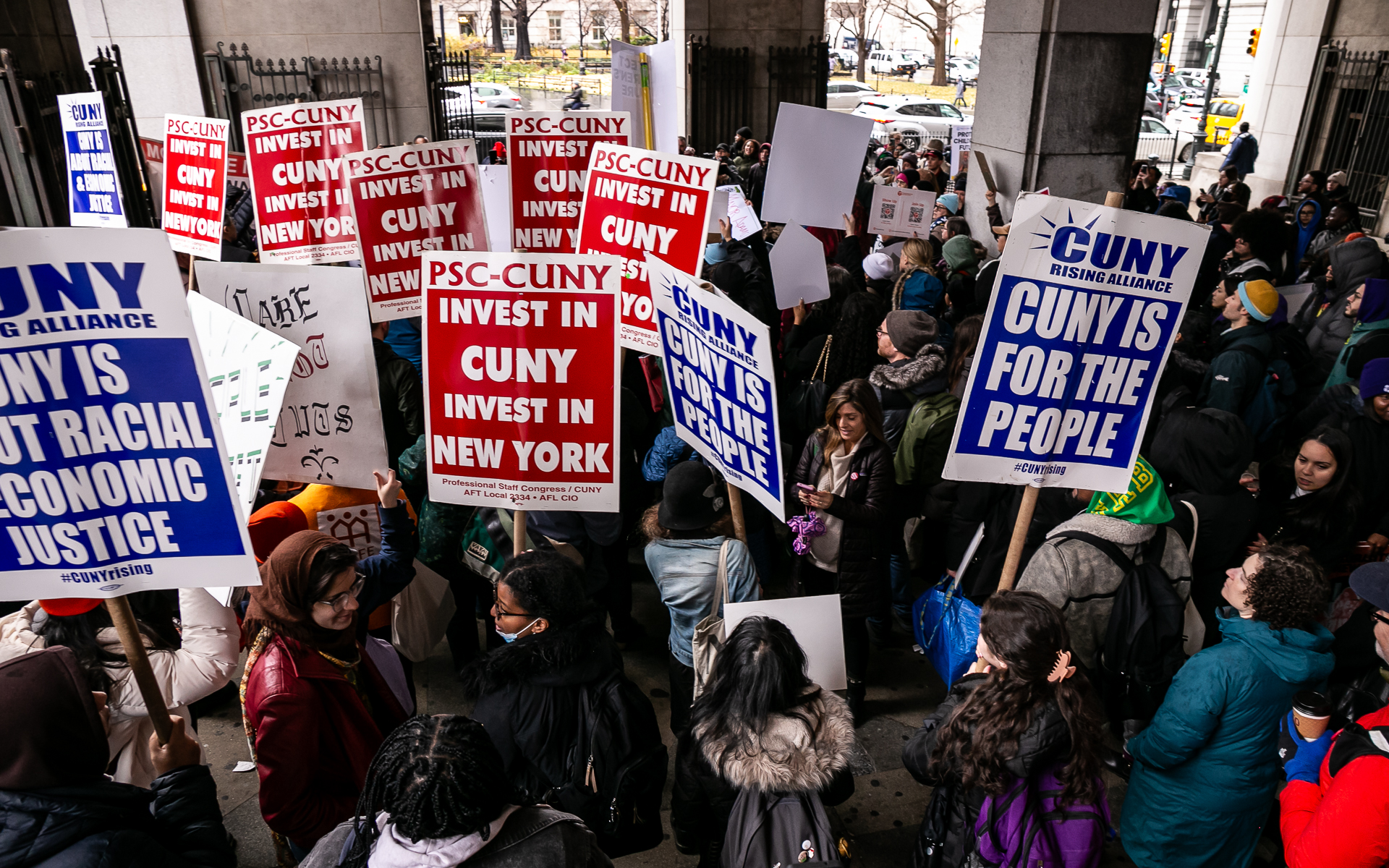
A 2023 rally calling for greater investment in CUNY.

CityViews are readers’ opinions, not those of City Limits. Add your voice today!

Every September, global climate leaders descend on New York City for the simultaneous occurrence of Summit of the Future and Climate Week NYC. Panels are stacked with a range of international delegates, but typically there are few, if any, seats reserved for community organizers already modeling climate justice on the ground in New York City.

Because low income communities of color are disproportionately impacted by climate change, climate justice demands that climate solutions redress racial and economic inequality. When local experts and community-based organizations (CBOs) are invited to the decision-making table, climate justice can be served.

With 25 campuses across all five boroughs, the City University of New York (CUNY) is a world-class system well-situated to catalyze hyperlocal research and support community-defined climate solutions at scale. For example, the NYC Climate Justice Hub is an extensive partnership between CUNY and New York City Environmental Justice Alliance (NYC-EJA), a coalition of grassroots organizations leading the fight for environmental and climate justice since 1991.

By leveraging the university as a civic asset in the fight against climate change, and resourcing community-university partnerships like the NYC Climate Justice Hub, New York City and State can achieve the ambitious climate goals they struggle to meet. But we need critical city, state, and federal funds to make CUNY “the climate justice university.”

CUNY is a minority-majority institution with 225,000 students, 40,000 employees, and ties to CBOs like NYC-EJA all across the city. In 2022, 23 percent of adults and 25 percent of children in New York City lived in poverty. By comparison, 60 percent of CUNY students report an annual household income of less than $30,000. Many students live, work, and learn in environmental justice areas regularly flooded by rainfall and choked by polluted air. With a mandate to serve “the children of the whole people,” CUNY increasingly works with local experts and CBOs to design curriculum and conduct research that secures greater environmental security and economic well-being for everyday New Yorkers.

Across the CUNY consortium, there is a concerted effort to build a climate justice bridge that links research, degree programs, and professional pathways. The CUNY Offshore Wind Advisory Network advances energy democracy at community colleges. Baruch College’s Climate Scholars Fellowship and John Jay College’s Sustainability and Environmental Justice program prepares students to shape climate law and regenerative economies. A new doctoral certificate program at the CUNY Graduate Center caters to emerging scientists and social scientists who seek research skills explicitly to serve their communities’ environmental justice needs.

Other initiatives like FloodNet and The Community Sensor Lab bring science, social justice, and local expertise together to implement community-based solutions to large climate challenges. Such efforts have the potential to positively transform the lives of New Yorkers across every economic stratum if CUNY is properly resourced to grow them to scale. Currently, those resources are sorely lacking.

While New York City increased its support for CUNY in Fiscal Year (FY) 2025, city and state funding still fall short of covering the estimated $3.5 billion CUNY will need to maintain and decarbonize 300 buildings across 25 campuses as climate breakdown intensifies. Additionally, the university needs reliable, long-term funding to hire, support and retain the faculty and students whose scholarship is the foundation for working with communities to create just solutions for climate change and environmental challenges.

New York City will be the first in the U.S. to implement climate budgeting, a visionary decision-making process that privileges science-based climate considerations when allocating funds. But to date, this decision-making matrix misses the point that an investment in CUNY—the largest public urban university in the U.S.—is an investment in achieving just and sustainable futures.

Last year, the federal government earmarked billions of dollars for community-led climate solutions through its Justice40 Initiative—currently caught up in city and state bureaucracies. There is a real risk that bad faith actors and powerful private institutions with massive endowments will take advantage of this windfall in the name of public good, without the will or capacity to deliver on it. CUNY can deliver because of its symbiotic relationship to communities, neighborhoods, and families who live, work, and organize on the frontlines.

Elizabeth Yeampierre, head of the Sunset Park, Brooklyn-based environmental justice organization UPROSE, has coined the phrase, “climate justice lives here.” By removing social, racial, and economic barriers to climate education, decision-making, and careers, we believe that climate justice lives at CUNY, too. But to fulfill its potential as “the climate justice university,” CUNY needs city, state, and federal buy-in.

Kendra Sullivan is the co-director of the NYC Climate Justice Hub and the director of the Center for the Humanities at the CUNY Graduate Center. Kieren Howard is a geologist and the executive officer of the earth & environmental sciences doctoral program at the CUNY Graduate Center.

Colorado King Soopers shooting: Jury finds shooter guilty of 55 counts

posted in: Society | 0

BOULDER — A Boulder County jury on Monday found Ahmad Al Aliwi Alissa guilty of 55 crimes in the March 2021 mass shooting at a King Soopers in which 10 people died.

Alissa killed Denny Stong, 20; Neven Stanisic, 23; Rikki Olds, 25; Tralona Bartkowiak, 49; Teri Leiker, 51; Boulder police Officer Eric Talley, 51; Suzanne Fountain, 59; Kevin Mahoney, 61; Lynn Murray, 62; and Jody Waters, 65.

Family and friends of the victims cried as the judge read the first guilty verdict. Police officers in the courtroom took deep breaths and sighed as the guilty count was read for their fallen colleague.

Alissa fidgeted in his seat, sipped water and talked with his lawyer as Boulder County District Judge Ingrid Bakke read the verdict. His family sat stoically behind him.

The charges included 10 counts of first-degree murder, one count of first-degree murder of a peace officer and 38 counts of attempted first-degree murder.

Alissa’s lawyers never disputed that he was the shooter but they tried to convince the jury that he was insane and could not tell right from wrong at the time of the shooting. Alissa was diagnosed with schizophrenia after the mass shooting and suffered auditory and visual hallucinations for several years leading up to the attack. His defense team said he was hearing voices that told him to carry out the shooting.

The jury started its deliberations in the mid-afternoon Friday but took a break for the weekend. They resumed deliberations at 9 a.m. Monday at the Boulder County Justice Center and had a verdict by 12:30 p.m. Monday.

Testimony lasted 10 days as people inside the grocery store described the terror of gunshots zipping through the store. People took cover under checkout counters while others hid in the deli, bakery, coffee stand and offices.

One 79-year-old woman testified that she fell and broke vertebrae. She prayed until a man lifted her and carried her to safety. A mom and son, who were buying strawberries and tea, waited until they heard Alissa reload before running out of the grocery.

Related Articles


FBI finds violent crime declined in 2023. Here’s what to know about the report


Boy abducted from California in 1951 at age 6 found alive on East Coast more than 70 years later


Two dead, three hurt after a shooting in downtown Minneapolis


St. Paul shooter sentenced in killing of teen during North End drug deal


3 plead guilty in cases tied to $250 million Feeding Our Future fraud scheme

Alissa’s parents testified that his behavior was strange before the attack and they thought he could be possessed by an evil spirit. He suffered from paranoia and delusion, experts testified.

But the jury did not buy arguments that Alissa was incapable of knowing right from wrong when he purchased an automatic gun and ammunition, scouted locations to carry out a massacre and then reloaded inside the grocery store.