Gophers football: ‘I-O-W-A!’ chant echoes in Huntington Bank Stadium

posted in: News | 0

Some Gophers football fans chanted “Who hates Iowa?” before the season opener against North Carolina on Aug. 29, showing their attention is never far from their bitter rival.

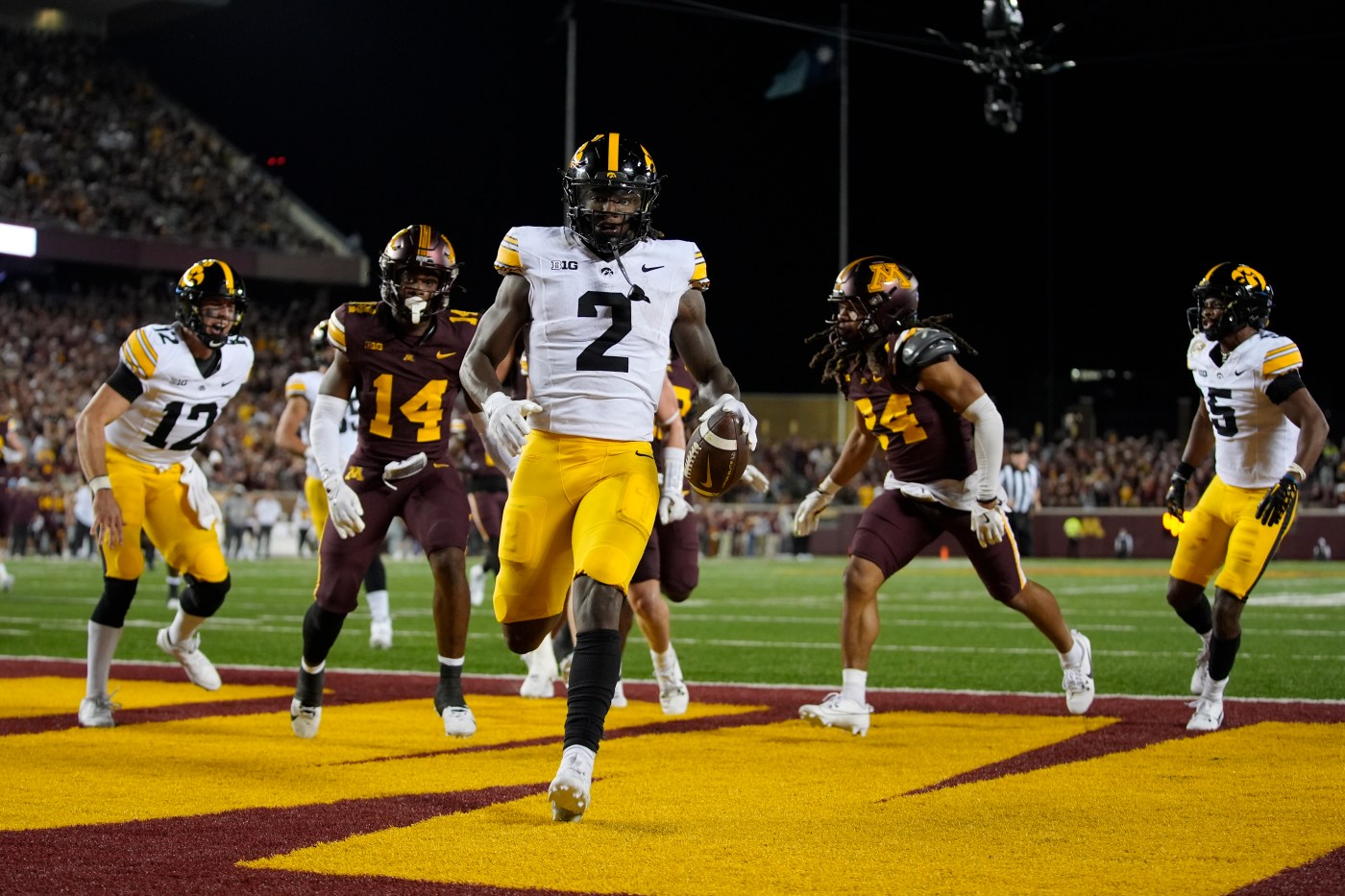
By the time the Floyd of Rosedale game arrived three weeks later, the majority of fans wore maroon for the game against the Hawkeyes at Huntington Bank Stadium. But many of those same fans had left the building after Iowa scored 24 unanswered points in a 31-14 win.

Hawkeyes fans converged on the northwest corner of the stadium for when the visiting players lifted the bronzed pig trophy in that end zone. Then Iowa fans were seen in videos chanting “I-O-W-A!” as they exited Minnesota’s stadium.

Since 2011, the Gophers are 1-7 against Iowa in Minneapolis.

Two bad halves

The Gophers (2-2) had 14-7 halftime leads against both Iowa and North Carolina, but were outscored 36-3 combined in those second halves to suffer two startling defeats.

“I think we have had two bad halves of football in four games, in terms of performance,” head coach P.J. Fleck said Monday. “When you go back and look and evaluate yourself constantly and go back and reflect as a head football coach, my job is to be able to get our team to play their absolute best for 60 minutes. Haven’t been able to do that in two of the games, in my opinion. That 100 percent falls on me.”

Missed tackles galore

Defensive coordinator Corey Hetherman had the Gophers down for 22 missed tackles against North Carolina. Pro Football Focus had the U down for 13 missed tackles against Iowa.

“It became a tackling issue in the second half,” Fleck said. “We’d miss one tackle or we would hesitate and not shoot our gun. We wouldn’t shoot tackle and breakdown. You do that against that (running back Kaleb Johnson). You can coach that, but you’ve got to go apply it. We did it in the first half. We didn’t do it in the second half. It wasn’t like nobody was there. We had people where they needed to be. We just didn’t make the play.”

Veteran safety Darius Green, who is expected to be a leader in the back end, had the lowest run grade and two missed tackles versus Iowa, per PFF. He has been working his way back from an offseason injury and missed the first two games of the season.

With safety Aidan Gousby and cornerback Justin Walley both out injured, Green’s errors were more glaring Saturday.

Briefly

Against No. 12 Michigan, the Gophers will face a defending national champion for the 10th time on Saturday. The U is 0-9 in the previous matchups. Minnesota has lost four straight to the Wolverines with the Little Brown Jug on the line, including a 52-10 blowout in Minnesota last October. … The Gophers’ game against No. 13 USC will be at 6:30 p.m. Oct. 5 and will air on Big Ten Network, the conference announced Monday.

Related Articles

College Sports |


P.J. Fleck’s plea: ‘Don’t give up on this team’ after Gophers’ loss to Iowa

College Sports |


Gophers overrun in 31-14 loss to Iowa in rivalry game

College Sports |


Gophers secondary down two key players for Iowa game

College Sports |


Gophers football: ‘Such a fulfilling win’ over Iowa last season

College Sports |


Gophers football: Quarterback Max Brosmer has link to Iowa

Texas jury clears most ‘Trump Train’ drivers in civil trial over 2020 Biden-Harris bus encounter

posted in: News | 0

By NADIA LATHAN, Associated Press

AUSTIN, Texas (AP) — A federal jury in Texas on Monday cleared a group of former President Donald Trump supporters and found one driver liable in a civil trial over a so-called “Trump Train” that surrounded a Biden-Harris campaign bus days before the 2020 election.

The two-week trial in a federal courthouse in Austin centered on whether the actions of the “Trump Train” participants amounted to political intimidation. Among those aboard the bus was former Democratic lawmaker Wendy Davis, who testified she feared for her life while a convoy of Trump supporters boxed in the bus along Interstate 35.

The jury awarded $10,000 to the bus driver.

No criminal charges were filed against the six Trump supporters who were sued by Davis and two others aboard the bus. Civil rights advocates hoped a guilty verdict would send a clear message about what constitutes political violence and intimidation.

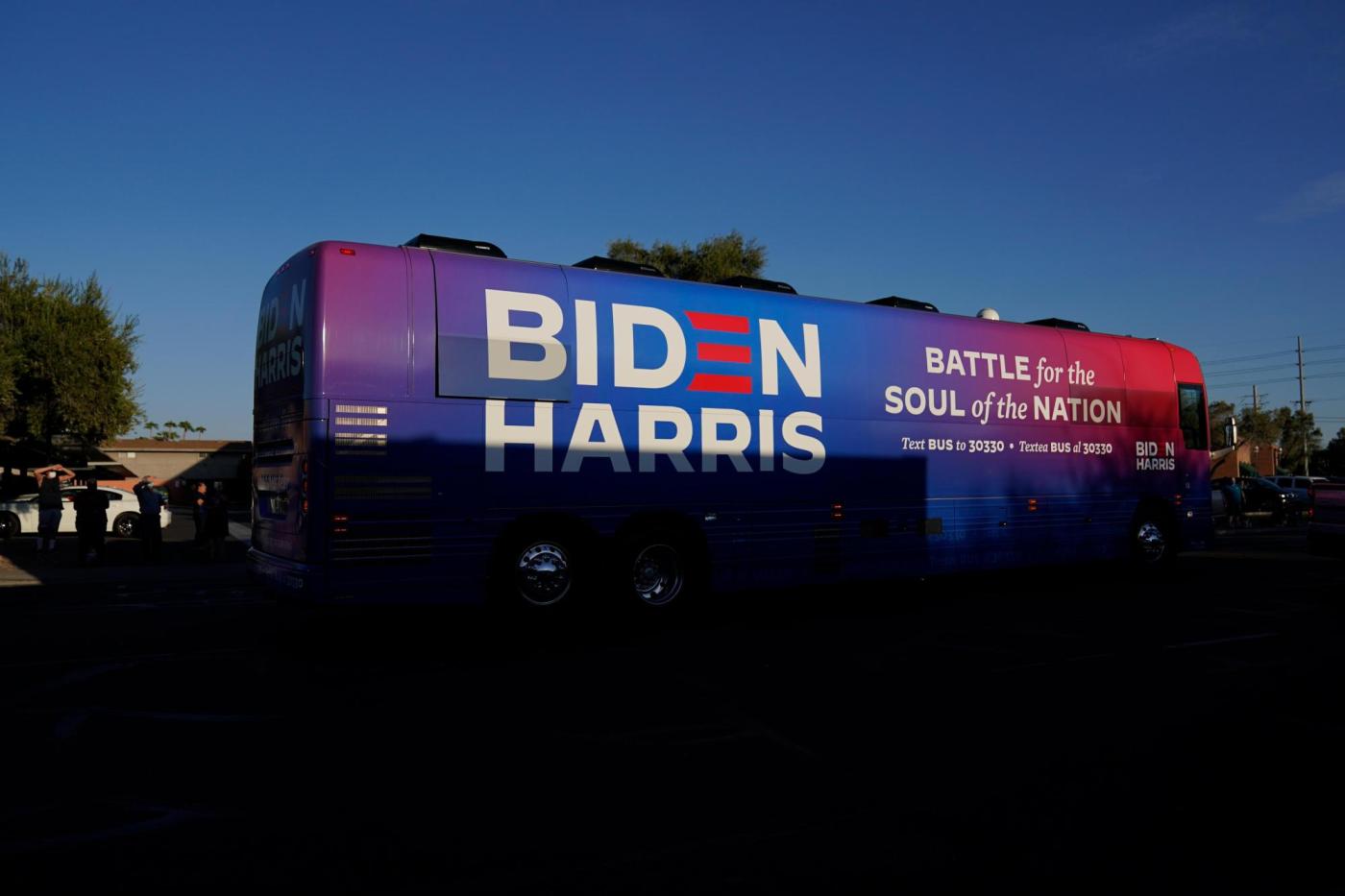
On Oct. 20, 2020, a Biden-Harris campaign bus was traveling from San Antonio to Austin for an event when a group of cars and trucks waving Trump flags surrounded the bus.

Video that Davis recorded from the bus shows pickup trucks with large Trump flags slowing down to box in the bus as it tried to move away from the group of Trump supporters. One of the defendants hit a campaign volunteer’s car while the trucks occupied all lanes of traffic, forcing the bus and everyone around it to a 15 mph crawl.

It was the last day of early voting in Texas and the bus was scheduled to stop at San Marcos for an event at Texas State University.

The event was canceled after Davis and others on the bus — a campaign staffer and the driver — made repeated calls to 911 asking for a police escort through San Marcos and no help arrived.

Davis testified that she felt scared and anxious throughout the ordeal. “I feel like they were enjoying making us afraid,” she testified. “It’s traumatic for all of us to revisit that day.”

‘Weird Al’ Yankovic books outdoor show at Treasure Island Casino in June

posted in: News | 0

“Weird Al” Yankovic will hit the road in 2025 for his first major tour in six years, which includes a June 28 stop at Treasure Island Casino Amphitheater.

Tickets for the pop parodist are priced from $159 to $39 and go on sale at 10 a.m. Friday through Ticketmaster.

“Weird Al” Yankovic will play his familiar parody songs live for the first time in six years when he hits the road in 2025 for a tour that includes a June 28, 2025 stop at Treasure Island Casino Amphitheater in Welch, Minn. (Courtesy of Sam Jones)

Yankovic, 64, began playing the accordion at the age of seven and grew up listening to Elton John, Spike Jones, Allan Sherman, Stan Freberg and Frank Zappa. When he was 16, radio DJ and Minneapolis native Dr. Demento spoke at his high school and Yankovic gave him a cassette recording of a song he wrote about his family’s Plymouth Belvedere. Dr. Demento played it on his syndicated comedy show, which Yankovic credits as the launch of his musical career.

While studying architecture at California Polytechnic State University, Yankovic began writing parody songs starting with “My Bologna,” a riff on the Knack’s hit “My Sharona.” He continued to get played on Dr. Demento’s radio show and, in 1981, joined the DJ’s stage show on tour. The following year, he signed a deal with Scotti Brothers Records.

Yankovic’s self-titled debut album arrived in 1983 and featured the parody singles “Another One Rides the Bus,” “Ricky” and “I Love Rocky Road” alongside seven original songs. He broke to a wider audience with his follow-up, “ ‘Weird Al’ Yankovic in 3-D,” thanks to his hit Michael Jackson parody “Eat It.” MTV put the video into heavy rotation and aired a series of specials starring Yankovic.

While it seemed like Yankovic’s shelf life would be short, he continued releasing albums through 2014’s “Mandatory Fun,” his first to hit No. 1 on the Billboard charts. He has said that’s his final record, although he has since issued a series of singles. Yankovic has won five Grammy awards out of 17 nominations and stands as the biggest-selling comedy artist in history.

In 2018, Yankovic embarked on what he called the Ridiculously Self-Indulgent, Ill-Advised Vanity Tour. On it, he scaled back his multimedia concerts to a more intimate series of theater shows with a set list filled largely with his original songs, not the parody numbers that made him famous. It turned out to be a hit with his fans, and he returned to the concept in 2022.

For his 2025 dates, Yankovic will return to his large-scale set list and stage, with a giant video wall, multiple costume changes and an eight-piece ensemble featuring his original band.

“We’ll be doing all the big crowd-pleasing parodies as well as some deep cuts for the hardcore fans — but with twice as many players on stage, everything is going to sound twice as good,” Yankovic said in a news release.

Related Articles

Music and Concerts |


Last chance: At new 825 Arts, ‘Divas & Drag’ pairs professional opera singers with drag and burlesque artists to explore ‘big emotions of how the music makes you feel’

Music and Concerts |


Minnesota Sinfonia sets October dates for final concerts in St. Paul and Minneapolis

Music and Concerts |


A Perfect Circle, Primus and Puscifer to play joint tour that stops at Xcel Energy Center in June

Music and Concerts |


‘Field of Bands’ fundraiser to aid veterans and troops

Music and Concerts |


Donald Glover postpones his Childish Gambino tour, which includes a stop in St. Paul

Two years after being identified, University of North Dakota is returning Native American remains to tribal nations

posted in: News | 0

GRAND FORKS, N.D. — A little over two years after University of North Dakota officials announced they’d identified the remains of dozens of Native Americans in the university’s possession, the return of the deceased to their descendants can begin.

“It’s finally done,” said Keith Malaterre, director of the Indigenous Student Center and a member of the Turtle Mountain Band of Chippewa Indians. “They finally get to go home.”

All told, the remains of some 57 ancestors and associated funerary objects are now available for repatriation, according to the two Federal Register notices published in August. Tribes have been able to submit written claims for ancestral remains since the notices went out.

Per the Federal Register notices, the remains have a “reasonable connection” to nearly two dozen Native tribes, including all five tribes in North Dakota as well as tribes in South Dakota, Minnesota, and Wyoming.

Many of the remains in question came from excavations of burial mounds across North Dakota. Ancestral remains were received by the university as early as 1907 and as late as 1982, according to the notices.

The university has also issued notices of intent to repatriate several sacred objects to area tribes, including the Turtle Mountain Band of Chippewa Indians and the Sisseton-Wahpeton Oyate of the Lake Traverse Reservation in South Dakota.

An unspecified amount of ancestral remains or related objects possessed by UND was also transferred under the legal authority of the U.S. Army Corps of Engineers in August, in order to comply with the Native American Graves Protection and Repatriation Act.

An apology

The return of ancestral remains comes just over two years after UND first announced it had located what it estimated at the time as around 250 boxes of sacred objects and the remains of what was initially estimated to be 70 Native American ancestors.

Faculty had first identified ancestral remains in the university’s possession in March 2022, beginning months of discussions with area tribal nations.

President Andy Armacost issued an apology to tribal nations across the country and pledged to return the remains and any sacred objects in the university’s possession to their respective tribes.

Since 2022, the university has worked since then with the affected tribes as well as multiple state and federal agencies to inventory the ancestral remains and identify their rightful recipients while remaining in compliance with NAGPRA.

The search

Crystal Alberts, co-chair of UND’s NAGPRA compliance committee, says staff has searched “building to building, floor to floor, door to door” to identify any ancestral remains in the university’s possession.

Even so, she did not rule out the possibility of more ancestral remains being found in the future.

“I can’t definitively say no one else will be found and there is no one else,” Alberts said. “That would be an irresponsible statement.”

Dianne Desrosiers, the tribal historic preservation officer for the Sisseton-Wahpeton Oyate tribe, credited UND for its handling of the reparation process.

“I have to commend UND,” Desrosiers said. “They worked with the tribes and did everything they could within their power to make this process easy and smooth for tribes.”

‘Private and sacred’

As opposed to its very public early stages, administrators have elected to avoid publicizing this latest step in the repatriation process.

An email went out to members of the university’s Indigenous community in July informing them of the forthcoming Federal Register notices.

“This is a very private and sacred time for our tribal nations and we want to respect that,” Armacost told the Herald earlier this month, adding the affected tribes had been “very patient” over the two years working with the university.

Keali’i Baker, a third-year law student who is president of the Native American Law Students Association, says he believes the end of the repatriation process will mean relief for Native students and the opportunity to heal.

“I think students will just be happy it’s over,” said Baker, a member of the Mandan, Hidatsa and Arikara Nation. “We’ll always be sad it happened in the first place and it wasn’t taken care of sooner.”

Still, he noted, he felt the university, and Armacost in particular, had handled the task of repatriation as best they could.

Sacred objects

The process of repatriating sacred objects and other objects of cultural patrimony will likely take longer than the return of ancestral remains.

According to a summary submitted by UND to the National Park Service under NAGPRA, UND has sent summaries of the sacred objects in its possession to 49 tribes that may have a claim to those items.

Two tribes and one lineal descendant have reached out to claim sacred objects so far. The Sisseton-Wahpeton Oyate tribe is claiming a pipe that belonged to a series of tribal chiefs named Standing Buffalo, per Desrosiers.

She said the Sisseton-Wahpeton Oyate tribe seeks to display the pipe alongside other sacred objects, with the goal of establishing a museum documenting the tribe’s history.

“We want to be able to educate people about us, about who we are, what our history here has been and how long it has been, because we have been here for thousands of years,” she said.

‘At peace’

Desrosiers declined to share specific details on how the tribe will address the return of ancestral remains.

“It is a very private thing,” she said. “We are repatriating human remains. It would be akin to going to retrieve your ancestors out of a museum or research facility.”

Malaterre, who also served on the repatriation committee, said he anticipated his tribe would hold a traditional burial for the ancestral remains the tribe receives from UND.

He said the tribe had responded similarly to the repatriation of the remains of ancestors who died at federally-run boarding schools.

A proper burial in the Ojibwe tradition is important, Malaterre said, because it helps to shepherd the spirit into the afterlife.

“I’m just happy they’re in the right place and at peace,” he said. “That they’re not in a state of unrest, that their spirit has moved on.”

Related Articles

Education |


North Dakota US Sen. Kevin Cramer’s son pleads guilty in car-chase death of a deputy

Education |


10 years later, family and friends still cope with unsolved killing of NDSU student

Education |


North Dakota’s wild horses to be featured in book, documentary on rich history, cultural heritage

Education |


Lawsuit could lead to massive change to college hockey’s landscape

Education |


North Dakota voters to weigh in again on marijuana legalization