On a screen near you: Officials are livestreaming the election process for more transparency

posted in: News | 0

By MIKE CATALINI

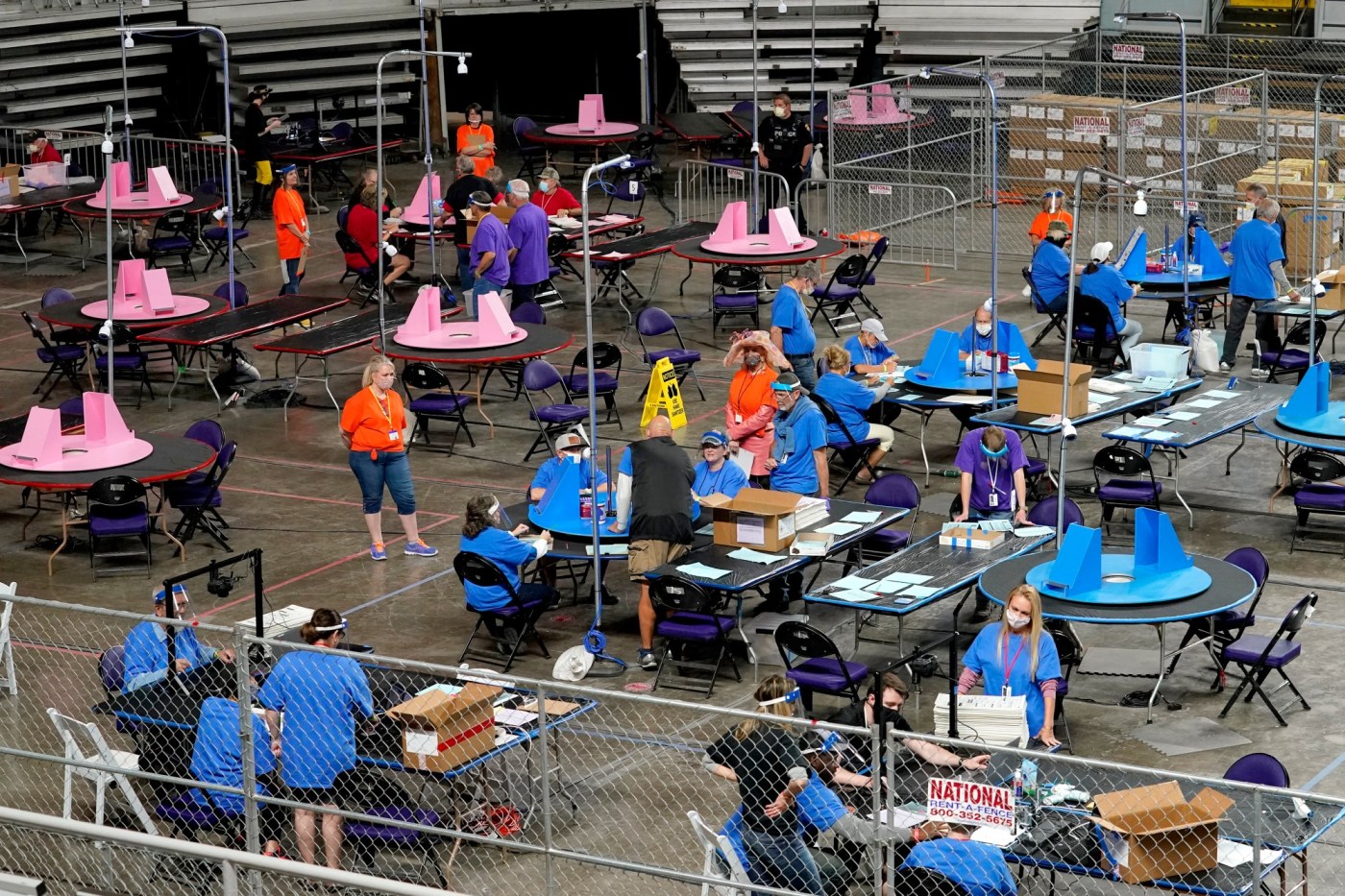
Rows of folding tables and empty chairs appear on Ballot Processing View 2. Over on Tabulation View 2, a man in a black T-shirt and shorts is seen shuffling papers near a waist-high machine.

The livestream scenes from Maricopa County, Arizona, of the 2024 election process may not be the most riveting video. But the feeds, already online, and other live videos like it streaming from election sites across the country have a serious aim. They are an effort by election officials to demystify voting and provide greater transparency to a process that in recent years has been subject to intense scrutiny, misinformation and false claims of widespread fraud.

The increase in livestreaming the election process, an operation conducted by local governments nationwide, reflects a broader rise in video streams online, according to Wendy Underhill, election and redistricting director at the National Conference of State Legislatures.

There is a concern, however, among officials that people unfamiliar with what’s happening in a livestream could misunderstand what they’re watching and reach misleading conclusions.

Here is a closer look at who is streaming elections and what you might see if you tune in.

Which states livestream elections?

National elections are run at the local level. There’s not a uniform standard or rule requiring live video feeds, but several jurisdictions, including large ones and those in battleground states, run livestreams. Among them are Philadelphia, Los Angeles County and Washington’s King County.

Arizona is an outlier because it has a state law requiring its counties to livestream the elections process, Underhill said.

If you want to understand more about whether your local government is providing a livestream, get involved by contacting them, said Tammy Patrick, chief program officer for the National Association of Elections Officials and a former Maricopa County elections official.

What can I expect if I watch?

That will vary by location. For example, Arizona offers various views of different parts of the process, from ballot drop boxes to tabulation rooms.

Other places, like Philadelphia, haven’t begun streaming yet. The city is set to begin streaming on Election Day, Nov. 5., at 7 a.m. EST.

One thing the streams will likely have in common is that the election processes they show can be slow-moving — the kind of methodical material that few would consider must-see TV.

People should be patient as officials deal with an array of circumstances, including having to drive ballots from polling places to processing centers, said Jennifer Morrell, CEO and co-founder of The Elections Group. It’s made up of former state and local election officials who offer training and other support to officials across the country.

In part because of technology, people are used to many things happening almost automatically, she said, but there are just the “logistical realities” that could make the process take longer. She warned against viewers making assumptions based on something they see on a livestream or a single moment in the vote-counting process, noting that leads can shift and a candidate who may be winning at one point in the count could be losing hours later.

That isn’t an indication of fraud. “I would just really emphasize that people have to be patient,” she said.

How do I know what I’m seeing?

That’s perhaps the biggest question and a potential hurdle to transparency, Patrick said.

Officials have learned since 2020, when livestreaming grew in popularity during the COVID-19 pandemic, that voters might not know or understand what they’re watching on a screen, she said.

“The more transparent we can be, the better off it is,” Patrick said. “When you are transparent, it does not mean that individuals will necessarily know what they’re seeing or understand what they’re seeing.”

Related Articles

National Politics |


Florida has nearly all ballots counted on Election Day, while California can take weeks. This is why

National Politics |


Want to follow election results like a pro? Here’s what to watch in key states

National Politics |


Courts keep weighing in on abortion. Next month’s elections could mean even bigger changes

National Politics |


US Elections 2024: A guide to American democracy

National Politics |


Woodward book reveals Trump’s calls with Putin and Biden’s private remarks on Obama and Netanyahu

It could provide fodder for someone to take something out of context. In part to address that, some places have begun adding signs to explain what elections workers are doing, so viewers have a better idea of what’s happening on screen, Patrick said.

A solution, Patrick suggested, is to get involved: Contact local and state officials, sign up for tours, ask to be a poll worker.

“There are plenty of roles where you can educate yourself on all the safeguards that are in place to protect the system, to make sure that it’s eligible voters that are participating,” she said. “And that’s, quite frankly, I think the best way to get involved. But you have to be willing to accept the facts and the truth.”

Read more about how U.S. elections work at Explaining Election 2024, a series from The Associated Press aimed at helping make sense of the American democracy. The AP receives support from several private foundations to enhance its explanatory coverage of elections and democracy. See more about AP’s democracy initiative here. The AP is solely responsible for all content.
Want to follow election results like a pro? Here’s what to watch in key states

posted in: News | 0

By LEAH ASKARINAM

WASHINGTON (AP) — Election night in the United States is a bit like a jigsaw puzzle, except that only one piece appears at a time, and you don’t get to look at the picture on the box.

As thousands of counties and towns report vote totals, it can be hard to figure out when the results reported so far will reflect the outcome.

The first report of the night might show a massive lead for one candidate, but why does that lead dwindle in some races and grow in others? Why does a single vote update from a big city sometimes confirm the winner when there’s still a substantial number of votes left to count? What’s the difference between a “mirage” and a real outcome?

Past elections can provide a guide.

FILE – Alan Zumel, an employee at The Abbey Food & Bar, watches presidential election coverage on a television above the bar, Thursday, Nov. 5, 2020, in West Hollywood, Calif. (AP Photo/Chris Pizzello, File)

They show that mail-in votes in recent elections have leaned heavily toward Democrats and that in some states, counties report those ballots first. That can create a “blue mirage” in races that end up being only narrow victories for Democrats or even substantial victories for Republicans. They show that Republicans can lose big cities overwhelmingly and still win the election.

Even so, sometimes the usual rules and patterns get thrown out the window, either because of unexpected changes to the state’s administration process or major swings in voter behavior.

Some recent examples in key states can help provide some idea of what to expect between the time that polls close in Florida early in the evening all the way through Arizona, where polls close at 10 p.m. EST.

Florida

The first clues of how election night is going usually come from Florida. Results start coming in at 7 p.m. EST even though the final polls don’t close in the state until 8 p.m. EST.

Not every state makes clear when it releases vote updates whether the reports include mail-in ballots, early in-person or Election Day ballots. But when states do provide that information, or enough clues are available to figure it out on our own, it’s hugely helpful in figuring out why the vote count looks like it does at that moment.

Related Articles

National Politics |


Florida has nearly all ballots counted on Election Day, while California can take weeks. This is why

National Politics |


On a screen near you: Officials are livestreaming the election process for more transparency

National Politics |


Courts keep weighing in on abortion. Next month’s elections could mean even bigger changes

National Politics |


US Elections 2024: A guide to American democracy

National Politics |


Woodward book reveals Trump’s calls with Putin and Biden’s private remarks on Obama and Netanyahu

Florida law requires each county to report its early and absentee ballots first. That includes mail-in ballots, which lean heavily Democratic.

Over the past two election cycles, Democrats have tended to vote by mail more than Republicans. That means the first results reported often look stronger for Democratic candidates than the eventual outcome. Then, as the votes cast on Election Day trickle in, Republicans start seeing much more favorable results.

Take the 2022 Senate race, when Republican Sen. Marco Rubio faced a challenge from Democrat Val Demings.

Demings won an early update in Broward County, giving her a lead of nearly 30 percentage points at the beginning of the night. But she lost an update two minutes later in Miami-Dade County, a particularly concerning sign for Democrats because these early updates should be the votes that are most favorable to them. In the end, Demings lost her lead as more Election Day votes and more votes from Republican-leaning areas were counted. Rubio won reelection, 58% to 41%.

Virginia

While the first votes of the night should favor Democrats in Florida, the order of events in Virginia tends to vary depending on what each county decides to do.

There are no strict rules dictating how counties should release results. But in past elections, early returns favored Republicans until the big cities and large northern Virginia suburbs reported their results, which took hours.

In Virginia and in most other states, Republican voters are more spread out geographically than Democratic voters, who are concentrated in major population hubs. So throughout the night, while the major Democratic-leaning counties were still counting votes, smaller counties, which tend to lean Republican, had already started reporting their votes.

In 2020, Republican Donald Trump led Democrat Joe Biden for five hours after polls closed on election night before heavily Democratic Fairfax County reported a nearly 400,000-vote update about 12:30 a.m. EST. Biden won Virginia that year by a margin of 10 percentage points.

Georgia

Georgia allows counties to begin counting absentee ballots on Election Day. By the time polls close, some counties already have major batches of votes ready to report.

Those first reports are often disproportionately favorable to Democrats. Then, prepare to wait for a while. After the first reports, it may be hours before the rest of the state starts sending in results as they continue to count votes, meaning that blue mirage could stick around for quite a while.

In 2022, the Senate election went to a runoff, because neither candidate received 50%. Democrat Raphael Warnock did end up with a single percentage point lead by the time votes were certified in the general election.

This fall, the State Election Board approved a new rule that requires poll workers to hand count the number of ballots cast — not the actual votes — after voting is complete. Critics, including GOP Secretary of State Brad Raffensperger, worried the rule would delay the reporting of election results.

Ohio

FILE – A bowl of voting stickers for early voters is shown March 15, 2020, in Steubenville, Ohio. (AP Photo/Gene J. Puskar, File)

In the 2022 Ohio Senate race, Rep. Tim Ryan started out with an early lead when Franklin County, home to the state capital of Columbus, reported its first batch of ballots of the night, which went 74% to 26% for Ryan over Republican JD Vance, now Trump’s running mate. That was the high point for Ryan. In the end, he carried Franklin with slightly less of the vote — about two-thirds — and lost the race statewide.

So why was his lead so much bigger early in the night?

Again, it’s all about mail-in ballots. Ohio releases its pre-Election Day votes first thing on election night, including mail-in votes. Like in other races since 2022, mail-in votes tended to lean toward Democrats. As Election Day votes trickled in, Republican JD Vance took the lead and eventually won by 6 points.

North Carolina

In the 2022 Senate race, about a half hour after polls closed in North Carolina, Democrat Cheri Beasley had a lead of nearly 200,000 votes. By midnight, Republican Ted Budd had a lead of over 150,000 votes.

North Carolina counts nearly all its ballots on election night. The first reports of the night in most North Carolina counties will be the results of mail ballots, followed by early in-person votes. Later updates will include results from ballots cast on Election Day. North Carolina has a history of counting its Election Day vote pretty quickly, so if a blue mirage does arise from those first reports, it might not last very long.

It’s unclear how vote counting may be affected by emergency changes put in place in the aftermath of Hurricane Helene, which ravaged western parts of the state. Among other changes, the North Carolina State Board of Elections said voters in 13 counties affected by Helene may drop off their ballots at voting sites on Election Day in addition to county elections offices. The ballots still must be turned in by 7:30 p.m. on Election Day in order to count.

Pennsylvania

Pennsylvania followed the same pattern as Georgia and Ohio in 2022.

Initial vote updates, which included a big chunk of mail-in ballots, gave Democrat John Fetterman a lopsided advantage before votes from Republicans began to narrow the gap in the Senate race. The state had reported even before poll closing that more than 7 in 10 mail ballots returned before Election Day came from registered Democrats.

Republican Mehmet Oz began to catch up as more of the rural and Election Day votes were tabulated. But those votes weren’t enough to overcome Fetterman’s lead.

When the AP called Fetterman the winner, he led by 2 percentage points. The AP estimated there were more than 800,000 votes left to be counted, but most of them were in counties where Fetterman was winning by large margins: Philadelphia and the surrounding counties of Delaware, Bucks and Montgomery. But the way Pennsylvania counts its votes could lead to a blue mirage, a red mirage, or both — at different times in the evening. Pennsylvania doesn’t require counties to report their mail-in votes first, and they aren’t allowed to start processing those votes until Election Day.

In the 2020 presidential election, Biden took a massive lead as pre-Election Day votes were counted, then Trump took a huge lead as Election Day votes were counted, and then Biden eventually regained his narrow margin as more mail votes were counted.

Wisconsin

In Wisconsin, municipalities report their vote totals to counties, and each city can choose how to report its results. Most combine mail-in ballots with Election Day votes, but some, including Milwaukee, release them separately. That dilutes the chances of a mirage but also adds an element of unpredictability.

The city of Milwaukee reports Election Day votes before mail-in votes. That can make it difficult to know how many votes remain to be counted there until election officials give specific information about how many mail ballots remain or confirm that they have been counted already.

In Wisconsin, information about the last votes to come from Milwaukee, which typically reports into wee hours of Wednesday morning, is often necessary to determine the winner in close races.

Michigan

FILE – Wendy Gill inserts her absentee ballot at a drop-off box as the sun sets on Election Day outside City Hall in Warren, Mich., Nov. 3, 2020. (AP Photo/David Goldman, File)

As in Wisconsin, there’s no universal pattern in Michigan for when counties report their mail ballots. That often makes geography a better indicator of the direction of a race than vote type.

The key to a close race in Michigan is to wait for Wayne, Oakland, and Washtenaw counties to release significant batches of votes before jumping to any conclusions. Wayne includes Detroit, while Oakland is made up of the city’s northern suburbs. Washtenaw County is home to Ann Arbor and the University of Michigan.

Michigan doesn’t permit absentee ballots to be counted until the morning of Election Day and warns on its elections website that high numbers of absentee ballots usually prolongs the counting process by hours if not days.

Arizona

FILE – Voters wait in line to vote at their polling station early, Tuesday, Nov. 8, 2016, in Tempe, Ariz. (AP Photo/Matt York, File)

Arizona won’t report votes until an hour after polls close, due to the state law. But that means when that first update comes in, it’s pretty big. Historically, about half of the state’s total votes are reported in the first update.

That update, like in many other states, has tended to lean heavily Democratic in recent elections because it includes mail ballots cast well before Election Day. That gap usually narrows as Election Day votes are counted. But after that, things take a more complicated turn in Arizona than in other states.

Ballots counted after Election Day include “late earlies” — the last-arriving mail ballots that include those dropped off on Election Day. Those ballots heavily favored Trump in 2020.

But in the 2022 Senate race, Democratic Sen. Mark Kelly took the lead in the first update, when Maricopa County, the state’s most populous county and home to Phoenix, released 837,000 ballots in its first report. He maintained that initial lead, even though it narrowed, when Election Day votes were reported. Votes counted after election night failed to eat into his advantage.

Read more about how U.S. elections work at Explaining Election 2024, a series from The Associated Press aimed at helping make sense of the American democracy. The AP receives support from several private foundations to enhance its explanatory coverage of elections and democracy. See more about AP’s democracy initiative here. The AP is solely responsible for all content.

Five weeknight dishes: One pot chicken and more

posted in: News | 0

The weather in New York last weekend offered a chilly, gray preview of the months to come. So at my house, we did the only rational thing: My husband lit a fire while I roasted a chicken.

I also baked an apple cake — part of my slow-going efforts to use up the 41 pounds of apples we brought home from apple picking a few weekends ago. (Not a typo: 41 pounds. In the orchard I am a woman possessed.) At least I’m well provisioned for Rosh Hashana cooking and baking — apples and honey are a sticky, tart and sweet tradition for the Jewish New Year, which is this week.

1. One-Pot Chicken and Rice With Caramelized Lemon

By Dan Pelosi

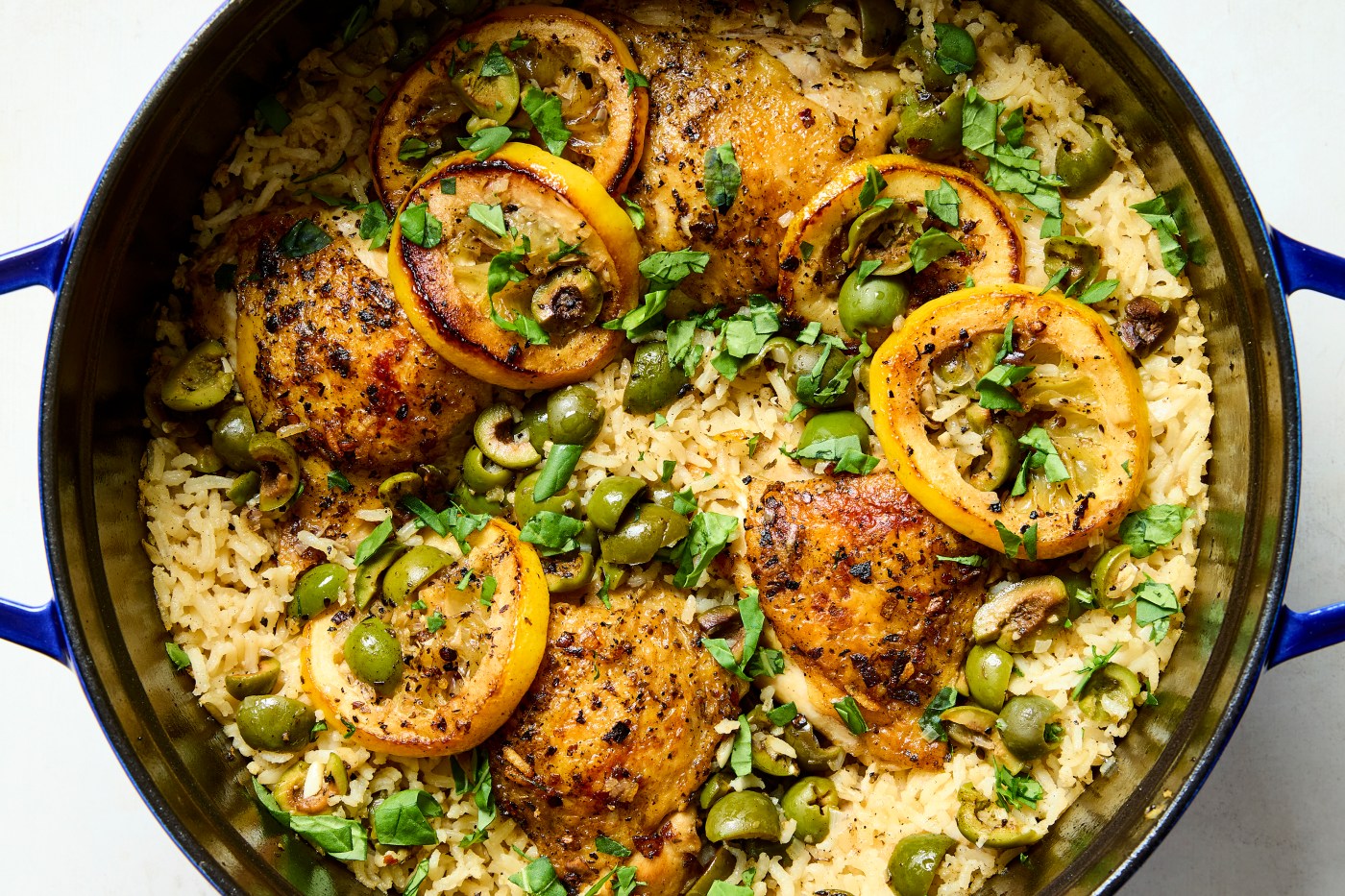
This simple one-pot chicken and rice dish is topped with caramelized lemon slices that add sweet flavor and texture. Thin slices of lemon are cooked in chicken fat and oil until their pulp dissolves, their pith sweetens and their rind softens to the point of being edible. Briny Castelvetrano olives and herby dried oregano are wrapped up in creamy rice and topped with juicy chicken thighs. Fresh parsley and a squeeze of fresh lemon juice on top before serving add brightness and crunch.

Yield: 4 servings

Total time: 55 minutes

INGREDIENTS

4 bone-in, skin-on chicken thighs (about 1 1/2 pounds)
Salt and black pepper
2 teaspoons dried oregano
Crushed red pepper
2 tablespoons extra-virgin olive oil
2 lemons
1 cup pitted Castelvetrano or kalamata olives, smashed and roughly chopped
6 garlic cloves, minced
1 medium shallot or 1/2 medium onion, minced
2 cups long-grain white rice, rinsed
4 cups (32 ounces) chicken broth
1/4 cup roughly chopped fresh parsley, for serving

DIRECTIONS

Heat the oven to 400 degrees. Use paper towels to pat the chicken thighs until dry on all sides. Season the chicken with 1 teaspoon each salt, pepper and dried oregano and a pinch of crushed red pepper.
Place a large Dutch oven or other heavy-bottomed pot over medium-high heat and add oil. Let oil heat up for a few minutes. Add thighs to the pot, skin side down, and let cook undisturbed until they self-release from the bottom of the pot, about 5 minutes. Remove from the pot and set aside.
Cut 1 lemon into 1/4-inch-thick slices. Add to the pot and cook until caramelized and softened, about 2 minutes. Remove from the pot and set aside.
Add the olives, garlic, shallot and 1 teaspoon each salt, pepper and dried oregano to the pot. Cook over medium-low heat, scraping browned bits from the bottom of the pan, until garlic is fragrant, 2 to 3 minutes. Turn the heat up to high, add the rice and broth to the pot, stir to combine and cover until it comes to a boil, about 5 minutes.
Remove the pot from heat, add the browned chicken thighs on top of the rice, skin side up, then cover the chicken thighs with the lemon slices. Place the pot, covered, into the oven and bake until the rice and chicken are fully cooked, 25 to 30 minutes. Serve topped with fresh parsley and a squeeze of lemon juice.

2. Crispy Gnocchi With Spinach and Feta

Hetty Lui McKinnon’s crispy gnocchi with spinach and feta. Put this schmaltzy, Mediterranean-ish recipe at the top of your fall cooking list. Food Stylist: Samantha Seneviratne. (Julia Gartland/The New York Times)

By Hetty Lui McKinnon

Inspired by the herbaceous and jaunty flavors of spanakopita, the savory, ever popular Greek pie, spinach and feta headline this textural gnocchi salad. The spinach is not cooked, but is simply massaged, which softens it while ensuring it maintains its leafy structure. Incorporating some feta to the spinach massage is a functional move — the salt in the feta helps to tenderize the leaves — but it also adds a hint of quiet luxury to this dish, as the leaves become coated with the creamy, briny cheese. Be heavy-handed with your herbs and lemon, as these bring boldness and freshness that play off the saltiness of the feta. Everyday shelf-stable gnocchi from your local supermarket is perfect for crisping in the pan; if you choose to use the frozen variety, no defrosting is required.

Yield: 4 servings

Total time: 25 minutes

INGREDIENTS

5 ounces baby spinach
6 ounces Greek feta, crumbled (about 1 cup)
1 lemon, halved
5 tablespoons extra-virgin olive oil
Salt and pepper
1 (16- to 17-ounce) package potato gnocchi (shelf-stable, fresh or frozen)
1/4 to 1/2 teaspoon crushed red pepper
2 scallions, thinly sliced
Big handful of chopped dill
Big handful of chopped mint

DIRECTIONS

Place the spinach into a large bowl. Add half of the feta, juice of 1/2 lemon, 1 tablespoon of olive oil and a big pinch of salt; rub the ingredients vigorously into the spinach to tenderize it. Leave to sit and soften further while you cook the gnocchi.
Heat a large (about 12-inch) cast-iron or nonstick skillet over medium-high; add 2 tablespoons of olive oil. Add the gnocchi to the pan, breaking up any that are stuck together. Cook for 8 to 10 minutes, tossing every 2 minutes, until golden and crispy all over. Allow to cool in the pan for 5 minutes; they will further crisp as they cool.
Add the gnocchi to the spinach, along with the red pepper, scallions, dill and mint. Drizzle with about 2 tablespoons of olive oil, add the remaining crumbled feta and toss to combine. Squeeze the remaining lemon juice over top and serve.

3. Malaay Qumbe (Coconut Fish Curry)

Malaay qumbe (coconut fish curry). Put this schmaltzy, Mediterranean-ish recipe at the top of your fall cooking list. Food Stylist: Cyd Raftus McDowell. (Armando Rafael/The New York Times)

By Ifrah F. Ahmed

Variations of coconut fish curry abound up and down the Swahili Coast, so much so that the dish is often broadly referred to as East African fish curry. Although Somalia has the longest coastline in mainland Africa, seafood is not a prominent part of mainstream Somali cuisine. But you’ll find malaay qumbe in coastal Somali towns. This version of coconut fish curry leans heavily on xawaash, a spice blend that is at the heart of Somali cuisine. The mild heat from the xawaash’s black pepper balances beautifully with the sweet, cooling coconut milk and the acidity from the tomatoes. Serve over plain white rice, or soak up the creamy coconut gravy with a flatbread like muufo. Malaay qumbe would also work well on top of soor for a hearty meal of creamy spiced coconut fish and grits.

Yield: 4 servings

Total time: 40 minutes

INGREDIENTS

1 pound barramundi or other firm white fish (such as halibut or cod), preferably 2 to 3 pieces
1 1/4 teaspoons fine sea salt
2 tablespoons olive oil
1 large white onion, finely diced
2 large roma tomatoes, finely diced
3/4 cup cilantro leaves
6 garlic cloves, minced
4 teaspoons xawaash (see Tip)
1 (14-ounce) can of unsweetened coconut milk
White rice, soor or flatbread (optional), for serving

DIRECTIONS

Season the fish with 1/2 teaspoon sea salt; set aside.
In a large pot over medium-high, heat oil until loose and rippling, about 1 minute.
Add the onion and cook, stirring occasionally, until completely soft, about 8 minutes. When the onion is soft, stir in tomatoes and cover. Stir and smash down tomatoes every once in a while until they cook down completely, about 7 minutes.
When the tomatoes have disintegrated, stir in cilantro, garlic, xawaash, the remaining 3/4 teaspoon salt, then the coconut milk. Cover and cook for 5 minutes.
Add the fish, making sure it’s immersed in the coconut milk. Cover and cook until the fish is tender, white and flaky, about 8 minutes. Take the curry off the burner as soon as the fish is done, so it doesn’t overcook.
Serve over rice, soor or accompanied by a flatbread of choice.

Tips: To prepare your own xawaash blend, add 8 teaspoons ground cumin, 2 teaspoons ground coriander, 1 teaspoon ground black pepper, 1/4 teaspoon ground cloves, 1/4 teaspoon ground cinnamon and 1/4 teaspoon ground cardamom to a small nonstick pan. Toast over low heat, stirring continuously, for 1 minute or until the spice mix becomes fragrant, then stir in 1 teaspoon ground turmeric. (This makes 4 tablespoons xawaash.)

4. Honey-Habanero Pork Chops With Carrots

Honey-habanero pork chops with carrots. Put this schmaltzy, Mediterranean-ish recipe at the top of your fall cooking list. Food Stylist: Simon Andrews. (Armando Rafael/The New York Times)

By Ali Slagle

In this sweet-and-spicy skillet dinner, lean boneless pork chops and carrots are glossed in a simple yet impactful trio of honey, habanero chiles and lime. The combination of ingredients is classic throughout the Yucatán, like in cochinita pibil, for a reason. Habanero chiles and honey are hot and sweet, sure, but they’re also upbeat, floral and fruity. Charring the chiles alongside the pork adds a hint of smokiness, while lime zest and juice add even more high notes. Eat on top of grits or mashed potatoes.

Yield: 4 servings

Total time: 25 minutes

INGREDIENTS

4 thin (1/2-inch) boneless pork chops (about 1 1/2 pounds total)
1 1/2 teaspoons paprika
Salt
1/4 cup neutral oil, such as grapeseed
4 medium carrots, thinly sliced
1 lime
2 habanero chiles, halved and seeded
1/4 cup honey
Chopped cilantro, for serving

DIRECTIONS

Pat the pork dry and season all over with the paprika and a big pinch of salt. Set aside.
Heat 2 tablespoons oil in a large cast-iron skillet over medium-high. Add the carrots, season with salt and stir occasionally until crisp-tender and charred in spots, 3 to 5 minutes. Turn off the heat. Scrape the carrots onto a plate and zest the lime over the top. Cut the lime in half.
Heat the remaining 2 tablespoons oil in the skillet over medium-high. Add the pork and the chiles. Cook, pressing the meat with tongs to prevent buckling, until browned, 3 to 4 minutes. Flip and cook until firm to the touch, 1 to 3 minutes. Transfer the pork to the plate (leave the chiles in the skillet).
Reduce the heat to medium-low and add the honey and juice from half the lime. Stir constantly until thickened and dark like maple syrup, 1 to 3 minutes. Turn off the heat, add the pork, carrots and any resting juices back to the skillet. Turn to coat in the glaze. Serve sprinkled with the cilantro.

5. Plantains With Jammy Tomatoes and Eggs

Plantains with jammy tomatoes and eggs. Put this schmaltzy, Mediterranean-ish recipe at the top of your fall cooking list. Food styled by Hadas Smirnoff. (Linda Xiao/The New York Times)

By Yewande Komolafe

Plantains are nutrient-rich starches that can sweeten as they cook, and, in many parts of the world, they find their way into the best stews and porridges. This recipe is based on “tomato eggs,” a dish popular in Lagos, Nigeria, and across West Africa. Tomato eggs can be made with yams or plantains, and here, firm yellow plantains work best because they hold their shape and texture while absorbing the flavors of the surrounding stew. It’s a perfect meal for days when you want something hot but not too heavy or filling. Any herbs you have on hand will work well, and the dish can be made vegan by substituting medium-firm or soft tofu for the eggs.

Yield: 4 servings

Total time: 30 minutes

INGREDIENTS

2 firm yellow plantains (about 1 pound)
3 tablespoons neutral oil, such as grapeseed or canola
1 small yellow onion, chopped
2 garlic cloves, sliced
1 (12-ounce) jar roasted red peppers, drained and chopped
1 fresh or dried bay leaf
1 Scotch bonnet pepper or 1 teaspoon red-pepper flakes
Kosher salt (Diamond Crystal)
1 (14-ounce) can whole peeled tomatoes
4 large eggs
1/2 cup fresh herbs, such as dill or flat-leaf parsley, chopped

DIRECTIONS

Cut off the ends of each plantain. Use a sharp knife to slice the peel along the length of each plantain without cutting into the flesh. Remove peels and discard. Cut each plantain into 2-to-3-inch-long pieces, and then cut each piece in half lengthwise.
Heat 2 tablespoons oil in a large skillet over medium until it shimmers. Place the plantains in the skillet with the long cut side down. Sear until the cut sides are deep golden brown, about 5 minutes. Transfer the plantains to a plate and set aside.
Pour in the remaining 1 tablespoon oil, and add the onion and garlic. Cook, stirring often, until softened, about 2 minutes. Stir in the roasted red peppers and bay leaf, and drop in the Scotch bonnet pepper. Season to taste with salt. Cook, stirring, until the liquid from the roasted peppers evaporates, about 2 minutes.
Add the whole peeled tomatoes with their liquid. Use a spatula to carefully break the tomatoes into smaller pieces in the skillet. Fill the can with 1 cup water, swirl to rinse it and pour the liquid into the skillet. Raise the heat to high and bring the sauce to a simmer. Allow the sauce to reduce, stirring occasionally, until thickened and about three-quarters its original volume, about 5 minutes. Season with additional salt if necessary.
Reduce the heat to medium and return the plantains to the skillet, nestling each piece in the sauce seared side up until almost submerged. Cook until the plantains are just soft and the tomatoes are jammy, 4 to 6 minutes. When you poke the plantains with a fork, there should be little resistance.
Remove and discard the bay leaf and Scotch bonnet pepper. Make four wells in the sauce, spaced out evenly, and gently crack the eggs into the wells one at a time. Cover with a lid or aluminum foil. Cook until the whites of the eggs are set and the yolks runny, 6 to 8 minutes. Remove the skillet from the heat. Garnish with the herbs and serve immediately.

Related Articles

Restaurants, Food and Drink |


The beet goes on: It’s time to embrace the earthy vegetable

Restaurants, Food and Drink |


Recipe: Crack the code for the tastiest caramelized, pan-fried pork chops

Restaurants, Food and Drink |


Key West comes to Stillwater with opening of DJ’s Clam Shack

Restaurants, Food and Drink |


Recipes: These apple-based desserts are perfect for autumn

Restaurants, Food and Drink |


After pandemic closing, iconic Mickey’s Diner reopens in downtown St. Paul

4 mom-approved cheap Halloween costume ideas

posted in: News | 0

By Elizabeth Ayoola | NerdWallet

The closest I got to Halloween as a child was through classic movies like “Hocus Pocus” and “Casper.” That’s because I grew up in a religious household that chose not to celebrate Halloween.

Since I didn’t embark on the adventure of costume wearing as a child, it’s become a first-generation tradition in my household. Although fun, my third year in, I’m realizing how expensive this costume business can become.

Americans are expected to spend about $104 on Halloween this year, according to the National Retail Federation. If you’ll be participating in spooky season festivities, keep reading for a few mom-approved tips for how to save on costumes.

Set a budget to avoid spooky spending

If you’re anything like me, when it comes to spending on creative ventures, you become a kid in a candy store. However, splurging on a Halloween costume can be counterproductive to your financial goals.

Karen Heffren, a mom from Tucson, Arizona, and owner of the DIY blog Desert Chica, says she’s always been frugal, and that’s no different on Halloween.

“When it came to costumes, I didn’t want to spend $25 on a costume that wasn’t great and my kid would wear for an hour,” she says.

Consider setting a hard limit on how much you’ll spend. If you’re unsure how to calculate what you can afford this year, remember your costume money should ideally come from your discretionary income. That’s what’s left after you meet all of your core financial needs.

If you use the 50/30/20 budgeting system, costume money should come out of your 30% wants category, while 50% goes to needs and 20% to debt and savings.

Push your creative boundaries with a DIY costume

You’d be surprised how much you can save by making a Halloween costume using items around the house. Heffren was first inspired to DIY Halloween costumes about 17 years ago when her family became a single-income household. She shares DIY costume ideas on her blog to help people who may need inspiration and says you don’t have to be a super crafter to use this option.

“You just have to be able to think about what skills you have, and then just modify your ideas to make it work,” she says.

Inspired by my research and interviews for this article, I plan to be Whitney Houston this year and have all the items I need at home already. I’ll use a black leather jacket, big hair, red lipstick, a white shirt and leggings. There are multiple resources you can consult for DIY costume research, such as Pinterest, YouTube, Instagram, blogs and TikTok.

It’s also important to keep track of your DIY costume spending along the way so it doesn’t end up costing significantly more than a ready-made costume. If it does cost more, the extra expense may be worthwhile if the costume can be repurposed, which we’ll discuss more below.

Choose costumes that can be repurposed

Kalia Johnson, a content creator and mother in Dallas, made a grape costume for her son last year, and it’s the gift that keeps on giving because most of the items are still functional. The inspiration for the costume came from her son playfully putting balls from his ball pit into his onesie.

Related Articles

Business |


What small-business owners need to know about digital security

Business |


How to get money advice without a side of shame

Business |


What to do with 2 million Marriott points? Get a Bellagio fountain show

Business |


Benefit trend: Employers opt to give workers an allowance for coverage

Business |


What the Fed’s rate cutting plans mean for the housing market

“The reason why I like this costume is because we still use all the items that we used for the costume,” she says. “He still uses ball pit balls. He still uses the bamboo sleeper as pajamas. He still uses the beanie if it [is] cold outside.”

The only items Johnson bought were the leaves she used, and they cost a couple of bucks.

Heffren, too, is a firm believer in using items that can be repurposed. She uses hoodies as an example.

One of her most memorable costumes was Olaf from the movie “Frozen,” and she used a hoodie and felt fabric to make it. Another example? Heffren says you can use a white button-down shirt, cardboard, an angry face printout, black slacks and some felt material to create the Anger character from the “Inside Out” movies.

Heffren recommends using duct tape or sewing items onto the costume base so you can easily repurpose it or fix mistakes. I plan to take this advice and use a hoodie and felt material to build my son’s Sonic costume this year.

Consider using pre-loved items

Using secondhand items for a Halloween costume is another way to save money.

Some places where you can buy a used costume or items for a DIY piece include Facebook Marketplace, eBay, OfferUp or your local thrift store. Keep in mind that one of the challenges with getting a ready-made costume may be finding one that you like and that comes in your size. If you want to coordinate costumes with loved ones, going this route could be difficult.

Heffren says people should remember that costumes don’t have to be perfect. That means you don’t have to coordinate your entire family’s costumes, nor do you need to turn costumes into a grand and expensive DIY project.

“I think you just have to set realistic expectations and it’s just for fun, you know? It’s not Picasso, right?”

Elizabeth Ayoola writes for NerdWallet. Email: eayoola@nerdwallet.com.