
Trump breaks GOP losing streak in nation’s largest majority-Arab city with a pivotal final week

posted in: Politics | 0

By JOEY CAPPELLETTI and MIKE HOUSEHOLDER

DEARBORN, Mich. (AP) — Faced with two choices she didn’t like, Suehaila Amen chose neither.

Instead, the longtime Democrat from the Arab American stronghold of Dearborn, Michigan, backed a third-party candidate for president, adding her voice to a remarkable turnaround that helped Donald Trump reclaim Michigan and the presidency.

In Dearborn, where nearly half of the 110,000 residents are of Arab descent, Vice President Kamala Harris received over 2,500 fewer votes than Trump, who became the first Republican presidential candidate since former President George W. Bush in 2000 to win the city. Harris also lost neighboring Dearborn Heights to Trump, who in his previous term as president banned travel from several mostly-Muslim countries.

Harris lost the presidential vote in two Detroit-area cities with large Arab American populations after months of warnings from local Democrats about the Biden-Harris administration’s unwavering support for Israel in the war in Gaza. Some said they backed Trump after he visited a few days before the election, mingling with customers and staff at a Lebanese-owned restaurant and reassuring people that he would find a way to end the violence in the Middle East.

Others, including Amen, were unable to persuade themselves to back the former president. She said many Arab Americans felt Harris got what she deserved but aren’t “jubilant about Trump.”

“Whether it’s Trump himself or the people who are around him, it does pose a great deal of concern for me,” Amen said. “But at the end of the day when you have two evils running, what are you left with?”

As it became clear late Tuesday into early Wednesday that Trump would not only win the presidency but likely prevail in Dearborn, the mood in metro Detroit’s Arab American communities was described by Dearborn City Council member Mustapha Hammoud as “somber.” And yet, he said, the result was “not surprising at all.”

The shift in Dearborn — where Trump received nearly 18,000 votes compared with Harris’ 15,000 — marks a startling change from just four years ago when Joe Biden won in the city by a nearly 3-to-1 margin.

No one should be surprised

The results didn’t come out of nowhere. For months, in phone calls and meetings with top Democratic officials, local leaders warned, in blunt terms, that Arab American voters would turn against them if the administration’s handling of the Israel-Hamas war didn’t change.

The Biden-Harris administration has remained a staunch ally of Israel since the brutal Oct. 7, 2023, attack by Hamas, which killed 1,200 Israelis and took over 200 hostages. The war between Israel and Hamas has killed more than 43,000 people in Gaza, Palestinian health officials say. They do not distinguish between civilians and combatants.

While Harris softened her rhetoric on the war, she didn’t propose concrete policies toward Israel or the war in Gaza that varied from the administration’s position. And even if she had, that might not have made much of a difference in places like Dearborn.

“All she had to do was stop the war in Lebanon and Gaza and she would receive everyone’s votes here,” said Hammoud.

More voters thought Trump would be better able to handle the situation in the Middle East than Harris, according to AP VoteCast, a survey of more than 120,000 voters nationwide. About half of voters named Trump as better suited, compared with about a third who said Harris.

Among those who opposed more aid for Israel, 58% backed Harris in the presidential election; 39% supported Trump.

Even some Harris voters had their doubts. About three-quarters of Harris voters in Michigan said she was the better candidate to handle the situation. Few preferred Trump, but about 2 in 10 Harris voters said they were equivalent or neither would be better.

In the absence of support for Harris in the Arab American community, Trump and his allies stepped in.

A key part of Michigan’s electorate — a state Trump won by nearly 11,000 votes in 2016 before he lost it by nearly 154,000 to Biden in 2020 — Arab Americans spent months meeting with Trump allies, who encouraged community leaders to endorse him.

Things began to move in September, when Amer Ghalib, the Democratic Muslim mayor of the city of Hamtramck, endorsed Trump. Shortly after, Trump visited a campaign office there.

That was a turning point, said Massad Boulos, the father of Trump’s son-in-law who led his outreach with Arab Americans.

“They very, very much appreciated the president’s visit and the respect that they felt,” said Boulos. “That was the first big achievement, so to speak. After that, I started getting endorsements from imams and Muslim leaders.”

An apparent shift toward Trump in final week

While support for Harris had been declining for months — especially after her campaign did not allow a pro-Palestinian speaker to take the stage at August’s Democratic National Convention — some voters say the last week of the campaign was pivotal.

At an Oct. 30 rally in Michigan, former President Bill Clinton said Hamas uses civilians as shields and will “force you to kill civilians if you want to defend yourself.”

“Hamas did not care about a homeland for the Palestinians, they wanted to kill Israelis and make Israel uninhabitable,” he said. “Well, I got news for them, they were there first, before their faith existed, they were there.”

The Harris campaign wanted Clinton to visit Dearborn to speak in the days following the rally, according to two people with direct knowledge of the discussions who spoke on condition of anonymity because they were not authorized to speak publicly about them. The potential visit never materialized after backlash over Clinton’s comments.

“That comment was the talk of the town. It hurt many like me, who loved him,” said Amin Hashmi, who was born in Pakistan and lives in suburban Detroit. A self-proclaimed “die-hard Dem,” Hashmi said casting a ballot for Trump “was a seismic move” that came after he stood in the voting booth for 25 minutes.

On the Friday before the election, Trump visited The Great Commoner in Dearborn, the Lebanese-owned restaurant. That stood in sharp contrast with Harris, who met with Dearborn’s Democratic mayor, Abdullah Hammoud — who didn’t endorse in the race — but never came to Dearborn herself.

“He came up to Dearborn. He spoke with residents. Whether some people say it wasn’t genuine, he still made the effort. He did reach out and try to work with them, at least listen to them,” said Samia Hamid, a Dearborn resident.

Amen said that at polling places in Dearborn on Tuesday, “people were coming out and saying they were either voting third party or they were voting for Trump.” When she asked what led them to support Trump, “they said, at least he came out here and he talked to us, he acknowledged our community.”

Related Articles

National Politics |


‘We are very scared’: Fear grips migrant families on both sides of the border over Trump deportations

National Politics |


Trump has vowed to kill offshore wind in the US. Will he succeed?

National Politics |


A look at those who could be on Trump’s health team short list

National Politics |


Trump names Stephen Miller to be deputy chief of policy in new administration

National Politics |


Trump chooses New York Rep. Elise Stefanik as ambassador to United Nations

Although Arab American support didn’t propel him to the White House, Trump has made several promises that stuck in voters’ minds. Mainly, they’ll be watching to see if he’ll follow through on his vow to end the war.

They also hope his next term will differ from his first, when he enacted the travel ban targeting Muslim-majority countries. His rhetoric on that score has been mixed — he even pledged to expand the ban to refugees from Gaza.

Osama Siblani, publisher of Arab American News based in Dearborn, said people will “hold him accountable.” Regardless, Siblani added, the community “survived the first four years” of Trump.

“We will survive the next four,” he said.

Cappelletti reported from Detroit. Associated Press journalist Hannah Fingerhut in Washington contributed to this report.
US top climate negotiator: ‘We won’t revert back’ as Trump prepares to take over

posted in: Politics | 0

By SETH BORENSTEIN and MELINA WALLING

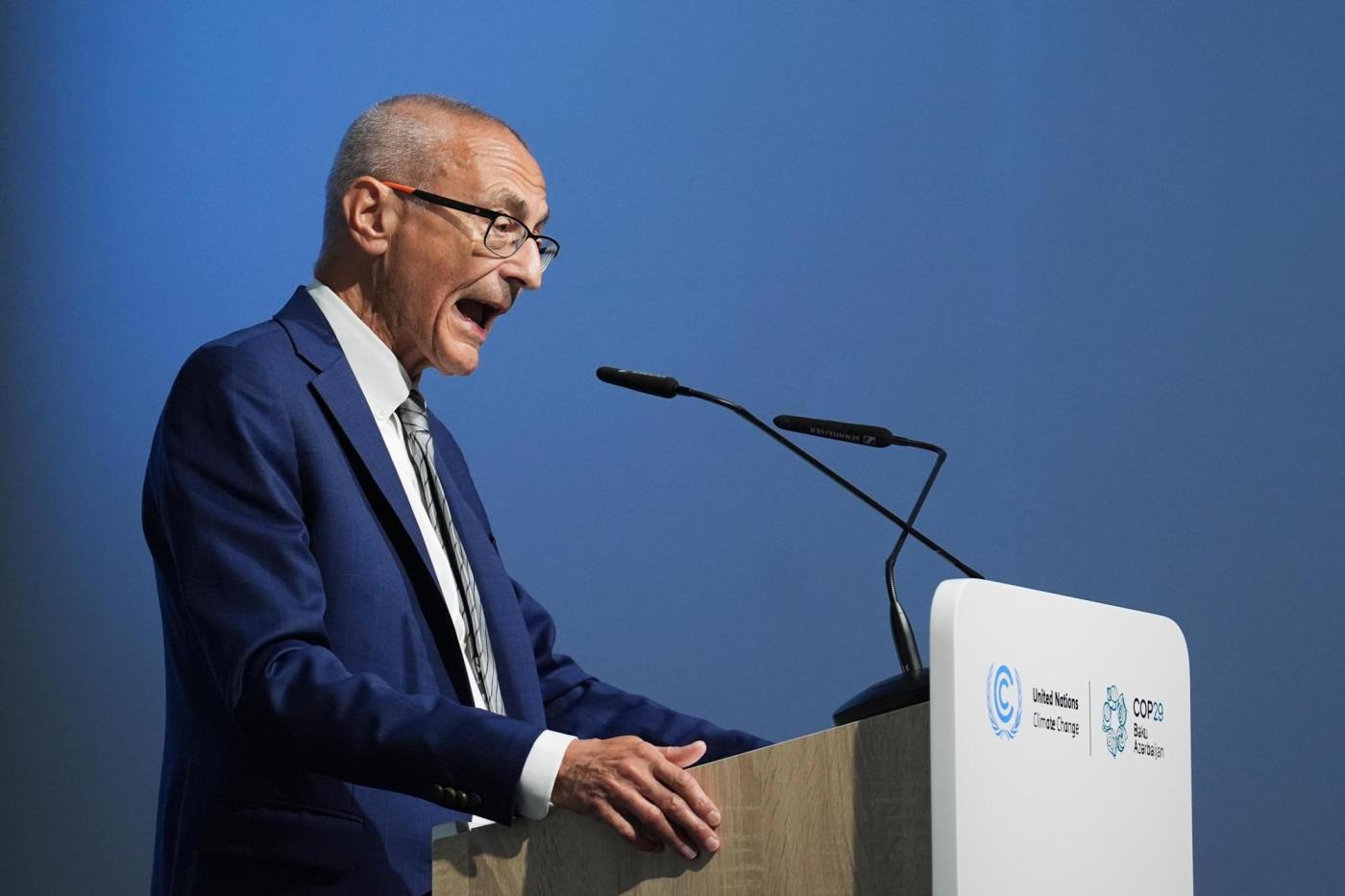
BAKU, Azerbaijan (AP) — No matter what kind of U-turn President-Elect Donald Trump will make on climate change, America’s clean energy economy won’t reverse into the dirty past, a combative but “bitterly disappointed” top American climate negotiator said Monday.

During the first day of the U.N. climate talks, COP29, Climate Adviser John Podesta struck a defiant but realistic tone in a press conference. He said Trump will likely pull the United States out of the landmark Paris Agreement and try to roll back many of the Biden Administration’s signature climate moves, including the 2022 Inflation Reduction Act that included $375 billion in climate spending.

“Are we facing new headwinds? Absolutely. But we won’t revert back to the energy system of the 1950s. No way,” Podesta said.

“Setbacks are unavoidable, but giving up is unforgivable,” Podesta said paraphrasing a Biden speech last week. “This is not the end of our fight for a cleaner, safer planet. Facts are still facts. Science is still science. The fight is bigger than one election, one political cycle in one country. This fight is bigger, still, because we are all living through a year defined by the climate crisis in every country of the world.”

During the campaign, Trump said would pull America from the Paris Agreement, rollback parts of the IRA and increase drilling and oil production. He has called emissions regulations part of a “green new scam” and claimed, without evidence, that offshore wind turbines harm whales.

During Trump’s first administration, between 2017 and 2021, many environmental regulations were rolled back, later to be reversed by the Biden administration. The incoming Trump administration has signaled it plans to now undo Biden’s changes.

During his press conference, Podesta ran through a shopping list of climate disasters, starting with the hottest day recorded, July 22, continuing with floods, hurricanes and droughts.

“None of this is a hoax. It is real. It’s a matter of life and death,” Podesta said. “Fortunately, many in our country and around the world are working to prepare the world for this new reality and to mitigate the most catastrophic effects of climate change.”

Podesta said the Biden administration is still negotiating even as it prepares to leave.

Related Articles

Environment |


Trump has vowed to kill offshore wind in the US. Will he succeed?

Environment |


Climate talks open with calls for a path away from the ‘road to ruin.’ But the real focus is money

Environment |


Trump 2.0 will alter global climate fighting efforts. Will others step up?

Environment |


European climate agency says this will likely be the hottest year on record — again

Environment |


In new term, Trump set to go after measures that are doing the most to fight climate change

“We are here to work, and we are committed to a successful outcome at COP29,” Podesta said. “We can and will make real progress on the backs of our climate committed states and cities, our innovators, our companies and our citizens, especially young people who understand more than most that climate change poses an existential threat that we cannot afford to ignore.”

Another senior U.S. official, who spoke on the condition of anonymity, said other countries are still working with American diplomats because they care what the U.S. thinks and any agreement struck here must be by consensus. Outside analysts had speculated the U.S. would be ignored.

“In January, we’re going to inaugurate a president whose relationship to climate change is captured by the words ‘hoax’ and ‘fossil fuels’,” Podesta said. “He’s vowed to dismantle our environmental safeguards and once again withdraw United States from the Paris Agreement. That is what he said. And we should believe him.”

The Associated Press’ climate and environmental coverage receives financial support from multiple private foundations. AP is solely responsible for all content. Find AP’s standards for working with philanthropies, a list of supporters and funded coverage areas at AP.org

‘We are very scared’: Fear grips migrant families on both sides of the border over Trump deportations

posted in: News | 0

Perched outside one of the nearly 40 tents at a migrant shelter in Tijuana, Emir Mejía smiles as she gently rocks her 15-day-old granddaughter. This has been her family’s home for over six months as they await an appointment to seek asylum in the United States.

The night before, her joy at welcoming her seventh granddaughter quickly turned to concern as U.S. voters elected former President Donald Trump to a second term in the White House, where he has promised mass deportations.

The fear and uncertainty Mejia and her family now face is shared with many migrants waiting in shelters for their turn to present their cases to U.S. officials — but also with nearly 2 million already living in California.

“Maybe a lot of people don’t understand,” she said in Spanish. “We don’t want to cross (to the U.S.) for pleasure, but to protect our lives.”

Trump has always taken a tough stance on immigration — something that resonated with his supporters.

During his previous tenure, he replaced the old U.S.-Mexico border fence with a taller one and launched the Migrant Protection Protocols, a policy that sent asylum seekers back to Mexico to await their hearings. The Biden administration ended that practice.

During the height of the pandemic, the Trump administration also enacted a policy known as Title 42, which allowed officials to expel migrants without screening their asylum claims, on the grounds of preventing the spread of COVID-19. Although the policy remained in place for the first years of the Biden administration, it was lifted in May 2023.

This time Trump campaigned heavily on securing the border and mass deportations of undocumented immigrants. “We’re gonna have to seal up those borders,” Trump reiterated this week during his victory speech. “We want people to come back in, but we have to let them come back in. But they have to come in legally.”

Mejía, 45, said they “want to do things right” and have not considered other options to cross because they don’t want to put themselves in a risky situation.

Asylum hopes remain despite uncertainty

José María García, director of the Juventud 2000 migrant shelter in Tijuana, described the mood at the site as “a state of fear, anxiety and uncertainty.”

“They knew things were about to change,” he added, referring to Wednesday morning, when many found out about the outcome of the election.

Three miles away, at the Casa del Migrante shelter, it’s a similar scenario. People have been asking, “What’s going to happen?” since election night, said Pat Murphy, a priest who is the shelter’s director. “There’s a lot of questions,” he said.

Ramón Torres, 18, also from Michoacán, has been waiting for an appointment in Tijuana for three months.

Torres, who works for a construction company while he waits at the shelter with his family, said they are now considering the possibility of staying in Tijuana. “If we don’t get an appointment between now and January, we could explore the possibility of staying here,” he said. But he said their hope is to seek asylum in the U.S., and reunite with his father.

Both migrant shelters in Tijuana visited by the San Diego Union-Tribune said they’ve recently seen an increase in those arriving to the shelters after being deported.

In June the Biden administration implemented an executive order restricting asylum and imposed stricter consequences for those who cross without authorization.

As a result, migrant encounters decreased along the southwestern border by 55%, and deportations increased, according to U.S. Customs and Border Protection’s latest data. From June through the end of September, the Department of Homeland Security removed or returned more than 160,000 individuals to over 145 countries.

The directors of both shelters also said they could expect more people to arrive at the U.S.-Mexico border in the weeks leading up to Trump’s inauguration. The Biden administration is already making contingency plans for a potential spike, according to an NBC News report.

A CBP spokesperson said Friday that “while border encounters remain at historic lows, CBP remains vigilant to constantly shifting migration patterns.”

“Migrants should not believe the lies of smugglers. The fact remains: The United States continues to enforce immigration law. Individuals who enter the U.S. unlawfully between ports of entry will continue to be quickly removed,” the spokesperson added.

Officials said that DHS leadership regularly holds meetings to discuss border operations, and these include ongoing contingency planning and preparedness.

Trump’s promise of mass deportation could potentially impact California more than any other state.

There were about 11 million undocumented immigrants living in the U.S. as of 2022, the latest year for which federal and Pew Research Center estimates are available. About 1.8 million of them lived in California, according to Pew, more than any other state — even though California’s share of the U.S.’s undocumented immigrant population has decreased in recent years.

Undocumented immigrants made up about 4.5% of the state’s total population and 17% of all California’s immigrants, according to Pew’s estimates. About 9% of K-12 students in California have at least one parent who is an undocumented immigrant.

The population of undocumented immigrants has likely grown since 2022, Pew researchers say, as the U.S. backlog of asylum cases has more than doubled from about 500,000 in mid-2022 to more than 1.1 million at the end of 2023. In the past two years the Biden administration has also allowed hundreds of thousands of immigrants from Ukraine, Cuba, Haiti, Nicaragua and Venezuela to temporarily reside in the U.S. as parolees via humanitarian programs.

Many welcome Trump’s more strict immigration policy.

In mid-September, county Supervisor Jim Desmond told lawmakers on the House Homeland Security Committee in Washington that the arrival of so many migrants has strained the county’s resources and raised concerns about how people entering the country were being screened for security threats.

Now that Trump has been reelected, Desmond said those concerns will likely subside.

“I’m looking forward to not having hundreds of thousands of unchecked people from around the world being dropped in the streets of San Diego County,” he said Friday in a statement. “I’m looking forward to not having boats being driven up upon our beaches and dozens of unchecked people from around the world walking into our neighborhoods.”

‘We are very scared’

At Perkins K-8 in Barrio Logan, where 40% of the school’s more than 300 students speak a native language other than English, some parents are frightened.

In the past two years Perkins has seen an increase of families enrolling at the school who fled unrest and violence in their home countries in Central and South America, especially Venezuela. The school has been working not just to teach them English, but has supported them as they heal from the traumas they experienced on their journey here and helped them find housing, supplies and other resources.

Principal Fernando Hernández has heard from some Perkins families who are fearful of being deported or having their work permits revoked under a Trump administration.

Zulynel Ferrer, 28, is an asylum seeker from Venezuela awaiting her court date set for 2027. Her oldest daughter is 7 and attends Perkins. On Tuesday, she said several migrants living in a San Diego homeless shelter were monitoring the election results. “We are very scared,” Ferrer said.

She fled extortion and violence from Colombia, where she initially thought she would find a better life. Ferrer, her husband, and two daughters made it to the U.S. border in May after a treacherous trek that included passing bodies along their path.

Once in San Diego County, she and her family lived in a tent at Cesar Chavez Park for two months. The camp was later cleared by port authorities.

Ferrer has found some relief at Perkins. Her oldest daughter, who witnessed most of her family’s hardships, is finally settling in, making new friends, learning English and participating in school activities.

Ferrer said she is worried about losing the peace and safety she has just found for her daughters.

Carly Bresee, a special education teacher who has taught for six years at Perkins, worries how Trump’s promises of mass deportation will play out for her students.

“The uncertainty is overwhelming … nobody knows what’s going to happen,” Bresee said. “I just feel sad for our students and families who are trying to find pathways to citizenship. It will become more difficult for them. I’m sad for the families who have come so far and suffered so much to be facing the possibility of just being kicked out.”

Defending the rights of asylum seekers

Migrant and human rights organizations here and across the country are preparing to fight Trump’s policies.

“The Trump administration will face an immigrants’ rights movement that is stronger than ever before,” said Lindsay Toczylowski, CEO of the Los Angeles-based Immigrant Defenders Law Center, in a statement.

“We believe Trump when he promises to enact disastrous policies that aim to tear families apart, destabilize communities, and weaken our economy,” she said. “But the U.S. Constitution didn’t disappear overnight. We will use all the tools we have to protect and defend the rights of all immigrants and asylum seekers.”

Adriana Jasso, program coordinator for the U.S.-Mexico border program of the American Friends Service Committee, urged immigrant families in the country to get information about their rights. She said the organization is currently gathering and updating information with resources and legal orientation to assist the community.

“It’s natural that there’s uncertainty,” she said Wednesday as she stood in front of the U.S.-Mexico border fence where she and other volunteers have been offering assistance to migrants waiting to be picked up for processing by the Border Patrol.

But Jasso noted that “we’ve seen this movie before.”

“We’ve already been through four years (of the Trump administration),” she said. “The most important thing is that instead of panicking, people should get informed.”

But even then, the process to seek asylum will be more difficult.

Trump has said he plans to end the Biden administration’s cellphone app used by asylum seekers to schedule appointments to present themselves at ports of entry for asylum screening. From January 2023 to September 2024 about 852,000 people had used the app to schedule appointments, according to CBP.

Related Articles

National Politics |


Trump breaks GOP losing streak in nation’s largest majority-Arab city with a pivotal final week

National Politics |


Trump has vowed to kill offshore wind in the US. Will he succeed?

National Politics |


A look at those who could be on Trump’s health team short list

National Politics |


Trump names Stephen Miller to be deputy chief of policy in new administration

National Politics |


Trump chooses New York Rep. Elise Stefanik as ambassador to United Nations

The wait can be long, up to nine months, according to a recent report by the Strauss Center at the University of Texas at Austin. The long wait has led thousands of migrants to cross from areas between ports of entry and turn themselves in to the U.S. Border Patrol.

Back at the Tijuana shelter, Mejía is helping in the kitchen as she always does, preparing to serve meals to the 130 migrants currently waiting for an appointment.

Mejía shared that one of the other cooks used to live near her house in the same neighborhood in Michoacán, but they only met for the first time at the shelter in Tijuana.

It looks like a normal day with all of the chatter and laughter, but an undercurrent of fear and uncertainty pulse through the shelter.

Mejía and her family left Michoacán to escape the violence, and she said they can’t go back. “We all pray to God that there is a chance for us to be let in the U.S.,” she said.

(Staff writer Emily Alvarenga contributed to this report.)

When to catch the last supermoon of the year

posted in: News | 0

By MARCIA DUNN, AP Aerospace Writer

CAPE CANAVERAL, Fla. (AP) — Better catch this week’s supermoon. It will be a while until the next one.

This will be the year’s fourth and final supermoon, looking bigger and brighter than usual as it comes within about 225,000 miles (361,867 kilometers) of Earth on Thursday. It won’t reach its full lunar phase until Friday.

The supermoon rises after the peak of the Taurid meteor shower and before the Leonids are most active.

Last month’s supermoon was 2,800 miles (4,500 kilometers) closer, making it the year’s closest. The series started in August.

In 2025, expect three supermoons beginning in October.

What makes a moon so super?

More a popular term than a scientific one, a supermoon occurs when a full lunar phase syncs up with an especially close swing around Earth. This usually happens only three or four times a year and consecutively, given the moon’s constantly shifting, oval-shaped orbit.

A supermoon obviously isn’t bigger, but it can appear that way, although scientists say the difference can be barely perceptible.

How do supermoons compare?

This year features a quartet of supermoons.

The one in August was 224,917 miles (361,970 kilometers) away. September’s was 222,131 miles (357,486 kilometers) away. A partial lunar eclipse also unfolded that night, visible in much of the Americas, Africa and Europe as Earth’s shadow fell on the moon, resembling a small bite.

October’s supermoon was the year’s closest at 222,055 miles (357,364 kilometers) from Earth. This month’s supermoon will make its closest approach on Thursday with the full lunar phase the next day.

What’s in it for me?

Scientists point out that only the keenest observers can discern the subtle differences. It’s easier to detect the change in brightness — a supermoon can be 30% brighter than average.

With the U.S. and other countries ramping up lunar exploration with landers and eventually astronauts, the moon beckons brighter than ever.

The Associated Press Health and Science Department receives support from the Howard Hughes Medical Institute’s Science and Educational Media Group. The AP is solely responsible for all content.