Real World Economics: Port strike suspended, issues remain

posted in: News | 0

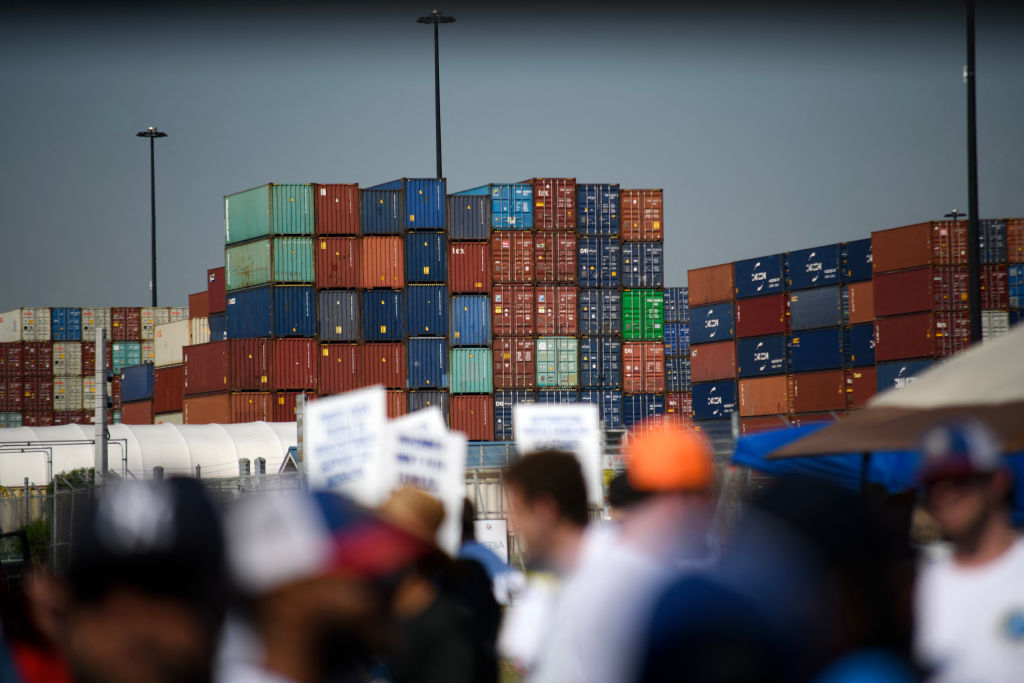
With a provisional settlement Thursday on the pay component of a multi-year contract between East Coast port operators and dockworkers, the U.S. dodged a bullet — although once closer to a BB gun than a deer rifle.

Edward Lotterman

Yet multiple economics lessons remain relevant here even if the harm this time was minimal. Some are minor but one presages an issue that will dominate coming decades.

Start with the mundane: That shelves in some stores were swept clear of toilet paper on news of the strike demonstrates how “expectations” can “shift” demand for products.

A “demand shifter” is any factor that increases or decreases demand even if the price does not change. There was no lack of TP anywhere nor was any special sale instituted, yet thousands of Americans, perhaps remembering COVID-era supply-chain issues, headed off to buyers’ clubs and big-box retailers to stock up.

Secondly, near-universal access to Internet-based news reporting and to social media have multiplied the speed and intensity with which information, rumor as well as fact, spreads throughout society. In the 1950s, one might read in a newspaper of a major strike but then read nothing else for 24 hours or more. If panic buying resulted in one area, few others would hear of it until the next day. Chain-reaction responses were subdued.

Thirdly, changes in the structure of the labor force have made union activity rare. The port strike made headlines as much because such actions seldom happen as because of any real economic impacts. In the 1950s, a third of all workers were members of unions. On any given day some strike was in progress in every state or major metro area but few made headlines. Only ones with nationwide effects got much coverage.

Now, fewer than 10% of all workers are unionized. Public employees, including teachers, postal workers and state, county and municipal employees make up the majority of all union members. Only 6% of private sector workers are organized.

One result is that reactions to strikes in the news generally trend negative. A slight majority of the population still express support for organized labor. But there is a sharp split between political parties with high levels of disapproval among Republicans versus support among Democrats.

Another result is that national union leadership increasingly is made up of white-collar workers with experience in negotiating and in lobbying and public relations, but with little experience in work stoppages, let alone on the shop floor.

Old-time labor leaders had done manual labor and had gone on strike in the face of violent opposition from employers. George Meany, who in 57 years of union leadership helped create the AFL-CIO and led myriad major strikes, was a plumber. John L. Lewis, the head of the United Mine Workers, had dug coal. Walther Reuther of the United Auto Workers had led strikes against which Ford Motor Co. goons had more guns than SEAL Team Six.

Such leaders personally understood issues of workplace safety and harsh management practices in ways that today’s leaders who are teachers or budget analysts do not.

Another lesson is that the power to extract real wage gains depends on the importance of a few workers in providing a product or service and the “inelasticity” of the demand for it. Dockworkers and railroad employees have power to shut vital chokepoints, thus quickly impacting millions of households and the operations of many businesses. Street maintenance workers or state income tax processors don’t have the same clout.

Federal power to limit strike activity is the flip side of that. The two most important U.S. federal labor laws are the National Labor Relations Act of 1935, or Wagner Act, and the 1948 Taft-Hartley Act. The first, passed by Democrats in the New Deal era, established nationwide rights to organize unions and to strike. The second, passed by Republicans in reaction to a post-World War II spate of strikes, limited rights granted in the Wagner Act. It gave the president the power to impose 80-day periods pausing strikes if such actions threatened to harm the national economy. The older Railway Labor Act already gave similar powers to limit strikes.

So President Joe Biden could have enjoined the dockworkers strike if it had gone on. The threat to the economy was clear, and went well beyond toilet paper. But such a move could have cost him and Democratic presidential candidate Vice President Kamala Harris support among labor-loving Democrats. However, letting the strike go on, with its inevitable supply-chain and consumer-price impacts, could have cost Harris votes too. With one month before the presidential election, the strike was bad timing for the incumbent Democrats either way. The tentative agreement between dockworkers and port operators on pay and the postponement on other issues into the new year was a political gift to both Biden and Harris.

Related Articles

Business |


Real World Economics: What’s all this I hear about tariffs?

Business |


Real World Economics: Regulations challenge some basic principles

Business |


Real World Economics: Reports of democracy’s death are greatly exaggerated

Business |


Real World Economics: Deficits matter, more than elections

Business |


Real World Economics: Elections have consequences; here are some

The remaining issue in this dispute for dockworkers — and the one with the broadest economic indications, both in theory and in the real world — centers on the degree to which jobs for humans can and should be replaced by machines. With rapid adoption of AI looming over us, this issue has major importance.

It is not a new one. In the 1950s, the hot question was whether trains still needed brakemen and firemen even though air brakes controlled from diesel locomotives had been used for decades. The jobs were cut, but it took decades.

Back then, hundreds of thousands of longshoremen were needed to physically wrestle crates, barrels and bales of cargo out of ship holds and into warehouses. Shipping containers did away with the majority of those jobs in two decades. But we still need crane operators, yard truck drivers and operators of straddle trucks and other machines to shift containers around in storage yards. And there still are humans who open and close gates. Port operators argue these are no longer needed. The union wants these jobs maintained. For now they will be.

Loading and unloading large cargo like locomotives and bulldozers will require humans for a long time. But container handling differs little from order picking in an Amazon warehouse. Operating cranes and the drayage trucks that bring containers to and from the cranes could be done with far fewer humans. In time they will be. The issue now is how long the change will take and what the economic fallout will be.

Mining labor boss Lewis was willing to accept mechanization if job cuts could be accommodated slowly via retirements and with higher wages for the jobs that remained. This worked until the expansion of open-pit mines, especially in Wyoming, killed the market power of underground mine owners as well as of miners. Cargo handling does not face alternate competitors of this sort. Ports will continue to trend to fewer workers.

This involves some 40,000 dockworkers. There probably are 40 million other workers whose jobs in any variety of fields might be done through Artificial Intelligence in a few decades, both blue-collar and white-collar. How this will unfold will be the central economic and political challenge of the next decades. The 30-year move from freight train crews of six to crews of two is not a positive omen.

St. Paul economist and writer Edward Lotterman can be reached at stpaul@edlotterman.com.
Gophers football: Five players share crowd storming experiences in 24-17 upset of No. 11 USC

posted in: News | 0

The similarities were uncanny.

A Gopher safety left his feet to make a late interception to seal an upset win in the East end zone of Huntington Bank Stadium.

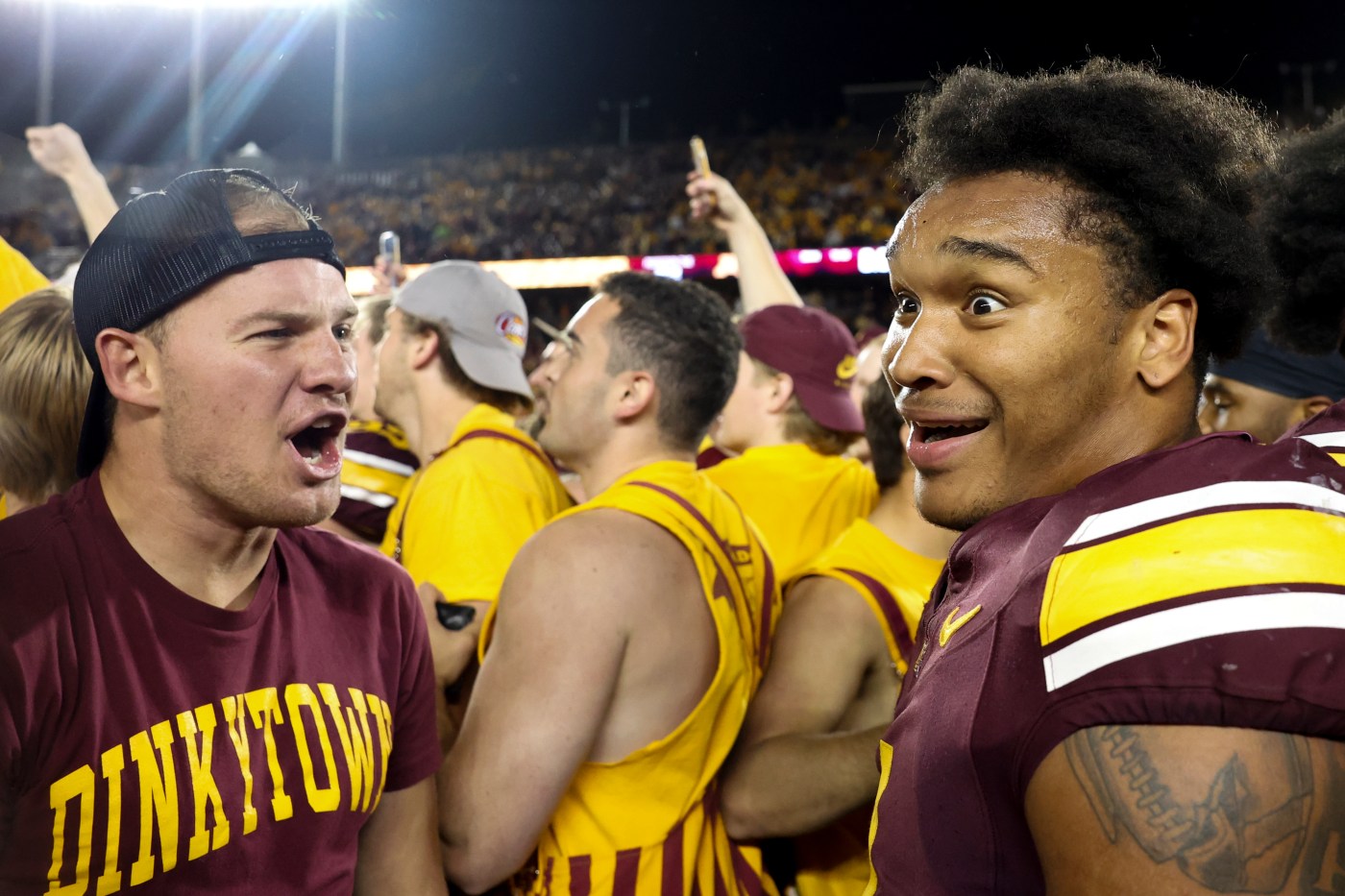
Jordan Howden did it on an “N” in the Minnesota script to beat No. 5 Penn State 31-26 in November 2019. Koi Perich achieved it a feet away from that, on the “E” to top No. 11 Southern California 24-17 on Saturday night.

Both win-clinching plays resulted in a maroon and gold sea of humanity flooding onto the field turf, creating memories for fans, players and coaches alike. It was the Gophers’ first home win against a Top 25 team since knocking off No. 18 Wisconsin for Paul Bunyan’s Axe in 2021.

“That was awesome,” Perich said about Saturday’s ensuing celebration. The Esko, Minn., native received hero treatment in being hoisted onto teammates’ shoulders. “I was in the middle and I don’t know who lifted me up, but I could just see everybody up on the field at the same time,” he added. “That was one of the coolest moments of my life.”

Jah Joyner, who had a crucial sack and forced fumble in the fourth quarter, watched his teammates and defensive line coach Winston DeLattiboudere on the sideline.

“We work so hard up to this point and in the offseason just for moments like that,” Joyner said. “I told the D-line that last week, those third and longs in passing moments against Michigan, I felt like I let the team down, just not getting the quarterback down.”

Joyner didn’t need to lament any longer the 27-24 loss to then-No. 12 Wolverines a week ago. On Saturday, the fifth-year senior was credited with three pressures, including another one that resulted in USC quarterback Miller Moss’ intentional grounding before the U took the final lead.

Quarterback Max Brosmer, who tallied three rushing touchdowns and the go-ahead score with 56 seconds remaining, was never a part of a field storming during his five years at FCS-level New Hampshire. After Perich’s pick, Brosmer took a knee to run out the final seven seconds of the upset as an eight-point underdog.

“I had no idea what to do,” Brosmer said. “First guy that came up to me was (right tackle Quinn Carroll). That was cool. We shared that moment together. We challenge each other every single day to be the best leaders we can and to finish a game that way with that team, the way we did was absolutely incredible.”

Carroll — on top of a big hug for his QB — said he will remember interactions with fans on the field.

“Obviously the fans are fun and are coming up and saying ‘good game,’ ” the Edina native said. “We went to work (Saturday) and we were blessed to have a win. Will always remember those moments on the field and obviously after the game with the guys.”

Running back Darius Taylor had a season-high 144 yards on 25 carries. The sophomore paced Minnesota throughout the game.

“Our fans were great,” Taylor said. “We stayed in it the whole game. Even when we were down, they were still rocking. It was great. Appreciate that. It keeps the team going, keeps us alive, keeps us energized.”

Related Articles

College Sports |


With gutsy call, Gophers pull off 24-17 upset of No. 11 USC

College Sports |


When the Gophers will play each new Big Ten opponent through 2028

College Sports |


Gophers football: Injuries continue to hit U defense going into USC game

College Sports |


Gophers football: USC game will be unfamiliar in many ways

College Sports |


Gophers football vs. USC: Keys to game, how to watch and who has edge

Readers and writers: A middle-grade tale about a dog, plus mysteries and horror

posted in: News | 0

A new middle-grade novel by award-winning Pete Hautman, two mysteries and a horror anthology. Who could ask for anything more on an autumn Sunday?

(Courtesy of Candlewick Press)

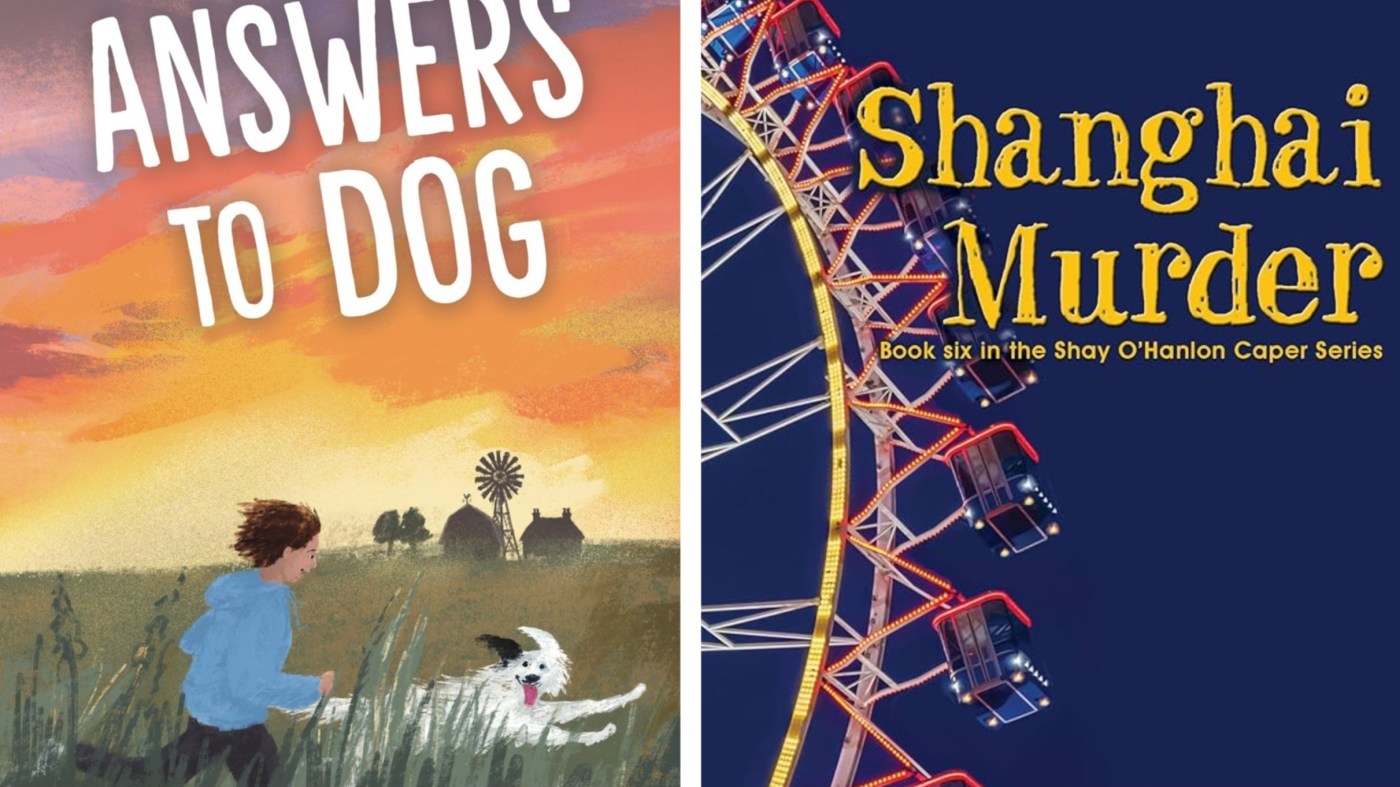
“Answers to Dog”: by Pete Hautman (Candlewick Press, $18.99)

The summer before Pete Hautman started fourth grade, everything he read was about dogs and boys. Now a National Book Award-winning writer, Hautman passes his love of dogs to middle-grade readers in his new novel “Answers to Dog,” a tender story featuring Evan, a mildly depressed eighth-grader, and the escaped border collie humans named Sam but answers to Dog.

“I wanted to write a book for 9-year-old Pete Hautman,” the author said during a phone conversation from the Golden Valley home he shares with poet/mystery writer Mary Logue, who was at their other house in Stockholm, Wis.

The inspiration for “Answers to Dog” goes back to Hautman’s childhood in St. Louis Park and Jim Kjelgaard, who wrote more than 40 novels. One of his most popular, “Big Red,” is about an expensive Irish setter that bonds with an orphan boy. Published in 1945, the book was made into a 1962 Walt Disney film.

“A few years ago an editor asked me to write the introduction to the 75th anniversary edition of ‘Big Red.’ This was huge for me. It was the first chapter book I ever read,” Hautman said. “Then I looked up various dog books. There are thousands, some good, some not so good. It’s like a genre within a genre. The ones I was most interested in had a substantial animal point of view.” That’s the kind of book Hautman wanted to write but without anthropomorphizing the dog too much.

After researching border collies, an intelligent breed that needs lots of exercise, Hautman imagined the dog coming out of nowhere to run beside Evan. They bond but become separated, and Hautman puts readers into Sam’s head as the dog journeys to find the human he thinks of as the Boy:

Pete Hautman (Courtesy of the author)

“He did not think he was lost. The dog did not think in those terms. He had been in new places before. Every place was connected to every other place. Sooner or later he would find his way back. He would find the kennel. He would find the Boy.”

And here we meet Evan, the Boy:

“He scrunched down in his seat, wondering how he had ended up being best friends with a morbid bald kid and an undersized sarcastic wuss. Not that there was anybody else he really wanted to hang out with. It was just hard sometimes.”

After Sam escapes the kennel, Evan and a girl in his class take on caring for the other dogs after the drunk owner falls off a ladder and is injured. When Sam shows up at Evan’s house his sad mother, who won’t say why she gave up her nursing career, cares for Sam’s injuries.

In the end, “Answers to Dog” could be considered a book about freedom. Sam has the border collie’s need to be free and never kept within walls. Evan is free when he runs with Sam, and Evan’s parents are freed from their preoccupations by everything that happens to their son and the dog.

Hautman and Logue share their homes with two small dogs. Gaston is a poodle and Baudelaire is “a mystery rescue who looks like a little white fox,” Pete says.

Logue and Hautman met at the Loft Literary Center when Logue was teaching a class and Hautman was her student. They have collaborated on young adult books including their three-book Bloodwater Mysteries and “Skullduggery.” Logue just sent to her publisher “The Wasp and the Beehive,” third in her 19th-century series featuring Irish immigrant Brigid Reardon, and her new middle-grade fantasy “Dreki” will be out next year. (Dreki is the Icelandic word for dragon.) She and her sister Dodi, a painter based in Delano, self-published “Terra Incognita,” made up of Dodie’s abstract paintings and Mary’s poems inspired by the artwork.

Hautman will be joined by foxy Beaudelaire at the launch of “Answers to Dog” at 6 p.m. Tuesday at Red Balloon Bookshop, 891 Grand Ave., St. Paul. Free. Seating is limited, reservations appreciated at redballoonbookshop.com.

(Courtesy of Bella Books)

“Shanghai Murder”: by Jessie Chandler (Bella Books, $17.95)

The dim glow from the bar stained a three-by-five-foot rectangle on the lumpy dirt floor. Above, a trapdoor swayed slowly back and forth. Then with a whomp! it somehow snapped up and shut tight, leaving me all alone, deep in the dark. — from “Shanghai Murder”

Minneapolis Rabbit Hole coffee shop owner Shay O’Hanlon spends a lot of time locked in a basement and wandering creepy adjacent rooms trying to escape in the sixth installment of Chandler’s series. This one is set in Portland, Ore., where Shay and her lover JT, a woman police detective, are attending a convention looking for new flavors to be served at the Rabbit Hole. They’re joined by Eddy, her senior citizen landlady and mom to all, who’s not been her peppy self lately, and young, full-of-facts savant Rocky and his wife, Tulip.

When Shay is walking behind a booth at the convention she trips, knocking over boxes that are not filled with coffee beans. With a gun at her throat she’s kidnapped and tossed through a trap door while her captors figure out when to kill her. Meanwhile, Tulip and some friends head for the Witch’s Castle in a park and she, too, disappears. When it’s clear Shay is not returning to the coffee show, JT and Shay’s best friend Coop track her on their phones, but when they get to the bar where she was taken, she isn’t there.

Chandler, who lives part time in Minnesota and worked at Once Upon a Crime bookstore in Minneapolis, writes such well-drawn characters that she’s able to keep all these plot lines going without confusing the reader. Shay’s appealing, if not always wise in her decisions, and her posse makes this series a lot of fun.

“Pike Island”: by Tony Wirt (Thomas & Mercer, $17)

The house was musty, dusty, and had a weird smell that Jake couldn’t place. But for a house that had been abandoned half a century ago, it was remarkably intact.

And that was the most unnerving thing about it. — from “Pike Island”

The postcard was blank, addressed to Andy Leonard. That was a name Andrew Harrison “Harry” Leonard hadn’t used for years. Why would someone from his past contact this Minnesota man when he was on the cusp of running for U.S. president with the support of Krista Walsh, his steely, ambitious chief of staff? When Leonard refuses to talk about the postcard, Krista uncovers a secret involving her boss and three buddies who spent a weekend at a lake cabin and found an old house that led to murder.

Wirt has a talent for dialogue, especially in scenes with the young men ready to party with no adults around. Unraveling the mystery of what happened to them that long-ago weekend is interesting, but the real question is what will Krista do when she learns the Pike Island secret? If she reveals all, Leonard’s career will be over and so will hers. Has she invested too much time and talent in Leonard’s campaign to go public with his secret?

“Good Night, Sleep Tight”: by Brian Evenson (Coffee House Press, $19)

His facrubbed along the floor and through the dust, and then there the other face was, right beside his own. It had not finished a face yet, or had gone about it wrongly. Where one would expect features there were only a gash for a mouth and two divots for eyes, the surface otherwise smooth and bled of color. — from “Good Night, Sleep Tight”

A man paralyzes a friend and buries him alive to get his possessions. Another man learns as a boy that there can be a monster under the bed. Another boy is baffled as he half-dreams about a door, and a robot oversees sleeping people in a space ship. These are some of the 19 horror/sci fi stories in this collection by an award-winning author described by National Public Radio as “one of our best living writers – regardless of genre.” If you enjoy this genre, you’ll love Evenson’s writing.

Related Articles

Books |


Literary calendar for week of Oct. 6

Books |


Minnesota’s first female lieutenant governor to speak in Stillwater

Books |


Books for fall 2024: 44 titles to read, from biographies to horror, and legendary authors waiting to break the ice

Books |


Louise Erdrich’s latest novel ‘The Mighty Red’ showcases her equally impressive talents

Books |


Readers and writers: A timely memoir from a Minnesota trailblazer

Skywatch: Unwind in the evening sky as we wait for Comet Tsuchinshan-Atlas

posted in: News | 0

In case you haven’t heard, which I’m sure many of you have, there’s a promising comet on the way. By promising, I mean it may be bright and bright enough to see with the naked eye, especially in the dark skies of the countryside. It may even be easily visible to stargazers from urban and suburban light-polluted locations. It may have a relatively sizable tail of dust and gas.

Presently, the comet is roughly in a line between the Earth and the sun, lost in the glare of our home star. But starting next weekend, look for it in the very low western sky during the later part of evening twilight. It might be really tough to spot then, but as October continues, Tsuchinshan-Atlas will start evenings a little higher in the west. I’ll have much more next week on the partially melting cosmic dirty snow and ice ball paying us a visit.

Meanwhile, I have a pleasant celestial challenge for you, the long and winding Draco the Dragon. It’s not the easiest of constellations to find, but once you do, you feel like you’ve accomplished something. It always reminds me of one of the great Beatles classics, “The Long and Winding Road,” because that is what it truly is in the northwestern October sky. It’s undoubtedly one of the larger constellations in the heavens, but the difficulty locating it is that most of Draco’s stars aren’t all that bright.

The best way to find Draco is to visualize it more as a coiled snake than a dragon as if we know what dragons look like anyway! According to Greek mythology, Draco is supposed to be a stretched-out dragon, so the snake appearance works … but we’ll visit that later.

(Mike Lynch)

To begin your quest of Draco, gaze high in the west-southwest heavens for the brightest star you can see. That will be Vega, high in the western sky and the brightest star in the small constellation Lyra the Harp. Look a little to the upper right of Vega for a modestly bright trapezoid of four stars that outline the head of the dragon. This is where you find Draco’s brightest star, which honestly isn’t all that bright.

Your Draco challenge is well underway. Hold your fist out at arm’s length. At about two of your “fist-widths” above and a little to the right of Draco’s head, you’ll find two faint stars reasonably close to each other.  These less-than-brilliant stars mark the end of the snake dragon’s neck. I believe locating those two stars is the key to seeing the rest of Draco. Draco’s body makes a U-turn from those two stars, coiling down and a little to the right about two and a half fist-widths. From there, you’ll see a reasonably faint but distinct horizontal line of stars that kink off to the right to depict the faint tail of Draco. You’ll observe that Draco’s tail lies above the much brighter Big Dipper and below the dimmer Little Dipper. I hope between my description and the star map, you can find Draco. It looks like a backward letter “S.”

How poor Draco wound up unwound in the sky is quite the mythological tale. One of the versions goes like this. Hera, the queen of the gods, was given a gorgeous basket of solid gold apples as a wedding present from her new but not-so-faithful husband, Zeus, the king of the gods. She kept her precious apples in her private garden at the castle and had her pet dragon, Draco, guard the apples. Draco has been Hera’s pet since childhood and is highly loyal to her. He guarded those apples 24/7 and fended off many dastardly thieves. No one got by Draco until one fateful night.

On that moonless night, while Draco was taking a catnap at his post, Hercules, the legendary hero, blitzed and smashed the palace gate and leaped toward the golden fruit. It was a lightning raid! Draco rousted himself immediately, and a tumultuous battle went on for hours and hours. Draco just about had Hercules trapped in his coiled tail and was about to squeeze the life out of him when, with all his might, Hercules managed to pull his emergency switchblade dagger out of his shoe and pierced it right through the beast’s heart. Hercules then made off with his plundering of golden apples.

Hera discovered Draco’s body minus a whole bunch of blood and the absent apples. She was greatly upset about losing the golden apples but was more upset about losing a pet she’d known all her life. Hera decided to reward Draco for his loyalty by magically placing his body in the stars as an eternal honor to him. The trouble is that when she picked up his bloody, mangled body and hurled it into the heavens, it quickly and unceremoniously unraveled.

Draco is not one of the easiest constellations to find, but looking for it and finding it will sharpen your stargazing skills. Wind down from your busy day and look for Hera’s loyal and now unwound celestial dragon.

Mike Lynch is an amateur astronomer and retired broadcast meteorologist for WCCO Radio in Minneapolis/St. Paul. He is the author of “Stars: a Month by Month Tour of the Constellations,” published by Adventure Publications and available at bookstores and adventurepublications.net. Mike is available for private star parties. You can contact him at mikewlynch@comcast.net.

Starwatch programs

Monday, Oct. 7, 7-8:30 p.m., near Marshall, Minn. For more information and location, call Marshall Public Library at 507-537-7003 or visit www.marshalllyonlibrary.org.

Tuesday, Oct. 10 (Weather backup date Oct. 12) in Chippewa Falls, Wis. For location, more information, and reservations, call 586-723-2050 or visit www.chippewavalleyschools.org/departments/community-ed.

Wednesday, Oct. 9, 7-9 p.m. at Isanti Middle School. For reservations call 763-689-6188 or visit www.c-ischools.org/school/community-ed.

Related Articles

Outdoors |


Skywatch: A great mix of summer and autumn stars, with possibly a bright comet

Outdoors |


Skywatch: Saturn is edgy

Outdoors |


Skywatch: Harvest moon shining bright with a power failure

Outdoors |


Skywatch: The delightful celestial dolphin

Outdoors |


Skywatch: Summer stars hanging in there with Saturn on the rise