By PETER SMITH
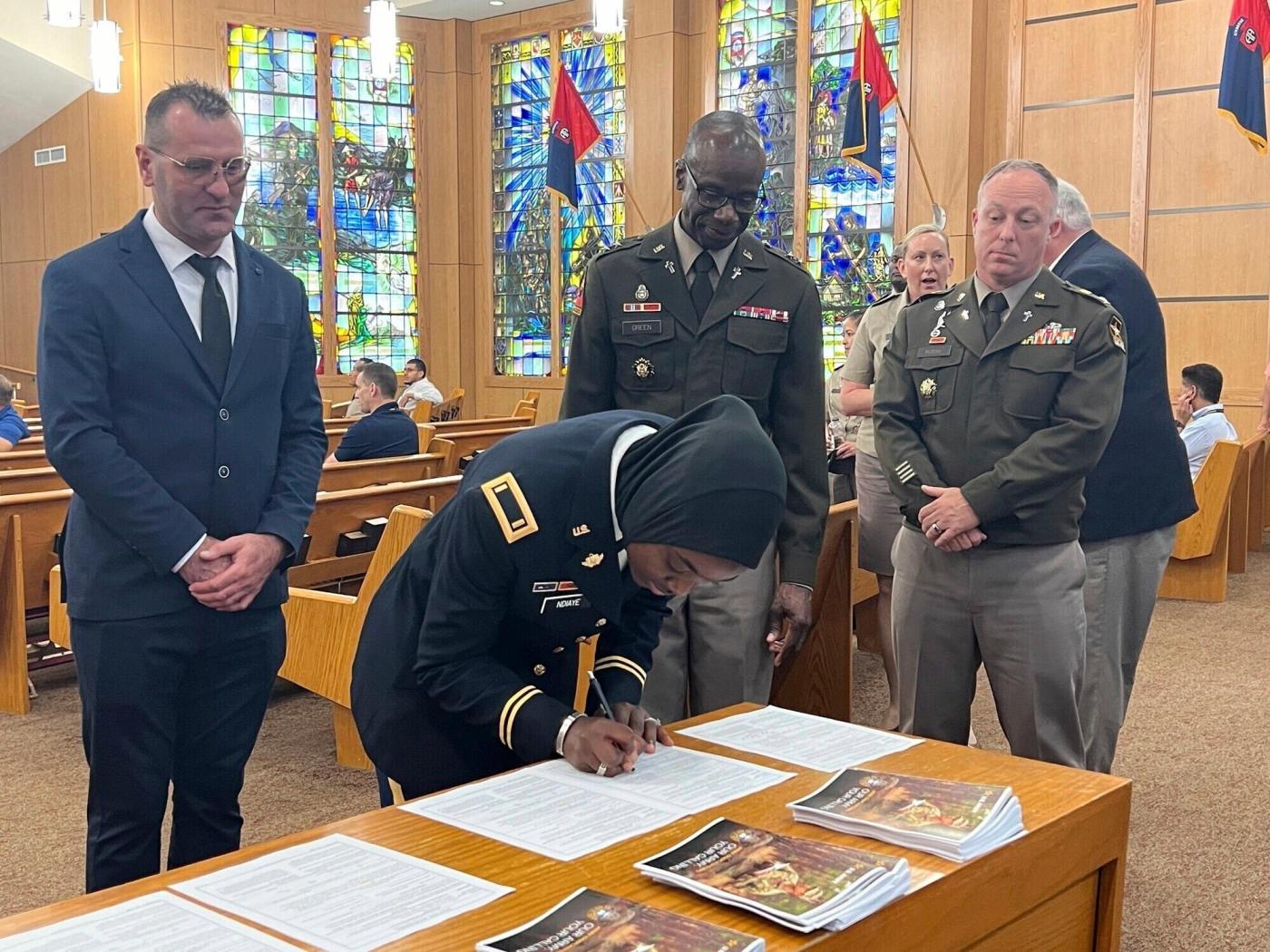
It was a history-making event: In a chapel at Fort Liberty, North Carolina, 2nd Lt. Khady Ndiaye stood proudly — wearing a hijab – as she became the first Muslim woman commissioned by the U.S. Army as a chaplain candidate.
Presiding over the ceremony in June was Maj. Gen. Bill Green, the Army’s chief of chaplains. He said the chaplains serve more than 200 faith groups, “while caring for the entire Army family … regardless of their personal beliefs.”
That ethos – a commitment to religious diversity throughout a U.S. military with 1.3 million active-duty troops — could be strained if Pete Hegseth, President-elect Donald Trump’s nominee for defense secretary, is confirmed as the next Pentagon leader.
Hegseth sometimes conveys his conservative Christian outlook in militaristic terms, has justified the medieval Crusades that pitted Christians against Muslims, and evokes the specter of Islamists seeking to impose their faith on non-Muslims. He has denounced the military’s initiatives to foster diversity, equity and inclusion, which include religion among other categories.
Today’s military “is one of the most diverse institutions in American society, racially, ethnically and especially religiously,” said Ronit Stahl, author of “Enlisting Faith: How the Military Chaplaincy Shaped Religion and State in Modern America.”
“Overall, the military was an engine of religious inclusion and really thinking about how to manage religious pluralism, but it was not a smooth or easy process,” said Stahl, a professor of history at the University of California at Berkeley. “To have a secretary of defense who promulgates a worldview or operates within a worldview where not just Christianity, but a certain strand of Christianity, is the right religion, potentially changes the tenor of what an ethos of religious pluralism looks like in the military.”
The military chaplaincy has evolved as America has diversified. It originally functioned with mainline Protestant and Catholic chaplains, expanding during World War I to include such groups as Jews and Mormons.
Recent decades have seen the military’s first Muslim, Hindu and Buddhist chaplains. The military has also made accommodations such as allowing Sikhs to maintain their religiously mandated turbans and beards.
Today, about 70% of active-duty military identify as Christian – including about 20% Catholic and about half Protestant or other Christian, according to a 2019 congressional report. About a quarter of troops were listed as “other/unclassified/unknown,” with small percentages of atheists/agonistics, Jews, Muslims and adherents of Eastern religions.
The Defense Department could not immediately confirm the figures. But they roughly match Americans’ religious demographics overall.
Today, the Army’s careers-and-jobs website depicts its chaplaincy as “a multi-faith program — ministers, priests, imams, rabbis, and more.”
The mission for its chaplains: “Observe the distinct doctrines of your faith while honoring other denominations and ensuring the right for others to observe their own.”
Rabbi Scott Klein. who serves as an Army chaplain within the 82nd Airborne Division and is garrison rabbi at Fort Liberty, said the military “has made significant strides in fostering an interfaith environment.”
“One area where I think we can continue to improve is in education and training,” he said via email. “Providing more opportunities for service members to learn about different faith traditions would further break down barriers and misconceptions.”
The U.S. Navy reports that it has 874 chaplains. Most have a range of Protestant affiliations, including 101 Southern Baptists. They also include 46 Catholics, 18 Latter-day Saints, 12 Jewish, 9 Eastern Orthodox, 4 Muslim and 1 Buddhist. Statistics from other branches were not immediately available.
Hegseth’s nomination requires confirmation from the Senate, where he’s facing deepening scrutiny over other controversies. He is subject to multiple allegations that have emerged in the media about alcohol intoxication at work events, sexual misconduct and potential financial mismanagement. He was flagged as a possible “Insider Threat” by a fellow service member in 2021.
Hegseth, now a Fox News host and author, is an Army National Guard veteran of deployments to Iraq, Afghanistan and Guantanamo Bay.
He has written of America as a Judeo-Christian nation, portraying the founders as Christians despite what historians say were their diverse religious views. He said Americans of any religion are welcome in a “righteous crusade for human freedom,” though he often fuses Christian and American identity. “We Christians — alongside our Jewish friends and their remarkable army in Israel — need to pick up the sword of unapologetic Americanism and defend ourselves,” he wrote in his 2020 book, “American Crusade.”
Mikey Weinstein, president of the Military Religious Freedom Foundation, said Hegseth “promotes the concept of fundamentalist Christian dominance and supremacy.”
Weinstein, an Air Force veteran, said military personnel have the right to practice and proclaim their faith – but within constitutional restrictions on the “time, place and manner” of such expressions.
“Christian nationalists like Hegseth believe there are no limits on when they can deploy their faith,” Weinstein said.
But other veterans are supporting Hegseth, including Damon Friedman, a retired 20-year Marine and Air Force veteran who now leads SOF Missions, a Florida-based program aiming to reduce veteran suicides.
Friedman, who served in Iraq and Afghanistan, said he shares Hegseth’s Christian faith. That didn’t interfere with his duty to lead troops regardless of their religion, he said.
“We live in a free country. We get warriors of all faiths,” said Friedman, a retired lieutenant colonel.
He favors Hegseth’s goal of rolling back diversity, equity and inclusion initiatives, which he contended is causing the military to focus on members’ various identities rather than on solidarity in being a “war-fighting machine.”
“We just need to get back to being green,” he said, referring to the primary uniform color.
Sen. Bill Hagerty, R-Tennessee, concurred.
“We need to get back to business, and I think Pete is just the person to do it,” Hagerty said recently on ABC’s “This Week with George Stephanopoulos″ .
Some concerns about Hegseth center on his views toward Islam and the religious motivations he cites for supporting Israel.
He has spoken enthusiastically about the possibility of a restored Jewish temple on its ancient site in Jerusalem. Such a move would involve the geopolitically explosive step of displacing the Al-Aqsa Mosque – one of Islam’s holiest sites and a symbol of Palestinian aspirations.
Hegseth made his comments at a 2018 conference in Jerusalem. He rejected Palestinian aspirations for statehood, saying there is “no such thing as the outcome of a two-state solution, there is one state.”
Hegseth bears a prominent tattoo proclaiming “Deus Vult,” (“God Wills It”), the Latin phrase attributed to the 11th century pope who called the First Crusade. That launched two centuries of fierce, intermittent warfare between Christian and Muslim armies in and around the Holy Land.
Hegseth wrote in his book that he wasn’t romanticizing the Crusades and but said the “present moment is much like the eleventh century.” He called for Christians, Jews and the Israeli army to “push Islamism back,” culturally and when necessary militarily.
He defined Islamism as an ideology imposing Islam on others. He contended that moderate Muslims may be peaceful but are either “complicit in Islamism’s expansion or impotent to reverse it.”
The Council on American-Islamic Relations opposes Hegseth’s nomination.
“If President-Elect Trump is serious about pursuing peace abroad and putting American interests above the interests of foreign governments, he should reconsider Mr. Hegseth’s nomination,” the Muslim advocacy organization said.
OpenAI Sam Altman ‘not that worried’ about rival Elon Musk’s influence in the Trump administration
US senators grill officials from 5 airlines over fees for seats and checked bags
Harris found success with women who have cats, but Trump got the dog owner vote
Biden in Africa pledges millions more for a rail project the US hopes will boost its influence there
Trump is bringing back Peter Navarro as a White House adviser as he builds out his administration
Thomas Lecaque, a professor of history at Grand View University, said the “Deus Vult” expression is unambiguously militant.
“There is no version of ’Deus Vult’ that means anything other than a call for violence,” said Lecaque, who studies religious violence from the Crusades to modern America.
The Trump-Vance transition team did not return emails seeking comment. Emails to Hegseth and his attorney also did not receive replies.
Larry Wilkerson, a retired colonel with 31 years in the military and an advisory board member of the Military Religious Freedom Foundation, said Hegseth is an alarming choice.
“Diversity is a strength, but you’ve got to know how to lead it,” said Wilkerson, a former chief of staff to Secretary of State Colin Powell. “You don’t do it by forcing the majority’s or even a large minority’s views on them.”