Napheesa Collier #24 of the Minnesota Lynx drives to the rim against DiJonai Carrington #21 of the Connecticut Sun during the second half of Game Three of the WNBA playoff semifinals at Mohegan Sun Arena on Oct. 4, 2024 in Uncasville, Connecticut. The Lynx defeated the Sun 90-81. (Joe Buglewicz / Getty Images)
Timberwolves coach Chris Finch delivered an apt scouting report of the WNBA Finals matchup between the Lynx and Liberty, which opens Thursday in New York:
“It looks like the two best teams in the league are going at it,” Finch said. “The two most complete teams in the league are going at it. Should be interesting.”
That was true all season. The Liberty earned the No. 1 seed with a 32-8 mark. Minnesota was No. 2 with a 30-10 record For the year, New York touted the WNBA’s No. 1 offense (107 points per 100 possessions), while Minnesota had the second-best defense (94.8).
Since the nearly month-long Olympics break ended in mid-August, both teams were excellent in all facets.
Minnesota had the best record post-break (13-2), while the Liberty were second (11-4). New York sported the best net rating in that span, outscoring opponents by 11.4 points per 100 possessions, while Minnesota was No. 2 (8.9).
Both teams sported top-four offenses and defenses post-break and have been impressive throughout this postseason, and they each possess two all-world forwards: Breanna Stewart for New York and Napheesa Collier for Minnesota.
KEY STATS (season-long numbers)
ASSIST PCT.
Minnesota: 76.4 (1st)
New York: 74.1 (3rd)
REBOUNDING PCT.
New York: 52.5 (1st)
Minnesota: 48.3 (10th)
Breanna Stewart of the New York Liberty heads for the net as A’ja Wilson of the Las Vegas Aces defends in the second half of Game Two of the WNBA Semifinals at Barclays Center on Oct. 01, 2024 in New York City. The New York Liberty defeated the Las Vegas Aces 88-84. (Photo by Elsa/Getty Images)
SEASON MATCHUPS
May 25 in Minnesota: Minnesota 84, New York 67
The Lynx jumped out to a 14-point lead through one quarter and were largely in control from there. It was a complete showing for the Lynx, who hit 14 triples and assisted on 26 of their 32 makes. Four starters scored 14-plus points.
Stewart had 20 points for New York, but the Liberty were inefficient as a whole, shooting 38% from the field and a putrid 7 for 29 from deep.
Minnesota outscored New York by 27 points in the 26 minutes Liberty all-star and Olympian guard Sabrina Ionescu was on the floor.
June 25 in New York: Minnesota 94, New York 89
Minnesota has already beaten New York in a title bout this season, as the Lynx edged New York for the Commissioner’s Cup at the end of June. Minnesota was outrebounded 43-25 but overcame that deficit via a stellar shooting performance — the Lynx were 14 for 29 from 3-point range — and by forcing turnovers.
New York tallied 20 giveaways in that contest. Bridget Carleton led Minnesota with 23 points on the strength of six triples, as she and Collier (21 points) just outmatched Ionescu (23) and Stewart (24). Notably, Minnesota held Liberty center Jonquel Jones to just three points on 0-for-3 shooting.
July 2 in New York: New York 76, Minnesota 67
This was a slugfest, as neither offense was able to get going. The Lynx shot 39% from the floor and 30% from deep, while New York shot 37% from the field and just 22% from deep.
But the difference in the game came on the offensive glass, as the Liberty had 10 offensive boards. Still, Minnesota led by one heading into the final frame but scored just eight points in the fourth quarter.
Sept. 15 in New York: Minnesota 88, New York 79
Minnesota jumped out early and never looked back, building a lead as large as 26 points before New York closed strong to make the score look closer than the contest actually was.
The Lynx shot 53% from the field and 50% from deep. Carleton was again a sharpshooter for Minnesota — burying five triples — while Collier had 18 points and 13 rebounds.
The Liberty got 38 points from Stewart, but New York’s remaining players shot just 36% from the floor and 23% from distance. Ionescu was just 4 for 21 from the field.
TAKEAWAYS
Perhaps great defense bests great offense, because Minnesota flustered New York’s offense significantly more than anyone else during the season. The Liberty’s pace and efficiency dipped precipitously against Minnesota, and New York’s players outside of Stewart struggled to produce. Even Stewart’s offense did not come easy, as the Liberty failed to establish any type of offensive rhythm.
Minnesota did that to most opponents throughout the season, but to do it against an opponent as talented as New York was especially impressive.
WAUKEGAN, Ill. (AP) — On a table at the office of the Waukegan Township Democrats sits a box of postcards with Wisconsin addresses that were collected during a postcard-writing pizza party to help turn out voters there. Leaning against the table are homemade Harris-Walz signs.
“We know they’re handing these out everywhere in Wisconsin,” said Matt Muchowski, chair of the Democratic club. “Here in Waukegan, it’s been harder to get a hold of Harris yard signs, so we’re printing out our own.”
One reason they’ve been in short supply: Waukegan is in Illinois, which is not a presidential swing state. It just sits across the border from one.
Matt Muchowkshi, chair of the Waukegan Township Democrats, looks outside from the Waukegan Township Democrats office in Waukegan, Ill., Monday, Sept. 16, 2024. (AP Photo/Nam Y. Huh)
Muchowski said this is emblematic of the limited attention cities outside of swing states receive from presidential campaigns. The United States’ unique Electoral College system, which replaces the popular vote, puts disproportionate voting power in the hands of a relative few states that are evenly divided politically and ensures that the majority of campaign dollars — and attention from the presidential candidates — goes to those states.
The lack of attention leaves voters in much of the country feeling as if they and the issues they care about have been sidelined. It’s a dividing line that is felt acutely in places such as Waukegan, one of Chicago’s farthest-flung suburbs.
Pedestrians walk past the Waukegan Township Democrats office in Waukegan, Ill., Monday, Sept. 16, 2024. (AP Photo/Nam Y. Huh)
The last time a presidential candidate set foot in the working class, majority Latino city was when former President Donald Trump landed at its airport in 2020. Trump walked off Air Force One, gave a single wave, and then immediately climbed into an SUV headed across the border to Kenosha, Wisconsin.
‘Lost in the national conversation’
In Racine, a Wisconsin city of a similar size just 50 miles north of Waukegan, Trump hosted a rally in June near a harbor overlooking Lake Michigan, where he gushed about the development along the lakeshore, spoke about revitalization efforts in Racine and the Milwaukee metropolitan area, and emphasized their voters’ importance in his attempt to return to the White House.
A pedestrian walks past the Waukegan Township Democrats office in Waukegan, Ill., Monday, Sept. 16, 2024. (AP Photo/Nam Y. Huh)
Just a month earlier, before he dropped out of the race, President Joe Biden lauded a new Microsoft center in Racine County during a campaign stop in the city. The city just south of Milwaukee has become a common stomping ground for presidential hopefuls as Wisconsin, one of just seven battleground states likely to determine this year’s presidential race, remains heavily targeted by the campaigns of Trump and Vice President Kamala Harris.
Cities such as Waukegan become “lost in the national conversation” during presidential elections, said Muchowski, who has lived in the area most of his life.
“It’s not so much the candidates as it is the anti-democratic Electoral College,” he said. “… It’s frustrating that certain voters’ votes count for more, and they discount and discredit the votes of more urban, more people of color voters.”
Campaigns visits to neighboring Wisconsin: 27
Illinois is a reliably Democratic state — it hasn’t voted for a Republican presidential candidate since George H.W. Bush in 1988. That predictability is reflected in the presidential campaigns every four years.
Except for fundraisers, the Republican and Democratic presidential tickets have been to Illinois just twice this year — once for an appearance by Trump before a group representing Black journalists and once by Harris when she came to Chicago for her party’s national convention. By comparison, they had visited Wisconsin 27 times through Tuesday, including when Biden was the presumptive nominee.
This year’s presidential battleground states — Arizona, Georgia, Michigan, Nevada, North Carolina, Pennsylvania and Wisconsin — represent 18% of the country’s population but have dominated the attention of the Democratic and Republican presidential candidates and their running mates.
Through Tuesday, they have had just over 200 total campaign stops — three-quarters of which have been to those seven states, according to a database of campaign events that is based on Associated Press reporting. Pennsylvania alone has been visited 41 times, the most of any state.
But it’s not just the state visits: The presidential campaigns are tailoring their appearances to specific counties they believe are crucial to their success. The AP’s database shows their campaign events in the seven battleground states have been concentrated in counties with 22.7 million registered voters — just 10% of all voters registered nationally for this year’s presidential election.
Electoral College, a system of ‘neglect’
Many residents of Waukegan wish it also could get on the candidates’ radar. They said they’re proud of how multiculturalism has shaped their city, a place where almost 60% of residents are Latino and more than 16% are Black, according to 2020 U.S. Census data.
The working class community was largely built on factory jobs that once offered residents a comfortable, middle class life. But after companies abandoned the city’s lakefront, starting in the 1960s, tens of thousands of jobs disappeared.
Waukegan never fully recovered.
A Welcome to Waukegan City sign is seen in Waukegan, Ill., Wednesday, Sept. 25, 2024. (AP Photo/Nam Y. Huh)
Its poverty and unemployment rates rise well above the state and national averages. Its school district is one of the worst-funded in the county, struggles with understaffing and has dismal graduation rates. And its lakeshore is a sagging reminder of the city’s heyday: An asbestos manufacturing plant, a coal plant and a gypsum factory all sit silent beside public beaches. Beside them are a crisscrossed network of abandoned railroad tracks.
The industries brought with them another problem — a legacy of environmental damage. The city of around 86,000 residents has five federal Superfund sites. In 2019, the state’s pollution control board ruled that Waukegan’s coal plant violated environmental regulations and contaminated groundwater, and it was shuttered three years later.
The scene in Waukegan contrasts with Racine’s pristine lakefront marina, where luxury condos flank coffee shops, restaurants and hotels.
An aerial view of Waukegan Harbor in Waukegan, Ill., Thursday, Sept. 26, 2024. (AP Photo/Nam Y. Huh)
People walk past a theatre in Waukegan, Ill., Saturday, Sept. 28, 2024. (AP Photo/Nam Y. Huh)
Customers shop at a grocery store in Waukegan, Ill., Friday, Sept. 20, 2024. (AP Photo/Nam Y. Huh)
Clyde McLemore, executive director for Black Lives Matter Lake County, listens as he attends the city council meeting in Waukegan, Ill., Monday, Sept. 16, 2024. (AP Photo/Nam Y. Huh)
Matt Muchowkshi, chair of the Waukegan Township Democrats, looks around at the Waukegan Township Democrats office in Waukegan, Ill., Monday, Sept. 16, 2024. (AP Photo/Nam Y. Huh)
Clyde McLemore, executive director for Black Lives Matter Lake County, listens as he interviews with a reporter after the city council meeting in Waukegan, Ill., Monday, Sept. 16, 2024. (AP Photo/Nam Y. Huh)
NRG Waukegan Generation Station on the Lake Michigan lakeshore is seen in Waukegan, Ill., Thursday, Sept. 26, 2024. (AP Photo/Nam Y. Huh)
Thomas Maillard, the director of city government affairs, poses for photos in Waukegan, Ill., Monday, Sept. 16, 2024. (AP Photo/Nam Y. Huh)
1 of 8
An aerial view of Waukegan Harbor in Waukegan, Ill., Thursday, Sept. 26, 2024. (AP Photo/Nam Y. Huh)
Thomas Maillard, the Democratic State Central Committeeman for Illinois’ 10th Congressional District and a lifelong Lake County resident, said the contrast between the two cities is clear. In Waukegan, he said he worries about gun violence and access to well-paying jobs, affordable housing, child care and health care.
“The history of Waukegan, unfortunately, is the history of this country’s neglect of those Rust Belt communities, especially along the Great Lakes,” he said. “… People are struggling.”
Maillard pointed to the Electoral College system as a culprit, calling it “a system of potential neglect.”
‘You need to hear us’
Sam Cunningham, a former mayor of Waukegan, said people feel forgotten in the city that he’s called home since elementary school. It’s clear, he said, that the national agenda prioritizes some states over others.
“They’re probably thinking, ‘Why should we put money over here when we need it in these battleground states?’” he said. “I understand the logic, but understand how we feel. Do we feel slighted? Of course we do. It doesn’t mean it doesn’t hurt.”
Sam Cunningham, the 40th mayor of Waukegan, poses for photos in Waukegan, Ill., Monday, Sept. 16, 2024. (AP Photo/Nam Y. Huh)
Margaret Padilla Carrasco, who has lived in the Waukegan area her entire life, drove to Milwaukee in August to see Harris speak. If Harris were to visit Waukegan, Carrasco said she would take her to the deteriorating houses on the south side of the city, to assisted living facilities where senior citizens are struggling to pay their bills and to a homeless shelter near her home.
Her message to Harris, she said, is to not count on their votes. Saddled with job losses and a rising cost of living, people in Waukegan are frustrated, she said. While she still plans to vote for Harris, Carrasco hears of more and more Waukegan voters pulling away from the Democratic Party, which has long won the lion’s share of the city’s votes.
“If you don’t spend the time with us, then don’t expect us to vote for you,” said Carrasco, 65, who trains young Latinas in Waukegan to ride horses in traditional Mexican Charro style. “You need to hear us. You need to talk to us.”
Margaret Padilla Carrasco, 65, who has lived in Waukegan her entire life, poses for a photo in Waukegan, Ill., Monday, Sept. 17, 2024. (AP Photo/Nam Y. Huh)
James Richard Wynn, a 35-year-old father of nine, said he feels doubly forgotten in Waukegan as a conservative in the predominantly Democratic city. He said he and the issues he cares most about — homeschooling, abortion restrictions, Second Amendment rights and government spending — often go ignored by presidential candidates.
“There is probably a mindset amongst a lot of conservatives, especially in Illinois, who think there’s no point in saying anything,” he said.
‘A city of grit and imagination’
Despite limited political attention, several residents praised what they described as Waukegan’s do-it-yourself spirit, which often translates into grassroots political organizing around issues such as housing and environmental justice.
On a sunny Tuesday recently, Pastor Julie Contreras, who helps support recent immigrants in the city, had a long to-do list. She was gathering community members to rebuild the roof for an undocumented couple whose house was damaged in a storm. Then she had to collect diaper donations for a woman who had just given birth.
Pastor Julie Contreras wipes tears as she has an interview with a reporter in Waukegan, Ill., Monday, Sept. 17, 2024. (AP Photo/Nam Y. Huh)
This is the Waukegan most people don’t see, said Contreras, an advocate with the local nonprofit United Giving Hope. She chastised candidates for just dropping in to the city’s airport before they head to Wisconsin without engaging with the voters there about their struggles.
“They’re missing out on a wonderful community right here,” she said.
Muchowski, of the Waukegan Township Democrats, said when the city feels ignored, its residents take care of each other. It’s something they’ve gotten used to, he said.
“Waukegan, for a lot of people, is a city of grit and imagination,” Muchowski said. “I don’t know a lot of people who are like, ‘I want to move across the country to Waukegan.’ But the people that come here really see the potential.”
If only, he said, candidates would see the potential, too.
Associated Press multimedia journalist Kevin S. Vineys in Washington contributed to this report.
The Associated Press receives support from several private foundations to enhance its explanatory coverage of elections and democracy. See more about AP’s democracy initiative here. The AP is solely responsible for all content.
Netanyahu’s office also confirmed that the prime minister had recently spoken with former President Donald Trump.
Trump, a Republican who is the midst of a close White House race against Democratic Vice President Kamala Harris, called Netanyahu last week and “congratulated him on the intense and determined operations that Israel carried out against Hezbollah,” according to Netanyahu’s office.
A Trump ally, Sen. Lindsey Graham, R-S.C., joined that call.
Israel has been discussing how to respond to the Iranian missile barrage from Oct. 1, which the United States helped to fend off. Biden last week said he would not support a retaliatory Israeli strike on sites related to Tehran’s nuclear program.
Israel Prime Minister Benjamin Netanyahu addresses the 79th session of the United Nations General Assembly, Friday, Sept. 27, 2024. (AP Photo/Richard Drew)
Israel’s other choices range from a largely symbolic strike — similar to how Israel responded after Iran launched missiles and attack drones in April — to hitting oil facilities and other infrastructure.
Since the leaders’ last call, Israel has carried out a brazen sabotage and assassination campaign against Iran-backed Hezbollah in Lebanon, where the militant group has continued to fire missiles, rockets and drones at Israel.
Israel is now undertaking what it has described as limited ground operations across its northern border with Lebanon to dig out Hezbollah. Airstrikes killed the group’s leader, Hassan Nasrallah, and decimated its leadership.
Last month, thousands of explosives hidden in pagers and walkie-talkies used by Hezbollah detonated, killing dozens of people and maiming thousands, including many civilians. Israel is widely believed to be behind the attack
The U.S. has maintained a stepped-up troop presence in the region, to defend Israel and American interests in the Middle East. Washington has grown increasingly vocal with Israeli officials about the need to be kept in the loop on their decision-making to ensure the protection of U.S. forces.
Israel’s defense minister, Yoav Gallant, had been scheduled to meet with Defense Secretary Lloyd Austin on Wednesday, but the Israelis postponed the visit, according to Pentagon spokeswoman Sabrina Singh.
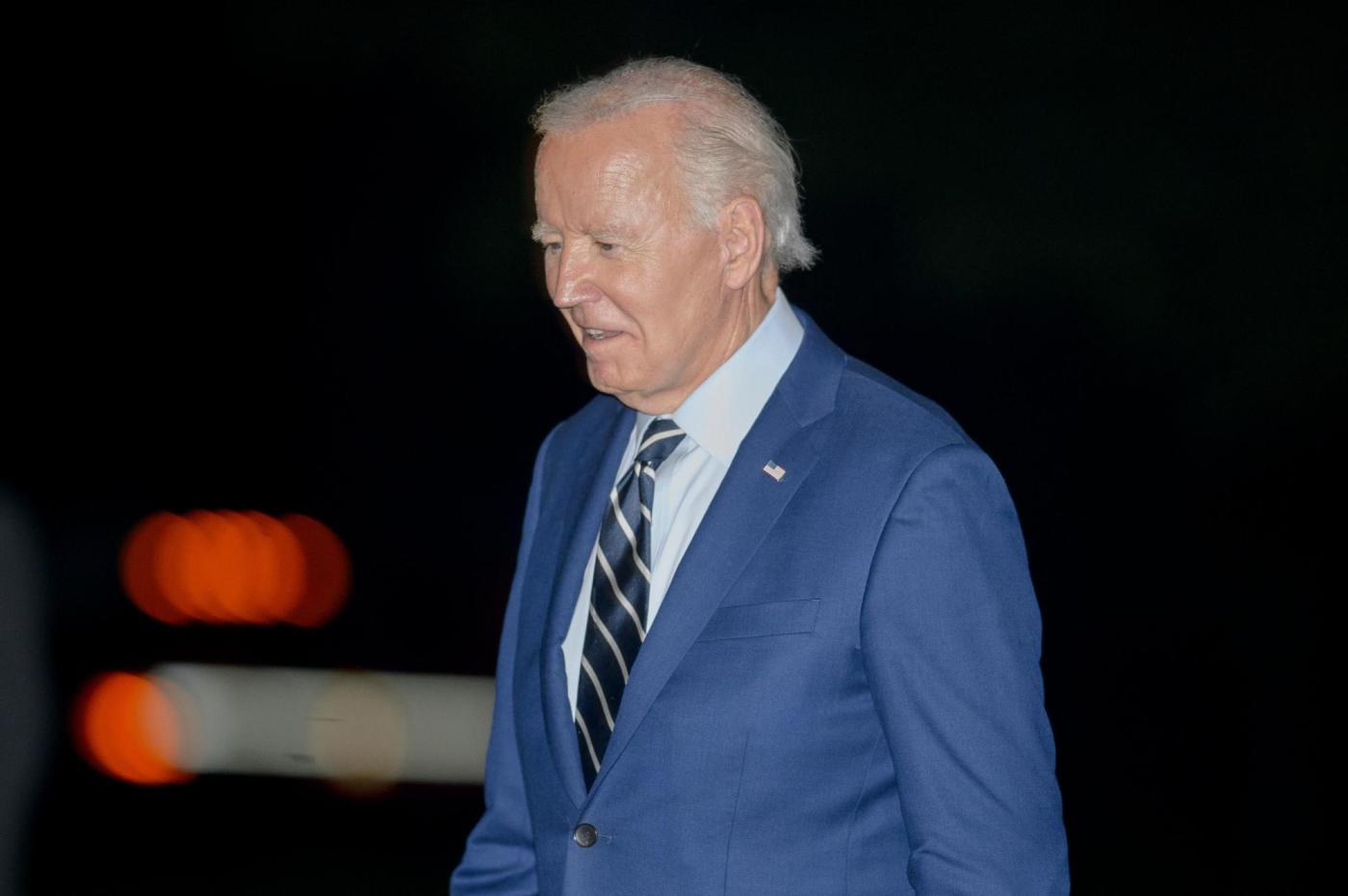
The Biden-Netanyahu took place one day after disclosures from journalist Bob Woodward’s new book, “War” that Biden has privately made his frustration and distrust of Israeli leader known.
The president privately unleashed a profanity-laden tirade, calling him a “son of a bitch” and a “bad f——— guy,” according to the book.
Biden said he felt, in Woodward’s accounting, that Netanyahu “had been lying to him regularly.” With Netanyahu “continuing to say he was going to kill every last member of Hamas.” Woodward wrote, “Biden had told him that was impossible, threatening both privately and publicly to withhold offensive U.S. weapons shipment.”
Hamas has been designated as a terrorist organization by the United States, Canada and the European Union.
The White House declined to comment.
Goldenberg reported from Jerusalem. Associated Press writer Lolita C. Baldor contributed to this report.
Hurricane Milton has started to bring its widespread impacts to Florida, with conditions expected to continue deteriorating over the coming hours from the central Gulf coast to the east coast through Thursday. View the scene from various spots using the live webcams below.
NOTE: The cams displayed were operating as of Wednesday morning, but may go offline as storm conditions worsen.