‘They answered the call’: 3 Burnsville first responders memorialized one year after they were killed in line of duty

posted in: All news | 0

A man holding an American flag and bagpipe silently saluted and put his hand over his heart on Tuesday in front of three wreaths memorializing three Burnsville first responders killed a year ago.

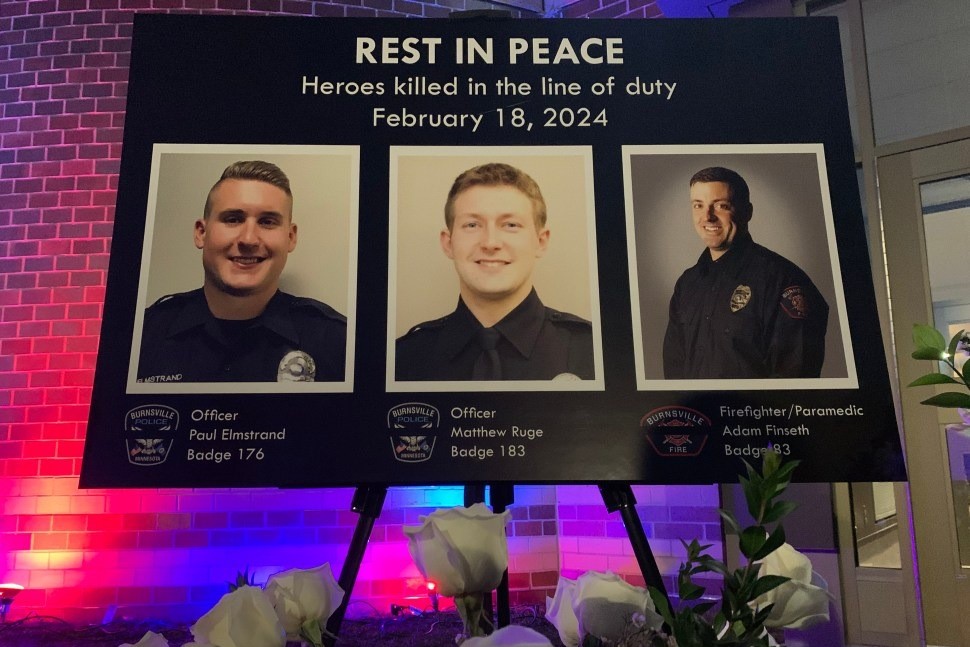
During a day of remembrances, Burnsville police officers gathered before dawn in the neighborhood where officers Matt Ruge and Paul Elmstrand, and firefighter/paramedic Adam Finseth were ambushed in a shooting.

Burnsville Deputy Police Chief Matt Smith said last week that he and officers wanted to be together at the same time they lost their colleagues and friends on Feb. 18, 2024.

“I said it at the memorial service last year and it’s so true, these guys — all three of them — were just the nicest guys,” Smith said. “We certainly miss them. … These sort of milestones are hard because it makes the feelings come back and they’re also, in their own way, healing to me.”

Related: In a year of sorrow, the women closest to Burnsville’s fallen first responders lean on each other

Last year, police responded to a 911 call about a domestic disturbance at a home on 33rd Avenue off Burnsville Parkway. Shannon Gooden, 38, barricaded himself in the home with seven children of his and his live-in girlfriend’s.

Police negotiated with Gooden for hours, but he opened fire “without warning” and shot more than 100 rifle rounds at law enforcement and first responders, the Minnesota Bureau of Criminal Apprehension said last year.

Gooden fatally shot Finseth, Elmstrand and Ruge, and wounded Sgt. Adam Medlicott.

“They answered the call of duty to rescue seven children with unwavering resolve,” Burnsville Mayor Elizabeth Kautz said at a memorial service at City Hall on Tuesday.

The mayor, city council members, and the police and fire chiefs were flanked by large photos of each of the three men in their uniforms, and memorial wreaths bearing ribbons with their names and “EOW (End of Watch) 2/18/2024.”

Memorial wreaths were also outside City Hall and people left bouquets of flowers; a crocheted blue heart was placed next to each officers’ wreath and a red heart by Finseth’s.

Among the people who visited the memorials Tuesday was Sue Allmann of Burnsville. She said she went to “thank them for their service and speak on the evil of the world, trying to bring light to what happened.”

Nathan Michels of Plymouth was in the area for a meeting and visited the wreaths to pay his respects. “I can’t believe it’s been a year,” he said. “… It’s just unreal.”

Related Articles

Crime & Public Safety |


Woodbury teen killed in Friday crash ‘so beloved’ by all who knew her

Crime & Public Safety |


No evidence NY killing of transgender MN man was hate crime, authorities say

Crime & Public Safety |


A Vermont border agent’s death, a MN native, was the latest violence linked to the cultlike Zizian group

Crime & Public Safety |


In a year of sorrow, the women closest to Burnsville’s fallen first responders lean on each other

Crime & Public Safety |


2 charged after Minnesota residents scammed out of $50,000

All the Burnsville officers who responded to the incident last year are back to work, Smith said.

“I think it’s a great testament to the resilience of everybody that works here and taking care of each other,” he said. “We’ve normalized getting mental health help, which we had already done before the incident.”

Last month, Ashley Dyrdahl, Gooden’s girlfriend, pleaded guilty to straw purchasing the firearms that Gooden used. Gooden, who died by suicide at the home after shooting the first responders, wasn’t allowed to possess firearms because of a past felony conviction.

Fundraising for trips to national memorials

The Minnesota Fraternal Order of Police Foundation is fundraising for family members and police and fire personnel to travel this spring to the National Law Enforcement Memorial and National Fallen Firefighters Memorial. Donations can be made at gofund.me/c592dd92.

Columbine High School shooting survivor dies decades after tragedy. Her tenacious spirit is remembered.

posted in: All news | 0

While Columbine High School shooting survivor Anne Marie Hochhalter’s life was shaped by tragedy, the tenacious woman worked hard to ensure tragedy did not define her.

Hochhalter was 17 when her life shifted from teen clarinet player to among the most injured survivors of the 1999 Columbine High School shooting. The high school junior was paralyzed after being shot in the back. She spent the rest of her days in a wheelchair with medical complications.

Six months after the shooting, her mother, Carla Hochhalter, walked into a pawnshop, asked to see a revolver and fatally shot herself.

Amid the media frenzy, medical care and grief, Anne Marie Hochhalter was determined to live life on her own terms. She went on to find her new normal, living independently in a handicap-accessible home with dogs to love and friends to cherish.

Anne Marie Hochhalter, 43, was found dead in her home Sunday.

Her death appears to be complications from the medical issues she suffered from the shooting, said Sue Townsend, stepmother of Lauren Townsend who died in the Columbine shooting. Sue and Rick Townsend reached out to Anne Marie Hochhalter after the tragedy and formed a familial relationship with her, calling her their “acquired daughter.”

“She was fiercely independent,” Sue Townsend said. “She was a fighter. She’d get knocked down — she struggled a lot with health issues that stemmed from the shooting — but I’d watch her pull herself back up. She was her best advocate and an advocate for others who weren’t as strong in the disability community.”

The families, united by tragedy, found joy within each other’s understanding, caring nature. They spent holidays and vacations together and developed a unique, intimate bond knitted together by wounds few else could understand.

“She was fun,” Sue Townsend said.

In 2018, they all took a Hawaii trip and rigged an innertube so Anne Marie Hochhalter could float in the ocean, her legs dangling in the water.

“She said the two hours she was out there she didn’t have any nerve pain at all,” Sue Townsend said. “The ocean was her happy place even though she didn’t get to go there but once.”

Nathan Hochhalter, Anne Marie Hochhalter’s brother, said his big sister was always a straight ‘A’ student who loved learning and reading. She had an affinity for musical instruments, playing harp, piano, clarinet and guitar.

“And she loved her mom a lot,” Nathan Hochhalter said.

Animals — particularly furry, four-legged friends — filled a huge part of Anne Marie Hochhalter’s heart.

She fostered dogs and owned several over the years, doting on them.

“She could probably name every dog in the neighborhood but maybe not the neighbors,” Sue Townsend said, laughing.

Two neighbors, Jan and Dave Anderson, who were a part of Anne Marie Hochhalter’s village, are taking her beloved chiweenie dog, Georgie.

Though Anne Marie Hochhalter was often in pain, she found escape in cinema. Sometimes, she and her friends would call each other, turn on a movie at the same time and watch it silently together over the phone, Sue Townsend said.

More than anything, Sue Townsend said Anne Marie Hochhalter would have wanted people to know she wasn’t a victim.

Her resilience, Sue Townsend said, was driven in part by stubbornness.

“It was this attitude of ‘I’ll show you,’” she said. “‘You’re not going to get me down.’”

In 2016, Anne Marie Hochhalter wrote a letter to the mother of Dylan Klebold who, along with Eric Harris, killed twelve students and one teacher in a shooting rampage at Columbine High School on April 20, 1999.

The letter to Sue Klebold coincided with an ABC television interview promoting her book “A Mother’s Reckoning: Living in the Aftermath of Tragedy.”

In the letter, Anne Marie Hochhalter told Sue Klebold she harbored no ill will toward her.

“Just as I wouldn’t want to be judged by the sins of my family members, I hold you in that same regard,” Hochhalter wrote. “It’s been a rough road for me, with many medical issues because of my spinal cord injury and intense nerve pain, but I choose not to be bitter towards you. A good friend once told me, ‘Bitterness is like swallowing a poison pill and expecting the other person to die.’ It only harms yourself. I have forgiven you and only wish you the best.”

Police say they believe bomb threat against Brian Thompson’s Maple Grove home was a hoax

posted in: News | 0

Police said Thursday that a bomb threat was made against the Maple Grove home of Brian Thompson, the UnitedHealthcare CEO who was fatally shot Wednesday morning in New York City.

The threat is believed to be a hoax, police said.

Maple Grove police put out a statement Thursday saying a “suspected swatting investigation” was underway. The department said it received a report of a bomb threat directed at two addresses around 7 p.m. Wednesday. The Minneapolis Bomb Squad and the Hennepin County Sheriff’s Office assisted, but investigators found no suspicions devices or other items.

“The case is considered an active investigation, while the incident appears to be a hoax. No further comments will be made at this time,” the police statement said.

Police reports provided to The Associated Press by the department show that officers made contact with family members at one of the homes and were told they had seen nothing suspicious and had received no direct threats.

Related Articles

Crime & Public Safety |


New images released of suspect in UnitedHealthcare CEO Brian Thompson killing without a mask, as manhunt shifts to UWS

Crime & Public Safety |


Gunman who killed UnitedHeathcare CEO Brian Thompson outside NYC Hilton left eerie message on bullets: NYPD sources

Crime & Public Safety |


Ammunition used in CEO’s killing had ‘Deny,’ ‘defend’ and ‘depose’ written on it, AP sources say

Crime & Public Safety |


MN-based UnitedHealthcare CEO Brian Thompson fatally shot in NYC. Here’s what we know.

Crime & Public Safety |


VIDEO: Killer of UnitedHealthcare CEO Brian Thompson stalked victim outside Midtown Hilton


The next census will gather more racial, ethnic information

posted in: News | 0

Tim Henderson | (TNS) Stateline.org

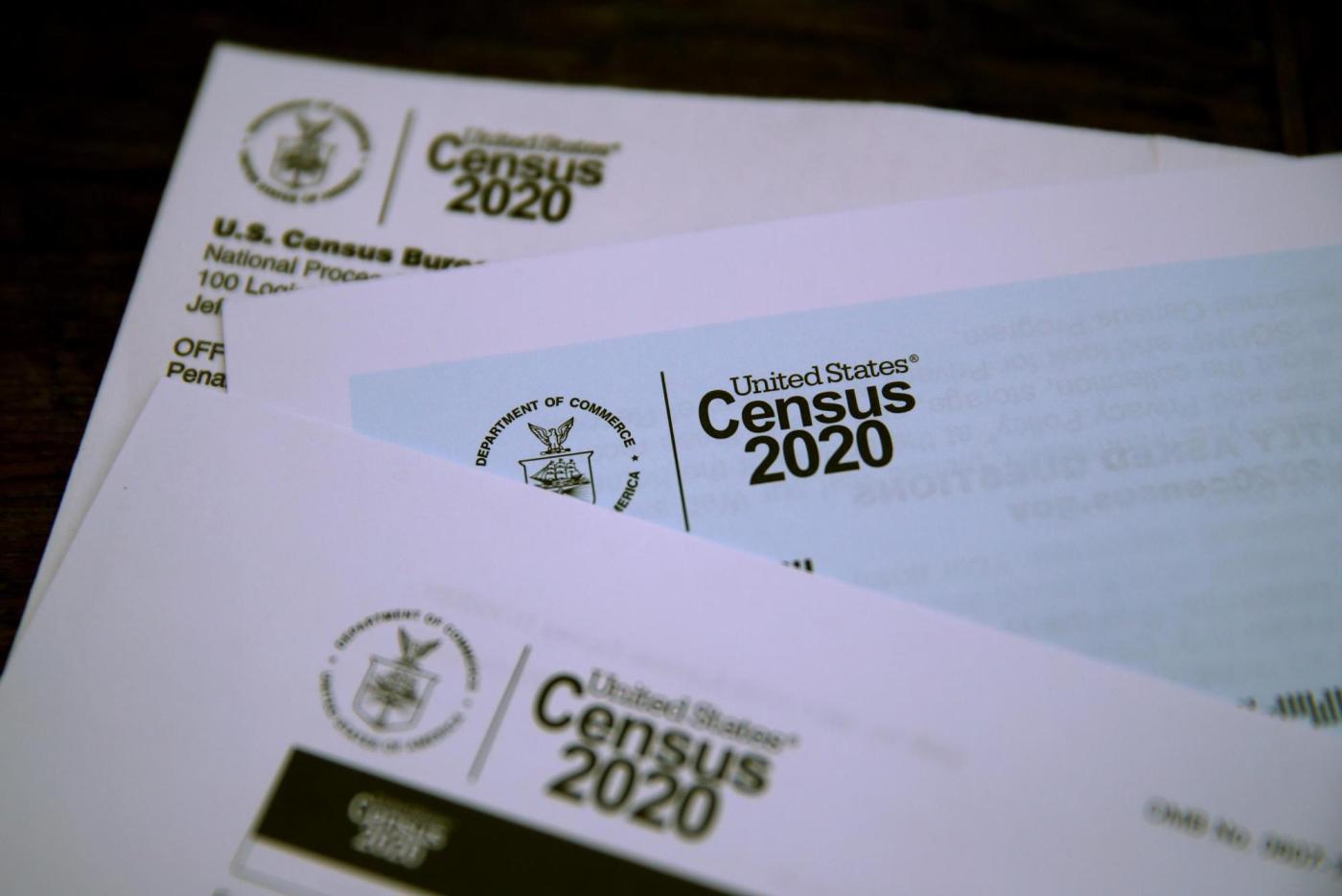
The U.S. Census Bureau and a growing number of states are starting to gather more detailed information about Americans’ race and ethnicity, a change some advocates of the process say will allow people to choose identities that more closely reflect how they see themselves.

Crunching and sorting through those specific details — known as data disaggregation — will help illuminate disparities in areas such as housing and health outcomes that could be hidden within large racial and ethnic categories. But some experts say the details also might make it harder for Black people from multiracial countries to identify themselves.

Racial data gleaned from the census is important because local, state, tribal and federal governments use it to guide certain civil rights policies and “in planning and funding government programs that provide funds or services for specific groups,” according to the Census Bureau.

The form will have checkboxes for main categories — current census groupings include “Asian,” “Black,” “African American” and “White,” among others — followed by more specific checkboxes. Under Asian, for example, might be Chinese, Asian Indian, Filipino, Vietnamese, Korean or Japanese. And then there will be an empty box for people to write in more specific subgroups.

Collecting more detail by allowing free-form answers, for example, will make it possible for people to identify themselves as part of more racial and ethnic subgroups — such as “Sardinian” (an autonomous region within Italy) instead of simply “Italian” — and include alternative names for certain groups, such as writing “Schitsu’umsh,” the ancient language for “Coeur D’Alene Tribe.”

And the Census Bureau will for the first time include Middle Eastern/North African as a separate racial/ethnic category for respondents with that heritage. Until now, Middle Eastern people who did not choose a race were treated as a subcategory under “white,” based on a 1944 court ruling intended to protect Arab immigrants from racist laws banning U.S. citizenship for nonwhite immigrants.

Under new federal guidelines approved in March, the bureau also will give people the option to check no race at all if they identify as Hispanic or Middle Eastern/North African.

The Census Bureau already has decided to use more open-ended questions in both the 2027 American Community Survey and the nation’s 2030 census. But the agency is seeking public comment on the way write-in responses will be categorized.

The bureau wants to hear how people are likely to identify themselves, said Merarys Ríos-Vargas, chief of the bureau’s Ethnicity and Ancestry Branch, Population Division, in a recent webinar. The agency also is interested in whether there are missing or incorrect entries in its proposed list of possible responses.

‘It’s about people’s lives’

Nancy López, a University of New Mexico sociology professor, said she and other experts in Black Hispanic culture think the census should have a “visual race” or “street race” question, so people can communicate how others see them as well as how they identify themselves. The answer might be “Black” or a yet-unrecognized racial category such as “brown.”

“A separate question on race as a visual status helps illuminate the kind of things we are interested in — discrimination in housing, discrimination in employment, discrimination in education and accessing health care in public spaces,” said López, who is the daughter of Dominican immigrants and a co-founder of the university’s Institute for the Study of “Race” & Social Justice.

“It’s about people’s lives, it’s about the future, it’s about children, it’s about access to opportunities and it’s about fairness,” she added, noting that even if the federal government doesn’t add such questions to surveys and the decennial census, state and universities can still do it on their own as they collect data for health care, student enrollment and other topics.

The NALEO Educational Fund, an organization representing Latino elected and appointed officials, supports the decision to make a race choice optional for Hispanics.

“Many Latinos did not see themselves in any of the categories for their racial identity,” said Rosalind Gold, NALEO’s chief public policy officer. “There’s a large number of Latinos who feel that identifying as Latino is both their racial and ethnic identity.”

Gold said NALEO understands the concern some have that failing to require a race designation will obscure racial information on Black Hispanics. But her group argues that the census can get what it needs by educating the public on how to respond and by including prompts on the questionnaires to guide race choices.

Black Hispanic people often see themselves as having a single racial and ethnic identity, according to several experts in Hispanic identity who spoke at a Census Bureau National Advisory Committee meeting Nov. 7.

“They conceptualize themselves as belonging to one [group],” said Nicholas Vargas, an associate professor of ethnic studies at the University of California, Berkeley, speaking at the committee meeting.

“They check ‘Black’ and they check ‘Dominican’ — and don’t want to be counted as two or more,” he said.

In response, Rachel Marks, an adviser for the Census Bureau on race and ethnicity, said the bureau will consider that issue and other “feedback on how people want to be represented” before making a final decision on survey details.

The bureau may recognize a term, Afro-Latino, that could be used to indicate both Black race and Hispanic ethnicity, according to a proposed code list from the agency, as well as “Blaxican” for Black Mexican and “Blasian“ for Black Asian.

The Leadership Conference on Civil and Human Rights, a coalition of civil rights groups, called the more detailed questions “a step forward” but also suggested more guidance on the forms to ensure people are categorized the way they want to be. In its comment on the changes, the group noted that in 2020, some people who wrote in “British” under the Black checkbox were categorized as partly white even if they didn’t mean that.

The group also said it is “concerned about a conflation of the concepts of race and ethnicity,” and it asked for more research to make sure people understand how to respond.

State actions

Some states are acting on their own to gather more detailed data about identity.

New Jersey is among the latest states to pass a law requiring more detailed race and ethnic data collection for state records such as health data and school enrollment.

A similar bill in Michigan would require state agencies that gather information to offer “multiracial” and “Middle Eastern or North African” as choices; the bill remains in committee.

And advocates in Oregon, which already has a law requiring detailed ethnic data collection, are asking the state for more details on Asian subgroups who face education challenges.

A December 2023 report by The Leadership Conference Education Fund identified 13 other states with laws requiring more detailed state data on ethnic and racial groups, including laws passed last year in Hawaii, Illinois, Massachusetts and Nevada.

The states of California, Connecticut, Minnesota, New Mexico, New York, Oklahoma, Oregon, Rhode Island and Washington already had such laws, the group found.

©2024 States Newsroom. Visit at stateline.org. Distributed by Tribune Content Agency, LLC.