Anger and anxiety loom over the Republican convention after the assassination attempt against Trump

posted in: News | 0

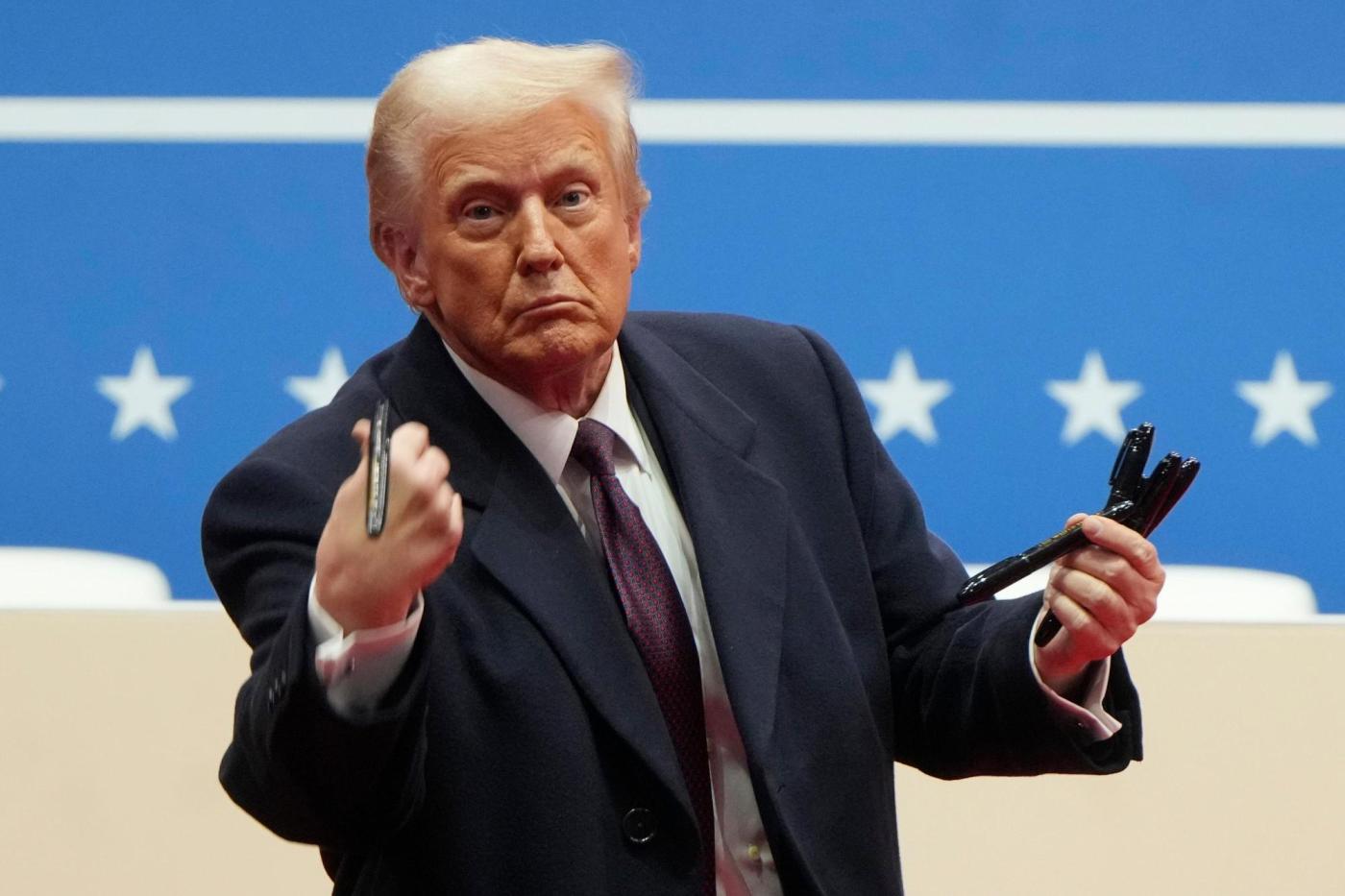
MILWAUKEE — Donald Trump’s campaign chiefs designed the convention opening this week to feature a softer and more optimistic message, focusing on themes that would help a divisive leader expand his appeal among moderate voters and people of color.

Then came a shooting that rattled the foundation of American politics.

Suddenly, the Democrats’ turmoil after the debate, the GOP’s potential governing agenda and even Trump’s criminal convictions became secondary to fears about political violence and the country’s stability. The presumptive Republican nominee and his allies will face the nation during their four-day convention in Milwaukee unquestionably united and ready to “fight,” as the bloodied Trump cried out Saturday while Secret Service agents at his Pennsylvania rally rushed him to safety.

Anger and anxiety are coursing through the party, even as many top Republicans call for calm and a lowering of tensions.

Sen. Tim Scott of South Carolina, known for his sunny and optimistic vision of Republican politics, suggested online the attempted assassination had been “aided and abetted by the radical Left and corporate media incessantly calling Trump a threat to democracy, fascists, or worse.”

Republican House Speaker Mike Johnson, another likely convention speaker, offered a more somber tone during a Sunday appearance on NBC.

“We’ve got to turn the temperature down in this country,” Johnson said. “We need leaders of all parties, on both sides, to call that out and make sure that happens so that we can go forward and maintain our free society that we all are blessed to have.”

There are no changes yet to the convention program

In an interview Sunday, Republican Party chairman Michael Whatley said the convention’s programming wouldn’t be changed after the shooting. The agenda, he said, will feature more than 100 speakers overwhelmingly focused on kitchen table issues and Trump’s plans to lift everyday working Americans.

“We have to be able to lay out a vision for where we want to take this country,” he said.

Whatley said the central message would have little to do with President Joe Biden’s political struggles, Trump’s grievances about the 2020 election or the ex-president’s promises to exact retribution against political enemies.

“We are going to have the convention that we have been planning for the last 18 months,” he said. “We are a combination of relieved and grateful that the president is going to be here and is going to accept the nomination.”

Beyond voting to formally give Trump the nomination, elected delegates from across the nation will update the GOP’s policy platform for the first time since 2016. The scaled-down platform proposal — just 16 pages with limited specifics on key issues, including abortion — reflects a desire by the Trump campaign to avoid giving Democrats more material on a key campaign issue.

The platform approved by a committee last week doesn’t include an explicit call for a national abortion ban, two years after the U.S. Supreme Court overturned Roe v. Wade and ended a federally guaranteed right to abortion.

Many anti-abortion advocates strongly opposed the Trump campaign’s rewriting of the platform. But after the shooting, at least one major religious conservative said he wouldn’t press to reverse the committee’s decision.

“More divisiveness would not be healthy,” said Tony Perkins, president of the Family Research Council.

Perhaps most importantly, Trump will use the convention to unveil his choice for vice president, which could come as soon as Monday. Some Republicans believe the pick will take on more importance than it would have otherwise given the new threats to Trump’s life.

His top three contenders are North Dakota Gov. Doug Burgum, Ohio Sen. JD Vance and Florida Sen. Marco Rubio, all expected to speak this week.

Despite a contentious primary season, any lingering tensions appear to have been set aside.

Former rivals Florida Gov. Ron DeSantis and Nikki Haley, the former United Nations ambassador, are expected to speak at the convention on Trump’s behalf.

Veteran Republican pollster Frank Luntz said the shooting ensured the GOP is united and motivated behind Trump, a dynamic he said will be on display all week in Wisconsin.

“Every single Trump supporter will now be a Trump voter,” Luntz said. “The average Trump voter is so angry at what just happened. They were angry before this, and now they’re furious.”

People connected to Jan. 6 will be involved

There will be reminders of Trump’s record in a speaking program that includes a handful of Republicans charged with crimes related to other political violence — the Jan. 6, 2021, attack on the U.S. Capitol.

Former White House trade adviser Peter Navarro, who’s in jail on contempt of Congress charges, is expected to speak at the convention just hours after his release. He was found guilty in September after refusing to cooperate with a congressional investigation into the Capitol attack.

Nevada GOP Chair Michael McDonald, who was indicted of criminal charges related to his involvement in the scheme to present fake electors who would overturn Biden’s victory over Trump, plans to present the former president with the party nomination at the convention. A judge dismissed the case against McDonald last month over a venue dispute.

Trump has repeatedly cast the people involved in efforts to overturn the 2020 election, including his many supporters who stormed the Capitol, as political prisoners.

For now, Democrats have scaled back their plans to offer a competing message during the Republican convention.

The Biden campaign over the weekend pulled down its campaign ads. Vice President Kamala Harris postponed a Tuesday appearance in Florida set to focus on Trump’s opposition to abortion rights. And the pro-Democratic group American Bridge is delaying the scheduled Monday release of faux trading cards designed to highlight controversial policy positions of Trump and other leading Republicans.

Biden’s campaign said that, after an interview he does with NBC airs Monday, it and the Democratic National Committee “will continue drawing the contrast” with Trump over the course of the GOP convention — even though it remains unclear when ads would resume.

Publicly and privately, Democrats feared that they were losing a critical opportunity to undermine Trump’s political ambitions at one of the biggest moments of the 2024 election.

“I’m very concerned that the net effect of the Republican convention will be neutralizing the core democracy critique of Trump — a felon who fomented a violent insurrection, tried to block the peaceful transfer of power, and said the Constitution may need to be terminated,” Adam Green, co-founder of the Progressive Change Campaign Committee, said Sunday. “There is a race to define the democracy critique of Trump as legitimate, and we all need to make clear now that protecting democracy is the exact opposite of political violence.”

There are expected to be protesters in Milwaukee

The convention, coming less than four months before Election Day, will take place in heavily Democratic Milwaukee, the largest city in a pivotal swing state Trump lost by less than 1 percentage point four years ago.

Even before the assassination attempt, major protests were expected, although movement will be severely restricted as part of enhanced security precautions established by the Secret Service.

Still, the risk of violent confrontation exists.

Security officials previously announced that people just outside the Secret Service perimeter would be allowed to carry guns openly or concealed as permitted by state law. Wisconsin statutes outlaw only machine guns, short-barreled shotguns and silencers.

___

Associated Press writer Thomas Beaumont in Pewaukee, Wisconsin, contributed to this report.

Related Articles

National Politics |


Floor fights, boos and a too-long kiss. How the dramatic and the bizarre define convention history

National Politics |


The RNC’s first day will still focus on the economy. Here’s what to know about Trump’s plans

National Politics |


When does a presumptive nominee become a nominee? Here’s how Donald Trump will make it official

National Politics |


America’s toxic political climate faces calls to ‘tone it down’ after assassination attempt on Trump

National Politics |


Trump shooting changes Biden’s strategy to revive 2024 campaign


Today in History: July 15, discovery of the Rosetta Stone

posted in: News | 0

Today is Monday, July 15, the 197th day of 2024. There are 169 days left in the year.

Today’s Highlight in History:

On July 15, 1799, the Rosetta Stone, a key to deciphering ancient Egyptian scripts, was found at Fort Julien in the Nile Delta during the Napoleonic campaign in Egypt.

Also on this date:

In 1834, the Spanish Inquisition was abolished more than 350 years after its creation.

In 1870, Georgia became the last Confederate state to be readmitted to the Union.

Related Articles


Reagan survived an assassination attempt and his response changed the trajectory of his presidency


Today in History: July 14, the storming of the Bastille


David Brooks: The deep source of Trump’s appeal


Today in History: July 13, Live Aid concerts


Today in History: July 12, Disco Demolition Night

In 1913, Democrat Augustus Bacon of Georgia became the first person elected to the U.S. Senate under the terms of the recently ratified 17th Amendment to the U.S. Constitution, providing for popular election of senators.

In 1916, The Boeing Company, originally known as Pacific Aero Products Co., was founded in Seattle.

In 1975, three American astronauts blasted off aboard an Apollo spaceship hours after two Soviet cosmonauts were launched aboard a Soyuz spacecraft for a mission that included a linkup of the two ships in orbit.

In 1976, a 36-hour kidnap ordeal began for 26 schoolchildren and their bus driver as they were abducted near Chowchilla, California, by three gunmen and imprisoned in an underground cell. (The captives escaped unharmed; the kidnappers were caught.)

In 1996, MSNBC, a 24-hour all-news network, made its debut on cable and the internet.

In 1997, fashion designer Gianni Versace, 50, was shot dead outside his Miami Beach home; suspected gunman Andrew Phillip Cunanan (koo-NAN’-an), 27, was found dead eight days later, a suicide. (Investigators believed Cunanan killed four other people before Versace in a cross-country rampage that began the previous March.)

In 2002, John Walker Lindh, an American who’d fought alongside the Taliban in Afghanistan, pleaded guilty in federal court in Alexandria, Virginia, to two felonies in a deal sparing him life in prison.

In 2006, Twitter (now known as X) was launched to the public.

In 2019, avowed white supremacist James Alex Fields Jr. was sentenced to life in prison plus 419 years for killing one and injuring dozens of others when he deliberately drove his car into a crowd of anti-racism protesters during a rally in Charlottesville, Virginia.

In 2020, George Floyd’s family filed a lawsuit against the city of Minneapolis and the four police officers charged in his death, alleging the officers violated Floyd’s rights when they restrained him and that the city allowed a culture of excessive force, racism and impunity to flourish in its police force. (The city would agree to pay $27 million to settle the lawsuit in March 2021.)

Today’s Birthdays:

Actor Patrick Wayne is 85.
R&B singer Millie Jackson is 80.
Singer Linda Ronstadt is 78.
Author Richard Russo is 75.
Musician Trevon Horn is 75.
Arianna Huffington, co-founder of The Huffington Post, is 74.
Former professional wrestler and Minnesota governor Jesse Ventura is 73.
Actor Terry O’Quinn (TV: “Lost”) is 72.
Rock drummer Marky Ramone is 72.
Rock musician Joe Satriani is 68.
Model Kim Alexis is 64.
Actor Willie Aames is 64.
Actor-director Forest Whitaker is 63.
Actor Brigitte Nielsen is 61.
Rock drummer Jason Bonham is 58.
TV personality Adam Savage (TV” “MythBusters”) is 57.
Actor-comedian Eddie Griffin is 56.
Actor-screenwriter Jim Rash (TV: “Community”) is 52.
Actor Scott Foley is 52.
Actor Brian Austin Green is 51.
Singer Buju Banton is 51.
Actor Diane Kruger is 48.
Actor Lana Parrilla (LAH’-nuh pa-REE’-uh) is 47.
Actor Travis Fimmel is 45.
Actor-singer Tristan “Mack” Wilds is 35.
NBA point guard Damian Lillard is 34.
Actor Iain Armitage (TV: “Young Sheldon”) is 16.

Floor fights, boos and a too-long kiss. How the dramatic and the bizarre define convention history

posted in: Politics | 0

By Will Weissert, Associated Press

WASHINGTON (AP) — In 1948, the Republican and Democratic parties did something unthinkable in today’s climate of ferocious political animosity: They not only held their national conventions in the same city, but shared some of the props.

Both gathered in Philadelphia, largely because its Municipal Auditorium had already been fitted with the wiring needed for then-groundbreaking live convention coverage on national television.

Related Articles

National Politics |


The RNC’s first day will still focus on the economy. Here’s what to know about Trump’s plans

National Politics |


When does a presumptive nominee become a nominee? Here’s how Donald Trump will make it official

National Politics |


America’s toxic political climate faces calls to ‘tone it down’ after assassination attempt on Trump

National Politics |


Trump shooting changes Biden’s strategy to revive 2024 campaign

National Politics |


A timeline of the assassination attempt on former President Trump

To save money, Democrats asked Republicans to leave the American flags and bunting up to be reused at its event 17 days later. The GOP complied, though some items became faded and worn in the interval.

Like party comradery, the more informal way conventions were staged has evaporated. Once bare-knuckled showdowns to hammer out presidential nominees, modern gatherings have evolved into carefully scripted, made-for-TV events meant to showcase party unity.

Republicans are largely on track to deliver that as they nominate former President Donald Trump in Milwaukee this week. The Democratic convention could feature more drama when it opens on Aug. 19, given the bitter debate over whether President Joe Biden should stay atop the party’s ticket.

But even with conventions now choreographed down to tiny details, the unexpected can still happen. Here’s a look at the floor fights, street battles, and other memorable convention scenes that were uplifting, outlandish or just plain awkward:

Ted Cruz’s non-endorsement

As the last candidate Donald Trump defeated during the 2016 GOP primary, Texas Sen. Ted Cruz amassed enough delegates to address the party’s convention in Cleveland — but balked at endorsing his former rival.

Still smarting over Trump calling him “Lyin’ Ted,” mocking his wife Heidi Cruz’s appearance and suggesting that the senator’s Cuba-born father was involved in the assassination of John F. Kennedy, Cruz implored delegates to “vote your conscience.” It drew prolonged boos.

Cruz reversed himself and endorsed Trump that fall, and today is among his staunchest defenders. But, at the time, the vitriol was high enough that Heidi Cruz was led from the convention floor, just in case.

Clint Eastwood’s empty chair

A head-scratching moment came in 2012, when Clint Eastwood addressed the Republican gathering in Tampa, Florida, with an empty chair standing in for then-President Barack Obama.

Actor Clint Eastwood speaks during the final day of the Republican National Convention at the Tampa Bay Times Forum on August 30, 2012 in Tampa, Florida. (Mark Wilson/Getty Images)

The actor and director spent 12 minutes conversing with the piece of furniture, and even dodging barrages of imaginary obscenities from it.

“What do you mean shut up?” Eastwood crowed.

He also joked about then-Vice President Biden’s reputation for gaffes — launching criticisms that may prove prescient given current questions about whether Biden can handle a second term, following his disastrous debate performance.

“Of course, we all know Biden is the intellect of the Democratic party,” Eastwood told the chair. “Just kind of a grin, with a body behind it.”

‘Audacity of hope’

The year 2004 was otherwise terrible for Democrats, President George W. Bush won reelection and Republicans retained control of Congress. But one bright spot came from Obama, then a little-known Illinois state senator, electrifying his party’s Boston convention.

Obama dubbed himself “a skinny kid with a funny name who believes that America has a place for him, too” and summed up his political philosophy as being built around “the audacity of hope.”

Gore’s extra-long kiss

As he stepped on stage to deliver a speech accepting his party’s 2000 presidential nomination in Los Angeles, Al Gore embraced his wife Tipper and gave her a full-mouthed kiss, hanging on much longer than usual for a display of passion in public.

Democratic presidential candidate Al Gore kisses his wife Tipper after she introduced him to the Democratic National Convention at the Staples Center, August 17, 2000 in Los Angeles, California. (LUCY NICHOLSON/AFP via Getty Images)

The crow cheered, but the kiss eventually encompassed an uncomfortable three seconds of screen time.

Gore had been battling criticisms that he was too stiff during public appearances, which may have explained how hard he leaned in. Regardless, the smooch was remembered more than Gore’s speech.

He went on to narrowly lose that November to Bush. A decade later, the Gores separated after 40 years of marriage.

Women on the ticket

At the Democrats’ 1984 convention in San Francisco, presidential nominee Walter Mondale announced Geraldine Ferraro as his running mate, making her the first woman on a major presidential ticket. Ferraro declared, “America is the land where dreams can come true for all of us,” though she and Mondale went on to win just 13 electoral votes compared to President Ronald Reagan ‘s 525.

Twenty years later, Sen. John McCain chose Sarah Palin as his vice presidential candidate, and her speech at the Republican convention in St. Paul, Minnesota, was a hit, mixing the then-Alaska governor’s compelling personal story with humor and political punch. It gave McCain a boost, but he still lost to Obama.

At the 2016 Democratic convention in Philadelphia, Hillary Clinton became the first major party female presidential nominee, declaring, “When any barrier falls in America, for anyone, it clears the way for everyone.” She eventually lost to Trump.

Kamala Harris was the first woman on a winning ticket, accepting being Biden’s running mate during a mostly virtual convention last cycle — and now is some Democrats’ choice to replace Biden in this year’s presidential race.

Opposing the incumbent

In 1976, Reagan, then California’s governor, challenged President Gerald Ford from the right and touched off a bitter struggle at the GOP’s convention in Kansas City. Ford narrowly prevailed with 1,187 votes to 1,070, but lost that November to Democrat Jimmy Carter.

Four years later, at the Democratic convention in New York, Carter himself faced a floor challenge from Massachusetts Sen. Ted Kennedy, who badly trailed the president in delegates but tried to loosen rules on how they were pledged to vote. Tensions ran high and, though the change was defeated, Carter later lost to Reagan.

Eagleton’s 18-day vice presidential candidacy

Biden facing increasing pressure to leave the race is without modern precedent at the top of a presidential ticket — but not when it comes to a nominee’s running mate.

Shortly after the 1972 Democratic convention in Miami, reports surfaced that Democratic presidential nominee George McGovern ’s vice presidential pick, Missouri Sen. Thomas Eagleton, had previously undergone electroshock therapy to treat depression.

A divided convention had prompted McGovern to tap Eagleton on its final day, after he was turned down by several alternatives. Eagleton therefore didn’t receive much vetting of his record, which might have surfaced the medical disclosures earlier.

Eagleton resigned after 18 days on the ticket and was replaced by Sargent Shriver. Incumbent Republican President Richard Nixon went on to win 49 out of 50 states that November.

Chaos in Chicago

After President Lyndon B. Johnson opted not to seek reelection and Robert F. Kennedy was assassinated, Vice President Hubert Humphrey secured the 1968 Democratic nomination at the party’s convention. But that was only after a raucous floor fight which ended with delegates defeating a peace platform seeking an end to the Vietnam war.

A police officer escorts a protestor to a squad car surrounded by dozens of anti-Vietnam War demonstrators outside the 1968 Democratic National Convention, Chicago, Illinois, August 1968. (Photo by Hulton Archive/Getty Images)

What happened at the convention was overshadowed by thousands of anti-war protesters who marched in the streets. Demonstrators were attacked by police, sparking such turmoil that the tear gas fired reached the 25th floor hotel suite where Humphrey was preparing for his appearance at a hotel five miles from the convention site.

The Democratic convention returns to Chicago in a few weeks, and widespread demonstrations are being planned to oppose the Biden administration’s support for Israel in its war with Hamas — leaving some to wonder whether a 1968 redux could be coming. With questions about Biden staying in the race still being raised, things inside the convention might get equally heated.

The RNC’s first day will still focus on the economy. Here’s what to know about Trump’s plans

posted in: Politics | 0

By Josh Boak, Associated Press

WASHINGTON (AP) — Donald Trump goes into the Republican National Convention with bold promises about the U.S. economy, but he has sketched out notably few details about how his plans would actually work.

The convention’s first day is still expected to focus on the economy even after Saturday’s shooting at a Trump rally in Pennsylvania in which the former president was injured.

If the program goes ahead as planned, expect speakers to argue that Trump’s agenda of sweeping tariffs and lower taxes would jump-start the economy.

The former president says he wants tariffs on trade partners and no taxes on tips and would like to knock the corporate tax rate down a tick. The Republican platform also promises to “defeat” inflation and “quickly bring down all prices,” in addition to pumping out more oil, natural gas and coal.

View of a Make America Great Again art installation in downtown Milwaukee, Wisconsin, on July 14, 2024, ahead of the 2024 Republican National Convention. (Photo by BRENDAN SMIALOWSKI/AFP via Getty Images)

The platform would address illegal immigration in part with the “largest deportation program in American history.” And Trump would also scrap President Joe Biden’s policies to develop the market for electric vehicles and renewable energy.

Democrats and several leading economists say the math shows that Trump’s ideas would cause an explosive bout of inflation, wallop the middle class and — by his extending his soon-to-expire tax cuts — heap another $5 trillion-plus onto the national debt.

Trump has released few hard numbers and no real policy language or legislative blueprints. Instead, his campaign is betting that voters care more about attitude than policy specifics.

The Associated Press sent the Trump campaign 20 basic questions in June to clarify his economic views and the campaign declined to answer any of them. Spokeswoman Karoline Leavitt insisted that Trump best speaks for himself and directed the AP to video clips of him.

By contrast, Biden has an exhaustive 188-page budget proposal that lays out his economic vision, even as his campaign had increasingly devolved before Saturday’s rally shooting into questions about his age and whether he should remain the nominee after a self-defeating June 27 debate.

A recent analysis by the Peterson Institute of International Economics showed that deporting 1.3 million workers would cause the size of the U.S. economy to shrink by 2.1%, essentially creating a recession.

Stephen Moore, an informal Trump adviser and economist at the Heritage Foundation, a conservative think tank, said Trump is unique in that he’s already been president and voters can judge him off his record in office.

“You want to know what he’s going to do in his second term, look at what he did in his first term,” Moore said.

Democrats have argued that Trump would be more extreme in his second term, using his own remarks to say he would put independent federal agencies under his direct control and use the federal government to settle scores with his perceived enemies. The Heritage Foundation’s Project 2025 blueprint is a template for what a second term would look like, they argue, a claim that Trump has disputed.

But Moore said he believes that Trump would be pragmatic in office and focus on the needs of business to drive economic growth.

“There is an idea that it’s going to be like slash and burn — I don’t think it’s going to be a radical agenda,” Moore said.

Some of Trump’s plans have gotten bipartisan backing. Both of Nevada’s senators, Jacky Rosen and Catherine Cortez Masto, are Democrats who would like to ban taxes on tips paid to workers, even as the Biden White House favors a higher minimum wage for tipped workers.

Companies do like Trump’s ideas to cut regulations and further lower the corporate tax rate from 21% to 20%. The tax rate had been 35% when he became president in 2017. Democrats, by comparison, want a 28% corporate tax rate in order to fund programs for the middle class and deficit reduction.

Related Articles

National Politics |


Trump shooting changes Biden’s strategy to revive 2024 campaign

National Politics |


A timeline of the assassination attempt on former President Trump

National Politics |


Former fire chief who died at Trump rally used his body to shield family from gunfire

National Politics |


What to know about the assassination attempt of Donald Trump

National Politics |


In prime-time address, Biden asks Americans to reject political violence and ‘cool it down’

But Trump has also floated huge tariffs that he says would protect U.S. manufacturing jobs. Biden preserved the tariffs on China that Trump introduced and went a step further by banning exports of advanced computer chips to China.

Companies generally dislike tariffs — which are taxes on imports — because they can raise costs, which are then likely borne by consumers. An analysis by the economists Kimberly Clausing and Mary Lovely found that Trump’s tariffs would cost a typical U.S. household $1,700 a year in what would effectively be a tax hike.

Trump’s tariff plans could worsen inflation as a result, even though the Republican says in videos that he would reduce inflation. It’s unclear how Trump would lower inflation, which peaked in 2022 at 9.1% and has since eased to 3% annually.

“The tariff issue is extremely important — and people are not paying enough attention to the magnitude of the Trump tariff policy, what the consequences would be,” said Clausing, a former Biden Treasury Department official and professor at the University of California, Los Angeles.

But tariffs might be more of a political winner than an economic strategy, according to a research paper earlier this year by the economists David Autor, Anne Beck, David Dorn and Gordon Hanson. The research found that the tariffs during Trump’s first term did not increase employment, but the tariffs did help Trump politically in the 2020 election in the industrial areas that lost jobs to China and other countries.

Clausing noted that Trump is proposing tariffs on more than $3 trillion of imports, a 10-fold increase over what he did in his first term. She noted that the tariffs could make it more expensive to bring in the raw materials that U.S. factories need while also raising prices for consumers already struggling with high inflation. She said she wants people to understand the risks Trump’s economic policies could pose before it’s too late.

““I think people will notice when everything gets wildly expensive,” she said. “This is going to be a huge disaster.”