China sticks to an economic growth target of ‘around 5%’ despite a looming trade war with US

posted in: All news | 0

By SIMINA MISTREANU and KEN MORITSUGU

BEIJING (AP) — The Chinese government unveiled an annual economic growth target of “around 5%” on Wednesday, despite the possible negative impact of a looming trade war with the United States, and pledged to address what it called “sluggish” consumer spending at home.

Related Articles

World News |


US charges Chinese hackers, government officials in broad cyberespionage campaign

World News |


Trudeau not willing to lift Canada’s retaliatory tariffs if Trump leaves some tariffs on Canada

World News |


Panama president calls Trump’s talk of ‘reclaiming’ the Panama Canal a lie

World News |


Trump administration signals that the tariffs against Canada and Mexico may soon have exemptions

World News |


Catholic Church opens Lent season with words of solidarity for pope sidelined with pneumonia

The target was announced at the opening session of the annual meeting of China’s legislature. It’s the same as for the last two years but will likely be more difficult to achieve because of the new, higher U.S. tariffs on Chinese products and other economic headwinds. The use of “around” gives the government some room if growth falls short.

The target signals the government’s intention to try to stabilize growth in challenging economic times but hold back on more dramatic action that some economists say is needed to supercharge it.

The government also said in a draft budget released Wednesday that defense spending would rise 7.2% this year to 1.78 trillion yuan ($245 billion), second only to the United States.

It released the growth target in a separate report, parts of which were presented to the nearly 3,000 members of the National People’s Congress by Premier Li Qiang. It acknowledged both international and domestic challenges.

“An increasingly complex and severe external environment may exert a greater impact on China in areas such as trade, science, and technology,” the report said, without specifics. “Unilateralism and protectionism are on the rise.”

It added: “Domestically, the foundation for China’s sustained economic recovery and growth is not strong enough. Effective demand is weak, and consumption, in particular, is sluggish.”

The International Monetary Fund has projected that China’s economy will grow 4.6% this year, down from 5% in 2024, according to Chinese government statistics.

The new report placed more emphasis on reviving domestic demand and consumption than last year’s, echoing a shift by the ruling Communist Party at meetings in December. It said the government should “make domestic demand the main engine and anchor of economic growth.”

The report added that “achieving this year’s targets will not be easy, and we must make arduous efforts to meet them.”

Across-the-board 20% tariffs imposed this week on Chinese products by U.S. President Donald Trump pose the latest threat to an economy already weighed down by a prolonged real estate slump and sluggish consumer spending and private business investment. The tariffs could crimp sales to one of China’s major export markets, making the need to boost domestic demand more urgent.

The new report offered some details on the party’s plans for a “more proactive fiscal policy,” including a rise in the government budget deficit from 3% to 4% of GDP, or the size of the overall economy. It also reiterated the party’s announcement in December that the central bank would shift its monetary policy from “prudent” to “moderately loose” for the first time in more than a decade.

The government will issue 1.3 trillion yuan ($180 billion) in ultra-long term bonds, up from 1 trillion yuan last year, the report said. Of that, 300 billion yuan would go toward a program launched last year that offers rebates to consumers who trade in automobiles or appliances for new ones, doubling central government support for the program.

Economists expressed doubts over whether the policies will do enough, noting that the government reduced its inflation target to 2% from 3% last year, and suggesting leaders have accepted that the economy is still mired in deflation, or a cycle of weakening prices.

The degree of support is “more modest than it may appear,” Julian Evans-Pritchard of Capital Economics said in a report. “We remain skeptical that it will be sufficient to prevent growth from slowing this year, especially given the headwinds on the external front and the lack of a more pronounced shift in government spending toward support for consumption.”

Chinese leader Xi Jinping also wants to wean the economy off its long-running dependence on the highly indebted real estate market.

He is directing economic resources into developing a more innovative, high-tech economy — and with growing restrictions on U.S. technology exports to China, one that isn’t beholden to other countries for the most powerful semiconductors and other electronic components.

Xi told delegates from Jiangsu province, one of China’s wealthier coastal provinces known for exports, on Wednesday that “technological innovation and industrial innovation are the basic paths to developing new quality productivity.”

He also referred to a meeting in February with the heads of China’s top private companies, and said the province should “treat all types of enterprises equally, and continuously optimize the business environment.”

The push towards developing a high-tech economy has been a long-term economic goal of the Communist Party, though it has enacted measures since September that suggest a shift in emphasis toward shoring up growth in the short term.

The new report highlighted artificial intelligence in a section on fostering “industries of the future,” saying the government would support the application of large-scale AI models, smart manufacturing equipment, connected vehicles and intelligent robots.

The Supreme Court confronts a national headache: What to do with the growing pile of nuclear waste

posted in: All news | 0

By MARK SHERMAN

WASHINGTON (AP) — The Supreme Court will hear arguments Wednesday in a fight over plans to store nuclear waste at sites in rural Texas and New Mexico.

Related Articles


Divided Supreme Court reinstates order requiring Trump administration to release frozen foreign aid


Eyeing a friendly Supreme Court, Republicans push for the Ten Commandments in schools


Supreme Court seems likely to block Mexico’s $10 billion lawsuit against US gun makers


Supreme Court won’t hear a challenge to college programs for reporting bias allegations


Supreme Court seems likely to rule for Ohio woman claiming job bias because she’s straight

President Joe Biden’s administration and a private company with a license for the Texas facility appealed a ruling by the 5th U.S. Circuit Court of Appeals that found that the Nuclear Regulatory Commission exceeded its authority in granting the license. The outcome of the case will affect plans for a similar facility in New Mexico roughly 40 miles (65 kilometers) away.

On this issue, President Donald Trump’s administration is sticking with the views of its predecessor, even with Texas Gov. Greg Abbott, a Republican ally of Trump, on the other side.

The push for temporary storage sites is part of the complicated politics of the nation’s so far futile quest for a permanent underground storage facility.

Here’s what to know about the case:

Where is spent nuclear fuel stored now?

Roughly 100,000 tons (90,000 metric tons) of spent fuel, some of it dating from the 1980s, is piling up at current and former nuclear plant sites nationwide and growing by more than 2,000 tons (1,800 metric tons) a year. The waste was meant to be kept there temporarily before being deposited deep underground.

A plan to build a national storage facility northwest of Las Vegas at Yucca Mountain has been mothballed because of staunch opposition from most Nevada residents and officials.

The Nuclear Regulatory Commission has said that the temporary storage sites are needed because existing nuclear plants are running out of room. The presence of the spent fuel also complicates plans to decommission some plants, the Justice Department said in court papers.

Where would it go?

The NRC granted the Texas license to Interim Storage Partners LLC for a facility that could take up to 5,000 metric tons of spent nuclear fuel rods from power plants and 231 million tons of other radioactive waste. The facility would be built next to an existing dump site in Andrews County for low-level waste such as protective clothing and other material that has been exposed to radioactivity. The Andrews County site is about 350 miles (560 kilometers) west of Dallas, near the Texas-New Mexico state line.

The New Mexico facility would be in Lea County, in the southeastern part of the state near Carlsbad. The NRC gave a license for the site to Holtec International.

The licenses would allow for 40 years of storage, although opponents contend the facilities would be open indefinitely because of the impasse over permanent storage.

Political opposition is bipartisan

Republicans and Democrats, environmental groups and the oil and gas industry all oppose the temporary sites.

Abbott is leading Texas’ opposition to the storage facility. New Mexico Democratic Gov. Michelle Lujan Grisham also is opposed to the facility planned for her state.

A brief led by Republican Texas Sen. Ted Cruz on behalf of several lawmakers calls the nuclear waste contemplated for the two facilities an “enticing target for terrorists” and argues it’s too risky to build the facility atop the Permian Basin, the giant oil and natural gas region that straddles Texas and New Mexico.

Elected leaders of communities on the routes the spent fuel likely would take to New Mexico and Texas also are opposed.

What are the issues before the court?

The justices will consider whether, as the NRC argues, the states forfeited their right to object to the licensing decisions because they declined to join in the commission’s proceedings.

Two other federal appeals courts, in Denver and Washington, that weighed the same issue ruled for the agency. Only the 5th Circuit allowed the cases to proceed.

The second issue is whether federal law allows the commission to license temporary storage sites. Opponents are relying on a 2022 Supreme Court decision that held that Congress must act with specificity when it wants to give an agency the authority to regulate on an issue of major national significance. In ruling for Texas, the 5th Circuit agreed that what to do with the nation’s nuclear waste is the sort of “major question” that Congress must speak to directly.

But the Justice Department has argued that the commission has long-standing authority to deal with nuclear waste reaching back to the 1954 Atomic Energy Act.

Follow the AP’s coverage of the U.S. Supreme Court at https://apnews.com/hub/us-supreme-court.

Trump administration pauses flow of intelligence to Ukraine that helps on battlefield

posted in: All news | 0

By DAVID KLEPPER and DARLENE SUPERVILLE

WASHINGTON (AP) — The U.S. has paused its intelligence sharing with Ukraine, cutting off the flow of vital information that has helped the war-torn nation target Russian invaders, but Trump administration officials said Wednesday that positive talks between Washington and Kyiv mean it may only be a short suspension.

Information about Russia’s intentions and military movements has been critical to Ukraine’s defense and a strong indication of support from the U.S. and other Western allies. The suspension comes after Trump paused military aid to Ukraine and is another sign of how he has transformed America’s relationship with close allies.

“We have taken a step back and are pausing and reviewing all aspects of this relationship,” national security adviser Mike Waltz said Wednesday.

Comments from top Trump administration officials suggest the decision is part of the broader negotiations between Trump and Ukrainian President Volodymyr Zelenskyy to negotiate a peace deal with Russia, and that intelligence could begin flowing to Ukraine again soon.

CIA Director John Ratcliffe called the suspension a “pause” and said it came after the disastrous meeting between Trump and Zelenskyy in the Oval Office last week. Ratcliffe said Trump wanted to know that Zelenskyy was serious about peace.

“On the military front and the intelligence front, the pause that allowed that to happen will go away, and I think we’ll work shoulder to shoulder with Ukraine as we have,” Ratcliffe said.

U.S. intelligence assistance is vital for Ukraine to track Russian troop movements and select targets. Ukrainians use the information when operating U.S.-supplied High Mobility Artillery Rocket Systems, or HIMARS, and the U.S. Army Tactical Missile System, known as ATACMS.

Intelligence from the U.S. and other allies also helps Ukraine prepare for Russian attacks, and supplied critical information in the war’s early days that allowed Ukraine to thwart Russian President Vladimir Putin’s hopes for a quick victory.

The CIA declined to respond to questions about the change in intelligence sharing.

Ukraine could soon be receiving intelligence from the U.S. once Zelenskyy shows to Trump he is serious about participating in talks on Trump’s terms, Waltz said on Fox News Channel’s “Fox & Friends.”

“I think if we can nail down these negotiations and move towards these negotiations and, in fact, put some confidence building measures on the table, then the president will take a hard look at lifting this pause,” he said. “We have to know that both sides are sincerely negotiating towards a partial, then permanent, peace.”

Related Articles

National Politics |


Trump administration plans to cut 80,000 employees from Veterans Affairs, according to internal memo

National Politics |


Trump administration moves to drop Idaho emergency abortion case with national implications

National Politics |


US Rep. and former Houston mayor Sylvester Turner dies at 70

National Politics |


Vance will visit the US-Mexico border to highlight the Trump administration’s immigration crackdown

National Politics |


Divided Supreme Court reinstates order requiring Trump administration to release frozen foreign aid

The moves by the new administration have dismayed leaders in Europe and Democrats in Washington, who say Trump is depriving a key American ally of assistance they need to fight Russia.

The flow of information to Ukraine has saved lives, U.S. Rep. Jim Himes of Connecticut, the top-ranking Democrat on the House Intelligence Committee, said Wednesday.

“The idea that we will now withhold life-saving intelligence from Ukrainians who are fighting and dying is unforgivable,” Himes said.

Officials in Ukraine declined to comment Wednesday on the country’s intelligence sharing relationship with Washington. CIA officials also declined to respond to questions.

It’s unclear whether the American suspension affects the intelligence sharing ties between Ukraine and other Western powers, including four of the Five Eyes, an intelligence sharing coalition of the U.S., Canada, U.K., Australia and New Zealand.

Prime Minister Keir Starmer’s spokesman, Dave Pares, would not confirm whether the U.K. is still supplying Ukraine with intelligence from the United States.

He said Britain was “will do everything to put Ukraine in the strongest possible position across all aspects of our support, particularly around defense and security, and our position hasn’t changed.”

Associated Press writers Jill Lawless in London, Barry Hatton in Lisbon, Portugal and Illia Novikov in Kyiv contributed to this report.

EU leaders to hold emergency Ukraine talks, seeking to adapt to new security demands without the US

posted in: All news | 0

By LORNE COOK and RAF CASERT

BRUSSELS (AP) — European Union leaders plan to hold emergency talks on Thursday to agree ways to quickly increase their military budgets after the Trump administration signaled that Europe must take care of its own security and also suspended assistance to Ukraine.

Related Articles

World News |


US charges Chinese hackers, government officials in broad cyberespionage campaign

World News |


Trudeau not willing to lift Canada’s retaliatory tariffs if Trump leaves some tariffs on Canada

World News |


Panama president calls Trump’s talk of ‘reclaiming’ the Panama Canal a lie

World News |


Trump administration signals that the tariffs against Canada and Mexico may soon have exemptions

World News |


Catholic Church opens Lent season with words of solidarity for pope sidelined with pneumonia

In just over a month, President Donald Trump has overturned old certainties about U.S. reliability as a security partner, as he embraces Russia and withdraws American support for Ukraine.

On Monday, Trump ordered a pause to U.S. military supplies to Ukraine as he sought to press President Volodymyr Zelenskyy to engage in negotiations to end the war with Russia, bringing fresh urgency to the EU summit in Brussels.

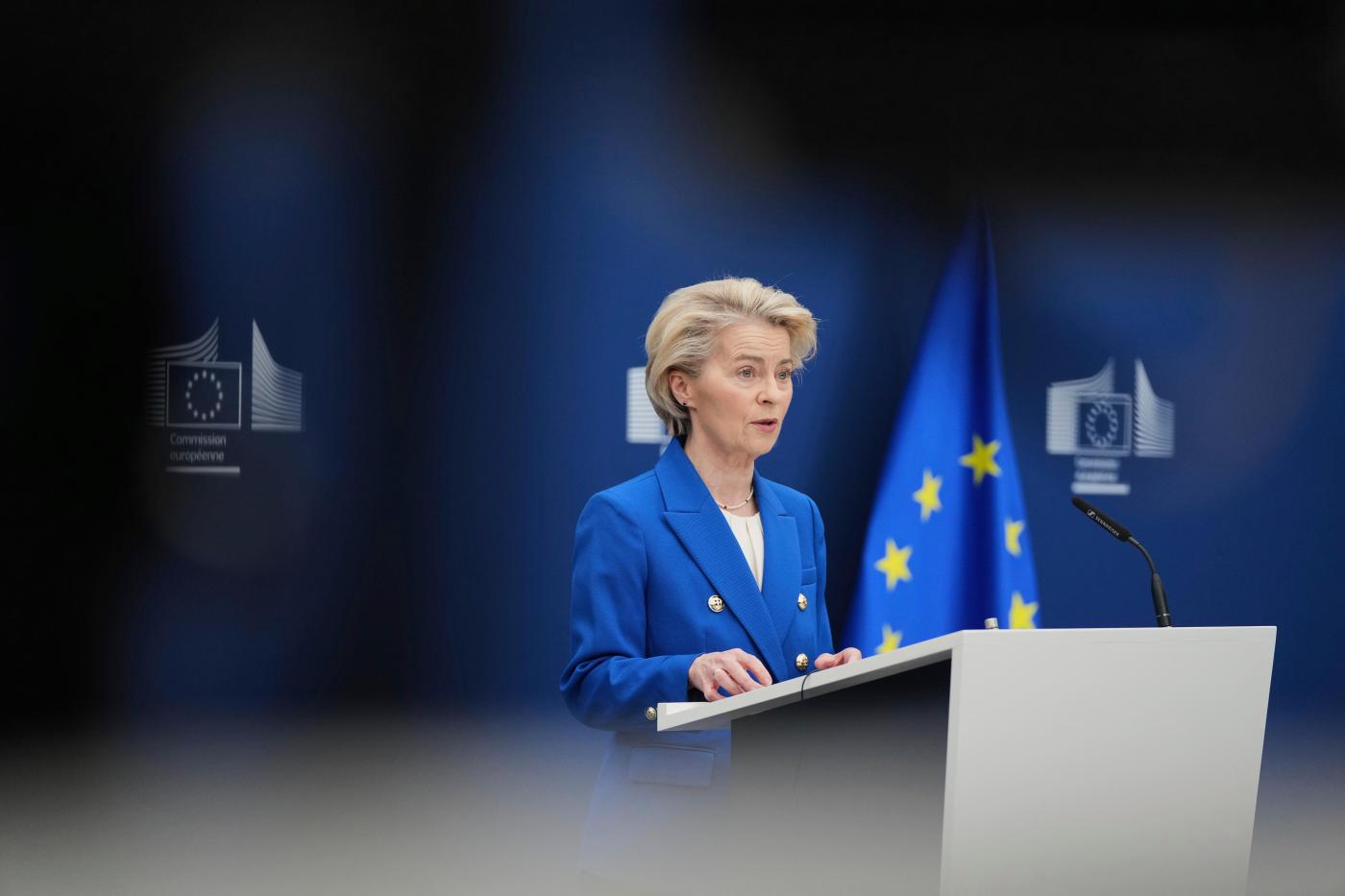
“Europe faces a clear and present danger on a scale that none of us have seen in our adult lifetime. Some of our fundamental assumptions are being undermined to their very core,” European Commission President Ursula von der Leyen warned in a letter to the EU’s 27 leaders, who will consider ways to access more money for defense spending and ease restrictions on it.

But perhaps the biggest challenge for the EU on Thursday will be to take a united stance at a moment when it’s fractured, since much of what the bloc does requires unanimous support.

Focus is Europe’s security

Whatever happens, the meeting is not expected to address Ukraine’s most pressing needs.

It is not aimed at urgently drumming up more arms and ammunition to fill any supply vacuum created by the U.S. freeze. Nor will it unblock the estimated 183 billion euros ($196 billion) in frozen Russian assets held in a Belgian clearing house, a pot of ready cash that could be seized.

Ukraine’s armed forces, meanwhile, are still battling to slow Russia’s advances along the 1,000-kilometer (600-mile) front line, especially in the eastern Donetsk region. Tens of thousands of soldiers and more than 12,000 Ukrainian civilians have been killed.

The focus of Thursday’s summit will be finances, and how to set the EU up as quickly as possible to provide for its own security, and help Ukraine, while breaking with decades of dependence on the U.S. defense umbrella.

“In view of the increasing threat situation, it is clear to us that Europe … must now very quickly make very big efforts, very quickly, to strengthen the defense capability of our country and the European continent,” Germany’s likely next chancellor, Friedrich Merz, said Tuesday.

The prospective partners in Germany’s next government are seeking to loosen the nation’s rules on running up debt to allow for higher defense spending.

A call for Europe to increase its defense spending

NATO Secretary-General Mark Rutte — who fears that Russia’s armed forces might be capable of launching an attack on another European country by the end of the decade — has warned that U.S. allies will have to spend more than 3% of gross domestic product on their military budgets.

The Trump administration is demanding that the Europeans spend as much as 5%, well beyond the NATO benchmark of at least 2%. Seven European allies still fall short of even that target. The U.S. spends around 3.4%, according to NATO figures, and a Pentagon audit that could reduce that is pending.

Related Articles

World News |


Trump administration pauses flow of intelligence to Ukraine that helps on battlefield

World News |


Trump administration plans to cut 80,000 employees from Veterans Affairs, according to internal memo

World News |


Trump administration moves to drop Idaho emergency abortion case with national implications

World News |


Trudeau not willing to lift Canada’s retaliatory tariffs if Trump leaves some tariffs on Canada

World News |


Panama president calls Trump’s talk of ‘reclaiming’ the Panama Canal a lie

Von der Leyen has proposed that the EU’s executive branch, the European Commission, raise up to 150 billion euros ($161 billion) on financial markets that would be loaned to member countries buy new military equipment for themselves, or to send to Ukraine.

The commission would also aim to free up funds from other sectors of the bloc’s massive long-term budget and to relax its stringent debt rules so that each country could invest up to 1.5% more of their GDP on defense, should they want to.

The leaders will also discuss whether to place more arms contracts with Ukraine’s defense industry, and to help integrate it into the European industrial network. Production costs in Ukraine are much lower, providing a relatively fast way to supply more arms and ammunition.

It’s an approach that Zelenskyy has praised.

“Last year alone, thanks to Ukrainian and partner efforts, we produced over 1.5 million drones of various types. Ukraine is now the world leader in drone warfare. This is our success. But it’s also your success,” he said earlier this month at the Munich Security Conference.

Possible EU support for a future force to police any peace agreement in Ukraine will also be weighed. Britain and France are leading that effort, which could involve several other European countries.

EU faces major challenges

The summit comes as the EU is arguably at its weakest point, fragmented by the steady rise of a hard right that is often pro-Russian.

Hungary and Slovakia have routinely undermined support for Ukraine. Hungary is threatening to veto a joint statement drafted for Thursday’s summit but would not be able to block any major security or financing decisions.

Meanwhile, many larger countries face uncertainties at home. Germany will soon have a new chancellor, but France’s latest government is fragile, and Spain relies on small parties to keep its coalition intact.

Poland offers strong leadership under Prime Minister Donald Tusk, however a presidential election looms and a right-wing candidate is well placed. The Dutch cabinet dominated by hard-right leader Geert Wilders is shaky.