By JESSE BEDAYN
COLORADO SPRINGS, Colo. (AP) — Derrick Johnson buried his mother’s ashes beneath a golden dewdrop tree with purple blossoms at his home on Maui’s Haleakalā Volcano, fulfilling her wish of a final resting place looking over her grandchildren.
Then the FBI called.
It was Feb. 4, 2024, and Johnson was teaching an eighth-grade gym class.
“’Are you the son of Ellen Lopes?’” a woman asked, Johnson recalled in an interview with The Associated Press.
There had been an incident, and an FBI agent would fly out to explain, the caller said. Then she asked: “’Did you use Return to Nature for a funeral home?’”
“’You should probably google them,’” she added.
In the clatter of the weight room, Johnson typed “Return to Nature” into his cellphone. Dozens of news reports appeared, details popping out in a blur.
Hundreds of bodies stacked on top of each other. Inches of body decomposition fluid. Swarms of bugs. Investigators traumatized. Governor declares state of emergency.
Derrick Johnson, whose mother’s body was one of 189 left to decay in the Return to Nature Funeral Home in Penrose, Colo., poses for a portrait in Colorado Springs, Colo., on Thursday, Feb. 5, 2026. (AP Photo/Thomas Peipert)
Johnson felt nauseated and his chest constricted, forcing the breath from his lungs. He pushed himself out of the building as another teacher heard his cries and came running.
Two FBI agents visited Johnson the following week, confirming his mother’s body was among 189 that Return to Nature’s owners, Jon and Carie Hallford, had stashed in a Colorado building between 2019 and Oct. 4, 2023, when the bodies were found.
It was one of the largest discoveries of decaying bodies at a funeral home in the U.S. Lawmakers overhauled the state’s lax funeral home regulations. And besides handing over fake ashes to grieving families, the Hallfords also admitted to defrauding the federal government out of nearly $900,000 in pandemic-era aid for small businesses.
Even as the Hallfords’ bills went unpaid, authorities said they spent lavishly on Tiffany jewelry, luxury cars and laser-body sculpting, pocketing about $130,000 clients paid for cremations.
They were arrested in Oklahoma in November 2023 and charged with abusing nearly 200 corpses.
Hundreds of families learned from officials that the ashes they ceremonially spread or kept close weren’t actually their loved ones’ remains. The bodies of their mothers, fathers, grandparents, children and babies had moldered in a room-temperature building in Colorado.
Jon Hallford will be sentenced Friday, facing between 30 to 50 years in prison, and Carie Hallford in April after a judge accepted their plea agreements in December. Attorneys for Jon and Carie Hallford did not respond to an AP request for comment.
Johnson, 45, who’s suffered panic attacks since the FBI called, promised himself that he would speak at Hallford’s sentencing and ask for the maximum penalty.
“When the judge passes out how long you’re going to jail, and you walk away in cuffs,” he said, “you’re gonna hear me.”
“She lied”
Jon and Carie Hallford were a husband-and-wife team who advertised “green burials” without embalming as well as cremation at their Return to Nature funeral home in Colorado Springs.
She would greet grieving families, guiding them through their loved ones’ final journey. He was less seen.
Johnson called the funeral home in early February 2023, the week his mother died. Carie Hallford assured him she would take good care of his mother, Johnson said.
Days later, she handed Johnson a blue box containing a zip-tied plastic bag with gray powder, saying those were his mother’s ashes.
“She lied to me over the phone. She lied to me through email. She lied to me in person,” Johnson told the AP.
The following day, the box lay surrounded by flowers and photos of Ellen Marie Shriver-Lopes at a memorial service at a Holiday Inn in Colorado Springs.
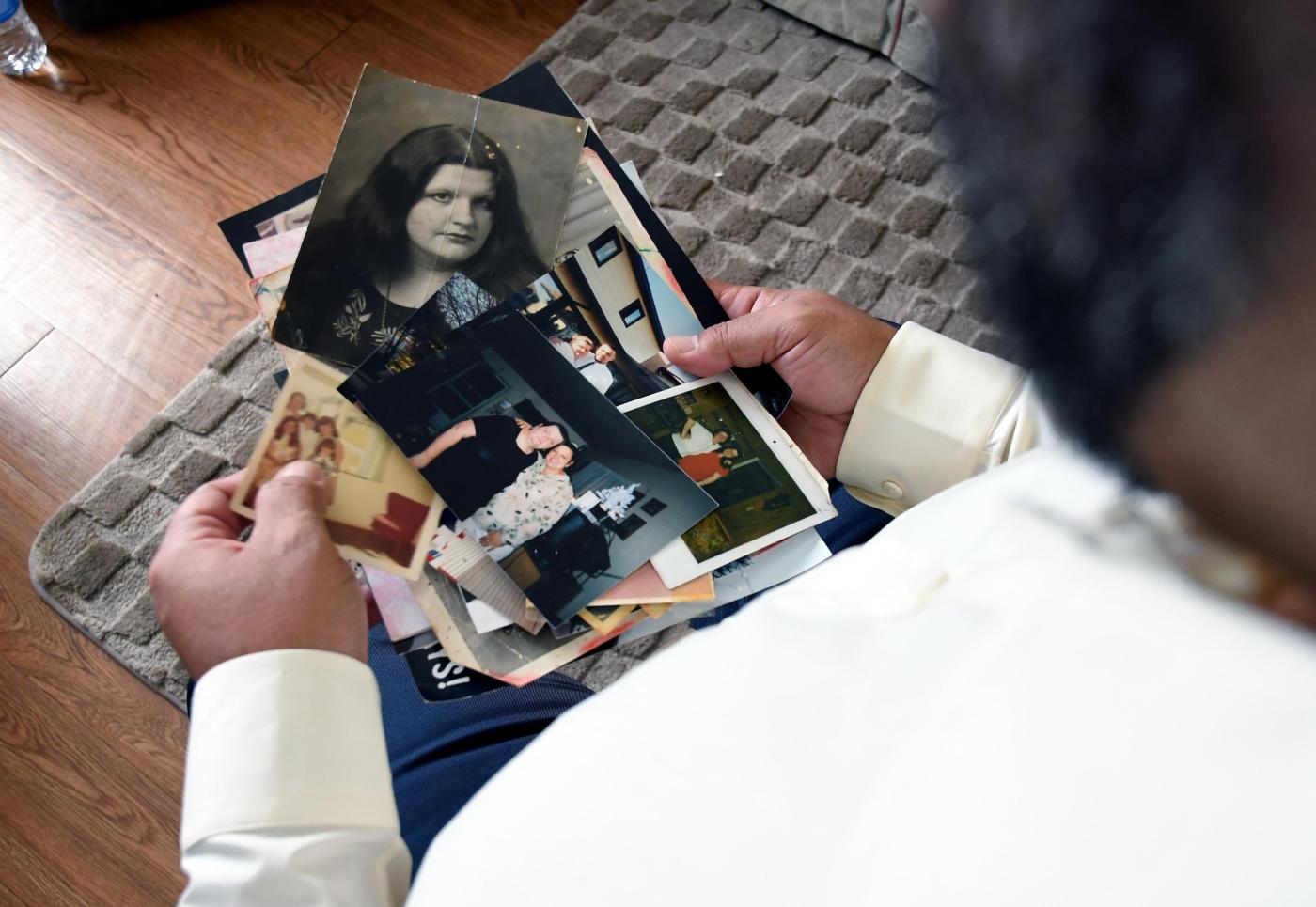
Photographs of Ellen Marie Shriver-Lopes, whose body was one of 189 left to decay in the Return to Nature Funeral Home in Penrose, Colo., are stacked in her sister’s home in Colorado Springs, Colo., on Thursday, Feb. 5, 2026. (AP Photo/Thomas Peipert)
Johnson sprinkled rose petals over it as a preacher said: “Ashes to ashes, dust to dust.”
Caught on video
On Sept. 9, 2023, surveillance footage showed a man appearing to be Jon Hallford walk inside a building owned by Return to Nature in the town of Penrose, outside Colorado Springs, according to an arrest affidavit.
Camera footage inside showed a body laying on a gurney wearing a diaper and hospital socks. The man flipped it onto the floor.
Then he “appeared to wipe the remaining decomposition from the gurney onto other bodies in the room,” before wheeling what appeared to be two more bodies into the building, the affidavit said.
In a text to his wife, Hallford said, “while I was making the transfer, I got people juice on me,” according to court testimony.
The neighborhood mom
Johnson grew up with his mother in an affordable-housing complex in Colorado Springs, where she knew everyone.
Johnson’s father wasn’t around much; at 5 years old, Johnson remembers seeing him punch his mom, sending her careening into a table, then onto a guitar, breaking it.
It was Lopes who taught Johnson to shave and hollered from the bleachers at his football games.
Neighborhood kids called her “mom,” some sleeping on the couch when they needed a place to stay and a warm meal. She would chat with Jehovah’s Witnesses because she didn’t want to be rude. With a life spent in social work, Lopes would say: “If you have the ability and you have the voice to help: Help.”
Johnson spoke with his mother nearly everyday. After diabetes left her blind and bedridden at age 65, she’d ask Johnson to describe what her grandchildren looked like over the phone.
It was Super Bowl Sunday in 2023 when her heart stopped.
Johnson, who had flown in from Hawaii to be at her bedside, clutched her warm hand and held it until it was cold.
A gruesome discovery
Detective Sgt. Michael Jolliffe and Laura Allen, the county’s deputy coroner, stood outside the Penrose building on Oct. 3, 2023, according to the 50-page arrest affidavit.
A sign on the door read “Return to Nature Funeral Home” and listed a phone number. When Jolliffe called it, it was disconnected. Cracked concrete and yellow stalks of grass encircled the building. At back was a shabby hearse with expired registration. A window air-conditioner hummed.
FILE – A hearse and van sit outside the Return to Nature Funeral Home, in Penrose, Colo., Oct. 6, 2023. (AP Photo/David Zalubowski, File)
Someone had told Jolliffe of a rank smell coming from the building the day before, the affidavit said.
One neighbor told an AP reporter they thought it came from a septic tank; another said her daughter’s dog always headed to the building whenever it got off-leash.
It was reminiscent of rancid manure or rotting fish, and struck anyone downwind of the building.
Jolliffe and Allen spotted a dark stain under the door and on the building’s stucco exterior. They thought it looked like fluids they had seen during investigations with decaying bodies, the affidavit said.
But the building’s windows were covered and they couldn’t see inside.
Allen contacted the Colorado Department of Regulatory Agency, which oversees funeral homes, which got in touch with Jon Hallford. Hallford agreed to show an inspector inside the next afternoon.
Inspector Joseph Berry arrived, but Hallford didn’t show.
Berry found a small opening in one of the window coverings, the affidavit said. Peering through, he saw white plastic bags that looked like body bags on the floor.
A judge issued a search warrant that week.
FILE – This combination of booking photos provided by the Muskogee County, Okla., Sheriff’s Office shows Jon Hallford, left, and Carie Hallford, owners of Return to Nature Funeral Home. (Muskogee County Sheriff’s Office via AP, File)
Bodies stacked high
Donning protective suits, gloves, boots and respirators, investigators entered the 2,500-square-foot (232-square-meter) building on Oct. 5, 2023, according to the affidavit.
Inside, they found a large bone grinder and next to it a bag of Quikrete that investigators suspected was used to mimic ashes. Bodies were stacked in nearly a dozen rooms, including the bathroom, sometimes so high they blocked doorways, the affidavit said.
There were 189.
Some had decayed for years, others several months, according to the affidavit. Many were in body bags, some wrapped in sheets and duct tape. Others were half-exposed, on gurneys or in plastic totes, or lay with no covering, it said.
Investigators believed the Hallfords were experimenting with water cremation, which can dissolve a body in several hours, the document said. There were swarms of bugs and maggots.
Body bags were filled with fluid, according to the affidavit. Some had ripped. Five-gallon buckets had been placed to catch the leaks. Removal teams “trudged through layers of human decomposition on the floor,” it said.
Investigators identified bodies using fingerprints, hospital bracelets and medical implants, the affidavit said. It said one body was supposed to be buried in Pikes Peak National Cemetery.
Investigators exhumed the wooden casket at the burial site of the U.S. Army veteran, who served in Vietnam and the Persian Gulf. Inside was a woman’s deteriorated body, wrapped in duct tape and plastic sheets.
The veteran’s body was discovered in the Penrose building, covered in maggots.
Families of plane crash victims ask US appeals court to revive a criminal case against Boeing
Freight train derails in Connecticut, sending cars carrying liquid propane into river
A newborn’s death likely linked to the mom drinking raw milk while pregnant
Hims & Hers launches copy of Wegovy pill, prompting legal threats from drugmaker Novo Nordisk
Pizza Hut closing 250 US stores as parent company considers selling the brand
“Ashes to ashes”
Following the call from the FBI, Johnson promised himself he would speak at the Hallfords’ sentencing. But he struggled to talk about what had happened even with close friends, let alone in front of a judge and the Hallfords.
For months, Johnson obsessed over the case, reading dozens of news reports, often glued to his phone until one of his children would interrupt him to play.
When he shut his eyes, he said he imagined trudging through the building with “maggots, flies, centipedes. There’s rats, they’re feasting.” He asked a preacher if his mother’s soul had been trapped there. She reassured him it hadn’t. When an episode of the zombie show “The Walking Dead” came on, he broke down.
Johnson started seeing a therapist and was diagnosed with post-traumatic stress disorder. He joined Zoom meetings with other victims’ relatives as the number grew from dozens to hundreds.
After Lopes’ body was identified, Johnson flew in March 2024 to Colorado, where his mother’s remains lay in a brown box in a crematorium.
“I don’t think you blame me, but I still want to tell you I’m sorry,” he recalled saying, placing his hand on the box.
Then Lopes’ body was loaded into the cremator and Johnson pushed the button.
Justice
Johnson has slowly improved with therapy, engaging more with his students and children. He practiced speaking at the Hallfords’ sentencings while in therapy. Closing his eyes, he envisioned standing in front of the judge — and the Hallfords.
“Justice is, it’s the part that is missing from this whole equation,” he said. “Maybe somehow this justice frees me.”
“And then there’s part of me that’s scared it won’t, because it probably won’t.”