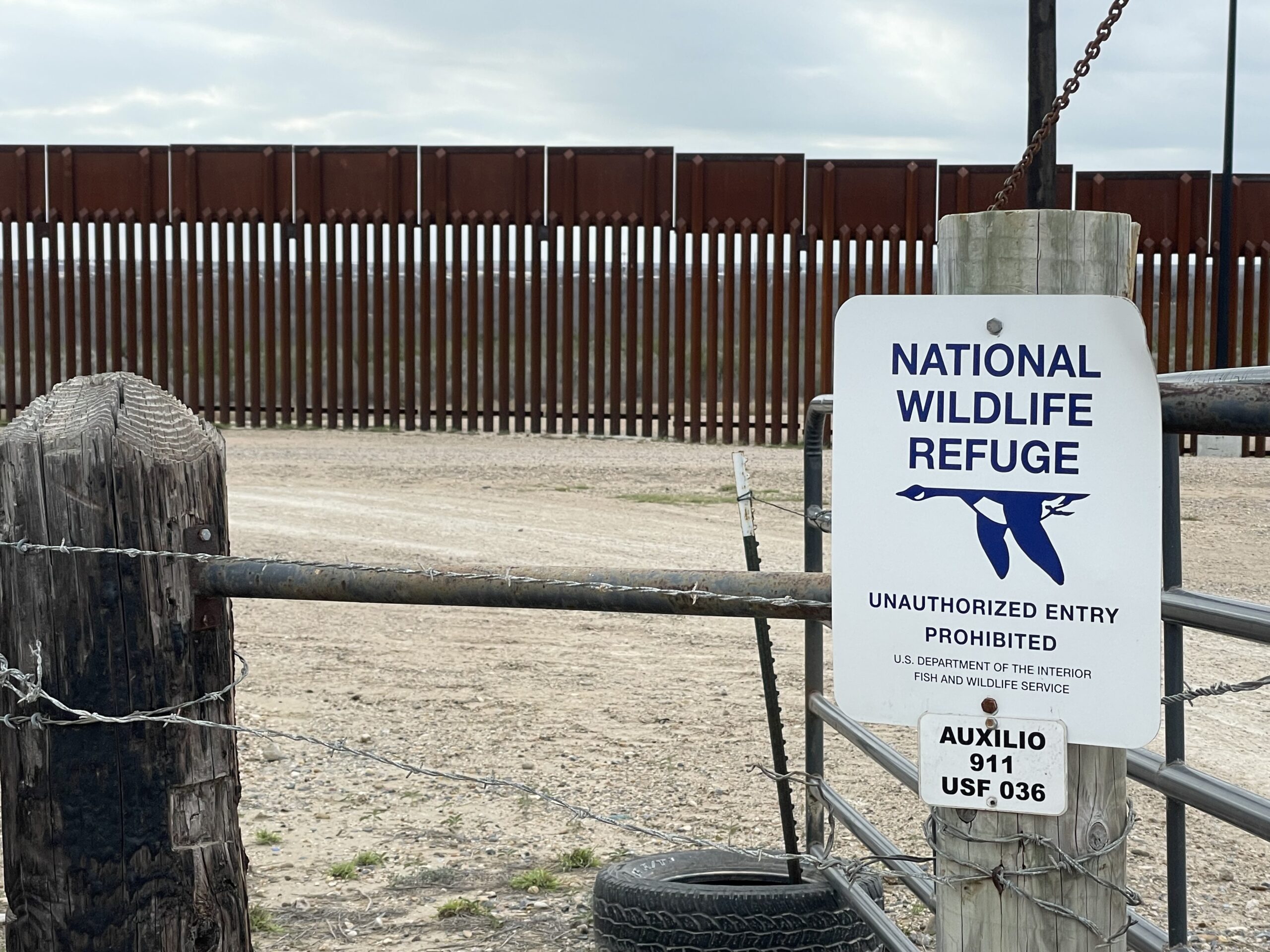
In February, bulldozers carved long straight lines, uprooting trees and scraping the earth bare, near the South Texas communities of Salineño and Roma, the start of the first new border walls built during Donald Trump’s second stint in the White House. The routes for these walls were mapped, and funding was provided by Congress, during Trump’s first term. Waivers issued at that time exempt this construction from the local, state, and federal laws that would otherwise protect the environment and local residents. Just like these new border walls, none of the hundreds of miles built since 2008 had to comply with these laws due to a provision of the federal REAL ID Act. These waivers have had real-world impacts.
Near the city of El Paso, for example, the Tiguas of the Ysleta del Sur Pueblo feared that border walls would cut off their access to religious sites on the Rio Grande and “irreparably alter the sacred character of the land.” Rather than address their concerns, construction was exempted from the American Indian Religious Freedom Act and the Native American Graves Protection and Repatriation Act. Along the river’s final stretch, border walls repeatedly slice through the Lower Rio Grande Valley National Wildlife Refuge, fragmenting a natural corridor set aside for endangered ocelots and uprooting endangered plants. With the Endangered Species Act (and dozens of other laws) waived, this ecological destruction was largely ignored by wall planners and builders.
The following chapter is excerpted from Walled, a new book edited by Andréanne Bissonnette and Élisabeth Vallet, and it tracks the application of waivers as walls have gone up from the Pacific Ocean to the Gulf of Mexico. While “restoring the rule of law” to the U.S.-Mexico border has been a resonant and repeated talking point for successive administrations, it is the border walls that they have built, not the border itself, that are lawless.
Editor’s Note: The following is a book chapter by Scott Nicol excerpted from Walled: Barriers, Migration, and Resistance in the U.S.-Mexico Borderlands, out March 2025 from the University of Arizona Press. © 2025 by The Arizona Board of Regents. Reprinted by permission of the University of Arizona Press.
The border wall in the Rio Grande Valley near Roma in 2022 (Courtesy/Scott Nicol)
Presented as a means to “restore the rule of law” to the United States’ southern border, where the undocumented crossing of migrants and asylum-seekers and the smuggling of contraband was decried by politicians and pundits as an invasion, hundreds of miles of border walls have been erected by successive presidential administrations. Nearly all the barriers that now stand were built outside of compliance with the laws and regulations that would govern any other federal project. Concerned that they were not being built quickly enough, Congress granted the Secretary of Homeland Security the unprecedented authority to waive laws in order to hasten construction. The application of waivers and the interpretation of their scope has repeatedly expanded, such that border walls are now privileged over all potential legal constraints short of the U.S. Constitution. Court challenges brought by stakeholders reveal both the constitutional and concrete issues raised by the waivers and some of the harms that walls inflict upon border communities and ecosystems. Stakeholders have, to date, been unsuccessful in their efforts to force ongoing border wall construction to comply with the law, and walls continue to be built beyond the reach of the rule of law.
The exemption of border walls from legal constraints began with the Illegal Immigration Reform and Immigrant Responsibility Act (IIRIRA) of 1996, which called for fourteen miles of fencing along the U.S.-Mexico border between San Diego and Tijuana. IIRIRA also granted the U.S. attorney general the power to waive two laws—the National Environmental Policy Act (NEPA) and the Endangered Species Act (ESA)—to hasten the construction of these new barriers. As he signed the bill, President Clinton said that adhering to the principle of the rule of law often means attempting to comply with statutes that are at odds with one another, and therefore rather than set aside NEPA and ESA, Attorney General Janet Reno would “make every effort, in consultation with environmental agencies, to implement the immigration law in compliance with those environmental laws.”
By 2005, work on the fence between San Diego and Tijuana had ground to a halt, with roughly three miles that would cross a canyon still unbuilt. Rather than drive down one side of the chasm and up the opposite, the Border Patrol proposed the creation of a massive berm across it that would stand 180 feet tall and be 800 feet wide at its base, with the fence and patrol road set atop it. The new structure would tower above one of the last intact estuaries in California, where the Tijuana River fans out before draining into the Pacific Ocean. The California Coastal Commission had rejected the project as a violation of the Coastal Zone Management Act, expressing particular concern regarding the erosion potential of the earthen structure. Sediment could bury vegetation and raise the elevation of the estuary enough to prevent tidal flushing, the process of sea water inundating parts of the estuary during high tide and draining when the tide goes out. A coalition of environmental organizations also brought suit, alleging that the federal government failed to fully comply with NEPA.
Frustrated by the stalled construction, Congress expanded the waiver authority that, with the creation of the Department of Homeland Security (DHS), was in the homeland security secretary’s hands. Incorporated into the REAL ID Act of 2005 was a far-reaching provision: “Notwithstanding any other provision of law, the Secretary of Homeland Security shall have the authority to waive all legal requirements such Secretary, in such Secretary’s sole discretion, determines necessary to ensure expeditious construction of the barriers and roads under this section” (REAL ID Act 2005). This provision modified the IIRIRA, replacing the language that had allowed for the setting aside of two specific laws.
The wall running through the Otay Mountain Wilderness Area in California in 2010 (Courtesy/Scott Nicol)
Michael Chertoff, who served as secretary of homeland security under President George W. Bush, issued the first waiver citing the REAL ID Act a few months after the bill was signed. Proponents like Representative Steve King had described the waiver as though it was narrowly focused, asserting that “the REAL ID bill would give the Secretary of Homeland Security the authority he needs to ensure that our national security is not compromised for dubious environmental concerns.” In fact, the legislation included no restrictions on subject or category. When the first waiver was published in the Federal Register it was not limited to the specific environmental laws that were impeding construction of the San Diego wall. Instead, it named eight federal laws, including two that had nothing to do with the natural environment, along with “all federal, state, or other laws, regulations and legal requirements of, deriving from, or related to the subject of” the named laws. This established the precedent of sweeping aside all potential legal hurdles, even those that were not actually holding up construction at the time that a waiver was issued.
The REAL ID Act states that once a waiver has been published, “a cause of action or claim may only be brought alleging a violation of the Constitution of the United States.” This precludes any legal challenges based on the actual, on-the-ground damages that a wall might inflict. Nonetheless, environmental organizations attempted to revive their lawsuit. Congress had granted an unelected functionary within the executive branch unfettered authority to set aside duly enacted laws and this, they said, violated the constitutional principle of the separation of powers. The Supreme Court had previously ruled that Congress cannot grant the executive the inherently legislative power to amend or void federal laws. But Judge Larry Burns rejected the plaintiffs’ claim, ruling that Congress had provided sufficient constraints upon the secretary’s power because it only applied to “laws and regulations which the DHS Secretary determines impede completion of this particular 14-mile California Triple Fence authorized by IIRIRA, and only upon the Secretary making a determination of necessity.”
Even with the waiver in place, the San Diego border fence was not completed until early into the Obama administration. Just as the California Coastal Commission and nongovernmental environmental organizations had predicted, the ecological damage was severe. The hilltops on either side of the canyon were blasted off as a first step toward creating a semi-level roadbed, with the resulting debris used as fill for the berm. Erosion issues were apparent almost immediately. In order to allow the Tijuana River to cross the border a tunnel was built at its base that, in funneling and constricting the water, caused it to enter the estuary with far more force than it had before. This caused it to carry more sediment and garbage, and following rain events it flooded private properties that in prior years were beyond the water’s reach. In October 2006, Congress passed and President Bush signed the Secure Fence Act. Like the REAL ID Act of 2005, it replaced language within the Illegal Immigration Reform and Immigrant Responsibility Act: the original mandate of fourteen miles of border barrier grew to approximately seven hundred miles. The waiver provision that the REAL ID Act had expanded to encompass “all legal requirements” could be applied to these additional walls and roads.
In building barriers where laws had not yet been waived, the Bush administration initially behaved as it would with any other project, drafting environmental assessments and environmental impact statements as required by NEPA. Environmental organizations alleged that they were just going through the motions, engaging in an exercise that gave the superficial appearance of compliance without the rigor that the law required. This came to a head in Arizona, with a span planned for the San Pedro Riparian National Conservation Area. One of the last remaining undammed rivers in the southwestern United States, the San Pedro meanders through Mexico for around twenty-five miles before crossing the border into the United States. It supports terrestrial and aquatic life, including endangered species, whose habitats elsewhere have been lost to development or water extraction. It also acts as a cross-border wildlife corridor, with documented use by black bears, pumas, coati, and kit foxes. In August 2007, the Bureau of Land Management granted a perpetual right-of-way to build bollard walls along most of the San Pedro’s southern boundary. Vehicle barriers made from crossed railroad ties would be installed in the riverbed.
Defenders of Wildlife asked the DC circuit court to issue a temporary restraining order on two miles of barrier that would directly impact the San Pedro River. In approving the border barriers in the San Pedro Riparian National Conservation Area, they alleged, the Bureau of Land Management had violated the Arizona-Idaho Conservation Act and NEPA. They predicted that pedestrian fencing and vehicle barriers would trap debris, which would dam water. This would destabilize the banks of streams and worsen erosion, uprooting vegetation and sending increased sediment loads into the river, which could bury the aquatic habitat of endangered fish and other rare creatures. They also asserted that combined border barrier mileage extending from the western side of Arizona through the San Pedro to New Mexico would block off numerous crossing points utilized by terrestrial animals, including the endangered jaguar. The ability to move back and forth across the border was critical for these species’ continued presence in the United States. Looking at less than two miles of barrier at San Pedro in isolation and ignoring the walls planned for the rest of the state, they alleged, was an impermissible attempt to minimize the effects of the project on paper in order to avoid addressing real-world impacts.
The court granted the temporary restraining order, halting construction of barriers in the immediate vicinity of the San Pedro River. In weighing the government’s claim that an urgent need for border walls warranted a rushed and truncated NEPA process without any opportunity for public comment, Judge Ellen Segal Huvelle determined that people and contraband entering the United States between ports of entry was hardly a new phenomenon, and the government was hard-pressed to show that a delay in order to fully comply with NEPA would be problematic. On the other hand, she found the plaintiff’s assertion that “this fence will cause irreparable environmental injury to both wildlife, vegetation and the riverbed” entirely credible.
Over the course of the hearing Judge Huvelle referred repeatedly to the REAL ID Act’s waiver provision, saying to the Department of Justice lawyer at one point early on that “the agency [DHS] has a lot more discretion and authority than I have in a lot of ways, don’t they, under this law?” The judge was constrained by federal law; the secretary of homeland security was not. She interpreted the actions of a federal agency as violating two laws; nine days after her ruling, Secretary Chertoff waived those laws, along with seventeen others and, again, all local, state, and federal laws relating to the subjects of the named statutes. Construction quickly resumed.
Plaintiffs then challenged the constitutionality of the waiver, but Judge Huvelle decided that the congressional grant of power to waive any and all laws was acceptable because it was limited to the “expeditious” construction of tactical infrastructure in places where the secretary claimed that high levels of illegal entry were occurring. It could not be applied for any other purpose, or outside of the border region. In response, the environmental organizations appealed to the Supreme Court.
On April 1, 2008, Homeland Security Secretary Chertoff issued a pair of waivers. Prior waivers had been applied to specific locations and relatively short distances: the first took in the westernmost fourteen miles of the border near San Diego; the second was applied to forty-two miles in the Arizona desert; the third ran for seven miles where the San Pedro River crossed into the United States. The 2008 waivers covered 470 miles, impacting all four border states and including every stretch of pedestrian fence and vehicle barrier then planned.
The 2008 waivers appeared to be preemptive, as no nongovernmental organization had filed suit to block construction at any of the locations that they covered. Secretary Chertoff may instead have issued them in response to other federal agencies. In interagency letters, the Department of the Interior and the Environmental Protection Agency were highly critical of the draft Environmental Assessments and Environmental Impact Statements that had been prepared ahead of border wall construction under the auspices of NEPA.
The Department of the Interior alerted Customs and Border Protection (CBP) to multiple places along the border where walls had the potential to harm endangered species. Federal agencies are required to enter into formal consultation with the Department of the Interior in such instances in order to work out ways to avoid or minimize such impacts, but CBP had failed to do so. More broadly, they determined that details regarding the project and its impacts were lacking. Mitigation of unavoidable damage was another key component that, they asserted, was mentioned only briefly and vaguely. Some of those inadequacies could be addressed with additional study and data collection, some would require more planning and consultation with stakeholders, while other issues, such as the assessment of the cumulative impacts of all the planned Secure Fence Act barriers, would require the replacement of environmental assessments with environmental impact statements.
At roughly the same time the Environmental Protection Agency was making many of the same points. The specificity of information regarding design, location, and likely impacts was “inadequate.” Walls planned for the Otay Mountain Wilderness Area near San Diego would involve filling a pair of canyons, and the subsequent erosion had the potential to violate the Clean Water Act. In the Tucson sector, they found that claims about the potential impacts of barriers were made without so much as an on-the-ground survey of the landscape to back them up. Likewise, in El Paso, “Conclusions are stated with little or no supporting analysis.” Compliance with federal law would require going back to the drawing board, significantly delaying construction.
As they typed up their comments, federal employees were aware of the likely outcome. In their letter regarding walls planned for the Border Patrol’s San Diego sector, the Environmental Protection Agency wrote, “We understand that the Secretary of the Department of Homeland Security has authority to waive environmental laws for these border fence projects in its mission to secure the homeland and protect it against conventional and unconventional attacks. We urge the Department to avoid the use of waivers and make every effort to comply with environmental laws, consistent with our national environmental policy.”
The Environmental Protection Agency submitted its letters in February. The Department of the Interior sent theirs in March. On April 1, Secretary Chertoff issued the waivers that would set aside all of the laws (and more) that provided the bases for their recommendations, across all of the lands (and more) about which they had expressed concern.
In an effort to assuage the fears of stakeholders, Secretary Chertoff issued a statement along with the waivers that said, “Although the exercise of my authority under Section 102(c) of IIRIRA means that certain laws will be waived, DHS is neither compromising its commitment to responsible environmental stewardship nor its commitment to solicit and respond to the needs of state, local, and tribal governments, other agencies of the federal government, and local residents. For example, for the majority of the miles covered by the waiver, we have prepared either a draft environmental assessment or an environmental impact statement.”
The draft environmental documents that he was pointing to were the same ones that had been systematically picked apart and found insufficient for NEPA compliance by both the Department of the Interior and the Environmental Protection Agency. Prior history also argued against taking Secretary Chertoff’s statement seriously. An internal DHS document dated eleven days before publication of the waiver noted that in San Diego, “When the waiver was invoked, it was determined that there was no further need to continue with resource mitigation.”
Among the laws named in the 2008 waivers that had been absent from earlier ones were the American Indian Religious Freedom Act and the Native American Graves Protection and Repatriation Act. The new waivers encompassed the traditional lands of multiple Native American nations, including the Kumeyaay and Quechan in California, the Cocopah and Tohono O’odham in Arizona, and the Tiguas in Texas. The fifteen miles of border walls originally mandated by the IIRIRA, and covered by the first waiver, ran through a landscape that the Kumeyaay had long been a part of. Construction of that fencing had involved the disturbance of at least fifteen so-called cultural resource sites, including one where human remains were unearthed and repatriated to the Kumeyaay. Additional border walls covered by the 2008 waiver would cut across Tecate Peak, which the Kumeyaay called Kuuchmaa and held to be sacred. The mountain’s southern flank was believed to be the home of the first shaman, who upon his death was cremated there. The site became a traditional final resting place for other shamans who came after. The Environmental Protection Agency pointed out that “meaningful government-to-government consultation” with affected tribes had not occurred. Instead, Secretary Chertoff waived the relevant laws, making the proper treatment and repatriation of any human remains that might be disturbed, in a place known to have been the site of cremations since time immemorial, entirely optional.
Within weeks a group of plaintiffs led by El Paso County filed a complaint against the 2008 waivers. Like the environmental organizations’ challenge to the San Pedro waiver, they began with the assertion that waiver authority violated the constitutionally mandated separation of powers. They also argued that in addition to the direct harm that could result from waiving laws, which included the Clean Water Act and Safe Drinking Water Act, the waiver itself was impermissibly vague. Aside from exempting the Department of Homeland Security and its contractors from any legal liability, it gave no guidance as to how entities that operated under a framework of compliance with federal laws were supposed to act going forward. If a water district was to continue to pull water from the Rio Grande for municipal or agricultural use, and that water passed through the area covered by the waiver, what federal laws would now apply to their activities?
Of even greater concern to them was the phrase preceding the list of waived laws stating that the waiver also covered “all federal, state, or other laws, regulations and legal requirements of, deriving from, or related to the subject of, the following laws.” The municipal plaintiffs argued that “the waivers are so broad and so vague as to state and local laws that they violate basic principles of Federalism by placing the governmental plaintiffs in the intolerable position of not knowing which state and local laws are currently in effect and which may have been indefinitely nullified.” The plaintiffs urged the court to find that section 102 of the REAL ID Act could not be used to void state or local laws.
Two months after Secretary Chertoff issued the 2008 waivers, the Supreme Court announced that it would not hear arguments challenging the San Pedro waiver. This was not the same as a ruling in favor of the waiver’s constitutionality—strictly speaking, they had not ruled one way or another. But it allowed the lower court’s determination that the waiver was acceptable to stand, thereby permitting border fence construction to continue without the need for compliance with numerous laws. Department of Homeland Security press secretary Laura Keehner responded, apparently without intended irony, that DHS was “obviously pleased” because “the American people expect this department to enforce the rule of law at the border.” One year later, with Barack Obama in the White House, the Supreme Court declined to hear El Paso v. Chertoff (Anonymous 2009). Once again the justices did not comment on the validity of the case or the issues that it raised, but the lower court’s ruling remained in effect.
The border fence in Arizona in 2015 (Courtesy/Scott Nicol)
Even with the setting aside of legal requirements that might slow construction, CBP failed to complete the mandated 700 miles of border wall by the time President Bush left office. Instead, pedestrian fencing stood on 278 miles of the U.S.-Mexico line, while an additional 248 miles had a vehicle barrier, for a total of 526 miles. In some locations border wall construction was under way when Barack Obama was sworn in as president, while in others barriers were on the drawing board but nothing had occurred on the ground. Three months after President Obama’s inauguration CBP spokesperson Lloyd Easterling told the press that “as it stands right now, we’re committed to completing the project at hand.” In total, 128 miles of border barrier would be built during President Obama’s time in office. The Obama administration relied upon the Bush administration’s waivers for all of these barriers but did not issue any new ones.
Bush era waivers were also cited to skirt legal compliance when walls on the border were repaired or replaced. In 2011, this included fencing that was replaced near Nogales, Arizona; a patrol road that was constructed near San Diego; a second layer of fencing that was added at Border Field State Park and the Tijuana Estuarine Research Reserve on the Pacific Coast; and the replacement of the border wall that enters the Pacific Ocean. The following year a portion of the border wall near Andrade, California, collapsed and was replaced. Not only had years elapsed since the publication of the waivers that CBP cited as exempting them from federal, state, and local laws, these projects were not even under consideration when the waivers were issued. The implication was that once a waiver was applied to a given location it remained in effect in perpetuity and could be applied to any border wall or road project at the site that any future administration might conceive.
Upon taking office President Trump claimed authority to build more border walls, derived from the repeatedly modified Illegal Immigration Reform and Immigrant Responsibility Act, which in its final iteration said that “the Secretary of Homeland Security shall construct reinforced fencing along not less than 700 miles of the southwest border.” He interpreted this to mean that there was a minimum, but no maximum, to the mileage that he could order installed. Where the Bush administration issued five waivers, and the Obama administration refrained from announcing any, during his single term as president, Donald Trump’s homeland security secretaries and acting homeland security secretaries issued twenty-seven. Secretary Chertoff’s waivers listed a total of thirty-seven federal laws (though the breadth of the waivers’ language encompassed many more that were not named); the waivers issued during the Trump administration named eighty-four federal laws and regulations.
The first of these waivers was issued by Homeland Security Secretary John Kelly in August 2017. It covered the same stretch of border in California that had been designated for barriers by the IIRIRA in 1996 and had seen the first waiver in 2005. Two projects were named: the replacement of older border walls and the erection of border wall prototypes. Multiple litigants filed challenges to this first Trump administration waiver. In each case they repeated the argument that the waiver was an unconstitutional delegation of power. They also claimed that the recent waiver was applied in a manner that did not comport with the provisions of the amended IIRIRA. One line of argument made by both the Center for Biological Diversity and, separately, the State of California, was that the seven hundred miles of border barrier described in the legislation had already been completed. On the same day that Secretary Kelly’s waiver was published in the Federal Register, the Border Patrol released a fact sheet showing that a total of 705 miles of barrier then stood. Plaintiffs also asserted that the REAL ID Act waiver was intended solely for walls described in the bill, not the replacement of fences or erection of prototypes that had not been envisioned at the time. California stated that the time for the “expeditious construction” of walls had passed, and therefore the authority to waive laws had expired years earlier.
California further asserted that the San Diego location did not meet the criteria prescribed by the IIRIRA, which called for the construction of “physical barriers and roads [. . .] to deter illegal crossings in areas of high illegal entry into the United States.” In Federal Register notices the Trump administration included the number of apprehensions and the quantities of narcotics seized in the Border Patrol sector that a given waiver covered as evidence that it was being applied to “an area of high illegal entry.” Those numbers lacked relevant context, however. In the San Diego waiver, the statistics were for the entire sector, which covers 60 miles of the U.S.-Mexico border and 114 miles of coastline, even though the new barrier would only cover 15 miles of the border and the coast would be unaffected. The waiver also provided no information about historic trends that might indicate whether apprehensions and seizures were rising, falling, or remaining stable. Four months prior to issuing the San Diego waiver Homeland Security Secretary Kelly told Congress that “U.S. Border Patrol apprehensions for the last two months have decreased dramatically.” This was the continuation of a long-term trend; in their suit, California pointed out that, between fiscal years 2000 and 2016, Border Patrol apprehensions in the San Diego sector had declined by 79 percent.
In February 2018, Judge Gonzalo Curiel determined that the waiver itself was sufficiently limited by purpose (construction of roads and barriers) and location (United States borders) to avoid being a constitutionally unacceptable delegation of legislative authority. As to the arguments that the secretary of homeland security had used the waiver in ways that did not comport with the statutory language of section 102 of the REAL ID Act, the judge began by writing, “Certainly, Section 102 is not a model of legislative precision.” The law, he said, was unclear when it came to exactly what was included under the umbrella of “additional barriers” whose “expeditious construction” it was intended to facilitate, and whether that included or excluded replacement barriers or prototypes. He pointed to the Obama administration’s use of the waiver in 2011 to replace border walls in Nogales as exemplifying an expansive interpretation of this. There was likewise no definition of an “area of high illegal entry” that a location might fit or fail to qualify for. Both plaintiffs and defendants could therefore push “varying plausible interpretations,” and due to the REAL ID Act’s “lack of a clear statutory mandate,” neither could prove that theirs was right and the other was wrong. Because of the lack of clarity in the legislation, “the court cannot conclude that the Secretaries acted in excess of their delegated powers contrary to a ‘clear and mandatory’ provision in Section 102,” and so the waivers were allowed to remain in effect.
In 2020, Acting DHS Secretary Wolf issued a waiver encompassing Webb and Zapata Counties in South Texas, which Zapata County and local landowners promptly challenged. Along with the constitutional issues raised by previous plaintiffs, they asserted that border residents’ rights to due process and equal protection, guaranteed by the Fifth Amendment, were violated. The REAL ID Act’s waivers applied solely to “fencing along [. . .] the southwest border,” which meant that laws that would otherwise protect border residents could be waived, while everyone else in the United States continued to enjoy them. Census figures showed that 95 percent of Zapata County’s residents identified as Hispanic or Latino. Zapata’s lawyer asserted that they were being unfairly targeted for walls and waivers due to “an animus towards Mexicans, Mexican Americans and/or border communities perpetrated by President Trump,” an assertion that plaintiffs backed with page after page of his tweets and public statements. The judge hearing the case rejected this argument, finding that even though the effects of the waivers disproportionately impacted communities of color, racial animus could not be proven to be the intent of either the REAL ID Act or the Laredo waiver.
Scott Nicol photographs the wall in Hidalgo County in 2018. (Gus Bova)
Zapata also claimed that Chad Wolf, whom President Trump had installed as acting homeland security secretary, did not legally hold that position. Upon the resignation of Secretary of Homeland Security Kirstjen Nielsen in April 2019, Customs and Border Protection Commissioner Kevin McAleenan was named as the acting secretary. The Government Accountability Office (GAO) later determined that McAleenan’s position fell outside of the legally proscribed order of succession for filling the vacancy. Upon his resignation seven months later, Chad Wolf moved into the role of acting secretary, again outside of the proper order of succession and without Senate confirmation. Zapata County claimed that this meant that Chad Wolf did not have the authority to issue waivers. Their argument was bolstered by decisions in other courts. Judge Paula Xinis had ruled that because “Mr. Wolf was not lawfully serving as Acting Secretary of Homeland Security,” memorandum that he had issued in regards to asylum applications were invalid (Casa de Maryland v. Wolf 2020). Soon after, Judge Nicholas Garaufis voided an attempt by Wolf to end the Deferred Action for Childhood Arrivals program on the same grounds (Vidal v. Wolf 2020).
The court did not rule on Zapata County’s waiver challenge until March 2023, two years into the Biden administration. Judge Diana Saldaña denied all of the county’s claims except for the assertion that Chad Wolf did not have legal authority to issue a waiver, allowing plaintiffs to move forward on that point. Three months later Homeland Security Secretary Alejandro Mayorkas rescinded the Webb and Zapata County waiver, mooting the plaintiffs’ challenge. In rescinding the waiver at issue Secretary Mayorkas avoided the potential for a ruling that could have delegitimized not just that one but by extension all of the Wolf waivers and possibly jeopardized the McAleenan waivers as well.
On the same day that the Zapata and Webb County waiver was rescinded CBP announced that border wall construction would resume in Starr County, Texas (downriver from Zapata County), in places that were covered by some of the Wolf and McAleenan waivers. In October 2023, Secretary Mayorkas issued his own waiver suspending the requirements of nearly three dozen laws for this border wall construction (Federal Register 2023b). As these were repeats of laws and locations covered by waivers issued by Wolf and McAleenan, the waiver might appear redundant, but its practical effect was to forestall legal challenges to the Trump-era waivers. Even if a court were to rule the earlier waivers invalid because the so-called acting Secretaries lacked the authority to issue them, Secretary Mayorkas’ waiver would remain in effect. This marked the first waiver issued by a Democratic administration, indicating that the idea that setting aside legal requirements was a precondition for the construction of border walls had taken hold.
Prior to the issuance of the San Pedro waiver in 2007, a Department of Justice lawyer called waiving laws “a power that’s extraordinary” and told the court that “a waiver is only applicable when the project is being delayed.” Soon thereafter the exercise of that power became routine. From 2008 on, waivers were issued for every planned mile of border barrier and were treated as though they were a standard part of the construction process and necessary for projects to move forward. None of the post–San Pedro walls were “being delayed” by lawsuits when their waivers were issued. Border walls could, of course, be erected in compliance with the law. When the REAL ID Act went into effect, just over nine of the fourteen miles that the Illegal Immigration Reform and Immigrant Responsibility Act called for had been built; border-wide, 135 miles of border barrier were already in place. Legal compliance might restrict certain types of infrastructure in certain locations, or require mitigation measures, or slow down the construction process, but the waiving of laws was by no means a prerequisite for the erection of all border walls.
Simultaneous with the increasingly routine use of waivers has been an increasingly expansive interpretation of how they can be utilized. The first court to rule on their constitutional acceptability emphasized the fact that they only applied to a fourteen-mile span of the U.S.-Mexico border. Nine months later, with the signing of the Secure Fence Act, laws could be waived along the entire nineteen-hundred-mile-long border. Judge Huvelle, ruling in the San Pedro case, decided that “the [San Diego] court’s reasoning was not dependent on the belief that the geographic scope of the waiver authority was so limited.” Instead, she focused on Judge Burns’ second restricting factor: the requirement that the secretary of homeland security determine that waivers were necessary. But, in 2018, Judge Curiel ruled that stakeholders could not challenge the validity of such a determination, thereby removing that supposed constraint. He also found that neither the power to waive laws nor the waivers applied to a given location were subject to expiration and that waivers could be used for projects that were tertiary to the border walls and patrol roads originally envisioned by Congress. The only check on this power is the office of the individual who wields it. The issuance of waivers and the decision to rescind them are at the “sole discretion” of the secretary of homeland security, and no one else.
One year after he issued the San Pedro waiver that mooted the temporary restraining order imposed by Judge Huvelle, Secretary Chertoff spoke at the University of Arizona. Making no mention of the waiver in his talk, he said that “the beauty of the rule of law is that we accept as a matter of principle that we will abide by the decisions of the judge.” When asked about waivers afterward, he focused on judges’ rulings that they were constitutional, without speaking to his use of a waiver to overturn Judge Huvelle’s decision. During his time as secretary of homeland security, Chertoff was happy to “abide by the decisions” that bolstered his ability to construct border walls but refused to abide by the temporary restraining order that would have slowed construction down. That does not uphold the rule of law, it undermines it. Laws and the rulings of judges are meant to be complied with consistently, not just when doing so proves convenient. The subordination of laws and of the courts tasked with upholding them was explicit in the REAL ID Act and its severe limitation of judicial review, so despite the hypocrisy of his statement, Secretary Chertoff’s actions aligned with the intent of its congressional authors.
Such cognitive dissonance is fundamental to border wall waivers. Rather than holding to a principle, the REAL ID Act’s waiver provision privileges the construction of border walls and patrol roads over all else. Nothing—not laws protecting coastal wetlands or endangered species, family farms or Native American graves, nothing whatsoever—is allowed to impede them in any way. This is done in the name of providing tools that the Border Patrol can use to uphold statutes that bar smuggling and irregular border crossings, and the existence of those activities is presented as the lawlessness that supposedly characterizes the border and justifies border walls. But while laws may be violated by a smuggler or undocumented border crosser, the laws that apply to their actions remain in effect, and they are subject to prosecution. The border wall that they might climb over, cut through, or simply avoid was not built, rebuilt, or maintained subject to federal, state, or local laws if it went up after 2008. Any violations that may have occurred in its planning, construction, or maintenance are not the purview of the courts or subject to prosecution. While proponents of immigration restrictions and border militarization speak hyperbolically about the U.S.-Mexico border as “lawless,” it is the border wall, not the geography in which it stands, to which that appellation more literally applies.
The post The Lawless Border Wall appeared first on The Texas Observer.