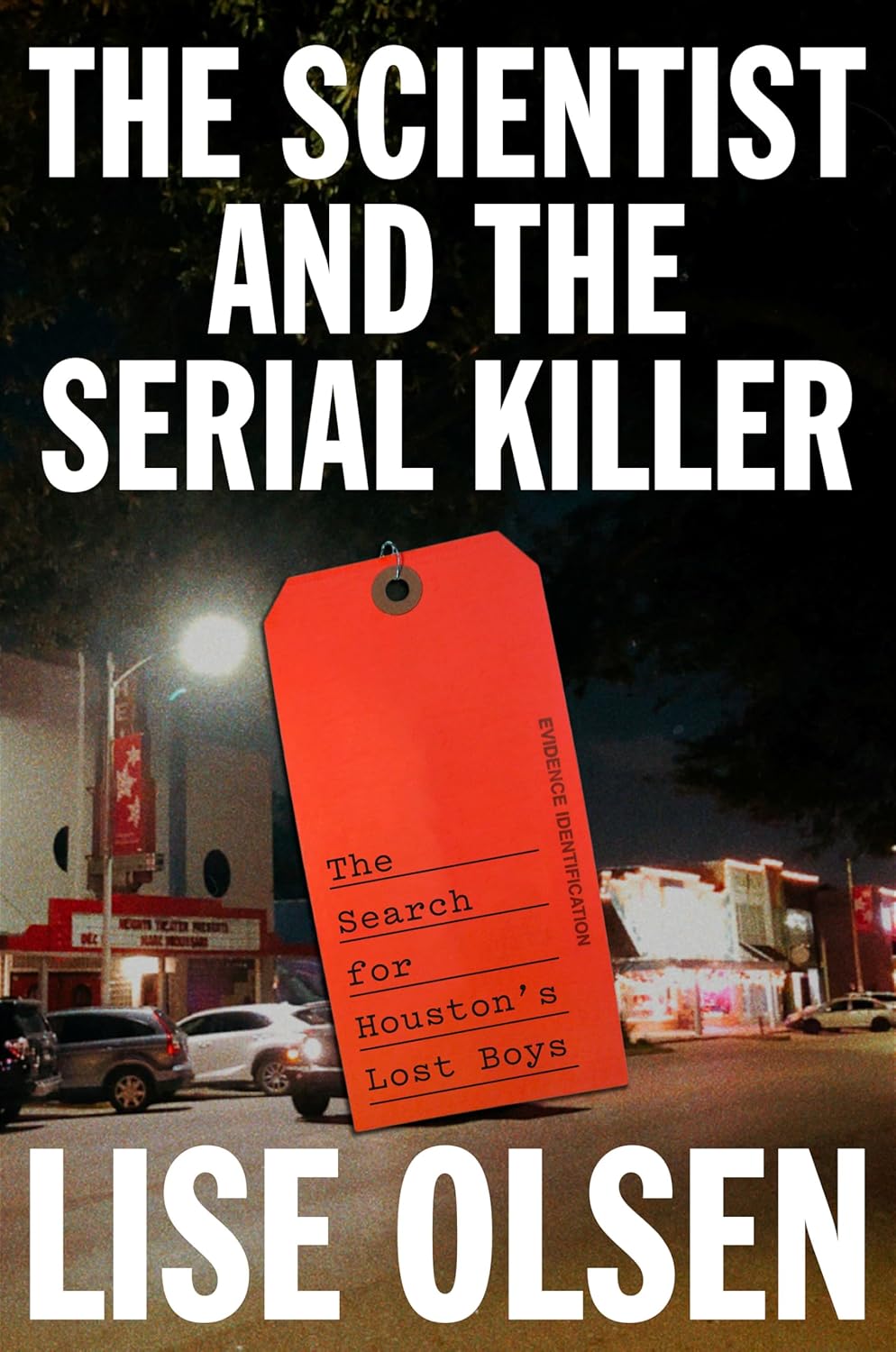
Editor’s Note: The following is excerpted from The Scientist and the Serial Killer: The Search for Houston’s Lost Boys (Random House, April 2025) by Texas Observer Investigations Editor Lise Olsen. The book traces a forensic anthropologist’s decades-long attempt to restore the identities of the victims of one of Texas’ most prolific serial killers—and explores the shocking reasons why so many boys who were kidnapped, tortured, and killed by a murderer trolling Houston neighborhoods in the early 1970s remained anonymous for so long.
The Scientist and the Serial Killer cover, Lise Olsen, Random House, April 2025
Harris County Medical Examiner’s Office, 2006
Sharon Derrick tugged open the sliding metal door and felt a blast of cold air as she stepped inside the long-term storage vault at the Harris County Medical Examiner’s Office, a three-story brick edifice on the edge of the Texas Medical Center. The careful and determined scientist entered the chamber, kept at a bone-chilling 40 degrees, filled with body bags and cardboard cartons containing the remains and effects of more than a hundred unidentified people—the department’s oldest and most perplexing unsolved identity cases. Some of these people’s remains had been collected after accidents or found on roadsides without wallets or witnesses. Many were victims of unsolved murders or suicides who had long ago been autopsied but still had nooses stored in their body bags or bullet holes in their skulls. A few had been discovered without any possessions at all; others remained here with their cowboy boots, wallets, party dresses, lockets, or wallets beside them.
Derrick, 49 years old and standing all of 5 foot 3 inches, edged past the rows of bagged corpses reclining on rows of metal shelves that stretched far above her head all the way to the ceiling. The thin plastic of her disposable autopsy gown offered little protection from the cold, but she felt a thrill of anticipation. For Derrick, an aspiring forensic anthropologist, this room contained enticing mysteries. By examining these boxes, bones, and bodies, she hoped to discover clues that could unlock the lost identities of these men, women, and children, though the conditions here were decidedly uninviting. It didn’t help that the room’s vintage 1980s heating and cooling system constantly leaked: “There was condensation dripping down from the ceiling so when you went in there you got wet. The body bags had a sheen on them.”
Time seemed suspended or irrelevant in this frigid, surreal space. Even in the 2000s, the chamber still resembled the set of a 1960s TV detective drama, with mint-green walls and a darker emerald acrylic floor. Derrick could easily pull out sliding removable metal trays to zip open and examine the contents of each of the body bags and then use labels to locate records for the corresponding medicolegal cases and autopsy photos in the office’s vast paper archives or in its computerized scanned records. But these shelves were so full of long-term occupants that many newer arrivals remained stored on gurneys, which meant Derrick had to weave her way through them, pushing some aside in order to unzip other bags and inspect their contents. Some corpses still looked like waxy sleeping versions of the people whose lives had been tragically lost. Others, after as many as four decades, had begun to assume rather unworldly forms. “I was not having any problems with current fleshed remains … but these people were just awful looking—big cauliflower-like growths, waxy fish skin … for someone who had never worked in that area it was disturbing,” she remembers.
Derrick, an ambitious working mom, was already an experienced bioarchaeologist with a Ph.D. But she was new to the Harris County ME’s Office in the spring of 2006 and had only recently begun training to become a full-fledged forensic anthropologist. She was eager to prove herself in her newly chosen field, though some relatives worried about her, wondering aloud how she could spend so much time with the dead. “Maybe it’s a quirk in my personality,” she’d say. Born into a family of musicians, Derrick had gravitated early toward science, and she found a talent for focusing intently and clinically on bones and bodies to unlock their secrets. To succeed, she had to be hyperalert: Key clues to a lost identity could be as subtle as the shape of the molars inside a skull, a faded label hidden inside a pair of pants, a telling tattoo, the curve of a pelvis, or the precise form and length of a long bone.
One of her first assignments was to inventory and examine the bones and bodies connected to cold cases, most of which had been found before DNA was available as a tool for identifications, and to collect samples for new genetic tests. The eventual goal was to “clear out” the mysterious unidentified remains inside this institutional cavern—and return at least some people to their families for proper burial. That task seemed overwhelming. In addition to the 100 unnamed individuals here, 300 more had been buried in graves marked only with numbers in the Harris County Cemetery, established in 1904 on a desolate patch of land along Oates Road on what was then the “Poor Farm” and became the last resting place for both the anonymous and the unclaimed dead.
AS DECADES PASSED, THE MANY MYSTERIES SURROUNDING DEAN CORLL ONLY DEEPENED.
Prior to her arrival at one of America’s largest medical examiner’s offices, Derrick had probed and exhumed the contents of many centuries-old graves. As a grad student, she’d viewed skulls and skeletons of early settlers and of Native Americans on digs across Texas and had studied the way cradleboards created holes in the backs of the skulls of infants in ancient Caddo burial mounds. That work had been deeply engrossing. After earning her doctorate in 2002, Derrick had chosen to study more modern deaths and leave prehistory to others. Her first job had been leading a team at the Harris County Health Department that reviewed troubling unnatural deaths among children, in an effort to find ways to prevent tragedies like teen suicides and fatal child abuse. It was during that period she’d met Dr. Luis A. Sanchez, MD, a forensic pathologist for Harris County, and when he later became chief medical examiner, she had convinced him to employ her in order to help tackle this very problem: the backlog of unidentified dead.
She had sought out Sanchez at meetings, buttonholed him with smiles and small talk, and engaged him in discussions of how an anthropologist—like her—could help resolve Harris County’s lost identity cases. Her arguments seemed to sink in, especially after a San Antonio medical examiner’s official failed to consult an anthropologist, publicly declared an unidentified woman’s skeleton to be male, and earned embarrassing publicity for his gaffe.
Derrick had already excavated archaeological graves and attended autopsies with no signs of queasiness. Yet her introduction to the unusual occupants of the ME’s long-term storage chamber felt unsettling. “I had not worked with a lot of bodies where only refrigerated decomposed flesh remained,” she recalls. Despite its fluorescent lighting and frequent cleanings, the room still seemed dark. “It was creepy.” But she felt a surge of excitement about her mission here. Like others in the business of investigating untimely or unnatural death, Derrick saw the restoration of identities as one of the highest callings of forensic science. Rediscovering lost names for these people, she knew, could provide answers and sometimes solace to waiting families and, in some cases, revive or resolve stalled murder investigations. Indeed, forensic anthropologists’ efforts to supply names to the deceased often represent “the victim’s last chance to be heard, to reveal a major insight into how a person lived or perhaps how she died,” wrote Douglas Ubelaker, a senior scientist at the Smithsonian Institution who was one of the pioneers in his field. “Sometimes their last words speak not only for the victim but for society and we ignore them at our peril.”
These bones and bodies were part of a tremendous problem that some called the nation’s “Silent Mass Disaster.” Across the country, remains belonging to more than 40,000 lost identity cases were stored in morgues and unmarked graves with only case numbers to mark their time on earth. Criminal justice experts warned the tremendous backlog of unsolved cases allowed too many murder victims to remain unidentified—and serial killers to remain undetected. In many other U.S. counties, records and remains of unknown persons were often buried and forgotten, and got lost or misplaced over time. But when Derrick first arrived in 2006, the Harris County ME had documentation on more than 400 open identification cases, what some called John, Jane, and Baby Does. (That outdated terminology had been banned by the decree of Chief Medical Examiner Sanchez, who considered the use of “Doe” unprofessional and dehumanizing.)
Sharon Derrick (Courtesy/Texas A&M University-Corpus Christi)
Harris County has one of the nation’s oldest professional county medical examiner’s offices—and one of the biggest backlogs of unidentified remains. The office, founded in 1957, had been led for many years by a legendary chief medical examiner with a law degree from Boston College and a medical degree from Harvard University: Dr. Joseph Jachimczyk (pronounced YA-him-chick). Many of the bones and bodies had been stored here under “Dr. Joe” and later by his successors in the hopes that one day new clues—or scientific breakthroughs—would help restore their identities. DNA had been available for criminal investigations since the late 1980s, but into the 1990s and early 2000s it remained difficult to extract usable DNA profiles for identification purposes from such cold cases. Fortunately, by the time Derrick arrived in 2006, DNA tests and lab techniques had gotten more powerful. Tiny amounts of different types of DNA could be extracted and then replicated from inside molars or the shafts of long bones to produce genetic profiles that could then be compared to potential relatives (or descendants), even for decades-old or degraded remains. (Indeed, mitochondrial DNA collected from ancient mummies and Ice Men had been analyzed.) Still, obtaining DNA profiles from older remains could be costly and time-consuming for a cash-strapped county government—especially if an exhumation was required to retrieve a tissue or bone sample. Many of these cold cases seemed hopeless.
Harris County’s oldest unsolved identity case from June 1964 involved the torso of a dark-haired man, nicknamed Old Stubby, who’d been decapitated and dismembered, likely with a hatchet or an ax, and discarded in a ditch near the Jones Creek Bridge in an apparent organized crime hit. The files were full of tips that had led nowhere, including the rumor that Old Stubby might have been a mafia boss, perhaps tied to Jimmy Hoffa, the powerful Teamsters union president who disappeared in 1975. After decades of attempts ended in failure, Dr. Joe and most of the staff attended a ceremony in the county cemetery in November 1984, after which Old Stubby’s remains were interred in one of the many plots marked with square stones and etched with case numbers. “In my heart of hearts, I feel we’ve done everything humanly possible,” Jachimczyk told a reporter that day. “Now I’ll know that whoever he is and whatever he did, at least he’s had a decent burial. If the shoe were on the other foot, God forbid, I hope someone would put me away, too.” Eleven years later, Dr. Joe retired, leaving these unresolved identifications to the next generation.
Derrick knew that some lost souls stuck in storage were the victims of serial killers. The Texas Chainsaw Massacre’s cinematic carnage was fiction, but Angel Maturino Resendiz, the mentally disturbed Railroad Killer; Henry Lee Lucas, the violent pathological liar known as the Confession Killer; and a demented serial strangler named Carl Eugene Watts all claimed victims in Houston. Next to the vault filled with body bags, an adjacent room contained shelves filled with dozens of boxes containing unidentified skeletal remains, property, and clothing, many of which had been relocated there in 1985 after the county’s original morgue closed.
In one of her early forays, Derrick spotted a series of corrugated brown shipping boxes on a shelf just below her eye level. They were labeled with the year 1973. “I immediately gravitated toward those three boxes,” she recalls. When she peeked inside, she knew right away that these “were boxes of young male bones. One had what looked like a complete set of skeletal remains.” Her discovery felt personal and intensely disturbing. “Each of them said ‘Houston Mass Murders,’ and I immediately clicked back to when I was in high school.” She recognized this real-life Texas horror story: These were the victims of Dean Corll, the so-called Candy Man, who’d gained the title of the nation’s most prolific modern killer in August 1973.
Those cartons contained the bones and effects of the Lost Boys, some of the 27 adolescent boys and young men known to have been killed by Corll and his two teenaged henchmen in the 1970s. Derrick felt stunned. They still have remains from that case? Those boys still haven’t been identified?
Many of Corll’s victims came from a neighborhood she knew well: Houston Heights.
Sharon McCormick (Derrick), a child of the 1960s and 1970s herself, grew up in a bucolic family compound north of Austin city limits in a house her father built. She was by far the youngest of the five McCormick siblings. Yet this coddled child, through happenstance, had been affected early and often by violent death. Her paternal grandfather, S. C. McCormick, whom she never knew, had been shot and killed in June 1920 by a Black man while serving an arrest warrant as a volunteer deputy sheriff in Wharton County. The homicide in that sparsely populated and heavily segregated rice-growing area had unleashed a mob of 250 who carried out a horrifying round of retaliatory murders, gunning down the triggerman and his brother and lynching two of their friends. Young Sharon McCormick heard those disturbing tales from her father, who’d been only a boy at the time. In the aftermath, her father rapidly relocated more than 50 miles northeast to Houston, where he later dropped out of school to work as a tile setter to support his widowed mother. Yet in a way, murder had enabled her parents to meet, since otherwise her father might never have left Wharton at all.
Her mom and dad were married in a church in the Heights, where her mother’s family, the Morses, had lived for three generations. When she first learned of the devastation that could be caused by a single prolific killer, Sharon was a charming child who played the flute, wore plaid jumpers, and pulled her hair up into long side ponytails. Her older brother was attending the University of Texas at Austin and her sister was working there on the day Charles Whitman climbed into the UT bell tower and opened fire in August 1966, killing 14 and wounding another 31—shocking the nation with the highest death toll caused by a mass shooter in a single incident up to that time. Sharon knew a student whose fiancé died in the melee—that young woman’s finger had been blown off when she reached for her beloved.
A few years later, in her junior high days, another friend’s sister committed suicide, prompting Sharon, preternaturally curious about death, to pose probing questions that adults seemed reluctant to answer.
As an older teen, Sharon often stayed up late at slumber parties with her best friend Susan, watching Saturday Night Live and late-night horror films on TV. Their favorite was a campy 1967 spoof by director Roman Polanski called The Fearless Vampire Killers, featuring actors with oily pompadours and capes cavorting through a haunted castle. One over-the-top scene featured the actress Sharon Tate sprouting fangs and taking a bite from the exposed neck of her hapless would-be savior (a role Polanski played). The on-screen chemistry Sharon McCormick noticed between those two actors was real: Tate married Polanski in 1968.
Teenaged Sharon McCormick knew Tate only from TV, yet she felt a strong connection—they shared the same name and similar roots. Sharon Tate spent her formative years in Texas too. As an 8-month-old, Tate had been named Miss Tiny Tot in a Dallas pageant. She’d moved often as the daughter of a U.S. Army officer, attending high schools in Pasadena and Dallas, and as an actress, she displayed a decidedly Texan sense of style. In the film, her blond updo, impeccable makeup, and glamor held up no matter what the vampires or stooge-like vampire hunters did or said. That familiar film lost all of its allure in August 1969, when Tate, eight months pregnant with her first child, was slain by real monsters: members of the Manson family who invaded her California home in one of their infamous “creepy crawly” raids and painted the word “pig” on a wall in the dead actress’ blood. Sharon McCormick felt those losses deeply. “We had watched that movie so many times, and then she was killed…”
Sharon attended David Crockett High School in Austin from 1970 to 1973, marching in the band and later switching to drill team to perform in go-go boots as a “Tex-Ann.” Her musically inclined family was astonished by her choice: The youngest McCormick had never mastered the flute and wasn’t much better at dancing. All of her parents’ musical genes seemed to have gone to her brothers, two of whom played in bands professionally, while she struggled to keep a beat. But the fun of her high school years was marred by yet another tragedy right after Christmas 1972. Some of her classmates were en route home from a Baptist youth gathering in New Mexico when an 18-wheel cattle truck jackknifed on a bridge, striking their bus and killing 16 teens and three adults. One of the victims had been in Sharon’s gym class. She inherited clothing from another dead girl who happened to share her size. A boy she knew was left grieving for his twin, and another survivor showed up at school in a wheelchair with a broken leg. Some 5,000 people attended a public memorial service in Austin, then a city of 250,000. Crockett High, named for Davy Crockett, a frontiersman and perhaps the most famous of the fighters killed at the Alamo, erected a monument to those who died on that bus.
But young Sharon McCormick felt a particularly strong jolt from homicidal violence on the sweltering summer morning in August 1973 when she ran out to grab the family’s rolled-up copy of the Austin American-Statesman. She unfurled the newspaper and was struck to see yearbook photos of handsome boys about her own age on the front page. All of them were dead. They had all been tortured, raped, and killed by a man named Dean Corll. Teenaged Sharon went on to read all she could about Corll’s crimes. The term “serial killer” did not yet exist, so police kept calling them the “Houston Mass Murders” and journalists began referring to the victims as the “Lost Boys.” Heartbreaking interviews appeared with some boys’ parents; others remained nameless. Two of Corll’s accomplices were teenagers too: Wayne Henley and David Brooks.
This tragedy didn’t seem at all distant to her. These murdered teens were mostly from the Heights, the same neighborhood where her parents had met and her grandparents had lived. Her paternal aunt and uncle and a band of boy cousins still hosted family gatherings at their bungalow in Oak Forest, a neighborhood just north of there. Sharon devoured those stories and stared at the boys’ school portraits. From that moment, she began forging a personal connection with the Lost Boys that deepened over time. “They were all so young,” she recalled. “And some looked like the handsome long-haired boys I liked to date in high school.”
(Courtesy/Texas A&M University-Corpus Christi)
The news about that Houston case kept getting worse. In a few days of gruesome excavations, the body count swelled to 27 males, aged 13 to 20. Texas Rangers, local news reporters, and national anchors all began describing this as the deadliest documented murder spree in modern American history: Corll had surpassed even the death toll of Juan Vallejo Corona, convicted in 1971 of slaying 25 migrant farmworkers and burying their bodies in California peach orchards. The Houston Mass Murders quickly went international. Pope Paul VI sent his sympathy to victims’ families, while the Vatican newspaper described the slayings as a horror “in the domain of the devil.” The Kremlin issued a statement distributed by United Press International that condemned American decadence. By early 1974, Truman Capote, a celebrity writer considered a true crime expert after In Cold Blood, turned up in a dark gray suit and matching fedora on assignment to cover the case for The Washington Post.
Still, many things about Dean Corll remained unclear: Had Corll killed only 27 victims, as authorities concluded after ending searches for graves in just four days? Or were there at least 40, as Henley’s defense attorney later claimed? Houston’s police chief and Harris County’s district attorney had pushed to quickly close the cases and end the barrage of negative attention as a “Murdertown” on a place so proud of its status as America’s Space City and as the Oil Capital of the World.
As decades passed, the many mysteries surrounding Dean Corll only deepened: The whodunit transformed into a whowerethey.
Of course, in her school days, Sharon McCormick never dreamed she’d play any role in that infamous murder case. In college, she initially focused on a possible career in journalism or in anthropology, and then deferred those career plans after falling in love with Al Derrick, a co-worker at a popular Austin café, a hot spot frequented by Willie Nelson and other outlaw country musicians. She was a hostess; he was a busboy. Back then, Al wore his hair long and charmed her with tales of crazy adventures, including a summer of camping, hiking, and scuba diving on remote beaches in Hawaii. Al’s more rebellious older brother had run away twice—hopping on a plane by himself and traveling out of state. But like most teenagers, Al and his brother survived their risk-taking years. These Lost Boys had been deprived of the chance to live into their own adulthoods. Now, years later, as an aspiring forensic anthropologist, Sharon Derrick was in a position to help them. She soon became engaged in this compelling upside-down murder mystery: The serial killer had been quickly identified, but for three decades, the identities of some of his victims remained unknown.
Derrick felt a pang of sorrow as she lifted the lids of the boxes and got her first look at the weathered bones and scraps of clothing inside that had belonged to boys who, like her, were teens in the 1970s, but never got any older. She could easily imagine their world: Texas in the Age of Aquarius—when teens wore bell-bottom jeans and hip boots and listened to Creedence Clearwater Revival, her own favorite band of that era. She knew that DNA and other advanced forensic techniques available to her hadn’t been around in the 1970s. But even in the 2000s, DNA was primarily useful as an identification tool only after an unidentified person’s closest prospective relatives had already been discovered and convinced to cooperate. To verify any ID, Derrick would also have to locate parents or siblings, close relatives who would share similar patterns with a decedent’s nuclear or mitochondrial DNA profile. The ranges needed to establish what scientists call “relatedness” varied, but generally mothers or fathers are preferred since a child inherits 50 percent of their DNA from each parent; Derrick knew that would be challenging, given the age of these cases.
Still, it perplexed her that these particular teens had not been identified long ago. Most of Corll’s known victims had been kidnapped and killed in a relatively compact area: the Heights and surrounding neighborhoods like Spring Branch, Garden Oaks, and Oak Forest. All of her life, Derrick had visited relatives in those same places. Certainly the Heights, which had again become fashionable in the 2000s, had experienced a slump in the 1970s, but even in those tough years, many Heights families still owned their bungalows and knew their neighbors. Why had no one ever recognized these boys and reclaimed them?
Some of the boys’ belongings seemed straight out of a 1970s time capsule. She spotted scraps of bedraggled bell-bottom jeans, a shirt with a peace sign on its pocket, and what looked like a surfer’s knotted jute bracelet tucked beside bones inside those boxes. One of the 1973 boxes contained a particularly confusing mixture of bones and odd items, including a stray piece of women’s hosiery as well as other bones that seemed to come from more than one teenager or perhaps an unrelated homicide case. Another held the bones of a boy who once wore a T-shirt with an elaborate U.S. Marine Corps decal with the hand-drawn black letters LA4MF, possibly sketched by someone in a unit deployed to Vietnam. That insignia, one veteran later told her, might refer to a dark joke: “Late for my funeral.” Inside that same box was a pair of faded Catalina swimming trunks with red, blue, and gold stripes that eventually earned this murder victim a nickname in the press: Swimsuit Boy.
Despite efforts in the 1970s and subsequent advances in forensics, no one had been able to use this evidence to find these victims’ families and restore their names. Derrick knew her own attempts to reexamine these bones and get a lab to extract DNA samples might be the last hope. Some mothers and fathers, likely in their 70s now, could still be waiting and able to provide comparison DNA samples. But time was running out to obtain answers for people who had loved these boys most and known them best. Without more clues—and prospective relatives willing to cooperate—the task might prove impossible. Still Derrick, a fundamentally optimistic person, remained full of hope. “I felt such compassion for them and for their families,” she remembers. “I thought that if I had the ability to give their identities back to them, that would feel good.” Derrick drew inspiration from her own mother, a bold and determined woman with five children, who had never been able to attend college but had somehow managed to become an Austin schoolteacher and eventually an administrative assistant by working hard, projecting confidence—and aiming high.
Derrick turned her attention to the third box, which held what seemed like the most promising collection of clues. It contained skeletal remains and a fairly complete set of clothing, including that shirt with the peace sign, a dark long-sleeved uniform jacket like the ones gas station attendants wore back when Americans rarely pumped their own, and a pair of well- worn leather boots. Something about that case called to Derrick. She would begin her quest with this boy—and his boots.
Join the Observer Wednesday, April 9, at BookPeople in Austin to celebrate the release of Lise Olsen’s book. RSVP information here.
The post The Scientist and the Serial Killer: Cracking the Case of Houston’s ‘Lost Boys’ appeared first on The Texas Observer.