Number of dead in a roof collapse at a nightclub in Dominican Republic rises to 218

posted in: All news | 0

By MARTÍN ADAMES ALCÁNTARA and DÁNICA COTO, Associated Press

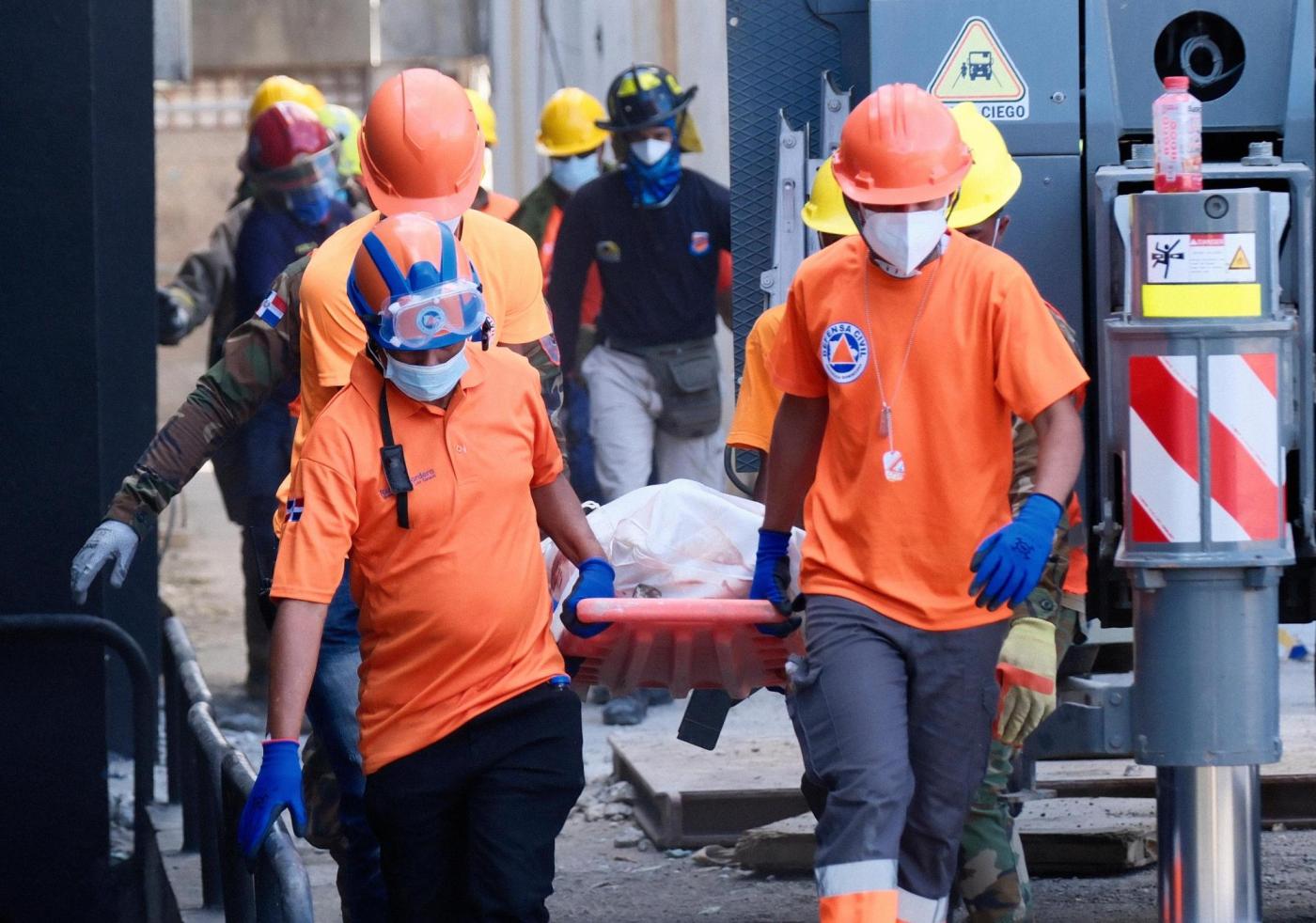
SANTO DOMINGO, Dominican Republic (AP) — The number of dead in a roof collapse at an iconic nightclub in the Dominican Republic surged to 218 on Thursday, an official said.

Juan Manuel Méndez, director of the Center of Emergency Operations, said crews at the scene were still looking for victims and potential survivors, although no one has been found alive since Tuesday afternoon.

“We’ve practically combed through ground zero,” he said, adding that there’s one very small area of rubble left that crews are focusing on. “This has been very difficult for us all.”

Rescue workers search for bodies at the Jet Set nightclub after its roof collapsed during a merengue concert in Santo Domingo, Dominican Republic, Thursday, April 10, 2025. (AP Photo/Matias Delacroix)

Doctors warned that some of the two dozen patients who remained hospitalized were still not in the clear, especially the eight who were in critical condition.

“If the trauma is too great, there’s not a lot of time” left to save patients in that condition, said Health Minister Víctor Atallah.

He and other doctors said that injuries include fractures in the skull, femur and pelvis caused by slabs of cement falling on those attending a merengue concert at the Jet Set nightclub in Santo Domingo, where more than 200 were injured.

On Wednesday, dozens of people had anxiously searched for their loved ones, growing frustrated upon getting no answers after visiting hospitals and the country’s forensic institute. By Thursday, a lone family remained with no answers.

María Luisa Taveras told TV station Noticias SIN that she was still looking for her sister.

People pray for their missing relatives outside Jet Set nightclub after its roof collapsed during a merengue concert in Santo Domingo, Dominican Republic, Wednesday, April 9, 2025. (AP Photo/Ricardo Hernandez)

“We have gone everywhere they told us,” she said, her voice breaking.

Taveras said the family has spread out, with a relative stationed at each hospital and at the forensic institute.

The government said Wednesday night that it was moving to a recovery phase focused on finding bodies.

The legendary club was packed with musicians, professional athletes and government officials when dust began falling from the ceiling and into people’s drinks early Tuesday. Minutes later, the roof collapsed.

Victims include merengue icon Rubby Pérez, who had been singing to the crowd before the roof fell; former MLB players Octavio Dotel and Tony Enrique Blanco Cabrera; and Nelsy Cruz, the governor of the northwestern province of Montecristi whose brother is seven-time Major League Baseball All-Star Nelson Cruz.

Also killed was a retired United Nations official; saxophonist Luis Solís, who was playing onstage when the roof fell; New York-based fashion designer Martín Polanco; the son and daughter-in-law of the minister of public works; the brother of the vice minister of the Ministry of Youth; and three employees of Grupo Popular, a financial services company, including the president of AFP Popular Bank and his wife.

Randolfo Rijo Gómez, director of the country’s 911 system, said it received more than 100 calls, with several of those made by people buried under the rubble. He noted that police arrived at the scene in 90 seconds, followed minutes later by first response units. In less than half an hour, 25 soldiers, seven fire brigades and 77 ambulances were activated, he said.

Crews used dogs and thermal cameras to search for victims, rescuing more than 180 survivors from the rubble, authorities said.

It wasn’t immediately clear what caused the roof to collapse, or when the Jet Set building was last inspected.

The government said late Wednesday that once the recovery phase ends, it will launch a thorough investigation.

The club issued a statement saying it was cooperating with authorities. A spokesperson for the family that owns the club told The Associated Press that she passed along questions about potential inspections.

Meanwhile, a spokesperson for the Ministry of Public Works referred questions to the mayor’s office. A spokesperson for the mayor’s office did not respond to a request for comment.

Defense chiefs from around 30 countries meet at NATO for talks on a future Ukraine force

posted in: All news | 0

By LORNE COOK and SAM McNEIL, Associated Press

BRUSSELS (AP) — Britain’s defense minister on Thursday urged military leaders from around 30 countries to press ahead with plans to deploy troops to Ukraine to police any future peace agreement with Russia.

The meeting at NATO headquarters in Brussels — the first between defense ministers representing the so-called coalition of the willing — comes after a visit to Kyiv last week by senior British and French military officers. It’s expected to work on fleshing out an agreement reached at an earlier meeting between leaders.

John Healey, Britain’s defense minister, opening the meeting said, “We must put more pressure on (Russia’s) President Putin to end his war.”

He said 200 military planners from 30 countries were working to develop plans for deepening European involvement in Ukraine.

“We must be ready for when that peace comes. That’s why the work of this coalition is so vital. We’re stepping up. We’re serious,” Healey said.

Ukrainian government officials and military analysts have said that Russian forces are preparing to launch a fresh military offensive in Ukraine in the coming weeks to maximize pressure on Kyiv and strengthen the Kremlin’s negotiating position in ceasefire talks.

As usual with coalition gatherings, the United States will not take part, but the success of the coalition’s operation hinges on U.S. backup with airpower or other military assistance. However, the Trump administration has made no public commitment to provide support.

The Netherlands, Sweden and Finland underlined the “crucial” role of the United States.

“The United States is a crucial player still in guaranteeing lasting security” in Ukraine, said Finnish Defense Minister Annit Häkkänen. His Swedish counterpart, Pål Jonson, said success in Ukraine requires “some form of U.S. engagement” while Dutch Defense Minister Ruben Brekelmans called American support “very important” but said the form it took might differ, depending on the chosen type of European mission in Ukraine.

EU foreign policy chief Kaja Kallas said ministers were “trying to keep the United States on board.”

Amid that uncertainty and U.S. warnings that Europe must take care of its own security and that of Ukraine in future, the force is seen as a first test of the continent’s willingness to defend itself and its interests.

Its make-up will depend on the nature of any peace agreement, but the contingent is unlikely to be stationed at Ukraine’s border with Russia. It would be located further from the ceasefire line, perhaps even outside Ukraine, and deploy to counter any Russian attack.

Building a force big enough to act as a credible deterrent is proving a considerable effort for nations that shrank their militaries after the Cold War but are now rearming. U.K. officials have talked about possibly 10,000 to 30,000 troops.

“Our reassurance force for Ukraine would be a committed and credible security arrangement to ensure that any negotiated peace does bring what President Trump has pledged: a lasting peace for Ukraine,” Healey said.

Countries are also reluctant to contribute personnel without U.S. support. The Europeans cannot match U.S. weapons systems, intelligence gathering and satellite surveillance capabilities.

The nature of the force will be determined by the terms of any peace agreement. The coalition is still trying to establish how it would operate: leading countries want a robust deterrence force to defend against any Russian attack.

The ceasefire is likely to be monitored with technical means such as surveillance cameras and satellites. Any troops doing this would have to be acceptable to both sides.

Brekelmans said key questions must still be answered like “what is the potential mission? What is going to be the goal? What is the mandate? What would we do in under different scenarios, for example, if there would be any escalation regarding Russia?”

Some countries — Italy and the Netherlands, for example — require the approval of their national parliaments before they can deploy troops.

On Friday, representatives from around 50 nations will gather at NATO to drum up military support for Ukraine. That meeting will be chaired by Britain and Germany. U.S. Defense Secretary Pete Hegseth is not expected to take part.

AP writer Sam McNeil contributed to this report from Barcelona, Spain

Author, wife of Weezer bassist arrested after being shot by police who say she pointed a gun at them

posted in: All news | 0

By ANDREW DALTON, Associated Press Entertainment Writer

LOS ANGELES (AP) — Jillian Lauren, author and wife of Weezer bassist Scott Shriner, was shot and injured by Los Angeles police and arrested on suspicion of attempted murder after pointing a gun at officers from her front yard, authorities said Wednesday.

The 51-year-old Lauren, identified by police as Jillian Shriner and listed as Jillian Lauren Shriner in jail records, had injuries that were not life-threatening after the shooting in the northeast Los Angeles neighborhood of Eagle Rock on Thursday, the LAPD said in a statement.

Related Articles


British police charge comedian Russell Brand with rape and sexual assault


Eagan native Eva Erickson joins an alliance of muscle on ‘Survivor’


Classic rock station KQRS’ reboot focuses on Gen X listeners and Minnesota acts


Review: Naomi Watts and a Great Dane mourn Bill Murray in ‘The Friend’


Josh Brolin, Francis Ford Coppola and Michael Mann pay tribute to Val Kilmer after his death

Her representatives did not immediately respond to requests for comment and there is no indication Scott Shriner was involved in the incident. Weezer is scheduled to play the Coachella Valley Music and Arts Festival on Saturday.

Police said they were assisting California Highway Patrol officers in their search for three suspects from a misdemeanor hit-and-run. Lauren was not among the suspects. But while pursuing one of them who had reportedly been running through a backyard, police came upon Lauren in the front yard of her neighboring residence, holding a handgun.

They ordered her several times to drop the gun, but she refused, and pointed it at them, police allege. They did not say whether she fired the gun, but said she was hit by police gunfire and fled into her home, where they took her into custody then took her to a hospital.

A 9-millimeter handgun was recovered from Shriner’s home, the police statement said.

She was later booked and released after posting $1 million bond, LA County jail records showed.

Lauren has not made a court appearance, and it was not immediately clear whether she has hired a lawyer. There were no immediate responses to an email to her manager and a message left on her author website. There was also no response to an email seeking comment from a representative for Weezer.

Lauren is the author of two bestselling memoirs, 2010’s “Some Girls: My Life in a Harem” and 2015’s “Everything You Ever Wanted.”

Weezer is a Los Angeles band beloved for their 1994 record unofficially known as the “Blue Album,” featuring songs including “Say It Ain’t So” and “Buddy Holly.” Shriner joined the band in the early 2000s.

Lauren and Shriner married in 2005, and they have two children.

One of the three hit-and-run suspects was found, cited by the CHP and released.

Related Articles


British police charge comedian Russell Brand with rape and sexual assault


Eagan native Eva Erickson joins an alliance of muscle on ‘Survivor’


Classic rock station KQRS’ reboot focuses on Gen X listeners and Minnesota acts


Review: Naomi Watts and a Great Dane mourn Bill Murray in ‘The Friend’


Josh Brolin, Francis Ford Coppola and Michael Mann pay tribute to Val Kilmer after his death

Forgotten Crossings at the Edge of Texas

posted in: All news | 0

Editor’s Note: Author Richard Parker died early last month, days after publication of his book The Crossing. “My dad was a person that loved learning about the world around him, and we saw that in his writing,” his daughter Olivia told the Albuquerque Journal. He was 61. 

For years, one of my favorite places to visit in El Paso was the crossing where the Spanish conquistador Don Juan Onate and several hundred Spanish, mestizo, and Indigenous settlers crossed the Rio Grande/Río Bravo—El Paso del Norte—in 1598 on their expedition from Mexico to northern New Mexico.

The spot has all kinds of significance. The first Europeans entered present-day Texas here. It’s where the expansion of the Spanish empire to California, Colorado, New Mexico, and Texas began. The El Camino Real trail to Santa Fe and Taos runs through here.

Part of the site’s appeal is how it has been ignored and willfully hidden. The four-acre site is a little sliver of forgotten territory squeezed between the 15-foot border fence and the channeled river to the west and Paisano Drive, the CanAm Highway, railroad tracks, and Interstate 10 to the east. It’s hard to get to and maybe too close to the border for the Border Patrol’s liking, I guess. 

For years, I’d take a meal at La Hacienda Mexican restaurant in the old house built in the 1850s by Simeon Hart, who operated El Paso’s first mill, so I could get a close up view of the crossing. Even when the restaurant was open, the area felt deserted. On one afternoon visit, I watched three teenage males emerge from the brush by the border fence and make haste toward Paisano Drive, having made their own crossing.

Just beyond the restaurant’s parking lot is a paved semi-circular plaza consisting of four markers along with a fountain that no longer flows, a mere stone’s throw from the fence and the miserable channel that passes for the Rio Grande. The markers commemorate the place as the major east-west link for telegraph lines and railroads in the United States and James Magoffin and Simeon Hart, portrayed as civic leaders and agents of the Confederacy during the Civil War who helped thwart Union soldiers from taking El Paso.

Since the closing of La Hacienda, access to the crossing has been blocked by a chain-link fence. 

Behind La Hacienda is the pocket-sized Doniphan Park with a small playscape and half court, plus the original Fort Bliss, a two-story adobe that was long forgotten since the military installation relocated east of Mount Franklin long ago.

I was always puzzled why the site was willfully forgotten, as if it was a history city and state leaders didn’t want you to know about. 

The Crossing: El Paso, the Southwest, and America’s Forgotten Origin Story is the title of Richard Parker’s new rich cultural and political history of El Paso. By virtue of the book being about El Paso, it’s an adventure into the Other Texas. El Paso has never really belonged to the Lone Star State. It’s in a different time zone. The landscape is sprawling desert pocked with dry mountain ranges, far from forests, lakes, and anything green. It’s dry and dusty, the antithesis of Texas alongside and east of Interstate 35, where most of the population lives. El Paso is the American West, geographically closer to Los Angeles than to Orange, Texas.

Parker writes about the tribes and traders who lived and traveled through the region before the Europeans arrived, and he makes the case that agriculture was practiced in the Lower Valley of El Paso before just about anywhere else on the continent. Even after the arrival of Juan Onate, Parker writes, the different folks who passed through El Paso generally got along—excepting the fierce Apache people—until the arrival of Anglos, the United States, and Texas. 

As part of New Spain, then Mexico, El Paso prospered as a trading center and commercial hub where many cultures mixed and mingled. The troubles started, according to this telling, at the end of the Mexican War in 1848 when the Rio Grande was declared the international boundary and Mexico ceded all claims to Texas and the Southwest. 

The new immigrants arriving in El Paso came mostly from the east, not the south, and included all kinds of outlaws, hustlers, and rapscallions, leading to a half-century of bloodshed (Cormac McCarthy’s sweet spot) and El Paso’s reputation as the Gunfighter Capital of the World. This mythic Marty Robbins-and-Felina-at-Rosa’s-Cantina version of El Paso has substance: Plaques on downtown streets identify where John Wesley Hardin was killed and where four men were shot dead in five seconds. 

Parker profiles a very different Pancho Villa from the one portrayed in legend, and he cites Villa’s numerous ties to the city. 

Mexican Americans suffered discrimination from “Juan Crow” segregation laws in Texas, often forced to attend separate schools and routinely refused service in restaurants and public facilities, even lynched because of the color of their skin. Efforts to delouse Mexican immigrants who commuted to and worked in El Paso with poison gas in the 1930s were successfully stopped, although the method caught the eye of German Nazi scientists, who employed a similar method in their concentration camps.

Parker also writes of tolerance and progress, such as when the Ku Klux Klan attempted to make inroads in El Paso in the 1920s and was rebuffed; of Company E and the Texas Thirty-Sixth Infantry Division and other uncredited Mexican-American heroes of World War Two; the Bracero program that admitted farmworkers from Mexico; the election of Raymond Telles as the first Hispanic mayor of a major city in the United States when he was picked to lead El Paso in 1957; and the Texas Western College Miners winning the NCAA basketball championship in 1966 with its starting lineup of all-African-American players beating the all-White University of Kentucky Wildcats. 

He writes of the military, immigration, the drug war—elements that define life in the borderlands—and of the Guggenheim-owned ASARCO copper smelter smokestack, the tallest in the world when it was built, and its history as a spewing font of noxious lead, arsenic, and cadmium.

The negative Anglo/U.S./Texas influence culminates in the murder of 23 shoppers at an El Paso Wal-Mart by a 21-year-old racist from the Dallas area in 2019. Parker makes clear the killings were the end product of the hate-spewing, Mexico-bashing U.S. President Donald J. Trump.

Parker’s manuscript could have used a more thorough edit. He sometimes tries to connect the dots between dates and events to make a point but doesn’t always hit the mark, particularly when breaking down the dynamics between Indigenous tribes in the region and delving into details of the Mexican Revolution. 

A photograph caption reads: “A view of contemporary El Paso’s East Side, with the Franklin Mountains, rising to seven thousand feet above sea level, in the background.” But the actual image, taken from the top of the Doubletree Hotel downtown, is of El Paso’s Westside, along with Juárez, with the Juárez mountains in the background.

But The Crossing brims with El Paso pride, citing elements that give El Paso its character, teasing out the small stuff that make it unique and unlike the rest of Texas, to the point that Parker suggests El Paso secede from Texas and join New Mexico because they’re more aligned culturally, socially, and politically, as well as geographically. 

El Paso (Shutterstock)

Parker tells his own story, too, growing up on El Paso’s Westside, i.e. the more prosperous side. His Arkansas-born Anglo father managed a maquiladora across the river in Juárez. His Hispanic mother came from Monterrey. Parker has been a reporter for the Albuquerque Journal, an opinion writer for The Atlantic and the New York Times, and an instructor at the University of Texas and Texas State University. His previous book Lone Star Nation: How Texas Will Transform America suggested Texas portends where the United States is headed.

Halfway through the book, I started wondering how Parker was going to frame his storytelling for Texas media at book events, whether he’d pull punches or be as blunt as he is in print. Then, days after publication, Parker was found dead in his residence. 

Two years ago, a non-profit called Abara House announced plans to restore Hart’s Mill/La Hacienda restaurant and repurpose the site as a multi-use borderlands center. A master plan has been designed, but to realize the project funds have to be raised. 

For now, the crossing is closed to people like you and me. The best I can recommend is to Google 1720 Paisano, and when you get there, drive real slow and peer through the chain-links and the brush, and you might catch a glimpse of the four historic markers and forlorn fountain in the grassy clearing. 

With Parker’s passing, The Crossing becomes a coda for his relationship to the borderlands, a place he portrays as a model of different cultures working together, tolerance, and understanding—a few things, he contends, the rest of Texas could learn from.

The post Forgotten Crossings at the Edge of Texas appeared first on The Texas Observer.