By KEVIN FREKING, Associated Press
WASHINGTON (AP) — Republicans narrowly got their budget plan over the finish line. Now comes the hard part.
The resolution adopted this week was only a first step that allows Republicans to draft legislation that they can push through Congress without Democratic support. Next, they begin crafting a final bill with enough spending cuts to satisfy those on the right while not jeopardizing the reelection prospects of more vulnerable lawmakers whose constituents rely on key safety net programs.
With thin majorities in the House and the Senate, Republicans can afford to lose hardly any votes from their side of the aisle as they draft legislation, giving each lawmaker leverage over the process.
“It’s going to take all of us to get it done,” said House Majority Leader Steve Scalise, R-La.
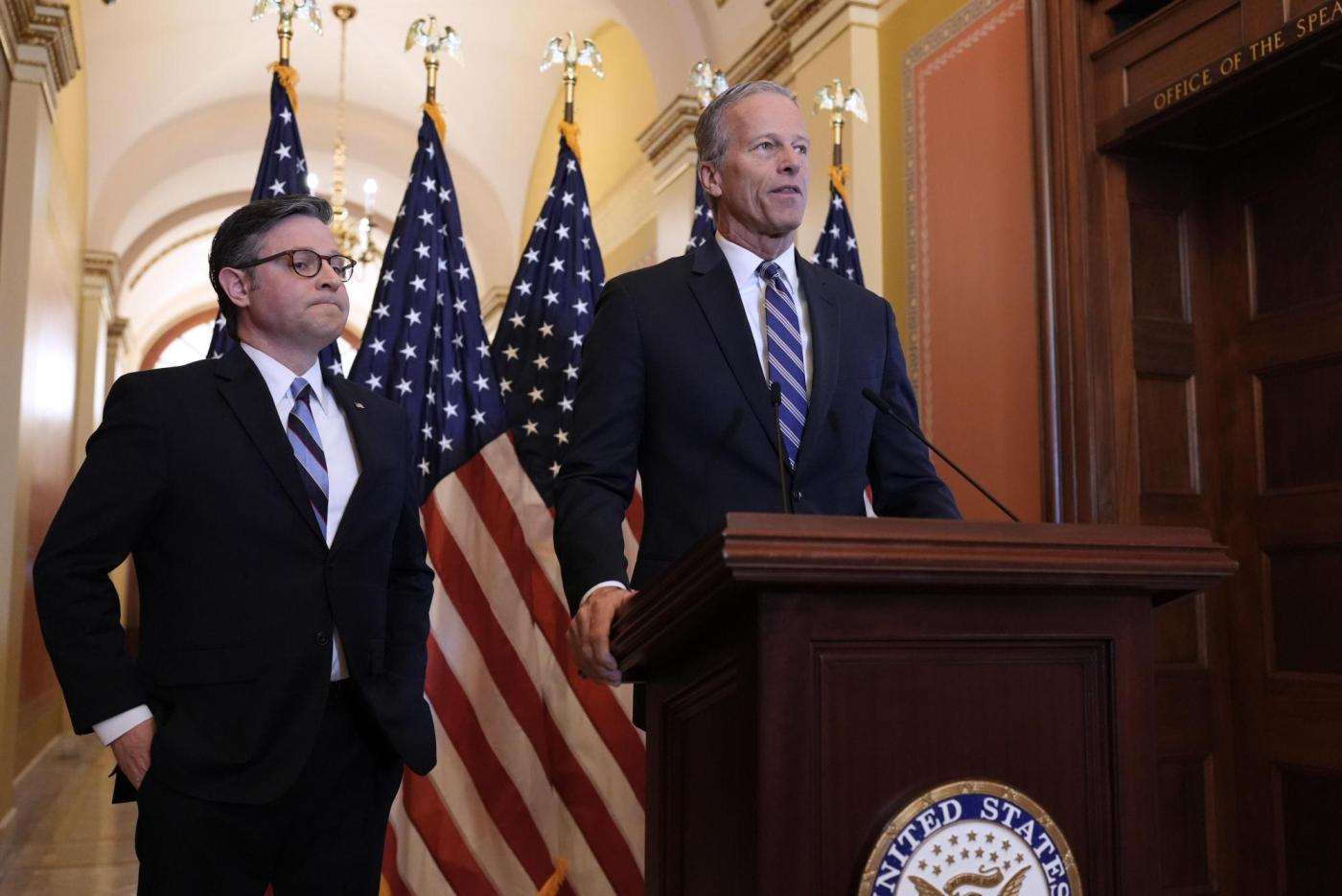
House Majority Leader Steve Scalise, R-La., talks to reporters just after House Republicans narrowly approved their budget framework, at the Capitol in Washington, Thursday, April 10, 2025. (AP Photo/J. Scott Applewhite)
The road ahead is daunting.
Republicans are determined to extend the individual tax cuts that were approved during President Donald Trump’s first term before they expire at year’s end. But they intend for the legislation to do far more than that, potentially enacting a host of tax reductions that Trump promised during the campaign, such as no income tax on tips and overtime.
And the tax cuts are only half the equation. Conservatives in the House gave the budget plan the final votes needed for passage Thursday after they said they received assurances from leadership in both chambers that they would work to have a final product with at least $1.5 trillion in spending cuts — forcing changes to federal programs including Medicaid that could prove hard for some in the party to support.
“The struggles Republicans have faced so far are only a glimmer of what’s to come,” said Senate Democratic leader Chuck Schumer.
Stephen L. Carter: Supreme Court’s rulings aren’t White House ‘wins’
Supreme Court says Trump administration must facilitate return of deported Maryland man
Judge will halt Trump administration from ending humanitarian parole for people from four countries
Requirement that all non-citizens register with federal government allowed to go into effect
National intelligence head says MLK and RFK assassination records will soon be public
Rep. Max Miller, R-Ohio, senses a difficult fight for Republicans. He said Trump has made clear he doesn’t want any benefit cuts for those who get health insurance coverage through Medicaid, which could conflict with the desire some conservatives have for steep spending cuts.
“If it’s this rocky now, it’s only going to get worse from here on out if the speaker is not able to get the entire conference in line,” Miller said.
Democrats have framed the debate as Republicans looking to slash key government programs so they can pass tax cuts that predominately help wealthier households. It’s a message Democrats will hammer home leading up to the 2026 midterm elections.
“At this point, they’re all worried about primaries and they are worried about Elon’s money, but they ought to be worried about a general election as well,” said Rep. Jim McGovern, D-Mass., referring to Trump’s billionaire ally and adviser, Elon Musk. “I think it’s going to be very difficult for a moderate Republican, if there’s still any left, to be able to vote for this and go home and defend it.”
Some Republicans also made clear to GOP leadership before Thursday’s budget vote that they will be closely monitoring the changes to Medicaid in the final bill.
“This was just making sure that there is a clear understanding here that there are a group of members that will not cut benefits from seniors and our most vulnerable New Yorkers who rely on Medicaid,” said Rep. Nicole Malliotakis, R-N.Y.
Sen. Susan Collins, R-Maine, who is up for reelection next year, said she’s also made her position known to leadership.
“I could not make my position on Medicaid cuts clearer,” she said. “I am not going to support cuts that affect low-income families, disabled individuals, low-income seniors, rural hospitals.”
Republicans say their focus is on instilling work requirements for able-bodied beneficiaries and more rigorous eligibility assessments. But Democrats say Republicans can’t generate the savings being discussed without also cutting benefits.
Meanwhile, Republicans see extending the individual and estate tax cuts passed in Trump’s first term as key to their electoral success next year. The House Ways and Means Committee says a family of four making $80,610 a year, the median income in the United States, would see a $1,695 tax increase if the tax cuts are not extended.
Republicans spent the last few years blaming President Joe Biden’s administration for increasing the debt, and a key test will be how many keep that focus as they seek to extend and expand tax cuts.
A recent estimate from the Joint Committee on Taxation projects that extending the 2017 tax breaks will add $5.5 trillion over the next decade when including interest, and $4.6 trillion not including interest. On top of that, adding Trump’s campaign promises would swell the price tag to $7 trillion.
Sen. Lindsey Graham, R-S.C., said he’ll advocate for splitting the measure into two reconciliation bills if Republicans take too long to get to a final product.
“I’m going to say break it apart, because they need money for the border yesterday and they also need money for DoD,” Graham said, referring to the Department of Defense.
House Speaker Mike Johnson said he looked forward to the challenge and there was a lot of work ahead.
Speaker of the House Mike Johnson, R-La., talks to reporters just after House Republicans narrowly approved their budget framework, at the Capitol in Washington, Thursday, April 10, 2025. (AP Photo/J. Scott Applewhite)
“The American people are counting on us,” Johnson said.
Rep. Tom Cole, R-Okla., said he’s confident a final bill will pass with the House winning the most important tussles on the scope of taxes and spending cuts.
“I will bet you they will fold rather than inflict the largest tax increase in American history on their voters,” Cole said of the Senate. “And two-thirds of them, with all due respect, aren’t on the ballot next time. … Whereas everyone here is on the line. And our majority is much more on the line that their majority is.”
Associated Press staff writers Mary Clare Jalonick, Lisa Mascaro and Stephen Groves contributed to this report.