Concert review: Tyler Childers offers enticing spin on classic country at Target Center

posted in: All news | 0

Midway through Tyler Childers’ Wednesday night concert at Minneapolis’ Target Center, the 33-year-old Kentucky native took to a satellite stage in the middle of the arena floor for a series of solo acoustic numbers.

Dramatically lit from soft lights below and two spots above, Childers looked a bit amused, a bit bewildered and a bit amazed as he sang “Born Again” to a full house of youthful fans hanging on his every word. For a moment, it felt like Childers wasn’t basking in the glory as much as he was wondering just how he got there.

To be sure, Childers is one of the most unusual country stars to come along since Zach Bryan, who went from active duty in the Navy to headlining stadiums in just three years. I’m guessing Bryan’s breakaway success helped boost the fortunes of Childers, who surely shows up in many a “since you listened to, you might like” playlists.

Related Articles


New SPCO season to feature more than 80 concerts and $16 tickets


Atmosphere to play Minnesota State Fair with Cypress Hill, Lupe Fiasco and the Pharcyde


Spring and summer concerts include AC/DC, Post Malone, the Weeknd


Classical music to welcome spring and summer


Taste of Minnesota returning to Minneapolis, announces lineup

Yet Childers is a different, and far more talented, beast than Bryan, who would probably be the first to admit it. He grew up in the same county that gave country Loretta Lynn, Crystal Gayle and Chris Stapleton and recorded his first album while he was still a teen.

Wednesday night, Childers and his well-oiled band the Food Stamps surveyed his career, from the title track of his 2011 self-released debut “Bottles and Bibles” to “Rustin’ in the Rain,” the title track of his sixth and most recent album. With the prominent fiddle, gospel-inspired keyboards and Childers’ nasal twang of a voice, it’s tempting to call him a classic country act.

Yeah, sure, his sound brought to mind both the early days of country and the outlaw turn the genre took in the ’70s. But there’s also something utterly modern about Childers’ approach and his direct, heartfelt songs that feel like old friends after the first spin. (Clad in a well-worn Kentucky sweatshirt and pleated Dockers, Childers clearly doesn’t care much about cultivating the image of a superstar.)

What’s most amazing about Childers is that he’s now at the point of filling arenas without hype or trickery, but sheerly on the strength of his songs, which he delivers with infectious passion. He’s a true storyteller who has captured the hearts of his audience, who sang along to the acoustic numbers “Shake the Frost” and “Lady May” but spent the rest of the night grinning and swaying along, from the raucous love song “All You’n” to the heartbreaking “In Your Love.” This kid is going places.

Tricks, and treats, as Wild sink Sharks for vital playoff points

posted in: All news | 0

The Minnesota Wild honored Ray Shero before their game with San Jose on Wednesday, with the home crowd offering a moment of silence to remember the team advisor who died recently.

There was very little silence inside Xcel Energy Center after that moment.

The Wild’s lineup got healthier before the game, and their playoff position got significantly healthier via a crazy 8-7 overtime win over the San Jose Sharks.

Joel Eriksson Ek, back on the line chart for the first time in more than a month, scored four goals — three of them after the Sharks had taken a 4-3 lead in the second period — to put an exclamation point on his return from a lower-body injury. Kirill Kaprizov also returned for the first time since Jan. 26 with two goals, including his 25th of the season 1:01 into overtime for the win.

Along the way, the fans roared for Eriksson Ek’s return to the starting lineup and Kaprizov’s first shift, as the Russian star played in just his fourth game since Christmas. The crowd also saved enough cheers for goalie Marc-Andre Fleury, making his final home start of a two-decade career.

By the end, Fleury had 24 saves and the Wild had two vital standings points with a week left in the regular season, which at least temporarily gave them a six-point cushion over Calgary in the race for the final Western Conference postseason assignment.

Minnesota’s win also mathematically eliminated Utah and Vancouver from the playoffs.

Macklin Celebrini had his first NHL hat trick for the Sharks, who own the NHL’s worst record but took the lead twice on Wednesday, before falling to 0-5-2 in their last seven. Alexandar Georgiev had 36 saves for San Jose.

Trailing 4-3 late in the second, the Wild got power-play goals from Kaprizov and Eriksson Ek to lead after 40 minutes, then two more from Eriksson Ek early in the third. They held on as the Sharks made a late charge to win Minnesota’s second in a row.

After trailing briefly in the opening period, the Wild led 2-1 after one period on goals from Marcus Johansson and Brock Faber, who sent a shot through a crowd and to the back of the net with 72 seconds left in the opening frame. Minnesota had 17 first-period shots — four of them from Kaprizov.

Celebrini’s initial second-period goal forged a 2-2 tie, but it didn’t last long.

Just 18 seconds later, Eriksson Ek got a second whack at the puck in the San Jose crease and celebrated his return from more than a month lost to injury with his first goal since Jan. 26. But the visitors knotted the score at 3-3 less than a minute later.

After Celebrini gave the Sharks the lead at 4-3, the Wild got a rare four-on-three power play, which gave Kaprizov the time and space needed for a missile into the upper left corner of the net to tie the game. He had last scored in a Dec. 23 win over Chicago.

The Wild took the lead for the third time in the game with 11.9 seconds left in the middle period when Eriksson Ek swatted in a loose puck at the top of the crease on another power play. There were six goals scored in the second period.

After Minnesota went up 7-4 in the third, the Sharks again forged a tie and forced extra hockey when Will Smith scored an extra attacker goal in the final minute of regulation.

Defenseman Jake Middleton, injured in a loss to the Islanders in New York last Friday, missed his second consecutive game on Wednesday but practiced with the team earlier in the day and could potentially return to the Minnesota lineup by the weekend.

The Wild head to western Canada for their final regular season road trip, facing the Flames in Calgary on Friday and the Canucks in Vancouver on Saturday. Their final regular season game is at home on Tuesday versus the Anaheim Ducks.

Related Articles


Kaprizov, Eriksson Ek set to make long-awaited returns to the Wild lineup


Wild executive Ray Shero dies at age 62


Wild’s Kaprizov, Eriksson Ek take another positive step toward returns


Frozen Four is first priority for Wild prospect Zeev Buium


John Shipley: Wild’s prospects, near and far, depend on Kirill Kaprizov

Joe Ryan pitches seven scoreless innings as Twins snap three-game skid

posted in: All news | 0

KANSAS CITY, Mo. — Right-hander Joe Ryan gave the Minnesota Twins just what they needed: a dominant starting pitching performance.

Twins hitters joined in, generating enough offense, and Minnesota’s bullpen finished off the Kansas City Royals in a 4-0 victory Wednesday at Kauffman Stadium.

Ryan allowed two hits and struck out four over seven scoreless innings. Ryan (1-1) filled the zone with 63 strikes on 85 pitches and lowered his ERA to 2.65 in three starts this season.

Griffin Jax, after finding trouble of all kinds in his previous outings, allowed a hard single in the eighth inning but got three outs. Jhoan Duran walked Bobby Witt with two outs in the ninth before Vinnie Pasquantino grounded to first for the last out.

Matt Wallner and Ty France hit solo home runs, the first of the season for both, and the Twins got RBI singles from Edouard Julien and France. The Twins stopped a three-game losing streak and improved to 4-8 overall.

Twins starting pitchers came in tied for 28th in innings pitched, averaging 4 2/3 innings per outing, but Ryan came in ready for more. Ryan himself hadn’t gone longer than five innings in his first two starts.

Royals right-hander Seth Lugo (1-1) kept the Twins off the scoreboard until two outs in the fourth, when Julien drove in a run with a single to right. With Carlos Correa heading home, it looked like Royals outfielder Hunter Renfroe had a play at the plate. But the trailing runner, Trevor Larnach, was between second base and third and Renfroe threw that way, letting Correa score. Larnach was tagged out in a rundown.

After an intentional walk to Larnach with two outs in the sixth, France found a hole on the right side for an opposite-field RBI single to make it 2-0.

Wallner hit a homer to right that just got out in the eighth, and France connected into the Twins’ bullpen for another solo shot in the ninth.

The Twins best defensive play happened in the fourth.

Bobby Witt went the other way for a double to right and, one out later, Salvador Perez hit a deep fly to center. Witt had tried to steal third on the pitch and slid into third. He had too far to return to second once Harrison Bader caught the ball. Bader made a perfect throw to an outstretched Julien, just nipping Witt at the bag.

Related Articles


Twins starter Pablo López has strained hamstring


Lopez hurt, Twins falls to Royals again


Twins’ Pablo Lopez leaves start with right hamstring tightness


Twins Report: Vazquez takes responsibility for manager’s ejection Monday


Twins fall flat at Kansas City

Ray Cavanaugh: Scholars failed to tell the truth about the genocidal Khmer Rouge

posted in: All news | 0

People who start their regime by vacating a capital city probably have some disturbing plans.

Fifty years ago, in April 1975, the Khmer Rouge forcibly evacuated all residents (including bedridden hospital patients) of Phnom Penh, Cambodia, and all other sizable population centers.

Those who survived the evacuation were sent to do agrarian work at labor camps in rural areas. This unusual and alarming development elicited a very strange reaction, though, from relevant scholars in such countries as the United States, the United Kingdom, Australia, France and Sweden, which seemed to think the forcible relocation was a positive step forward.

In ensuing months, emaciated Cambodian refugees began to surface at the border with Thailand. These refugees largely gave reports of forced labor, starvation and appalling savagery.

And yet positive views of the Khmer Rouge remained prevalent among Western scholars who — embracing revolution from thousands of miles away — dismissed the myriad Cambodian refugee reports and pounced on anyone who wrote stories that corresponded with refugee accounts.

Cambodia, also known in that period by the euphemistic name Democratic Kampuchea, had basically ended all contact with the outside world. But it might have been fruitful to visit the Thai side of the Cambodian border, where thousands of emaciated and traumatized refugees had gathered. This type of setting could have helped even the most intransigent of scholars realize that reports of Khmer Rouge atrocities likely had validity.

Among those who took up the cause of minimizing Khmer Rouge misdeeds was Massachusetts Institute of Technology linguist and all-around guru Noam Chomsky, who contended that reports of atrocity were part of a “vast and unprecedented propaganda campaign” perpetrated by Western media.

Though Chomsky was the most prominent Khmer Rouge apologist, he was by no means the only significant one. Far from being the pursuit of a kooky fringe, the defense of the Khmer Rouge came to represent a mainstream view among relevant scholars.

This viewpoint was so prevalent in the West that it was labeled the “standard total academic view” (STAV) on Cambodia by Sophal Ear, a Cambodian refugee who became a political scientist in the U.S. and is now an associate professor in the Thunderbird School of Global Management at Arizona State University.

“Many academics indeed treated Cambodia as a testing ground for their theories,” Ear said. He said they were also enamored with the concept of peasant revolutions and the Khmer Rouge policies of self-reliance, which they viewed as “an authentic anti-colonial stance.”

Additionally, it was feared that acknowledgment of Khmer Rouge atrocities would validate the U.S. military endeavors in Indochina, which many people — especially leading scholars — had come to excoriate.

In their 1976 book “Cambodia: Starvation and Revolution,” co-authors George C. Hildebrand and Gareth Porter stated, “Cambodia is only the latest victim of the enforcement of an ideology that demands that social revolutions be portrayed as negatively as possible.”

But perhaps no one was drawn to Pol Pot as much as Scottish scholar Malcolm Caldwell. Caldwell had written that the Khmer Rouge revolution “opens vistas of hope not only for the people of Cambodia but also for the peoples of all other poor third world countries.”

Caldwell received a rare invite to visit the utopia and even scored a private meeting with Pol Pot on Dec. 22, 1978. But hanging out with “Brother Number One” was always rather risky, and later that night, the visiting scholar was gunned down. It is likely this case would have received more interest from Western media, but less than three days after Caldwell’s murder, Vietnam invaded Cambodia.

The Vietnamese were fed up by that point: In addition to committing a genocide against Cambodians of Vietnamese ancestry, the Khmer Rouge had launched repeated attacks on Vietnamese soil, including the massacre of an entire village.

Vietnam’s military was superior in size, organization and morale. Troops easily invaded Phnom Penh, causing high-ranking Khmer Rouge to flee to western Cambodia’s mountainous terrain along the Thai border.

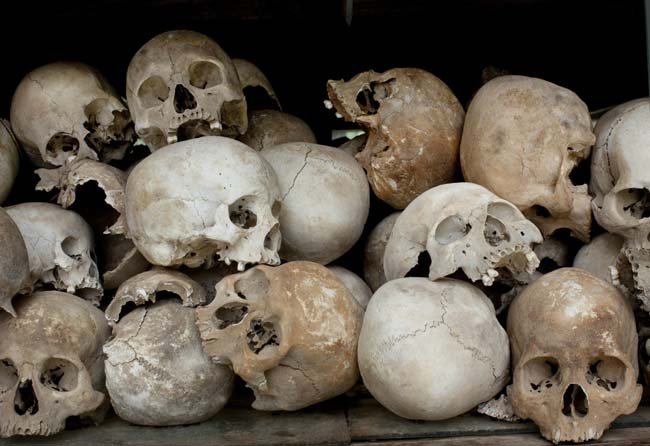
With Cambodia’s door forcibly opened, the ensuing revelations of killing fields and grisly interrogation centers was about as close as you can get to incontrovertible proof of widespread atrocity. Among Western scholars, some former supporters emerged to recant their previous statements. Other supporters quietly withdrew from the now-obvious horror they had spent several years denying. However, some scholars remained as unrepentant as the war criminals, unmoved by any amount of ghastly hard evidence, or at least not sufficiently moved to forsake the revolution.

“Saying, ‘I’m sorry, I was wrong,’ is just too much for some people,” Ear said. “They want to be correct in their minds, always.”

Even in 1981, after the consequences became grotesquely clear, Egyptian-French scholar Samir Amin described the Khmer Rouge period as “one of the major successes of the struggle for socialism in our era.” Not only did Amin express approval for what happened in Cambodia, but he also recommended that African nations adopt the Khmer Rouge model. As if Africa had not endured enough, what it really needed, according to Amin, was its own Khmer Rouge.

Meanwhile, the real Khmer Rouge was not dead yet. Although forced out of Phnom Penh very quickly, the group still controlled much of Cambodia, particularly in the geographically rugged western part of the country. Along with holding significant military resources, the Khmer Rouge enjoyed a degree of international legitimacy: Into the early 1990s, the party of Pol Pot managed to hold Cambodia’s seat at the United Nations.

Moreover, many Cambodians thought the Khmer Rouge was going to make a comeback in the 1990s, regain control of the country and repeat the nightmare. Ear said, “This fear persisted until the Khmer Rouge’s final dissolution,” which did not occur until the end of the millennium.

Now 50 years since the invasion, both the Khmer Rouge and their Western apologists serve as a cautionary tale of the depths to which people can sink for their ideals.

Ray Cavanaugh is a freelance writer with an interest in Cambodian history. He wrote this column for the Chicago Tribune.