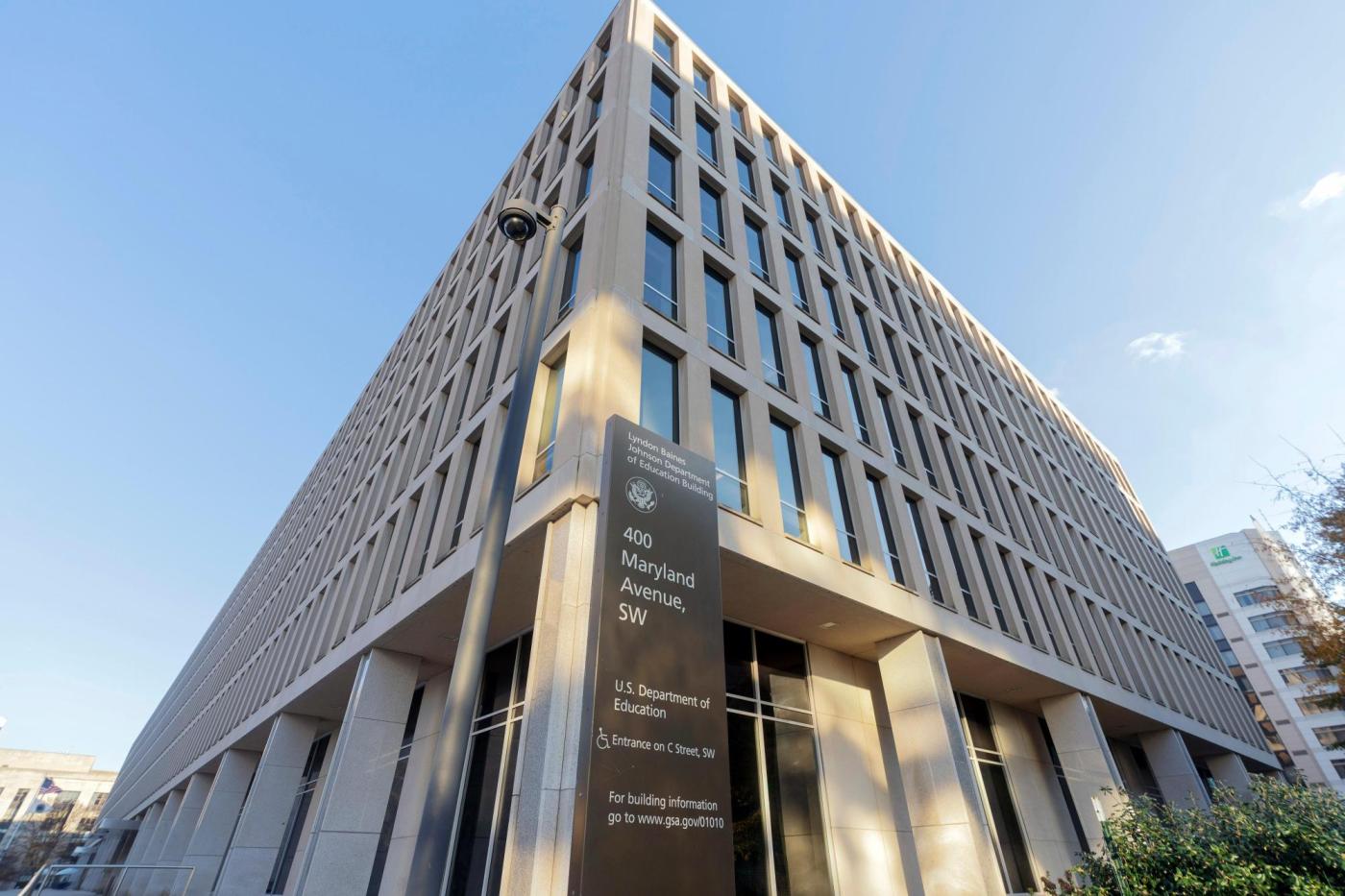
NEW YORK (AP) — Starting next month, the Education Department says student loans that are in default will be referred for collections.
Roughly 5.3 million borrowers are in default on their federal student loans and soon could be subject to having their wages garnished.
Referrals for collection had been put on hold since March 2020 because of the COVID-19 pandemic, when the U.S. government also paused federal student loan payments and interest accrual as a temporary relief measure. That grace period was extended multiple times by the Biden administration and ended in October.
The department says it will soon begin sending notices on collection efforts, but there are options for borrowers to get out of default.
Here are some key things to know.
How will involuntary collection work?
Beginning May 5, the department will begin involuntary collection through the Treasury Department’s offset program. Borrowers who have student loans in default will receive communication from Federal Student Aid in the upcoming weeks with information about their options, according to the Education Department.
Involuntary collection means the government can garnish wages, intercept tax refunds and seize portions of Social Security checks and other benefit payments to go toward paying back the loan.
What is the difference between delinquent and default in my student loans?
A student loan becomes delinquent when a borrower doesn’t make a payment 90 days after its due date. If you continue to be delinquent on your loan for 270 days — or roughly nine months — then your loan goes into default.
Related Articles
Harvard sues Trump administration to stop the freeze of more than $2 billion in grants
Student loans in default to be referred to debt collection, Education Department says
Sleep training is no longer just for babies. Some schools are teaching teens how to sleep
Lawsuit challenges revocation of visas for international students
Wisconsin governor can lock in 400-year school funding increase using a veto, court says
While being delinquent affects your credit score, going into default has more serious consequences such as wage garnishment.
What happens when a loan goes into default?
When you fall behind on a loan by 270 days, the loan appears on your credit report as being in default. Once a loan is in default the government will send the borrower into collections.
What can I do right now if my student loan is in default?
The Education Department is recommending borrowers visit its Default Resolution Group to make a monthly payment, enroll in an income-driven repayment plan, or sign up for loan rehabilitation.
Betsy Mayotte, president of The Institute for Student Loan Advisors, recommends loan rehabilitation as an option.
Borrowers in default must ask their loan servicer to be placed into such a program. Typically, servicers ask for proof of income and expenses to calculate a payment amount. Once a borrower has paid on time for nine months in a row, they are taken out of default, Mayotte said. A loan rehabilitation can only be done once.
What does forbearance mean?
Student loan forbearance is a temporary pause on your student loan payments granted to borrowers who are experiencing financial difficulties. To apply for forbearance, borrowers must contact their loan servicer.
Borrowers can be granted forbearance by their loan servicer for up to 12 months but interest will continue to accrue during this period.
The Associated Press receives support from Charles Schwab Foundation for educational and explanatory reporting to improve financial literacy. The independent foundation is separate from Charles Schwab and Co. Inc. The AP is solely responsible for its journalism.
SRINAGAR, India (AP) — Indian police say at least 20 tourists have been killed by gunmen at a tourist resort in Indian-controlled Kashmir.
Two senior police officers said at least four gunmen, whom they described as militants, fired at dozens of tourists from close range Tuesday. The officers said at least three dozen others were injured, with many in serious condition.
Officials collected at least 20 bodies in Baisaran meadow, some five kilometers (3 miles) from the disputed region’s resort town of Pahalgam. The officers spoke on condition of anonymity in keeping with departmental policy.
Police described the incident as a “terror attack” and blamed militants fighting against Indian rule.
“This attack is much larger than anything we’ve seen directed at civilians in recent years,” Omar Abdullah, the region’s top elected official, wrote on social media. The attack appeared to be a major shift in the regional conflict in which tourists have largely been spared from violence.
THIS IS A BREAKING NEWS UPDATE. AP’s earlier story follows below.
SRINAGAR, India (AP) — Many people are feared to have died after gunmen indiscriminately fired at tourists in Indian-controlled Kashmir on Tuesday, officials said.
Police have described the incident as a “terror attack” and blamed militants fighting against Indian rule.
“This attack is much larger than anything we’ve seen directed at civilians in recent years,” Omar Abdullah, the region’s top elected official, wrote on social media.
“The death toll is still being ascertained so I don’t want to get into those details,” he said.
Indian tourists rests on a bench as policemen guard near a clock tower at city centre in Srinagar, Indian controlled Kashmir,Tuesday, April. 22, 2025. (AP Photo/Mukhtar Khan)
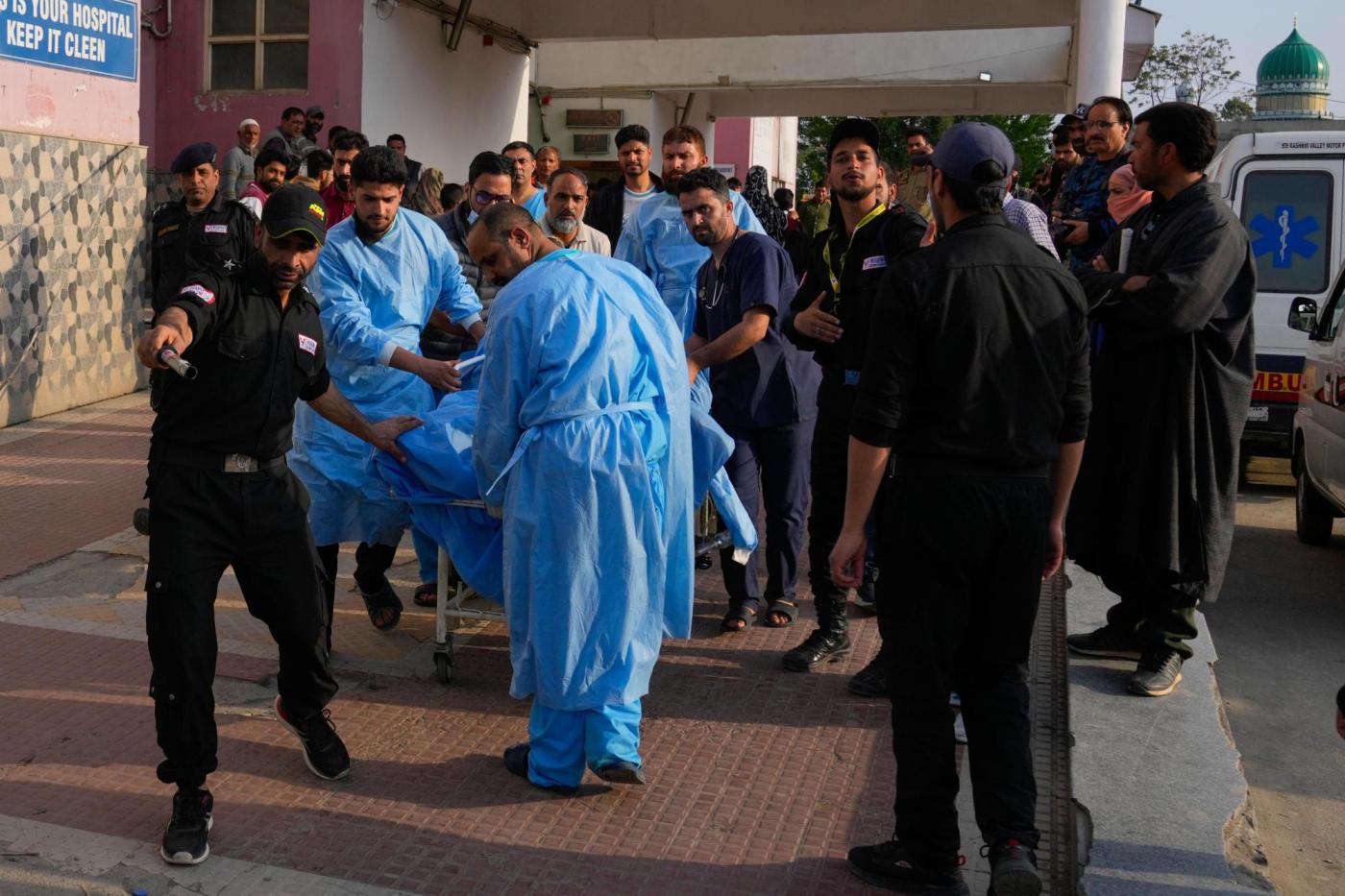
Paramedic carry a wounded tourist on a stretcher at a hospital in Anantnag after assailants indiscriminately fired at tourists visiting Pahalgam, Indian controlled Kashmir, Tuesday, April 22, 2025.(AP Photo/Dar Yasin)
An Indian policeman checks a bag of a civilain near a clock tower at city centre in Srinagar, Indian controlled Kashmir,Tuesday, April. 22, 2025. (AP Photo/Mukhtar Khan)
Indian tourists take pictures near a clock tower at city centre in Srinagar, Indian controlled Kashmir,Tuesday, April. 22, 2025. (AP Photo/Mukhtar Khan)
An Indian tourist woman talk to her cell phone as Jammu and Kashmir Special Operation Group (SOG) personnel patrol at a Dal Lake in Srinagar, Indian controlled Kashmir,Tuesday, April. 22, 2025. (AP Photo/Mukhtar Khan)
An Indian tourist, right, with blood-soaked trousers speaks on the phone as she arrives at a hospital in Anantnag after assailants indiscriminately fired at tourists visiting Pahalgam, Indian controlled Kashmir, Tuesday, April 22, 2025.(AP Photo/Dar Yasin)
Indian security officers patrol in armored vehicles near Pahalgam in south Kashmir after assailants indiscriminately opened fired at tourists in Pahalgam, Indian controlled Kashmir, Tuesday, April 22, 2025. (AP Photo/Dar Yasin)
An Indian security officer stands guard in south Kashmir after assailants indiscriminately opened fired at tourists in Pahalgam, Indian controlled Kashmir, Tuesday, April 22, 2025. (AP Photo/Dar Yasin)
Indian security officers stand guard on a highway in south Kashmir after assailants indiscriminately opened fired at tourists in Pahalgam, Indian controlled Kashmir, Tuesday, April 22, 2025. (AP Photo/Dar Yasin)
An Indian security officer stands guard in south Kashmir after assailants indiscriminately opened fired at tourists in Pahalgam, Indian controlled Kashmir, Tuesday, April 22, 2025. (AP Photo/Dar Yasin)
Indian security personnel stand guard in south Kashmir after assailants indiscriminately opened fired at tourists in Pahalgam, Indian controlled Kashmir, Tuesday, April 22, 2025. (AP Photo/Dar Yasin)
Indian security officers stand guard near Pahalgam in south Kashmir after assailants indiscriminately opened fired at tourists in Pahalgam, Indian controlled Kashmir, Tuesday, April 22, 2025. (AP Photo/Dar Yasin)
1 of 12
Indian tourists rests on a bench as policemen guard near a clock tower at city centre in Srinagar, Indian controlled Kashmir,Tuesday, April. 22, 2025. (AP Photo/Mukhtar Khan)
Initial reports said shots were fired at mostly Indian tourists visiting Baisaran meadow, some 5 kilometers (3 miles) from the disputed region’s resort town of Pahalgam.
Police and officials said tourists with gunshot wounds were evacuated to local hospitals.
The scene of the attack was cordoned off as police launched an operation to track down the attackers.
India’s home minister, Amit Shah, is heading to Srinagar, the main city in Indian-controlled Kashmir, where he said he would review the situation. Prime Minister Narendra Modi, who is on an official visit in Saudi Arabia, has been briefed about the incident, Shah said.
“We will come down heavily on the perpetrators with the harshest consequences,” Shah wrote in a post on the X social media platform.
Mirwaiz Umar Farooq, a key Kashmiri resistance leader, condemned what he described as a “cowardly attack on tourists.”
“Such violence is unacceptable and against the ethos of Kashmir which welcomes visitors with love and warmth. Condemn it strongly,” he wrote on X.
The meadow in Pahalgam is a popular sightseeing destination, surrounded by snow-capped mountains and dotted with pine forests. It is visited by hundreds of tourists every day.
Nuclear-armed rivals India and Pakistan each administer part of Kashmir, but both claim the territory in its entirety.
Tensions have been simmering ever since as India has intensified its counterinsurgency operations.
The region, known for rolling Himalayan foothills, exquisitely decorated houseboats and pristine meadows, has also become a major domestic tourist destination, with hotels booked out for months. Kashmir has also drawn millions of visitors, who enjoy a strange peace kept by ubiquitous security checkpoints, armored vehicles and patrolling soldiers.
Although violence has ebbed in recent times in Kashmir Valley, the heart of anti-India rebellion, fighting between government forces and rebels has largely shifted to remote areas of Jammu region including Rajouri, Poonch and Kathua, where Indian troops have faced deadly attacks.
Militants in the Indian-controlled portion of Kashmir have been fighting New Delhi’s rule since 1989. Many Muslim Kashmiris support the rebels’ goal of uniting the territory, either under Pakistani rule or as an independent country.
India insists the Kashmir militancy is Pakistan-sponsored terrorism. Pakistan denies the charge, and many Kashmiris consider it a legitimate freedom struggle. Tens of thousands of civilians, rebels and government forces have been killed in the conflict.
NEW YORK (AP) — The Anti-Defamation League says the number of antisemitic incidents in the United States reached a record high last year and notes that 58% of the 9,354 incidents related to Israel, notably chants, speeches and signs at rallies protesting Israeli policies.
In a report released Tuesday, the ADL, which has produced annual tallies for 46 years, said it’s the first time Israel-related incidents — 5,422 of them in 2024 — comprised more than half the total. A key reason is the widespread opposition to Israel’s military response in Gaza after the Hamas attack on Israel on Oct. 7, 2023. Hamas has been designated as a terrorist organization by the United States, Canada and the European Union.
The ADL’s findings add grist to an intense, divisive debate among American Jews — and others — over the extent to which vehement criticism of Israeli policies and of Zionism should be considered antisemitic.
FILE – Pro-Palestinian demonstrator Mahmoud Khalil, second from left, debates with a pro-Israel demonstrator during a protest at Columbia University, Thursday, Oct. 12, 2023, in New York. (AP Photo/Yuki Iwamura, File)
FILE – Tents and pro-Palestinian protesters occupy a quad at Drexel University, in Philadelphia, Tuesday, May 21, 2024. (AP Photo/Matt Rourke, file)
FILE – A student protester against the war in Gaza walks past tents and banners in an encampment in Harvard Yard, at Harvard University in Cambridge, Mass., on April 25, 2024. (AP Photo/Ben Curtis, file)
FILE – A student protester stands in front of the statue of John Harvard, the first major benefactor of Harvard College, draped in the Palestinian flag, at an encampment of students protesting against the war in Gaza, at Harvard University in Cambridge, Mass., on April 25, 2024. (AP Photo/Ben Curtis)
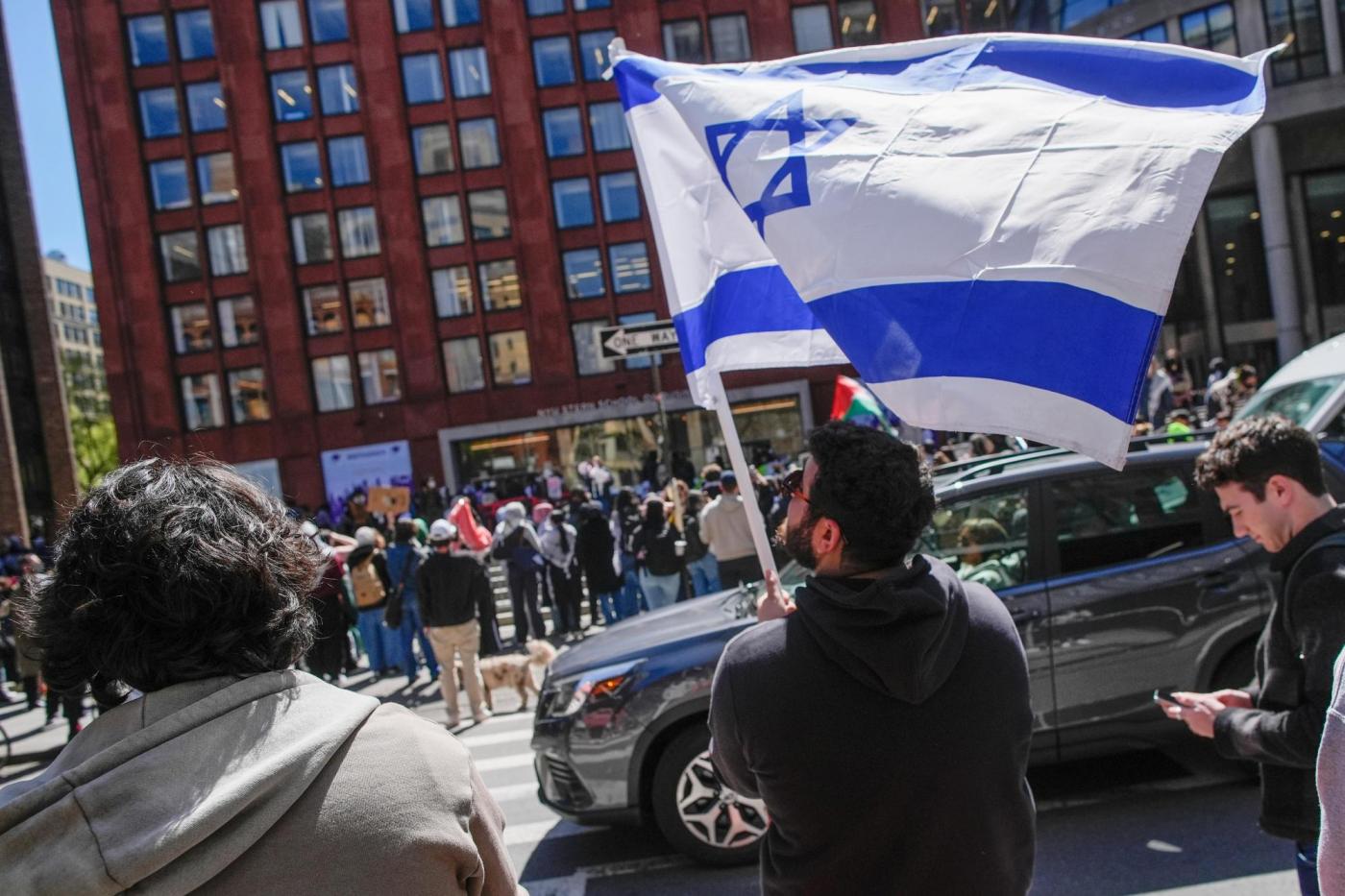
FILE – A student wrapped in an Israeli flag listens to Pro-Palestinian protesters gathered on campus at the University of Texas at Austin, on April 30, 2024, in Austin, Texas. (AP Photo/Eric Gay, File)
1 of 5
FILE – Pro-Palestinian demonstrator Mahmoud Khalil, second from left, debates with a pro-Israel demonstrator during a protest at Columbia University, Thursday, Oct. 12, 2023, in New York. (AP Photo/Yuki Iwamura, File)
The debate has broadened as President Donald Trump’s administration makes punitive moves against universities it considers too lax in combating antisemitism and seeks to deport some pro-Palestinian campus activists.
The upshot, for numerous Jewish leaders, is a balancing act: Decrying flagrant acts of antisemitism as well as what they consider to be the administration’s exploitation of the issue to target individuals and institutions it dislikes.
“The fears of antisemitism are legitimate and real — and we don’t want to see those real fears exploited to undermine democracy,” said Amy Spitalnick, CEO of the Jewish Council for Public Affairs. “I feel that a majority of American Jews can believe that two things are true at the same time.”
The ADL said in its new report it is “careful to not conflate general criticism of Israel or anti-Israel activism with antisemitism.” But there are gray areas. For example, the ADL contends that vilification of Zionism — the movement to establish and protect a Jewish state in Israel — is a form of antisemitism, yet some Jews are among the critics of Zionism and of the ADL itself.
Incidents at anti-Israel rallies that counted as antisemitism in the new ADL tally include “justification or glorification of antisemitic violence, promotion of classic antisemitic tropes … and signage equating Judaism or Zionism with Nazism.” Also counted were celebrations of the Hamas attack on Israel and “unapologetic support for terrorism.”
“In 2024, hatred toward Israel was a driving force behind antisemitism across the U.S.,” said Oren Segal, who leads the ADL’s efforts to combat extremism and terrorism.
Keeping Jewish students safe
The report depicted university campuses as common venues for antisemitic incidents, saying many Jewish students “face hostility, exclusion and sometimes physical danger because of their identity or their beliefs.”
The experience of those students was evoked by Rabbi Rick Jacobs, president of the Union for Reform Judaism — an umbrella group for more than 800 Reform congregations in North America — as he discussed the complexities arising from current antisemitism-related developments.
“We have an obligation to our students on campus,” Jacobs said. “Can they go to Seder? Can they feel safe wearing a yarmulke?”
“At the same time, this current administration has weaponized the fight against antisemitism by weakening core democratic institutions,” Jacobs added.
He referred to the detention and threatened deportation of Mahmoud Khalil, a 30-year-old graduate student who served as a negotiator and spokesperson for pro-Palestinian activists at Columbia University. Khalil has been detained since March 8 despite facing no criminal charges.
“There has to be a legal case — not just you don’t like what he says,” Jacobs said. “What has kept Jewish people safe is the rule of law, due process. If it is undermined for Palestinians, it will be undermined for all of us.”
Criticism of ADL
The ADL dismayed some progressive Jewish leaders by welcoming Columbia’s acquiescence in March to Trump administration demands and by initially commending the campaign targeting pro-Palestinian activists such as Khalil.
Recent critics of the ADL include Michael Roth, the first Jewish president of Wesleyan University; political commentator Peter Beinart; and Columbia professor James Schamus, who has been urging his fellow Jews on the faculty to oppose the university’s compliance with administration demands.
Washington Post columnist Matt Bai wrote a scathing column about the ADL on April 1.
Related Articles
From ‘conclave’ to ‘white smoke,’ a glossary of terms used in a papal transition
Pope Francis’ funeral to be held Saturday, with public viewing starting Wednesday
Pope Francis was a source of controversy and spiritual guidance in his Argentine homeland
Which cardinals are seen as contenders to be the next pope?
Francis changed church policy on the death penalty and nuclear weapons but upheld it on abortion
“You can’t call yourself a civil rights organization in the United States right now — let alone a civil rights organization for a minority that has been brutally evicted all over the world — and not loudly oppose the cruel and unlawful removal of foreigners whose views happen to be out of fashion,” Bai wrote.
Two days later, the ADL’s CEO, Jonathan Greenblatt, wrote an opinion piece for eJewishPhilanthropy seeking to distance the ADL from aspects of the Trump administration’s crackdown on pro-Palestinian activists.
“As an organization that has fought for a minority community for more than 100 years, ADL is incredibly sensitive to the importance of allowing all views to be expressed — even those that we or the majority of Americans disagree with,” Greenblatt wrote. “We should be holding people accountable for actual crimes, not Orwellian thoughtcrimes.”
“We can protect the civil liberties of Jewish students even as we preserve the civil liberties of those who protest, harass or attack them because they are innocent until proven guilty,” he added. “If we sacrifice our constitutional freedoms in the pursuit of security, we undermine the very foundation of the diverse, pluralistic society we seek to defend.”
Beyond the Israel-related incidents, these were among the other findings in the new ADL report:
— The total number of antisemitic incidents in 2024 was up by 344% from five years ago.
— 196 incidents, targeting more than 250 people, were categorized as assault; none of these assaults were fatal.
— 2,606 incidents were categorized as vandalism. Swastikas were present in 37% of these cases.
— There were 647 bomb threats, most of them targeting synagogues.
— Antisemitic incidents occurred in all 50 states and the District of Columbia. More than 10% of the incidents occurred in New York City.
— There were 962 “antisemitic propaganda incidents” linked to white supremacist groups. Three groups — Patriot Front, Goyim Defense League, and the White Lives Matter network — were responsible for 94% of this activity.
The ADL says its annual report tallies criminal and noncriminal acts of harassment, vandalism and assault against individuals and groups as reported to the ADL by victims, law enforcement, the media and partner organizations, and then evaluated by ADL experts.
Associated Press religion coverage receives support through the AP’s collaboration with The Conversation US, with funding from Lilly Endowment Inc. The AP is solely responsible for this content.
DUBAI, United Arab Emirates (AP) — Negotiations between Iran and the United States over Tehran’s rapidly advancing nuclear program will move Wednesday to what’s known as the “expert level” — a sign analysts say shows that the talks are moving forward rapidly.
However, experts not involved in the talks who spoke with The Associated Press warn that this doesn’t necessarily signal a deal is imminent. Instead, it means that the talks between Iranian Foreign Minister Abbas Araghchi and U.S. Mideast envoy Steve Witkoff haven’t broken down at what likely is the top-level trade — Tehran limiting its atomic program in exchange for the lifting of economic sanctions.
“Agreeing to technical talks suggests both sides are expressing pragmatic, realistic objectives for the negotiations and want to explore the details,” said Kelsey Davenport, the director for nonproliferation policy at the Arms Control Association who long has studied Iran’s nuclear program.
“If Witkoff was making maximalist demands during his talks with Araghchi, such as dismantlement of the enrichment program, Iran would have no incentive to meet at the technical level.”
That technical level, however, remains filled with possible landmines. Just how much enrichment by Iran would be comfortable for the United States? What about Tehran’s ballistic missile program, which U.S. President Donald Trump first cited in pulling America unilaterally out of the accord in 2018? Which sanctions could be lifted and which would be remain in place on the Islamic Republic?
“The most important determinant of expert talks’ value lies in whether there is a political commitment to do something and experts just need to figure out what,” said Richard Nephew, an adjunct fellow at the Washington Institute for Near East Policy who worked on Iran sanctions while at the U.S. State Department during negotiations over what became the 2015 nuclear deal.
“If the experts also have to discuss big concepts, without political agreement, it can just result in spun wheels.”
Experts and the 2015 nuclear deal
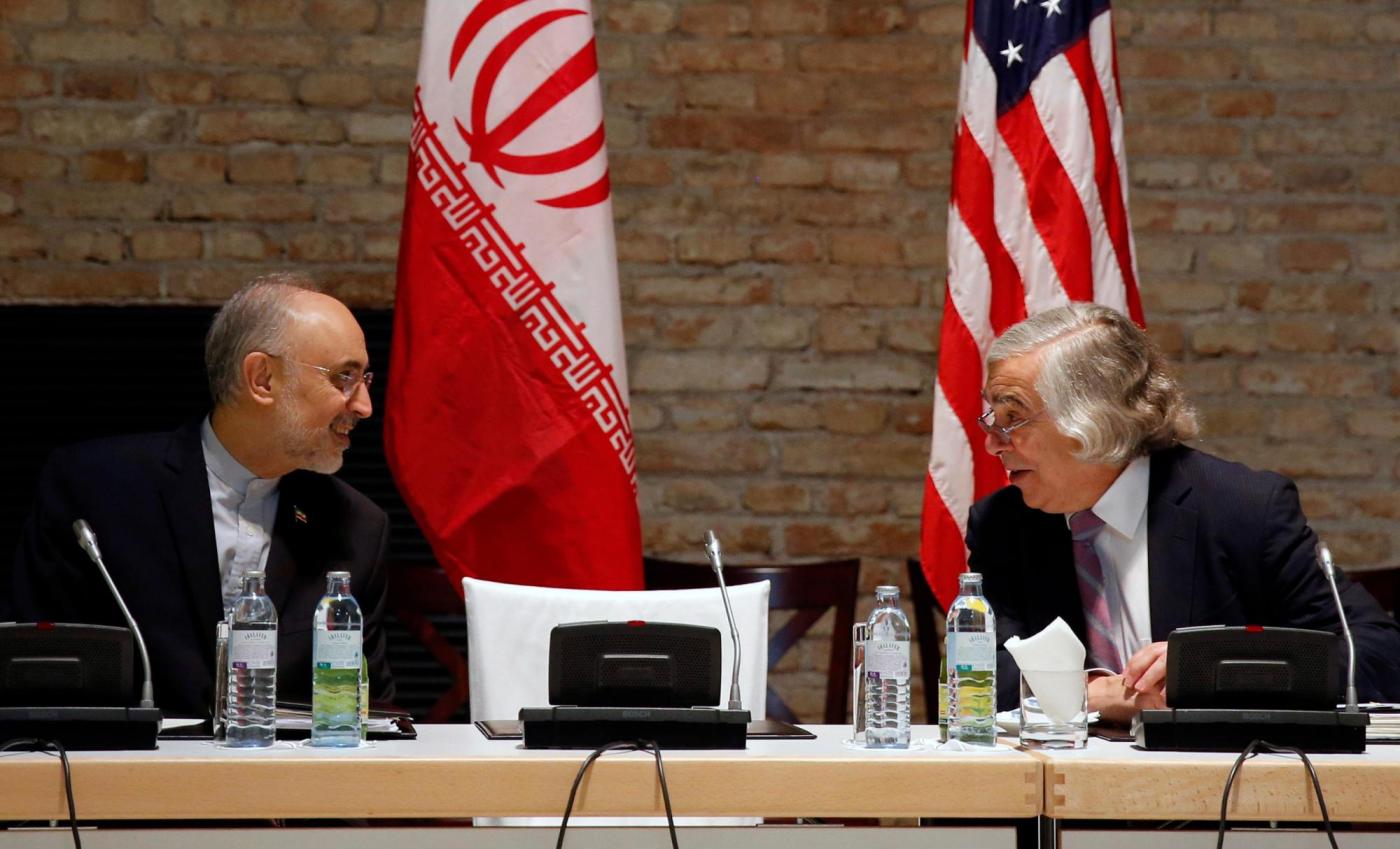
The 2015 nuclear deal saw senior experts involved in both sides of the deal. For the U.S. under President Barack Obama, Energy Secretary Ernest Moniz reached an understanding working with Ali Akbar Salehi, then the leader of the Atomic Energy Organization of Iran. Both men’s technical background proved key to nailing down the specifics of the deal.
Under the 2015 agreement, Iran agreed to enrich uranium only to 3.67% purity and keep a stockpile of only 300 kilograms (661 pounds). Today, Iran enriches some uranium up to 60% purity — a short, technical step away from weapons-grade levels of 90%. The last report by the International Atomic Energy Agency put Iran’s overall uranium stockpile in February at 8,294.4 kilograms (18,286 pounds).
The deal also limited the types of centrifuges Iran could spin, further slowing Tehran’s ability to rush for a bomb, if it chose to do so. It also set out the provisions of how and when sanctions would be lifted, as well as time limits for the accord itself.
Reaching limits, relief and timelines require the knowledge of experts, analysts say.
“A nonproliferation agreement is meaningless if it cannot be effectively implemented and verified,” Davenport said. “The United States needs a strong technical team to negotiate the detailed restrictions and intrusive monitoring that will be necessary to ensure any move by Iran toward nuclear weapons is quickly detected and there is sufficient time to respond.”
It remains unclear who the two sides will be sending for those negotiations.
Hiccups already heard in these negotiations
Both the Americans and the Iranians have been tightlipped over exactly what’s been discussed so far, though both sides have expressed optimism about the pace. However, there has been one noticeable dispute stemming from comments Witkoff made in a television interview, suggesting Tehran could be able to enrich up to 3.67% purity. However, analysts noted that was the level set by the 2015 deal under Obama.
Witkoff hours later issued a statement suggesting that comparison struck a nerve: “A deal with Iran will only be completed if it is a Trump deal.”
“Iran must stop and eliminate its nuclear enrichment and weaponization program,” Witkoff added.
Araghchi responded by warning that Iran must be able to enrich.
“The core issue of enrichment itself is not negotiable,” he said.
Despite that, experts who spoke to the AP said they remained positive about the talks’ trajectory so far.
“Although still early stages, I’m encouraged so far,” said Alan Eyre, a former U.S. diplomat once involved in past nuclear negotiations with Tehran. “The pace of negotiations — to include starting expert level meetings this Wednesday — is good.”
He added that so far, there didn’t appear to be any “mutually exclusive red lines” for the talks as well — signaling there likely wasn’t immediately any roadblocks to reaching a deal.
Nephew similarly described reaching the expert level as a “positive sign.” However, he cautioned that the hard work potentially was just beginning for the negotiations.
“They imply the need to get into real details, to discuss concepts that senior (officials) might not understand and to answer questions. I also think too much can be read into them starting,” Nephew said. “Expert talks can sometimes be a fudge for seniors to avoid working on tough issues — ‘let’s have experts discuss it while we move on to other things’ — or to sidestep big political decisions.”
Corey Hinderstein, the vice president for studies at the Carnegie Endowment for International Peace and a former U.S. government nuclear expert, described herself as feeling “cautious optimism” over the expert talks beginning.
“Heads of delegation are responsible for setting strategic goals and defining success,” she said. “But if there is a deal to be made, the technical experts are the ones who will get it done.”