By Gretchen McKay, Pittsburgh Post-Gazette
With decades of cooking and testing recipes under my apron, I’m no spring chicken. (Sadly.)
But I certainly love to eat a good spring chicken, especially if preparing the meal for my family entails an easy recipe that’s built on inexpensive, everyday pantry ingredients and fresh, seasonal fruits and vegetables.
This simple, budget-minded dinner for four is perfect for the first sunny days of spring.
Nothing is more comforting than the aroma of a roasting chicken, but when you’re busy with work or kids or just would rather spend those two or three hours outdoors, you might consider that a stuck-indoors, winter activity.
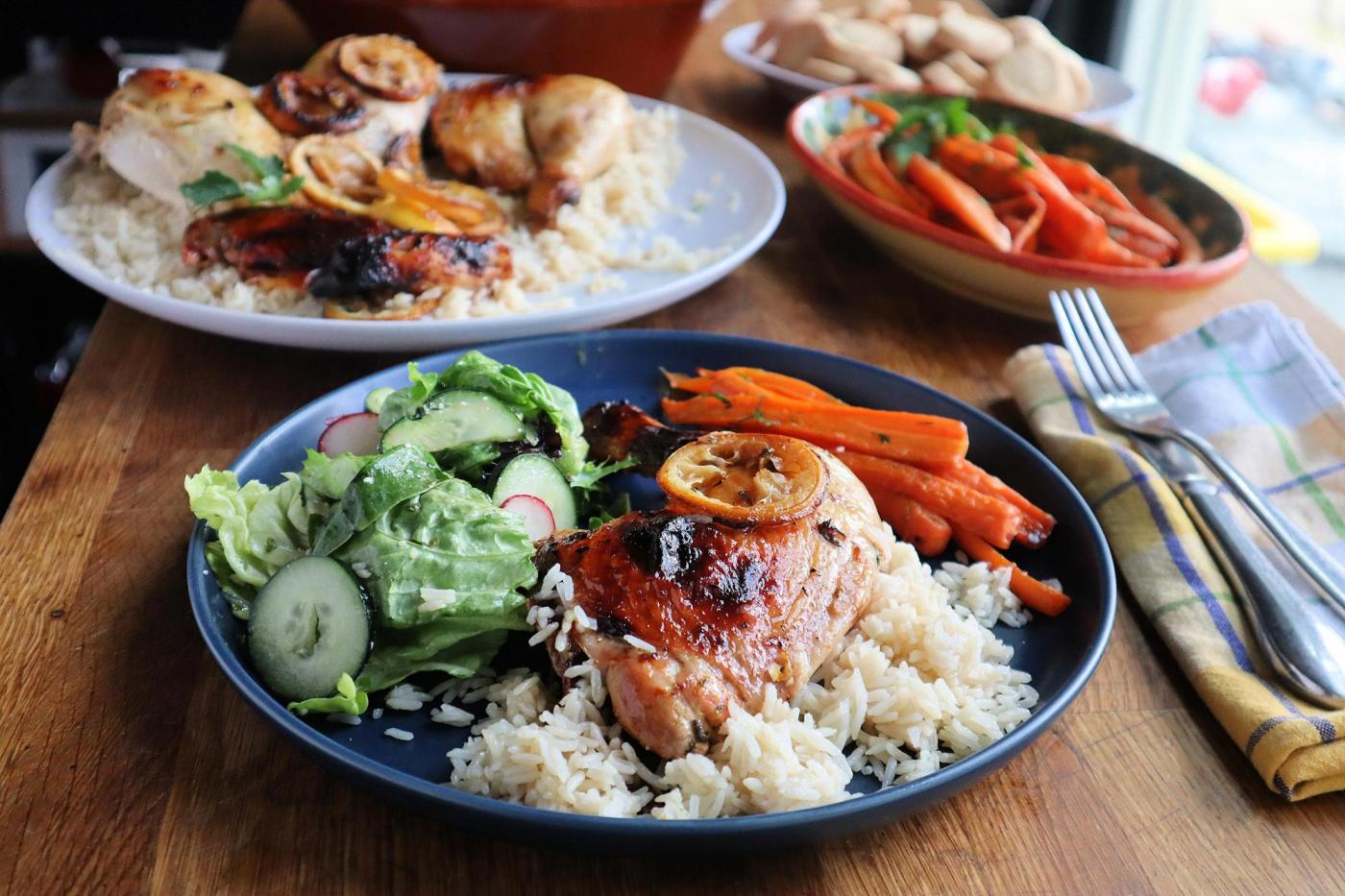
A spatchcocked chicken marinated in citrus, garlic and fresh herbs before being roasted makes an easy spring meal for four. (Gretchen McKay/Pittsburgh Post-Gazette/TNS)
Yet if you follow my lead and spatchcock (butterfly) a whole bird — removing the backbone and then cracking it with the heel of your hands to flatten it — you will not only cut precious cooking time in half, but the breasts and thighs will also cook more evenly.
As for the sides, shine a light on carrots and a salad of tender butterhead lettuce tossed with crunchy radish and cucumber.
To keep costs down, I shopped at several stores rather than filling my shopping cart at the most convenient (and often more expensive) grocery.
Recipe: Kimchi and shrimp-fried rice stir-fry packs a protein punch
The startup behind Shark Tank’s seaweed-based bacon
Recipes: Asparagus dresses up in this springy dinner party
Recipes: Four fresh ideas for spring lettuce
Pork and asparagus stir-fry with spicy cucumber salad
For instance, when a whole roaster chicken found where I do most of my everyday shopping looked like it was going to eat up too much of my $25 budget, I talked myself into using chicken thighs instead. Then, I happened to dash into Aldi to pick up a last-minute bag of lemons ($2.89) after a little shoe shopping and, voila! I found a plump, 4-pound roaster in the meat section for just $8.59 and I was back to my original plan.
While the carrots I sliced and roasted as a side dish were downright cheap at 99 cents per pound, the $3 I paid for a nice-sized head of fresh Boston lettuce was a bit of a surprise. At least the radishes and cucumber were cheap.
Eggs are still kind of pricey, even at today’s “bargain” price of around $5 a dozen. But the crumbly, shortbread-like French butter cookies I made for dessert (followed by late-night snacking) only required two, so no big whoop, right?
Not to sound like a broken record, but this probably bears repeating in these tough economic times: Smart shoppers peruse their refrigerators and pantries before they go grocery shopping, both to get some fresh ideas for dinner (what leftovers aren’t people eating?) and to make sure they don’t buy something they already have or need to use up ASAP.
They also make sure their stomachs are full so there’s no impulse buying or taking shortcuts with already-prepared foods, which tend to be more expensive than scratch dishes.
Ingredients I was able to leave off my shopping list (but wouldn’t have added a lot to the final tally) include the olive oil and mustard used in the vinaigrette and marinade, a cup and a half of rice to serve with the chicken, and some of the spices and herbs used for flavoring and aromatics.
I also am lucky to have an uber-local source for high-quality honey: my niece Amanda’s husband, Phil, a firefighter at Fire Station 34 in Perry North, has five hives in his Brighton Heights yard.
Setting a plate of cookies on the table is always a great way to end a meal. And a new French cookbook that recently landed on my desk made it super easy to choose one that was fancy enough to feel like a true dessert, but didn’t require any hardcore baking skills.
My husband and grandson weren’t the only ones who loved them — my co-workers gobbled them up in a matter of minutes when I brought half the batch into the office. You’ll adore them, too.
Those responsible for putting dinner on the table each night will appreciate the cost of the entire meal even more: just $24.83, or around $6.20 per person for a family of four.
Spring Salad with Citrus-Herb Vinaigrette
Serves 4, PG tested
This zesty vinaigrette gets its bright flavor from citrus and fresh herbs. I added some crumbled feta to give it more bite, but you also could sprinkle it with a little grated Parmesan or add some crunch with homemade croutons (a great way to use up day-old bread).
INGREDIENTS
For salad
6 ounces mixed spring greens and/or butter lettuce
1/2 cucumber, thinly sliced
1 carrot, peeled and shredded
4 radishes, thinly sliced
1/2 cup crumbled feta cheese
For vinaigrette
1/4 cup extra-virgin olive oil
2 tablespoons freshly squeezed lemon juice
1 tablespoon orange juice
1 teaspoon maple syrup or honey
1 teaspoon Dijon mustard
1 tablespoon finely chopped fresh herbs such as basil, parsley or mint
Salt and freshly ground black pepper to taste
1/4 cup crumbled feta cheese, optional
DIRECTIONS
Wash and dry the mixed spring greens and butter lettuce thoroughly.
In a small bowl, whisk together the olive oil, lemon juice, orange juice, maple syrup or honey, Dijon mustard and chopped fresh herbs until well combined. Season to taste with salt and pepper.
Place salad greens in a large bowl. Add cucumbers, carrots and radishes and toss to combine. Drizzle vinaigrette on top and toss again, making sure all the veggies are coated with the dressing.
Sprinkle feta on top, and serve.
— Gretchen McKay, Post-Gazette
Spatchcocked Roasted Lemon Chicken
The marinade for a roasted spatchcocked chicken includes citrus juice and zest, garlic, fresh herbs and honey. (Gretchen McKay/Post-Gazette/Pittsburgh Post-Gazette/TNS)
Serves 4, PG tested
Spatchcocking a chicken — or butterflying it by removing the backbone and flattening it — cooks faster and more evenly than a whole bird. This one is marinated for a few hours in a bath of olive oil, citrus juice and zest, fresh herb and garlic.
INGREDIENTS
For chicken
1 4-pound whole chicken
Kosher salt and freshly ground black pepper
Cooked rice, for serving
For marinade
5 tablespoons olive oil
3 large cloves garlic, finely minced
2 tablespoons fresh rosemary, chopped
2 tablespoons parsley, chopped
Zest and juice of 1 lemon, plus 2 sliced lemons
Zest and juice of 1 orange
1 tablespoon honey
DIRECTIONS
Using poultry shears, cut along each side of the chicken backbone and remove it. (Save the backbone for stock.)
Turn the chicken breast side up and press down on the breastbone to flatten the bird. You may also want to cut the cartilage at the top of breastbone with a sharp knife to open it up more easily.
Season inside the chicken generously with salt and pepper.
In a small mixing bowl, combine olive oil, garlic, rosemary, lemon and orange juices and zest, and honey.
Pour into a resealable plastic bag (I was able to fit it into a 1-gallon bag) and add the chicken, squishing the bag to coat the chicken. Let rest in the fridge for a few hours or overnight.
Preheat the oven to 425 degrees; remove the chicken from the fridge 30 minutes prior to cooking.
Place the marinated chicken, cut side down, on a cookie sheet. Spoon any marinade on the top and cover with 2 sliced lemons.
Bake uncovered for 45 minutes, or until instant read thermometer reads 160 degree when inserted into thickest part of chicken breast.
Remove from the oven and rest uncovered for 10 minutes on a cutting board before slicing.
— Gretchen McKay, Post-Gazette
Honey-roasted Carrots
Serves 4, PG tested
Could there be an easier recipe? Just slice, toss and roast! A drizzle of honey butter just before serving adds to the subtle sweetness.
INGREDIENTS
1 1/2 pounds whole carrots, peeled
2 tablespoon extra-virgins olive oil
2 tablespoons butter, melted
1 tablespoon honey
Kosher salt and ground black pepper to taste
Chopped dill or parsley, for garnish, optional
DIRECTIONS
Preheat oven to 425 degrees.
Place whole carrots in a baking dish, and drizzle with olive oil. Mix with your hands until carrots are completely covered with oil.
Drizzle honey over top, then season generously with salt and pepper. Toss until evenly coated.
Bake in preheated oven until carrots are just tender, about 30 minutes — they should easily pierce with a fork — or a few minutes longer if you prefer softer carrots.
When carrots are just about done cooking, mix melted butter with honey in a small pan over medium heat.
Remove carrots from oven to a serving platter, then drizzle the butter mixture over them and toss to coat. Garnish with dill or parsley, optional.
— Gretchen McKay, Post-Gazette
Vanilla Sables
Makes 40 cookies, PG tested
Sables are a simple French cookie known — and beloved — for their crumbly, shortbread-like texture. These are flavored with vanilla.
The cookies will keep for up to a week in an airtight container.
INGREDIENTS
1 vanilla pod or 2 teaspoons vanilla bean paste
7 ounces unsalted butter, at room temperature, diced
3/4 cup sugar
1/2 teaspoon flaked sea salt
2 large egg yolks
1 3/4 cup all-purpose flour
Demerara or turbinado sugar, for decorating
DIRECTIONS
Cut the vanilla pod, if using, in half and scrape out the seeds. Put the seeds or vanilla bean paste in a large bowl or the bowl of an electric mixer.
Add butter and, using the electric mixer, beat until smooth and creamy. (I used a KitchenAid stand mixer.)
Add sugar and salt and beat until light and fluffy for a few minutes more.
Add egg yolks and beat until fully combined. Sift in flour in one go and mix on slow speed until mixture resembles sand or gravel. Do not over-mix; it should not form a uniform dough.
Tip the mixture onto a work surface and use your hands to gently bring together in a uniform dough.
Divide the dough in half and roll into two logs 1 1/2 inches thick. Wrap in plastic wrap and transfer to the refrigerator to chill for 3 hours or until firm. (If you are in a rush, you can freeze the dough for 30 minutes or until firm.)
Preheat the oven to 325 degrees and line two baking trays with parchment paper.
Remove the dough from the fridge and roll it in a few tablespoons of the Demerara sugar, coating the entire outside of the log. (I used regular sugar.)
Using a thin, sharp knife, cut the dough into 5/8 -inch slices and put onto the prepared baking trays. Bake for 20-25 minutes until very lightly browned around the outside.
Leave to cool on trays for 10 minutes, then transfer to a wire rack to cool completely.
— “French Bakes Made Simple: From Macaron to Millefeuille and More” by Edd Kimber (Octopus Books, $30)
©2025 PG Publishing Co. Visit at post-gazette.com. Distributed by Tribune Content Agency, LLC.