NESKOWIN, Ore. (AP) — The National Oceanic and Atmospheric Administration is searching for the person who stabbed a baby seal multiple times on a beach in Oregon.
The seal survived the March attack in a cove in the small town of Neskowin, which sits along the Pacific Ocean, NOAA said Monday. The administration’s marine stranding team was able to help the animal relocate after monitoring and evaluating it.
The agency’s law enforcement office, which is investigating the attack, was searching for a “person of interest” spotted by a witness. Officials were also looking for the owner of a vehicle seen in a parking lot near the cove behind a condominium building that may be connected with the Sunday evening attack, according to NOAA.
Officials are asking anyone with information on the person of interest, vehicle owner or attack to call NOAA’s enforcement hotline.
In the spring and summer, juvenile elephant seals will often drag themselves onto Oregon’s beaches to spend weeks shedding their hair and skin, according to Oregon State University’s Marine Mammal Institute. Adult elephant seals are rarely seen in the state.
The federal Marine Mammal Protection Act prohibits harassing, harming, killing or feeding wild elephant seals and other marine mammals. Violators can face criminal penalties of up to $100,000 in fines and up to 1 year in jail.
POLSON, Mont. — When someone accused of a crime in this small northwestern Montana town needs mental health care, chances are they’ll be locked in a basement jail cell the size of a walk-in closet.
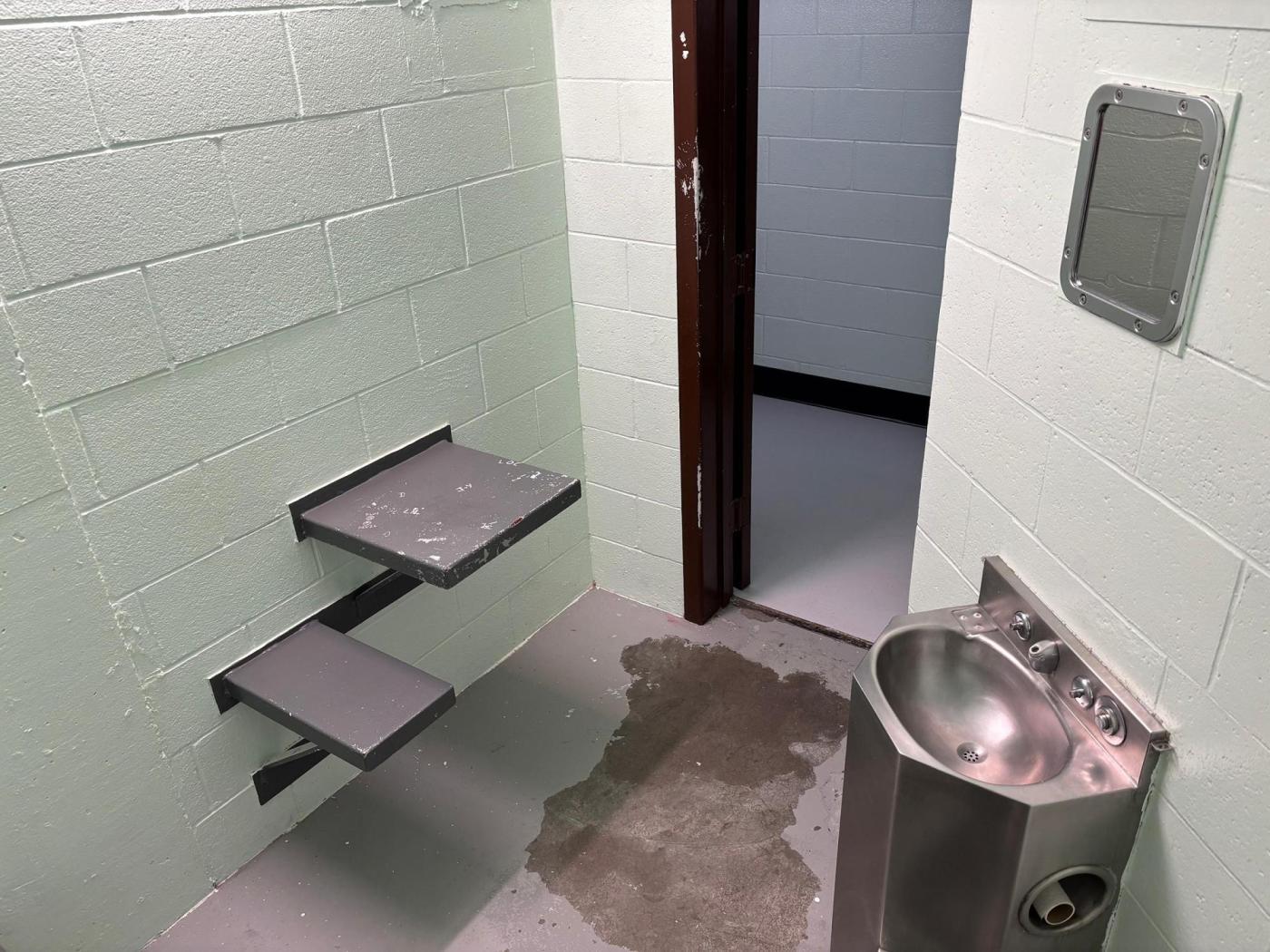
Prisoners, some held in this isolation cell for months, have scratched initials and the phrase “love hurts” into the metal door’s brown paint. Their pacing has worn a path into the cement floor. Many are held in a sort of limbo, not convicted of a crime but not stable enough to be released. They sleep on a narrow cot next to a toilet. The only view is a fluorescent-lit hallway visible through a small window in the door.
Lake County Attorney James Lapotka stood at the cell’s center talking about the people he helps confine here. He stretched out his arms, his fingertips just shy of touching opposite walls. “I’m getting anxiety just being in here,” Lapotka said.
Some are held there for months as they wait for an open bed at the Montana State Hospital. (Katheryn Houghton/KFF Health News/TNS)
The Lake County jail is in the basement of the courthouse in Polson, Montana, a town of 5,600 on the southern shore of Flathead Lake, one of the largest lakes west of the Mississippi River. (Katheryn Houghton/KFF Health News/TNS)
Joel Shearer, a Lake County, Montana, detention commander, walks into the jail in the basement of the courthouse, which has become a fallback for holding people in a mental health crisis who can’ t access inpatient treatment at the state psychiatric hospital. (Katheryn Houghton/KFF Health News/TNS)
Someone in crisis in Lake County has two options: jail or an emergency room. The room reserved for people in crisis at Providence St. Joseph Medical Center leaves patients both isolated and without privacy. The locked door’ s thick glass looks onto a busy emergency room hallway. (Katheryn Houghton/KFF Health News/TNS)
The Lake County, Montana, jail’s emergency restraint chair is used to bind prisoners considered a danger to themselves or others. Their shoulders, arms and legs are tied down, and they are given a break to stand once an hour until they calm down. Due to lack of space, those strapped into the chair are placed in either a hallway or a locker room. “It sounds horrible; it is horrible,” said Joel Shearer, a Lake County detention commander. (Katheryn Houghton/KFF Health News/TNS)
Vincent River has worked as the Lake County jail’ s sole mental health clinician for 25 years. (Katheryn Houghton/KFF Health News/TNS)
Some are held there for months as they wait for an open bed at the Montana State Hospital. (Katheryn Houghton/KFF Health News/TNS)
1 of 7
Some are held there for months as they wait for an open bed at the Montana State Hospital. (Katheryn Houghton/KFF Health News/TNS)
Last year, a man sentenced for stealing a rifle stayed in that cell 129 days. He was waiting for a spot to open at Montana’s only state-run psychiatric hospital after a mental health evaluator deemed he needed care, according to court records.
A man in the next cell around the same time was on the same waitlist roughly five months. He faced near-daily stints in the jail’s emergency restraint chair — a steel contraption wrapped in foam with straps for his shoulders, arms, and legs. He regularly saw the jail’s mental health doctor. Still, Joel Shearer, a Lake County detention commander, said the man routinely experienced psychotic episodes and asked to be locked in the chair when he felt one coming on and stayed there until his screams subsided.
“Somebody who’s having a mental health crisis — they don’t belong here,” Lapotka said. “We don’t have anywhere else.”
Lake County’s two, roughly 30-square-foot isolation cells are an example of how communities nationwide are failing to provide mental health services — crisis care, in particular. Nearly half of the people locked in local jails in the U.S. have a mental illness.
More than half of Wyoming’s 23 sheriffs told lawmakers there that they were housing people in crisis awaiting mental health care for months, WyoFile reported in January. Nevada has struggled despite a $500 daily fine for each jailed patient whose treatment is delayed. Disability Rights Oregon has said delays in that state continue after two people died in jail while on the state’s psychiatric waitlist.
In Montana, counties are jailing mental health patients they’re not equipped to handle when the Montana State Hospital is at capacity. Few local hospitals have their own inpatient psychiatric beds. As a result, people arrested for anything from petty theft to felony assault can be jailed for months or longer as their mental health worsens. Many haven’t been convicted of a crime.
Montana officials have known for years they have a problem. State officials have said they don’t have space for all the people ordered to the hospital. The psychiatric hospital has 270 beds, with 54 for people in the criminal justice system. Staffing shortages can shrink that capacity further.
The Montana Department of Public Health and Human Services backed two bills this legislative session that would shield the state from liability for delays when the Montana State Hospital is full. Ahead of the bills, the agency wrote the hospital has “struggled to maintain appropriate levels of care” due to money and staffing constraints, a lack of community-based services, and having no control over the flow patients Montana courts send its way.
The agency also announced April 23 that $6.5 million was available through one-time grants to help set up jail-based mental health stabilization services.
Officials have said patients deserve care closer to home, in less restrictive settings. But counties say the local services needed don’t exist.
“You have to do the hard things first,” said Matt Kuntz, executive director of the Montana chapter of the National Alliance on Mental Illness. “You have to build the beds.”
Related Articles
AED installed at Stillwater field where teen nearly died during football practice
Nearly a quarter of people on long-acting opioids develop addiction
Moderna study shows immune response in older adults for a combo flu and COVID-19 shot
Washington County horse barn under precautionary quarantine
Dog data may help track dangerous disease for humans
Health advocates have backed a proposal that would require the state to pay for community commitments. That measure is headed to Republican Gov. Greg Gianforte after passing the state House and Senate. Another bill that was still pending would create a new psychiatric hospital for people in the justice system. But implementing those ideas could take years.
The number of inpatient beds for people with a serious mental illness nationwide has plummeted. At one time, that drop was intentional, part of a movement away from locking people up in state-run mental hospitals. But the intended fix, local homelike centers, hasn’t filled the void.
One of Montana’s biggest providers, Western Montana Mental Health Center, had to close some of its crisis sites because of money problems, said Western’s CEO, Bob Lopp. That includes a facility less than a mile from the Lake County jail.
“If that’s not where the funding is, you can’t just do it for the sake of argument and hope that it comes,” Lopp said.
Gianforte has promised to pour money into rebuilding the state’s behavioral health system. Mental health workers in small towns find such promises hard to trust after seeing local services come and go for years.
Health department spokesperson Holly Matkin said the agency is proud of its work to fix “systems that have been broken for too long” and that it will improve services for people who need inpatient care in their communities.
Lake County is known to outsiders as an Instagram-worthy stop on their way to Glacier National Park. It overlaps with the Flathead Indian Reservation, land of the Bitterroot Salish, Upper Pend d’Oreille, and Kootenai tribes. It’s home to a slice of the Rocky Mountains and a gateway to millions of acres of wilderness. Polson, the county seat and site of the jail, is a town of 5,600 on the southern shore of Flathead Lake, one of the largest lakes west of the Mississippi River.
Vincent River has worked as the jail’s sole mental health clinician for 25 years. He said he’s not always available because he’s the only psychologist in four northwestern Montana counties evaluating whether a person in jail needs psychiatric care.
Some are released without care if they linger too long on the state hospital’s waitlist.
“I talk to these family members. I hear them plead with me with their fear in their voices and tell me all that’s been going on for days or weeks or months,” River said. “And then I can’t get people into the hospital. That is a giant crisis.”
It’s not just the state hospital. River said he can’t get people into any psychiatric bed in Montana because there are too few. Instead, he tries to stabilize people while they’re jailed. That has shortfalls.
The jail can’t force someone in psychosis to take medication without a court order and a qualified doctor on hand to administer the prescription. Lake County’s aging facility has faced lawsuits because of poor conditions amid overcrowding, and River has to see patients wherever there’s room.
There isn’t even space for the jail’s restraint chair. Jail workers leave strapped-down prisoners in a hallway or locker room.
River said many gradually get better and leave isolation. Some don’t.
“They languish there, psychotic and lonely,” he said, “at the mercy of what the voices are telling them.”
Locals are working to fill some gaps. A mobile team launched in February is staffed by people who have lived with mental and substance use disorders to provide peer support. But someone truly in crisis has only two options: jail or an emergency room.
The room reserved for people in crisis at Providence St. Joseph Medical Center in Polson leaves patients both isolated and without privacy. The locked door’s thick glass looks onto a busy emergency room hallway.
Those who deteriorate enough to be deemed dangerous to themselves or others are sent down the road to jail.
Rebecca Bontadelli, an ER physician, said patients can be housed in the room for days as hospital staffers scour Montana and nearby states for an open psychiatric bed. Some reject care in the meantime.
“We’re not really helping them,” Bontadelli said. “They feel like they’re in prison.”
An automated external defibrillator at Stillwater Area High School helped save sophomore Keegan Hawke’s life last fall after he went into cardiac arrest during a Tuesday afternoon football practice.
“They got it from inside the school,” Dowdle said. “If it had happened an hour later, or two hours later, or on the weekend, it would have been a different outcome – because the school would have been locked.”
Craig and Emily Dowdle, of Cottage Grove, created Teddy’s Heart as a way to honor their son, Teddy Dowdle, who collapsed and died of sudden cardiac arrest in 2022 after going up for a rebound while playing basketball with his older brother and friends at Woodridge Park in Cottage Grove. He was 22.
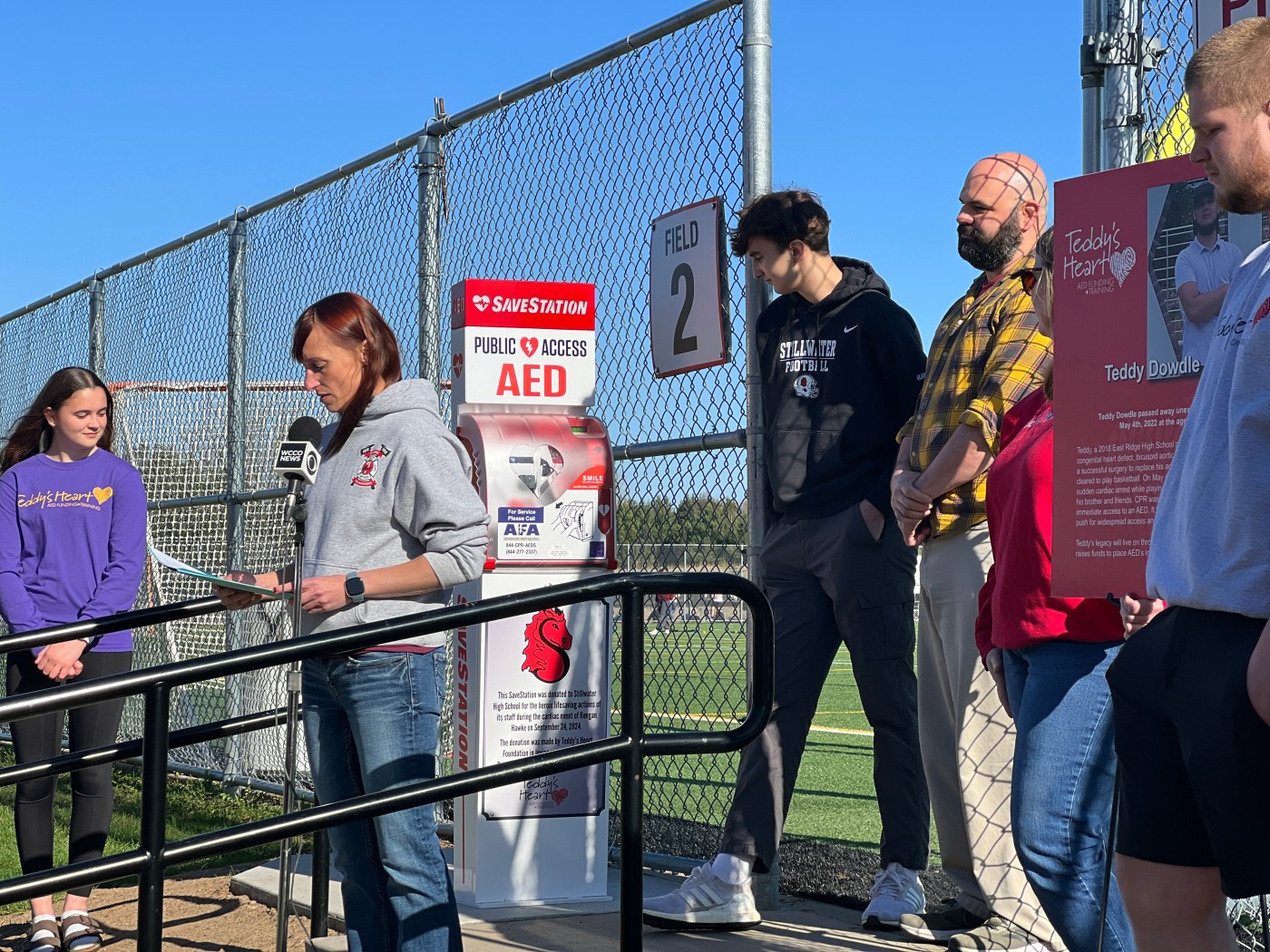
Teddy’s Heart last week dedicated a new SaveStation AED device near the turf practice field where Keegan, 16, collapsed on Sept. 24, 2024, the day before his 16th birthday.
“We thought this was the best place for the first one,” Dowdle said. “A lot of soccer tournaments are held here.”
The Dowdles hope to raise enough money to install a second SaveStation AED this fall at a location closer to the baseball fields at Stillwater Area High School, Dowdle said. Each device costs about $8,000 with installation.
The one dedicated last week was the 22nd paid for by Teddy’s Heart; the Dowdles hope to hit 30 by the end of the year, Craig Dowdle said.
“We want to make sure other families don’t have to go through what our family went through,” Dowdle said. “Hearing what happened to Keegan and the outcome is unbelievable, and that’s what we want to happen every time. With having AEDs available, it’s happening more often.”
Keegan Hawke’s cardiac arrest has been linked to Torsades de Pointes, a type of heart-rhythm disorder, and he has had defibrillator implanted under the skin in his chest to monitor his heart rhythm and deliver electrical shocks to correct life-threatening arrhythmias, Katie Hawke said. He will undergo an ablation later this month at Minneapolis Children’s Hospital, she said.
Related Articles
Stillwater officials sign off on plans for new $400M Lakeview Hospital
As temps climb in May, some local splash pads will open early (but not in St. Paul)
Washington County horse barn under precautionary quarantine
Oakdale: Kristina Handt hired as interim finance director
44 burglaries, $200K stolen. Eight men now face racketeering charges
Katie Hawke said she is grateful for the AED and people who restarted Keegan’s heart and saved his life. “He would not have survived if all of those people and equipment weren’t in place,” she said.
Installing an AED is for one of those “high-risk, low-frequency events” that may never occur, she said.
“The hope is that they are an expensive piece of equipment that never has to be used, but when you need it, it needs to be there, and it needs to be ready and you need to know how to use it,” she said.
A plaque on the SaveStation AED at Stillwater Area High School Practice Field No. 2 notes that it was installed to honor both boys.
More than one in five people prescribed extended-release painkillers such as OxyContin developed an addiction within a year, according to a newly released study mandated by the U.S. Food and Drug Administration.
Related Articles
AED installed at Stillwater field where teen nearly died during football practice
Moderna study shows immune response in older adults for a combo flu and COVID-19 shot
Washington County horse barn under precautionary quarantine
Dog data may help track dangerous disease for humans
Government watchdog expects Medicaid work requirement analysis by fall
The study, repeatedly delayed by more than a decade and released Monday, revealed a far higher percentage of pain patients addicted to opioids than drugmakers’ sales reps claimed in their marketing materials and representations to physicians.
The FDA now faces the question of how to use this data to evaluate whether the agency should make changes to opioid regulation, limiting broad approvals of long-acting opioids for extended use. The FDA is currently holding hearings to discuss the findings and is being asked by advocates to change the drugs’ labels, which guide how doctors prescribe them.
When the opioid market was thrown open to millions of chronic pain patients in the 1990s and early 2000s, Purdue Pharma’s sales reps and promotional videos asserted that fewer than 1% of patients became addicted to painkillers. Extended-release pills were designed to continually dose opioids to stave off chronic pain.
Data released Monday show that 22.5% of pain patients who started on extended-release, long-acting drugs developed opioid use disorder, or addiction, within a year. The findings stem from a post-marketing study requirement mandated by the FDA in 2013, which was funded by a consortium of opioid manufacturers including Purdue, Mallinckrodt Pharmaceuticals and Endo Pharmaceuticals – all of which have filed for bankruptcy following settlements.
“The findings are striking and disturbing and they raise ethical questions because so many study subjects were harmed,” said Andrew Kolodny, president of Physicians for Responsible Opioid Prescribing. “How can you have a label that suggests this is safe and effective when you now have evidence that it’s unsafe and still don’t have evidence that it’s effective?”
In March, Purdue filed a $7.4 billion bankruptcy plan to resolve thousands of lawsuits related to the company’s role in the opioid epidemic. A representatives for Purdue declined to comment. Spokespeople for Mallinckrodt and Endo weren’t immediately available.
Efforts to get a clear picture of exactly how addictive these long-acting opioids are have been thwarted through the years as drugmakers and patient advocates lobbied for easy access to opioids and disputed the definition of “addiction.” The epidemic has claimed more than 800,000 lives in the US since 1999 and remains a major public health problem.
Millions of Americans have become dependent on opioid pills, even as mounting evidence suggests these drugs should never have been approved as safe and effective for chronic pain. The agency’s own labeling — meant to define a drug’s use, flag its risks, and limit its marketing — helped legitimize widespread, high-dose, long-term prescribing without the clinical evidence to support it, as revealed in a Businessweek investigation.