City Limits’ climate reporter Mariana Simões spoke with WNYC’s The Brian Lehrer Show to discuss her recent reporting on the Trump administration’s decision to layoff staff at the U.S. Environmental Protection Agency, and what it means for local communities.
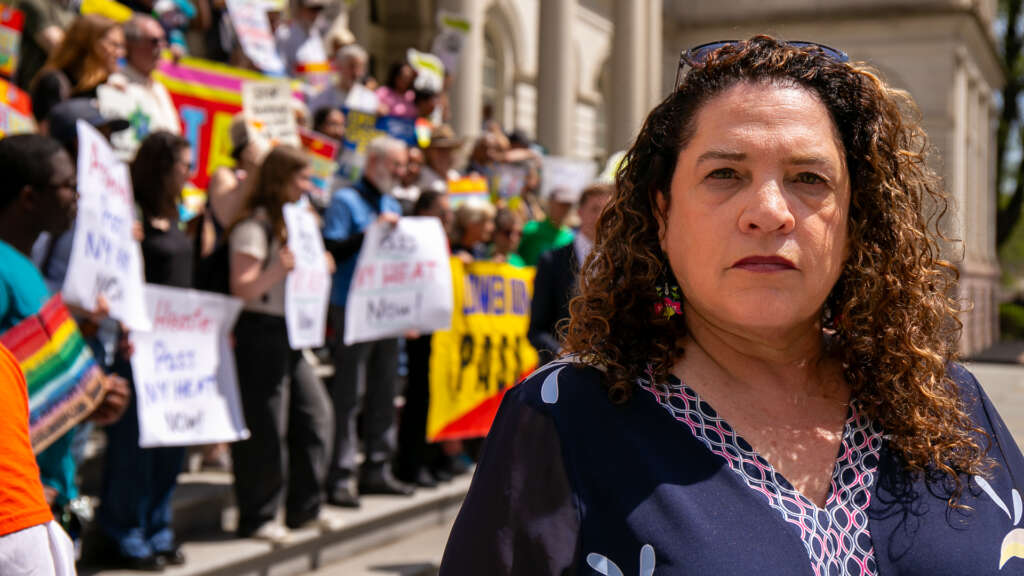
Lisa Garcia, a former EPA administrator, at an Earth Day Rally at City Hall last month. She recently spoke to City Limits about the impact the agency layoffs will have on New York City communities dealing with environmental issues. (Photo by Adi Talwar)
Last month, the day before Earth Day, the Trump administration told more than 450 staffers at the U.S. Environmental Protection Agency that they were being let go or reassigned—part of the White House’s plan to do away with “environmental justice” and “diversity, equity, and inclusion” efforts at the federal agency.
But what is environmental justice exactly, and what does the elimination of those positions mean for New York City communities dealing with air pollution or contaminated land?
That was the subject of a segment on WNYC’s The Brian Lehrer Show Wednesday, featuring City Limits’ climate reporter Mariana Simões, who joined the public radio host to discuss her recent reporting on EPA cuts and their local impact. They also took questions and heard feedback from callers who shared their thoughts on what environmental justice means to them.
“I grew up in the Bronx, and I remember when I was a kid, I would see hazardous waste trucks driving through my community, and I would always say to myself, ‘I don’t see these in Manhattan. I don’t see these in the suburbs,’” one caller said. “I think another way to think about environmental justice is simply racial justice.”
DEIR AL-BALAH, Gaza Strip (AP) — Israeli strikes across Gaza killed at least 92 people, including women, children and a local journalist, officials said Wednesday, as Israel prepares to ramp up its campaign in the strip, with the devastating war now entering its 20th month.
Two Israeli airstrikes on Wednesday in central Gaza killed at least 33 people and wounded 86, including several children, though the actual death toll is likely higher, according to health officials.
The Israeli military had no immediate comment on the strikes.
A makeshift tent camp for displaced Palestinians stretches across Gaza City on Tuesday, May 6, 2025. (AP Photo/Jehad Alshrafi)
Palestinians struggle to get donated food at a community kitchen in Khan Younis, Gaza Strip, Monday, May 5, 2025. (AP Photo/Abdel Kareem Hana)
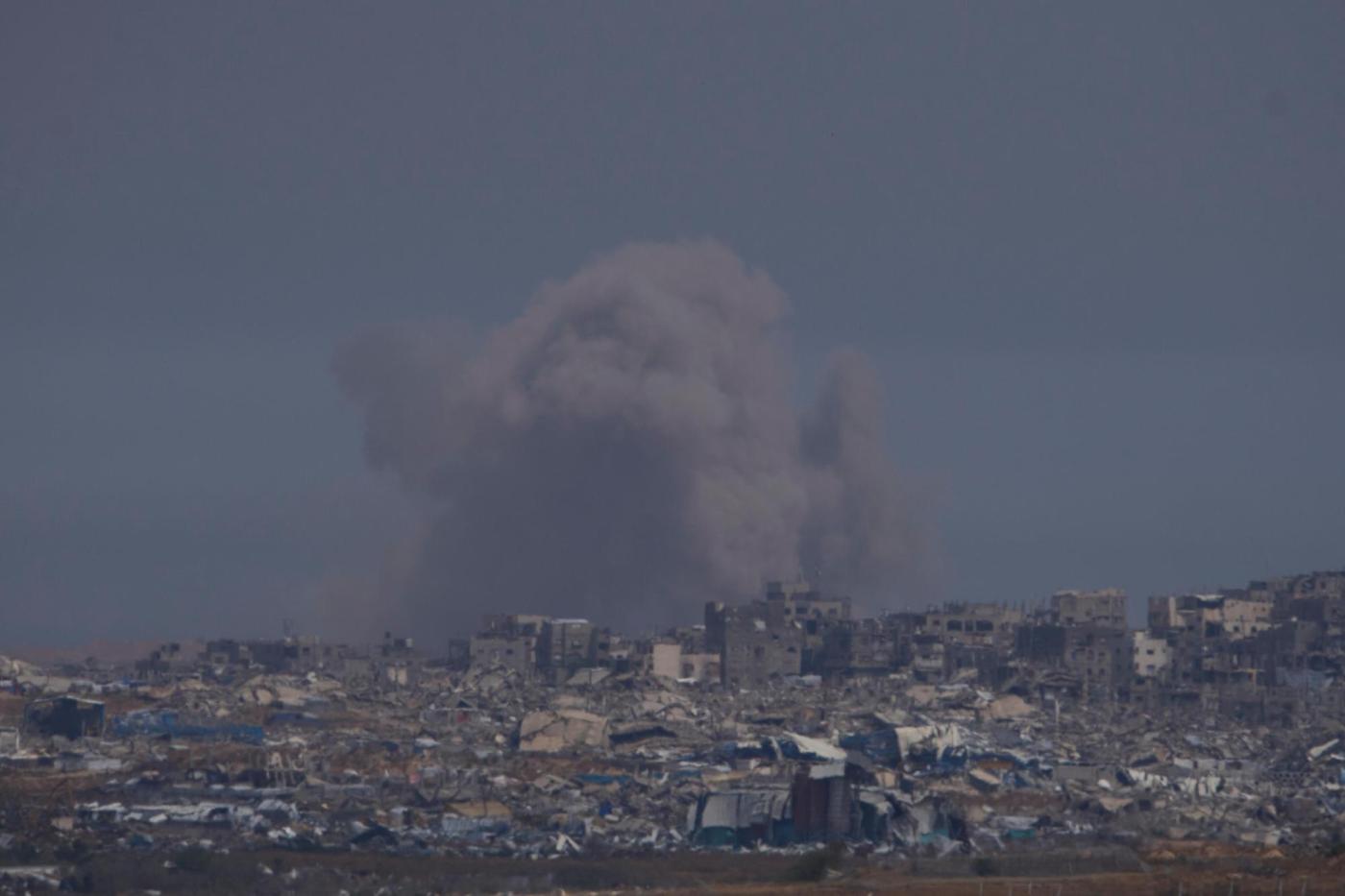
Destroyed buildings in the Gaza Strip as seen from southern Israel, Tuesday, May 6, 2025. (AP Photo/Ohad Zwigenberg)
1 of 3
A makeshift tent camp for displaced Palestinians stretches across Gaza City on Tuesday, May 6, 2025. (AP Photo/Jehad Alshrafi)
The new bloodshed comes days after Israel approved a plan to intensify its operations in the Palestinian enclave, which would include seizing Gaza, holding on to captured territories, forcibly displacing Palestinians to southern Gaza and taking control of aid distribution along with private security companies.
Israel is also calling up tens of thousands of reserve soldiers to carry out the plan. Israel says the plan will be gradual and will not be implemented until after U.S. President Donald Trump wraps up his visit to the region later this month.
Any escalation of fighting would likely drive up the death toll. And with Israel already controlling some 50% of Gaza, increasing its hold on the territory, for an indefinite amount of time, could open up the potential for a military occupation, which would raise questions about how Israel plans to have the territory governed, especially at a time when it is considering how to implement Trump’s vision to take over Gaza.
The Israeli offensive has so far killed more than 52,000 people in Gaza, many of them women and children, according to Palestinian health officials who do not distinguish between combatants and civilians.
Israel blames Hamas for the death toll, saying it operates from civilian infrastructure, including schools. Hamas has been designated as a terrorist organization by the United States, Canada and the European Union.
Strikes target crowds in Gaza City
Wednesday’s strikes included two attacks on a crowded market area in Gaza City, health officials said.
Footage posted online reportedly showed the aftermath with men found dead, including one still seated in a chair inside a Thai restaurant, used by locals as a gathering spot, and several children lying motionless on the ground, covered in blood.
Journalist Yahya Sobeih, who freelanced for several local outlets, was among those killed, according to Gaza’s media office. He had shared a photo on Instagram of his newborn baby girl.
Victims of the blasts, some with severe injuries, were taken to nearby Al-Shifa Hospital, Gaza health ministry spokesperson Zaher al-Wahidi told The Associated Press.
An attack Tuesday night on a school sheltering hundreds of displaced Palestinians killed 27 people, officials from the Al-Aqsa Hospital said, including nine women and three children. The school has been struck repeatedly since the war began. Earlier, a strike on another school turned shelter in Gaza City killed 16 people, according to officials at Al-Ahli Hospital, while strikes in other areas killed at least 16 others.
In Bureij, an urban refugee camp, paramedics and rescuers rushed to pull people out of a blaze after a large column of smoke and fires pierced the dark skies above the school shelter.
Trump jars Israelis with remark on hostage figures
The war began when Hamas-led terrorists attacked southern Israel, killing 1,200 people and taking about 250 hostages.
Trump on Tuesday stunned many in Israel when he declared that only 21 of the 59 hostages remaining in Gaza are still alive. Israel insists the figure stands at 24, although an Israeli official said there was “serious concern” for the lives of three captives. The official said there has been no sign of life from those three, whom the official did not identify. He said that until there is evidence proving otherwise, the three are considered to be alive. The official, who spoke on condition of anonymity to discuss sensitive details related to the war, said the families of the captives were updated on those developments.
Related Articles
Trump says only 21 hostages held by Hamas in Gaza now believed to be alive
An Israeli plan to seize the Gaza Strip is met with alarm
Gaza aid dries up as Israeli blockade enters a third month
Israel plans to capture all of Gaza under new plan, officials say
Drones strike ship carrying aid to Gaza, organizers say, in latest confrontation over assistance
The Hostages and Missing Families Forum, a group representing the families of the captives, demanded from Israel’s government that if there is “new information being kept from us, give it to us immediately.” It also called for Israeli Prime Minister Benjamin Netanyahu to halt the war in Gaza until all hostages are returned. “This is the most urgent and important national mission,” it said on a post on X.
Since Israel ended a ceasefire with Hamas in mid-March, it has unleashed fierce strikes on Gaza that have killed hundreds and captured swaths of territory. Before the truce ended, Israel halted all humanitarian aid into the territory, including food, fuel and water, setting off what is believed to be the worst humanitarian crisis in 19 months of war.
Key interlocutors Qatar and Egypt said Wednesday that mediation efforts were “ongoing and consistent.” But Israel and Hamas remain far apart on how they see the war ending. Israel says it won’t end the war until Hamas’ governing and military capabilities are dismantled, something it has failed to do in 19 months of war.
Hamas says it is prepared to release all of the hostages for an end to the war and a long-term truce with Israel.
The US-Houthi deal does not appear to cover Israel
Against the backdrop of the plans to intensify the campaign in Gaza, fighting has also escalated between Israel and Iranian-backed Houthi rebels in Yemen.
The Houthis fired a ballistic missile earlier this week that landed on the grounds of Israel’s main international airport. Israel responded with a series of airstrikes over two days, whose targets included the airport in Yemen’s capital, Sanaa.
The Houthis have been striking Israel and targets in a main Red Sea shipping route since the war began in solidarity with the Palestinians. On Tuesday, Trump said the U.S. would halt a nearly two-monthlong campaign against the Houthis in Yemen, after the rebel group agreed not to target U.S. ships.
Israel does not appear to be covered by the U.S.-Houthi agreement.
The Israeli official said the deal came as a surprise to Israel and that it was concerned by it because of what it meant for the continuation of hostilities between it and the Houthis.
Goldenberg reported from Tel Aviv, Israel. Associated Press reporter Fatma Khaled in Cairo contributed to this report.
All-American forward Abbey Murphy is returning to the University of Minnesota women’s hockey program for her final season of eligibility, head coach Brad Frost announced on Wednesday.
“We are ecstatic that Murph has chosen to come back,” Frost said in a statement. “She is a staple within our Gopher program and women’s hockey worldwide. Our team and college hockey will be better with her in it.”
Murphy, a senior last season, finished with a career-high 65 points during the 2024-25 season, second in the nation in goals (33) and fourth in point. She has the opportunity to return because of an Olympic redshirt during the 2021-22 season and an extra year of eligibility that was granted in 2020 due to the circumstances surrounding COVID-19.
“I’m beyond excited to announce I will be coming back for my final year of college hockey,” Murphy said in a statement. “I am pumped for another go around with this team. It’s been a great ride but we’re not done yet.”
Related Articles
NCAA Frozen Four: Gophers season comes to a close
NCAA Frozen Four: Gophers, Badgers ready for Chapter 6
Women’s hockey: Gophers roll early, hold off Colgate to earn Frozen Four berth
Women’s NCAA hockey: Gophers have confidence, and home ice
It may feel like you have to attend law school to understand the American legal system. However, that is not the case. We broke down some of the most common legal terms used in the lawsuits surrounding the Trump administration.
What’s the general process for a lawsuit?
Lawsuits are sometimes called “complaints” for good reason: They tell a judge about something that allegedly caused you harm, and why you think someone else is to blame. Lawsuits also include a request for the kind of “relief” sought, like money or an order stopping the harmful actions.
The person being sued is always given a chance to respond. They might tell the judge the lawsuit is wrong, argue that someone else is to blame, or say the conduct wasn’t actually harmful. Often, the person being sued will file a “motion to dismiss,” asking the judge to reject the lawsuit entirely.
What’s a plaintiff?
The people who file a lawsuit are the “plaintiffs,” and the people being sued are the “defendants.” If a lawsuit is brought on behalf of a big group of people, it might become a “class action” lawsuit.
What’s a TRO? And what’s a PI?
Resolving a lawsuit can take months, so plaintiffs often ask the judge to temporarily stop the defendants from doing whatever allegedly caused the harm while the case is decided.
Related Articles
Biden calls Trump’s pressure on Ukraine ‘modern-day appeasement’ in 1st post-presidential interview
Trump administration abruptly removes the vice chair of the National Transportation Safety Board
Trump plans to announce that the US will call the Persian Gulf the Arabian Gulf, officials say
Top US officials will meet with Chinese delegation in Switzerland in first major talks of trade war
Trump says only 21 hostages held by Hamas in Gaza now believed to be alive
A “temporary restraining order” or “TRO” is a short-term emergency order designed to stop immediate, irreparable harm.
A “preliminary injunction” or “PI” lasts until the lawsuit is resolved. A PI typically isn’t granted unless the plaintiff shows they are likely to “succeed on the merits,” or win the case.
What’s the difference between an appeal and a stay?
If one side thinks the judge made the wrong call, they can ”appeal” by asking a higher court to decide if the ruling was correct.
They can also ask for a “stay,” which puts a judge’s order on pause while a dispute or appeal is worked out.
What does contempt of court mean?
If someone disobeys a court order or disrespects the judicial process, the judge might hold them in “contempt of court.”
Contempt of court convictions can carry big penalties, including fines or imprisonment. The punishments are designed to pressure the troublesome party to comply, so they typically end once the disobedience stops.
What’s ‘discovery,’ and why is some ‘privileged?’
“Discovery” happens when both sides request information from each other as they search for facts supporting their side of the case. Discovery can include witness names, documents, or sworn statements from people.
If one side thinks something should be kept confidential, they might claim “privilege.” Attorney-client communications are generally privileged. “State secrets” privilege is invoked if the government thinks sharing the information would put national security at risk.
Why all the jargon?
Legal terms carry very specific definitions. The jargon can feel fussy, but it’s all meant to help lawyers and judges avoid any ambiguity.
For instance, the term “jurisdiction” refers to whether a court has the authority to decide a case. It might seem simpler to just use the word “venue,” but there are many different types of legal jurisdiction, and the word venue just doesn’t cover it all.
Jurisdiction can be based on a geographic area or on the subject matter of the lawsuit. It can even be based on timing, or which court gets first dibs on a case.