Skywatch: Crowded space

posted in: All news | 0

A little over 240 years ago, birds were the only things that could fly above the ground untethered without eventually falling. That all changed in 1783 when Jean-François Pilâtre de Rozier and François Laurent d’Arlandes made the first successful hot-air balloon flight over Paris. Just think about what must have been going through their heads when they saw the Earth from above. No humans had ever had a bird’s-eye view like that before and lived to tell about it!

It took until 1903 for the next major aviation feat to be accomplished when the Wright brothers flew the first airplane in the skies just south of Kitty Hawk, N.C. Fifty-four years later, the Soviet Union put the first human-made satellite, Sputnik 1, in orbit around the Earth, and four years after that, the Russians launched the first human-occupied satellite, Vostok 1, with astronaut Yuri Gagarin aboard.

Since that time over 11,000 satellites have been launched into orbit, with and without people aboard. Many of those satellites have long since burned up in the Earth’s atmosphere because of orbital decay. Others, mainly occupied by humans, have successfully re-entered the atmosphere to either land on the ground or splash down in the ocean.  There is a fantastic website, www.N2YO.com, that tracks objects in the sky. If you go to their search engine and type in Vanguard 1, you can see that it is in the first position of one of the first U.S. satellites launched in 1958 and is still in orbit 67 years later! When you explore N2YO, you can get orbital data on thousands in orbit. However, many of those satellites have stopped functioning, and many are actually spent rocket stages that boosted satellites into orbit. It’s crowded above the Earth, but there’s still a lot of room left.

The really cool thing is that stargazers can see many of these satellites. If you’re intently studying the night sky looking for constellations and observing with binoculars or a telescope, it’s hard to go more than a half-hour without seeing a satellite zipping along. Most satellites move from west to east, but some are in polar orbits. The best time to see them is in the early evening for a couple of hours after evening twilight or a couple of hours before the start of morning twilight. That’s because satellites have to reflect sunlight to be visible. Even if satellites had huge spotlights mounted on them, you’d never see them. They’re just too high up. Just before morning twilight, and for a little while after evening twilight, there’s no direct sunlight available to us on the ground, but high in space there’s still enough sunlight to bathe satellites, sending secondhand sunshine our way. During the middle of the night the sun is entirely behind the Earth, so all satellites pass over in total darkness.

By far, the easiest satellite to spot is the International Space Station. It’s as bright as a jetliner passing over. Because of that many people see it all the time and figure it’s a jet. Its first component or module was launched in 1998, and the station was completed in 2011. It’s longer than a football field! What makes it so bright are the eight solar panels that are over 100 feet long and nearly 40 feet wide! They bounce a heck of a lot of secondhand sunshine our way!

The ISS orbits the Earth about every 90 minutes, traveling at almost 5 miles a second. It moves in a general direction from west to east across the dome of the sky. The ISS doesn’t pass over the same location each orbit. That’s because of the nature of its orbit and the fact that Earth is rotating. There can be stretches of nights when it doesn’t pass over at all. That’s why you need to have an app or a website that will let you know where and when to look. Some apps will even alert you when the ISS is expected to pass over your location on Earth.

My favorite website for keeping up with the travels of the ISS is www.heavensabove.com. With Heavens-Above all you have to do is configure it for your location with their massive database. Among many of its features, it’ll provide a schedule for ISS flyovers and even a sky map to track it. You can also find out when other bright satellites will be passing over. My favorite free app for tracking the ISS is ISS Tracker. Allow that app to know your location, and you’re good to go.

A sample map from Heavens Above (Mike Lynch)

Depending on where it’s crossing your sky, the ISS can take up to around five minutes to pass. It resembles a super bright star. Depending on when you’re watching it, in the early morning or early evening, it can suddenly disappear in the sky as it enters the Earth’s shadow, or it can pop into view coming out of the shadow in the early morning.

As much fun as it can be to observe satellites in the night sky, I’m afraid that in the future the skies may become too crowded. I’m worried that it’s already beginning to happen. In particular I’m referring to Starlink satellites launched by the Space Exploration Technologies Corporation, otherwise known as SpaceX, a private space transportation enterprise founded in 2002 by South African native Elon Musk.

Starlink satellites can provide much more available access to the internet throughout the world, even in remote areas. Already, there are hundreds and hundreds of Starlinks in orbit, and it’s very easy to see them, sometimes in groups or lines, especially after they are first launched. As it is with the International Space Station, you can keep up with all of them on the Heavens-Above website, as well as other sites and apps.

A Starlink satellite chain. (Mike Lynch)

The big fear is that the natural beauty of the night sky could be ruined with too many satellites. Earth-based astronomical observations, both done by professionals and by amateur astronomers, are going to be interfered with significantly. I believe, and so do many others, that there must be some international regulations to keep this from happening. I can tell you as an astrophotographer that it’s getting tougher and tougher to get time-exposure images that aren’t marred by satellite streaks.

Watching satellites is a lot of fun but let’s not get the heavens too congested!

Mike Lynch is an amateur astronomer and retired broadcast meteorologist for WCCO Radio in Minneapolis/St. Paul. He is the author of “Stars: a Month by Month Tour of the Constellations,” published by Adventure Publications and available at bookstores and adventurepublications.net. Mike is available for private star parties. You can contact him at mikewlynch@comcast.net.

Related Articles


Skywatch: Dippers and bears flying high


Skywatch: A crow, a cup and a water snake


Skywatch: The two brightest stars, and a guest star


Skywatch: Celestial twins proudly sharing Orion’s shoulders


Skywatch: Out with the hunter. In with the Lion.

Mihir Sharma: Why I’m thinking twice about traveling to the US

posted in: All news | 0

In the months and years after 9/11, going to the U.S. was scary for many of us. Border security became harsh and unforgiving, and we could feel our rights drop away upon entering American airspace. Novels were written and movies were made about how an encounter with hostile, suspicious border officials could radicalize even those who previously loved America.

Today feels worse. During George W. Bush’s administration, we could tell ourselves that the country was confused, suffering and lashing out. In Trump’s America, it seems to outsiders that cruelty to foreigners is the point of politics, not a byproduct of trauma.

I can’t stress enough how different that makes America feel, above all to those of us who hold it in affection and look forward to our trips there. A well-justified suspicion that the government hates us will naturally keep potential visitors away. Fear doesn’t attract tourists.

I’m no exception. I have frequent-flier miles saved up for a trip to the U.S. this year, and — like so many others — I now believe that they will be better spent elsewhere.

Are such fears groundless and irrational? Perhaps. But the stories add up. We read about long-term residents sent off to prison camps in El Salvador, and researchers deported for attending a protest or writing an op-ed. That’s awful enough. But it’s even weirder to hear from innocent tourists who found themselves in jail for minor problems with their travel plans. Many of us know people who have had border officials demand their phones and cross-examine them about emails they have sent.

It’s depressing to learn that European officials are now issued burner phones if they’re going to America. Or that the U.S. Embassy in Tokyo has reminded Japanese travelers that they must include details of all their social media accounts over the past five years if they don’t want their visa application rejected. But it is positively absurd that we now ask friends arriving in the U.S. to message that they’re safe after clearing security.

Going through the U.S. border was already an intimidating experience, and now it has gotten terrifying. I may never feel as vulnerable, as exposed, when I stand in an immigration queue at an American airport, clutching the flimsy shield of paperwork I hope will protect me from the baleful gaze of the federal government. In no other country and at no other time is there so great a gulf between public principles and officials’ attitudes. A country founded on rights wants you to know at your moment of arrival that now you have no rights at all.

Some testimony from those detained at airports is particularly concerning. Two German teenagers deported from Hawaii told the media back home that immigration officials fixated on the girls’ statement that they would continue to occasionally freelance remotely for companies back home while they backpacked through America.

That was illegal on a visit to the U.S., they were told. What does that mean? Everyone knows that visiting the U.S. means you can’t work there. But is it the case that someone on holiday there can no longer answer work emails, or edit a shared spreadsheet, or participate in a conference call at their workplace a continent away? Will I have to remove my work email from my phone the moment I land in the U.S.?

The number of overseas visitors to the U.S. is already declining. There were 12% fewer arrivals in March than in the same month a year earlier. The Financial Times found that the decline in travelers from some European countries was particularly sharp: Visitors from Germany fell by almost 30%, for example.

Going after visitors in this fashion damages the U.S. most of all. Companies will suffer if ordinary business travelers worry that they will have to answer confusing questions about what counts as “work.” Tourism accounts for 2.5% of the U.S. economy, and it will struggle if fear keeps away high-spending Europeans.

Related Articles


Parmy Olson: AI chatbots want you hooked — maybe too hooked


Lisa Jarvis: Parkinson’s disease finally finds a source of hope


Christopher Cokinos: To dumbly go where no space budget has gone before


Jonathan Levin: Warren Buffett caps a career built on humility


Parmy Olson: OpenAI can’t have its money both ways

And deporting students and researchers isn’t a good idea, either. America has led the world in science, innovation and industry precisely because it attracts the best people. Harvard’s Kseniia Petrova isn’t working on cancer detection any more, because she’s in a facility in Louisiana with her visa canceled — for an offense, traveling into the U.S. with biological samples, that is normally accorded only a minor fine.

The U.S. worked as the center of research and innovation because, even as a visitor, you had rights there. Take that away, replace it with a system where you constantly feel at the mercy of apparatchiks who take pleasure in tormenting you, and American universities will be as attractive to foreign talent as, say, China’s. I started avoiding trips to the mainland and Hong Kong some years ago, but I never dreamed I would one day put the U.S. in the same category.

A U.S. that cuts itself off from the world will be one that is less vibrant, less understood, and less loved. An America nobody wants to visit would no longer be the center of the world.

Mihir Sharma is a Bloomberg Opinion columnist. A senior fellow at the Observer Research Foundation in New Delhi, he is author of “Restart: The Last Chance for the Indian Economy.”

Today in History: May 11, Deep Blue defeats Kasparov

posted in: All news | 0

Today is Sunday, May 11, the 131st day of 2025. There are 234 days left in the year.

Today in history:

On May 11, 1997, the IBM supercomputer Deep Blue defeated chess grandmaster Garry Kasparov in the final game of a six-game match in New York, winning 3 ½-2 ½ and marking the first time a computer won a match against a reigning world champion.

Also on this date:

In 1935, the Rural Electrification Administration was created as one of President Franklin D. Roosevelt’s New Deal programs.

Related Articles


Today in History: May 10, golden spike completes transcontinental railway


Today in History: May 9, FDA approves first birth control pill


How Putin uses the USSR’s victory in World War II to rally support for him and the war in Ukraine


Today in History: May 8, ‘Son of Sam’ killer pleads guilty


Today in History: May 7, RMS Lusitania torpedoed, sunk by German submarine

In 1946, the first CARE packages, sent by a consortium of American charities to provide relief to the hungry of postwar Europe, arrived at Le Havre, France.

In 1953, one of the deadliest tornadoes in Texas history devastated the city of Waco, killing 114 people and injuring nearly 600.

In 1960, Israeli agents captured Nazi war criminal Adolf Eichmann in Buenos Aires, Argentina.

In 1973, the espionage trial of Daniel Ellsberg and Anthony Russo in the “Pentagon Papers” case came to an end as Judge William M. Byrne dismissed all charges, citing government misconduct.

In 1981, reggae artist Bob Marley died in a Miami hospital at age 36 of acral lentiginous melanoma.

In 1984, Claus Barbie, the Nazi Gestapo chief known as the “Butcher of Lyon,” went on trial in Lyon for crimes against humanity after being extradited from Bolivia, where he lived for over 30 years after World War II. (Barbie would be found guilty and would die in prison four years later.)

In 1996, an Atlanta-bound ValuJet DC-9 caught fire shortly after takeoff from Miami and crashed into the Florida Everglades, killing all 110 people on board.

Today’s Birthdays:

Rock singer Eric Burdon is 84.
Actor Frances Fisher is 73.
Former MTV VJ Martha Quinn is 66.
Olympic boxing gold medalist Mark Breland is 62.
Actor Tim Blake Nelson is 61.
Basketball Hall of Famer Lauren Jackson is 44.
Former NFL quarterback Cam Newton is 36.
Latin pop singer Prince Royce is 36.
Actor Lana Condor is 28.
Singer-actor Sabrina Carpenter is 26.

Timberwolves rally past Warriors in fourth for 2-1 series lead

posted in: All news | 0

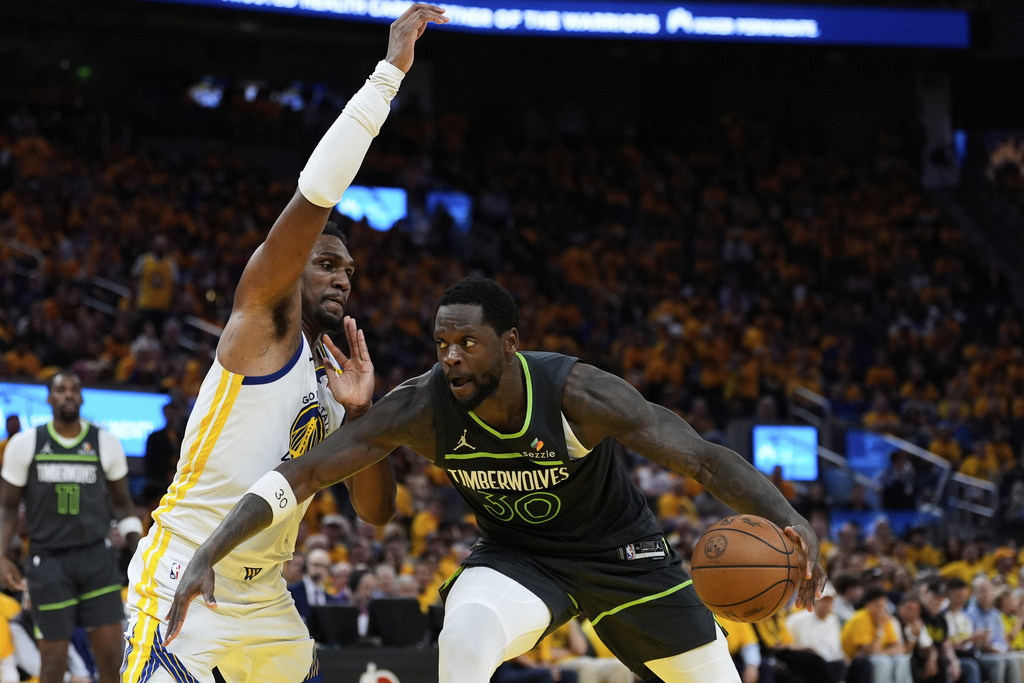
San Francisco — With Golden State playing without Steph Curry, Minnesota has a massive talent advantage over the Warriors.

And it used every bit of it to rally past Golden State on Saturday in San Francisco.

After three quarters of uninspiring basketball, in which they were outwitted and outhustled by an undermanned Golden State team, Minnesota mustered up enough good basketball when it needed it, rallying from six down in the final frame to beat the Warriors, 102-97 to claim a 2-1 series lead.

Jimmy Butler was the best player on the floor for most of the evening. But he was tasked with carrying a large load on both ends of the floor for the Warriors, and seemed to run out of gas down the stretch, with a number of looks coming up short.

Golden State struggled to score the moment that became the case.

Golden State’s offense melted into a puddle once Butler’s effectiveness dipped. The Warriors scored just 24 points in the final frame, including 16 when the game was still in the balance, and Minnesota raced past Golden State.

Anthony Edwards struggled mightily in the first half, but found his 3-point shot over the final two quarters, scoring 28 of his 36 points in the second half. Julius Randle was a monster for Minnesota, tallying 24 points, 12 assists and 10 rebounds. His interior offense often stabilized Minnesota when it needed it most.

And it certainly did need it. Even without Curry, the Warriors can defend at a high level. That was evident in the final 6 minutes, 30 seconds of the second quarter, in which it held Minnesota to just one point. The Warriors led by two at the break.

But Draymond Green was a big part of that defense, and he picked up his fourth foul early in the third quarter which sent him to the bench. And collected fouls No. 5 and No. 6 in a 30 second span in the fourth quarter.

Butler finished with 33 points, but went just 1 for 7 in the fourth quarter. Jonathan Kuminga had 30 points off the bench for Golden State.

Game 4 is on Monday in San Francisco.

Related Articles


With Julius Randle, Timberwolves coach Chris Finch presses right buttons


Nickeil Alexander-Walker met Timberwolves’ challenge in Game 2


One fan was ejected for comments made to Draymond Green in Game 2 as Wolves investigation continues


Mizutani: It’s obvious the Timberwolves won’t need their best to win this series


Timberwolves blast Warriors’ bench for Game 2 victory