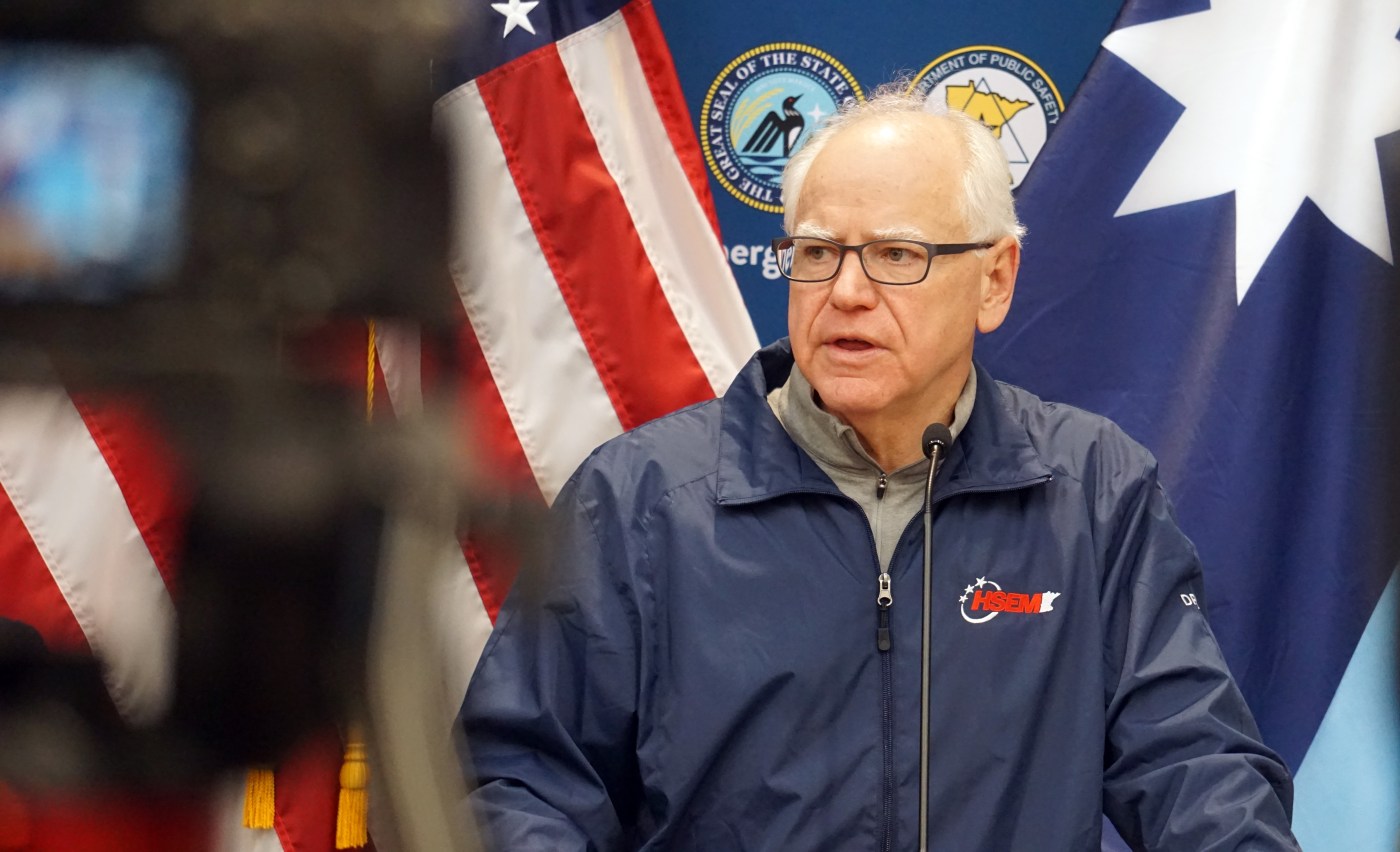
Gov. Tim Walz said Tuesday he hopes White House Border Czar Tom Homan will announce this week an end to the surge of federal agents in Minnesota.
“It would be my hope that Mr. Homan goes out before Friday and announces that this thing is done,” and that it will be done in a matter of days, Walz said Tuesday at a press conference discussing the economic impacts of Immigration and Customs Enforcement activity in the state. “That would be my expectation.”
Walz said that statement is based on conversations he had with Homan on Monday and White House Chief of Staff Susie Wiles on Tuesday.
“I’m very careful with dealing with this administration,” Walz said. “I’ll let them make the announcements. We have been absolutely clear that they need to reduce these numbers back to the pre-surge level, which has been about 150.”
Homan has said it’s his intention to reach a complete drawdown of the roughly 2,000 federal agents remaining in the state, but that it’s contingent on continued state and local cooperation.
Last week Homan announced the withdrawal of about 700 federal officers — roughly a quarter of the total deployed to Minnesota — after state and local officials agreed to cooperate by turning over arrested immigrants.
Homan has said he thinks the ICE operation in Minnesota has been a success with a number of individuals wanted for violent crimes being taken off the streets. Critics say immigration agents have detained legal residents — in some cases based on racial profiling — and have made the Twin Cities less safe.
Trump’s border czar took over the Minnesota operation in late January after the second fatal shooting by federal officers and amid growing political backlash and questions about how the operation was being run.
Federal officials began an immigration action in the state with thousands of agents. Since then, masked, heavily armed officers have been met by resistance from residents who are upset with their aggressive tactics. Renee Good was fatally shot by a federal agent on Jan. 7. Alex Pretti was killed on Jan. 24.
Related Articles
After one month, how is Minnesota paid leave holding up?
Daughter of governor candidate Jeff Johnson stabbed to death in St. Cloud
Scott Jensen withdraws from MN governor’s race, will run for state auditor
A Hmong child bride who killed her husband years ago dreads her next ICE check-in
A month of learning, advocacy, frustration for St. Paul Mayor Kaohly Her
CORTINA D’AMPEZZO, Italy — Sweden’s brother-and-sister team of Isabella and Rasmus Wranå won gold in mixed doubles curling at the Milan Cortina Olympics, beating the United States’ Duluth duo in the final on Tuesday night.
The Wranås won 6-5 over Cory Thiesse and Korey Dropkin, who became the first Americans to medal in Olympic mixed doubles. Thiesse is the first American woman to medal in Olympic curling.
The Wranå siblings grew up as rivals and were coached by their father, Mats Wranå. They’re Sweden’s first sibling team at the Olympics.
The championship game was agonizingly close, with the Swedes pouncing on an opening left by the Americans in the last end.
Throughout the match, the Wranås enjoyed a somewhat silent camaraderie with their small contingent of fans. The two remained stoic while Dropkin played to the crowd, whipping up the loud American supporters.
The Wranås won the world title in 2024. Dropkin and Thiesse won at worlds a year earlier.
The Swedish duo started their Olympic bid on stumbly legs, losing three games in a row in the round robin. The skid prompted the Swedish media to label their Olympic bid a “Curlingfiasko.”
But they soon managed to turn it around, winning most of their remaining matches.
It was a heartbreaker for the Americans, who enjoyed roaring support. An American curler screamed from the rafters, “Show me your biceps!” Dropkin obliged.
Dropkin and Thiesse are based in Duluth, Minnesota, and have full-time jobs. Thiesse is a lab technician and Dropkin a real estate agent. Dropkin is engaged and Thiesse is married.
They were classmates in college. Dropkin asked Thiesse to be his mixed doubles partner after a failed qualification run for the Beijing 2022 Games. She agreed and they were world champions a year later.
Italy wins bronze
Italy’s Stefania Constantini and Amos Mosaner won bronze, defeating Britain 5-3.
It was a bittersweet result for the Italians, the defending Olympic champions whose fans packed the stands throughout the round-robin in hopes to see a repeat. And it was devastating for the Brits, Jennifer Dodds and Bruce Mouat, who were expected to make the final after exiting the round-robin with the most wins of any pair.
They faltered against exacting throws from Mosaner and Constantini, who hails from Cortina and has become a darling of this stadium. The British duo walked off the ice dejected.
Related Articles
‘Miracle’ teammates continue work of late teammate Mark Pavelich
Raedler and Huber of Austria win team combined at the Olympics, Mikaela Shiffrin is 4th
‘Don’t jump in them’: Olympic athletes’ medals break during celebrations
US figure skater Amber Glenn resolves copyright issues with a Canadian music artist at the Olympics
Harvey, Dunne lead U.S. to 3rd straight win in Olympic women’s hockey
NEW YORK (AP) — Paramount is again sweetening its hostile takeover bid for Warner Bros. Discovery, while again extending the deadline for its tender offer as it scrambles for more shareholder support.
Related Articles
US stocks flirt with records as Hasbro soars but Coca-Cola slips
Is a weaker U.S. dollar a good thing?
Retail sales unchanged in December from November, closing out year on a lackluster tone
Target CEO reshapes his leadership team in first big move since taking over this month
What you need to know before making financial gifts
On Tuesday, the Skydance-owned company said it would pay Warner shareholders an added “ticking fee” if its deal doesn’t go through by the end of the year — amounting to 25 cents per share, or a total of $650 million, for every quarter after Dec. 31. Paramount also pledged to fund Warner’s proposed $2.8 billion breakup payout to Netflix under its studio and streaming merger agreement.
The value of Paramount’s offer otherwise remains unchanged. The company is offering to pay $30 per share in cash to Warner’s stakeholders, who now have until March 2 to tender their shares.
In a statement, Paramount CEO David Ellison said that the “additional benefits” announced Tuesday “clearly underscore our strong and unwavering commitment to delivering the full value WBD shareholders deserve for their investment.”
Paramount wants to buy Warner’s entire company for $77.9 billion, with a total enterprise value of $108 billion including debt. Beyond studio and streaming operations, that includes Warner’s networks like CNN and Discovery.
But it has a long way to go in terms of getting shareholder support — which, according to recent company disclosures, has appeared to decline over the last month. As of Monday, Paramount said that more than 42.3 million Warner shares had been “validly tendered and not withdrawn” from its bid, down from over 168.5 million Warner shares on Jan. 21.
Warner has about 2.48 billion shares outstanding in series A common stock today. Paramount would need more than 50% to effectively gain control of the company.
Netflix and Warner did not immediately respond to requests for comment Tuesday.
The new March 2 deadline marks the third time Paramount has pushed back the expiration of its tender offer, which it may keep extending. Paramount has also promised a proxy fight. Last month, the company begun soliciting proxies to challenge Warner’s agreement with Netflix.
Warner’s leadership has consistently backed the deal it struck with Netflix. In December, Netflix agreed to buy Warner’s studio and streaming business for $72 billion — now in an all-cash transaction that the companies have said will speed up the path to a shareholder vote by April. Including debt, the enterprise value of the deal is about $83 billion, or $27.75 per share.
Netflix and Warner have maintained that their agreement is better Paramount’s bid. But Paramount argues that its offer is superior — and on Tuesday pointed to a “sliding scale” value of the Netflix merger, which could range from $21.23 to $27.75 per share, depending on debt spanning from Warner’s previously announced spinoff of its networks business.
Unlike Paramount, Netflix doesn’t want to acquire Warner networks like CNN and Discovery. Under Netflix-Warner’ agreement, “Discovery Global” would become its own separate public company before their merger is closed.
The prospect of a Warner sale to either company has raised tremendous antitrust concerns from lawmakers worldwide. The U.S. Department of Justice has initiated reviews of both Warner’s agreement with Netflix and Paramount’s hostile bid — with all three companies disclosing that they’ve been in contact with the DOJ over requests for more information.
The companies have argued their proposed deals will be good news for consumers and the wider entertainment industry, claiming that merging will give streaming customers more content through bigger libraries. But unions and other trade groups have warned that further consolidation in the industry could result in job losses and less diversity in content — with particularly negative consequences for filmmaking.
RAMALLAH, West Bank (AP) — A top Israeli official said Tuesday that measures adopted by the government that deepen Israeli control in the occupied West Bank amounted to implementing “de facto sovereignty,” using language that mirrors critics’ warnings about the intent behind the moves.
Related Articles
Survey says democracies’ anti-corruption efforts are slipping and raises concern about the US
Netanyahu wants Trump to demand more from Iran. The leaders will meet this week
Russia can’t attack NATO this year but plans to boost its own forces, an intelligence chief says
Today in History: February 10, Chess champ loses against a computer
China critic and former media tycoon Jimmy Lai is sentenced to 20 years in a Hong Kong security case
The steps “actually establish a fact on the ground that there will not be a Palestinian state,” Energy Minister Eli Cohen told Israel’s Army Radio.
Palestinians, Arab countries and human rights groups have called the moves announced Sunday an annexation of the territory, home to roughly 3.4 million Palestinians who seek it for a future state.
Cohen’s comments followed similar remarks by other members of Prime Minister Benjamin Netanyahu’s government, including Finance Minister Bezalel Smotrich and Defense Minister Israel Katz.
The moves — and Israeli officials’ own descriptions of them — put the country at odds with both regional allies and previous statements from U.S. President Donald Trump. Netanyahu has traveled to Washington to meet with him later this week.
Last year, Trump said he wouldn’t allow Israel to annex the West Bank. The U.S.-brokered ceasefire between Israel and Hamas that aimed to stop the war in Gaza also acknowledged Palestinian aspirations for statehood.
Widespread condemnation
The measures further erode the Palestinian Authority’s limited powers, and it’s unclear the extent to which it can oppose them.
In a statement on Tuesday, President Mahmoud Abbas’ cabinet “instructed all public and private Palestinian institutions not to engage with these Israeli measures and to strictly adhere to Palestinian laws and regulations in force.”
A group of eight Arab and Muslim-majority countries expressed their “absolute rejection” of the measures, calling them in a joint statement Monday illegal and warning they would “fuel violence and conflict in the region.”
A Palestinian street vendor displays fruits and vegetables for sale in the West Bank city of Tulkarem Sunday, Jan. 18, 2026. (AP Photo/Nasser Nasser)
Palestinian laborer Shuhrat Barghouthi shows her empty fridge, saying that she struggles to buy food after Israel revoked work permits for Palestinians in the West Bank city of Tulkarem Sunday, Jan. 18, 2026. (AP Photo/Nasser Nasser)
Palestinian public transportation drivers play cards while they wait for passengers at the main bus station, in the West Bank city of Tulkarem Sunday, Jan. 18, 2026. (AP Photo/Nasser Nasser)
An Israeli checkpoint between Israel and the West Bank near the West Bank village of Nilin, Monday, Jan. 19, 2026. (AP Photo/Nasser Nasser)
1 of 4
A Palestinian street vendor displays fruits and vegetables for sale in the West Bank city of Tulkarem Sunday, Jan. 18, 2026. (AP Photo/Nasser Nasser)
Israel’s pledge not to annex the West Bank is embedded in its diplomatic agreements with some of those countries and renewed warnings that it was a “red line” for the Emirates led Israel to shelve some high-level discussions on the matter last year.
United Nations Secretary General Antonio Guterres said he was “gravely concerned” by the measures.
“They are driving us further and further away from a two-State solution and from the ability of the Palestinian authority and the Palestinian people to control their own destiny,” his spokesperson, Stephane Dujarric, said on Monday.
What the measures mean
The measures, approved by Netanyahu’s Security Cabinet on Sunday, expand Israel’s enforcement authority over land use and planning in areas run by the Palestinian Authority, making it easier for Jewish settlers to force Palestinians to give up land.
Smotrich and Katz on Sunday said they would lift long-standing restrictions on land sales to Israeli Jews in the West Bank, shift some control over sensitive holy sites — including Hebron’s Ibrahimi Mosque, also known as the Tomb of the Patriarchs — and declassify land registry records to ease property acquisitions.
They also revive a government committee empowered to make what officials described as “proactive” land purchases in the territory, a step intended to reserve land for future settlement expansion.
Taken together, the moves add an official stamp to Israel’s accelerating expansion and would override parts of decades-old agreements that split the West Bank between areas under Israeli control and areas where the Palestinian Authority exercises limited autonomy.
More than 700,000 Israelis live in the occupied West Bank and east Jerusalem, territories captured by Israel in 1967 and sought by the Palestinians for an independent state along with the Gaza Strip.
Palestinians are not permitted to sell land privately to Israelis. Settlers can buy homes on land controlled by Israel’s government.
The international community overwhelmingly considers Israeli settlement construction to be illegal and an obstacle to peace.
“These decisions constitute a direct violation of the international agreements to which Israel is committed and are steps toward the annexation of Areas A and B,” anti-settlement watchdog group Peace Now said on Sunday, referring to parts of the West Bank where the Palestinian Authority exercised some autonomy.
Natalie Melzer contributed reporting from Nahariya, Israel.