For many low-income and immigrant New Yorkers, an unregulated basement or cellar unit is all they can afford. While the city has made efforts to legalize underground apartments, like a pilot program in 2019 and another one upcoming, some basement tenants and homeowners still feel left behind.
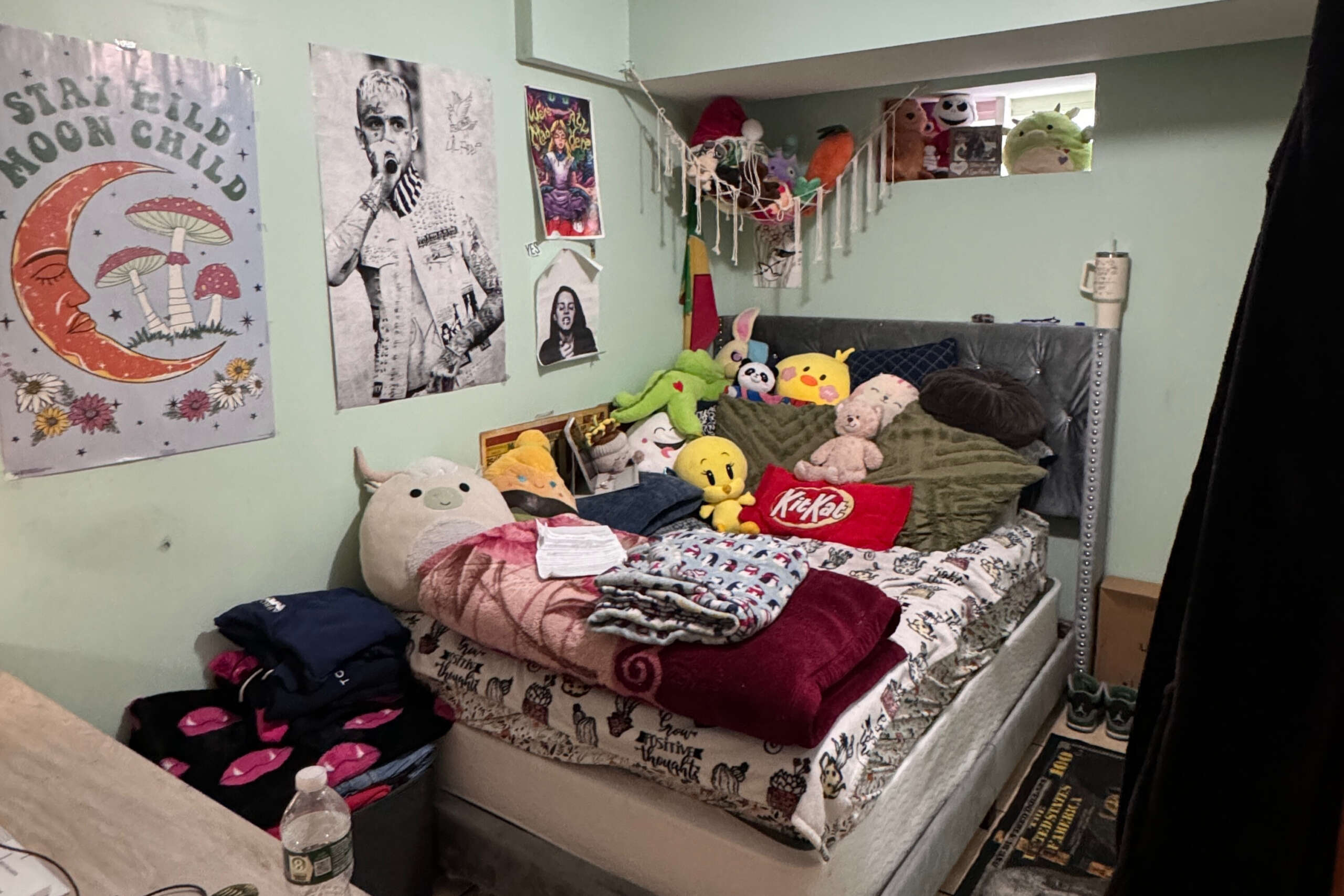
16-year-old Miranda’s (a pseudonym) bedroom inside the basement apartment where she lives her mother and sister. (Photo by Connor Patton)
This story was produced as part of a capstone reporting project at NYU’s Arthur L. Carter Journalism Institute, with editing by Professor Donna Borak.
Editor’s note: City Limits is using pseudonyms for the renters and homeowners in this story, who did not want to be identified by their real names for fear of jeopardizing their housing. Names that are pseudonyms are identified by an asterisk (*).
Thirty-five years ago, Sherri Singh* arrived in Queens from Trinidad with her mother and brother and settled in a basement apartment a few blocks from her current residence in South Ozone Park, paying only $450 a month for the space.
Today, she is the landlord to a single mother, Hannah,* who lives in the basement of Singh’s own duplex with her two daughters, and pays $1,500 a month for two bedrooms. The pristine white walls and almost full modern kitchen make the place look like a luxury apartment for a family tight on cash—if one doesn’t notice the two egress windows, only wide enough to fit a sitting Squishmallow plushie.
For renters like Hannah, a cramped basement is the only affordable option. Legal two-bedroom apartments in Queens average at least $2,700, but many surpass $3,000 a month.
“For the rent price of an upstairs apartment, we could probably just afford a one bedroom, but with two kids, we couldn’t have a one bedroom,” Hannah said.
“But with this space, we made it a home,” her 16-year-old daughter Miranda* added.
Basement apartments aren’t unique to the house Singh built with her husband more than a decade ago. She is confident almost everyone on her street rents their basements like she does, after years of watching a stream of new faces park walk down side doors at neighboring houses.
“I could rent my apartments for a lot of money [because] they’re nice,” Singh said. “But I believe a family willing to work and help out [should pay less] just like I got helped out when I came here.”
There are estimated to be more than 22,000 basements and cellars beneath residential buildings in South Ozone Park and South Jamaica, neighborhoods that have some of the highest concentrations of below-ground dwellings in the city, according to an analysis by Pratt Center for Community Development.
As the cost of living in New York City continues to rise, many homeowners in low-density neighborhoods in the outer boroughs rent their lower floors to New Yorkers looking for affordable options.
However, these spaces are largely illegal to rent due to safety codes requirements. And in recent years, increased flooding fueled by climate change—including 2021’s Hurricane Ida, which killed several people residing in converted underground units—highlight the risks of such homes.
Still, New York’s acute affordability crisis has pushed many low-income and immigrant New Yorkers to the brink, choosing to save money on rent despite the risks that come with unregulated units.
And while the city has made efforts to legalize underground apartments, like a pilot program in 2019 and another one upcoming, basement tenants and homeowners still feel left behind. Eye-catching headlines about city inspectors busting basements with more than 70 people living inside have created fear that they’ll be evicted next.
“We are both in the business of making sure that buildings are safe, and that is critically important, and wanting tenants who are living in illegal basements not necessarily to be immediately removed,” said Deputy Commissioner of Policy at the Department of Housing, Preservation, and Development (HPD), Lucy Joffe, during a conversation with student reporters last fall.
“We need a pathway [to basement legalization], so we actually can get in there, [and] have something that we can offer people that doesn’t just destroy a bunch of lives,” Joffe said.
Homes in the Cypress Hills neighborhood of Brooklyn, where the city ran a basement legalization pilot in 2019. (Photo by Adi Talwar)
Past basement legalization efforts
To bring basement renters out of the shadows, the de Blasio administration partnered with the community organization Cypress Hills LDC and launched a basement apartment pilot program in 2019 that would have legalized qualifying spaces in East New York and Cypress Hills.
The pilot temporarily lifted code restrictions that hampered basement apartment construction, like allowing cellar apartments and removing window dimension and ceiling height requirements.
However, zoning code rules and high construction costs still greatly limited the reach of the program. The average cost to upgrade a basement apartment through the East New York Pilot Program loomed around $275,000, an expensive venture for homeowners in a neighborhood where the median household income in 2022 was $56,510.
“It has been frankly a nightmare,” Vicki Been, former HPD commissioner and faculty director at the NYU Furman Center, said regarding the basement pilot. “It was unbelievably expensive because most of the time, you actually had to excavate under the basement and make it bigger and waterproof it.”
On top of the heavy price tag, more than a third of homeowners with basement apartments interested in applying were automatically disqualified from the program due to a zoning law that required a set number of parking spaces per unit. The parking requirement increased when legal basement apartments additions are turned a two-family home into a multi-family home.
Those rules have changed some in the years since. When the City Council adopted a modified version of the City of Yes plan in December, parking mandates were removed or reduced in certain neighborhoods, including some areas in the 2019 basement pilot.
But if the owners of two-family homes passed initial approval, they then faced another regulatory hurdle: a state-level Multiple Dwelling Law. This would force the now multi-family homes to add sprinkler systems, railings, and access to roofs, adding an additional $50,000 to $100,000 to the conversion costs, according to a report by the Citizens Housing Planning Council.
“One property might have three different straitjackets around it, one representing a set of regulations,” said Ryan Chavez, the director of the basement pilot program.
Jessica Katz, the city’s former chief housing officer, speaking at a rally in Jackson Heights in 2023 calling on the state to legalize basement and cellar units. (Photo by Adi Talwar)
Keeping quiet
After the 2019 pilot exposed the challenges to conversion, a coalition of tenant associations and city planners organized to demand legalization through the Basement Apartments Safe for Everyone (BASE) campaign. Leading participants include Cypress Hills LDC, which spearheaded the 2019 pilot program, and Chhaya CDC, a non-profit that educates and organizes South Asian tenants and homeowners in Queens.
Sadia Rahman is the deputy director of policy at Chhaya CDC and has been working with basement tenants for over a decade. While the non-profit supports immigrant families purchasing their first homes and tenants whose landlords refuse to make repairs, basement tenants facing eviction or unsafe living conditions have fewer available options.
“Usually the homeowner got fined…and they don’t want the risk any more of getting fined, and so they evict the tenant,” Rahman said. “But since these lease agreements aren’t legal and loosely written, we can [only] coach a tenant through how to buy time to find a new apartment in an eviction case.”
If tenants come to Rahman advocating for building repairs like leaky faucets or mold growing around their shower, she’d usually educate them on how to file a 311 report against their landlord. However, for basement dwellers, a call to 311 may lead to a Department of Buildings (DOB) or HPD inspector discovering their illegal living space, risking eviction. As a result, many opt to keep quiet for fear of outing themselves.
If caught, homeowners can face fines of $1,000 per day until the violation is resolved, fees that can amass up to $25,000. Rahman says most basement homeowners she’s encountered are in just as tough financial situations as their tenants. So when faced with a potential $25,000 fine or evicting someone paying less than $2,000 a month in rent, it makes sense for homeowners to kick their tenants to the curb if caught.
Still, many basement violations go unenforced. HPD had yet to follow up with 57 percent of the more than 1,700 vacate orders the agency issued to basement homeowners from 2020 to the end of 2024, and only 18 percent of those cases were closed during that time, according to an analysis of city data.
Graph by Connor Patton based on violations data from 2020 to the end of 2024.
In the same period, DOB received more than 57,000 complaints for illegal occupancy, which includes attics, garages, basements, and other illegal dwelling spaces.
When inspectors went to investigate these claims, homeowners refused to answer the door 63 percent of the time, the data shows. If an inspector is unable to gain access after their second inspection attempt, DOB can close the case. Only 6 percent of all complaints resulted in a violation being served against the homeowner, the data shows.
Graph by Connor Patton based on complaints data from 2000 to the end of 2024.
During a City Council hearing last fall, DOB First Deputy Commissioner Constadino Sirakis said the agency largely bases its underground enforcement on complaints from the public and the FDNY.
“Not necessarily every scenario involves a vacate [order]. A violation could be issued, but a vacate may not necessarily be in order, for instance, if egress is in order,” Sirakis told lawmakers at the time. “Other scenarios, though, would trigger maybe an automatic vacate for things such as illegal gas work that might be in connection with the additional dwelling unit.”
Skirting Inspections
Signh knows the art of avoiding the DOB. She is among those 63 percent of homeowners who faced an illegal occupancy violation and never answered the door to an inspector.
More than a decade ago, Singh returned home from work to find a DOB inspection notice on her door. Someone reported her for having “two illegal apartments in the cellar.” Since the notice was for Singh’s side of her duplex, and not the separate part she rented out, she obliged the inspectors who later knocked on her door, thinking she could out-maneuver them by only having to show half her property.
“I showed him the whole place,” Singh said. On her side of the duplex, she had two bedrooms in the basement for family or visitors, but never rented them out. “When they came and saw the two bedrooms, they said, ‘Oh, you’re not supposed to have this, the walls in between,’” Singh said. DOB imposed a violation and ordered her to remove the wall.
And while Singh says the agency never followed up, she eventually tore down the wall anyway to add more storage space.
When she was faced with another DOB inspection a few years later, this time on the side of the duplex she had been renting out, Singh never answered the door. DOB inspectors knocked on two occasions, records show, and following the department’s policy, they closed the case not long after.
In the roughly 15 years Singh has been renting out her basement, she’s had to keep up appearances to her neighbors. Leading up to her first DOB inspection, Singh had been renting her basement to an elderly couple for $1,200 a month. All was well until the couple moved in their son, then their daughter-in-law, and eventually their soon-to-be grandchild.
Singh didn’t want to raise alarm bells with her neighbors, who would have to compete for parking spots with her growing household. And fitting five people in a two-bedroom basement was too nerve-racking. “We didn’t want to overcrowd it,” Singh said. “I didn’t want to risk things happening.” She asked the family to leave, and says one of them sought retribution by reporting her to the city.
She says maintaining a cordial relationship between neighbors and tenants is paramount to avoiding violations. And her current tenants said they are confident in their living situation. “We have a good relationship with Sherri,” said Hannah, her basement tenant. “So [vacate orders and evictions] are not something I’m worried about.”
The only window in Jane Smith’s (a pseudonym) basement, located across from the room she rents to a tenant. (Photo by Connor Patton)
Tales from a cramped apartment
In neighboring Woodhaven, 65-year-old Jane Smith’s* face turned pale as she walked to work beneath the J/Z subway tracks running along Jamaica Avenue one day last fall. In stunned silence, Smith stared at a black DOB inspection car stopped at a red light, waiting to turn down a side street with no space to park.
“Whose life are they f—ing up today?” Smith asked herself, relieved to see the car pass her street. After her son moved out about a decade ago, Smith converted part of the first floor of her Victorian home into a one-bedroom apartment and the third floor into a two-bedroom apartment.
In the basement, beneath creaky wooden floorboards and tucked up against the home’s boiler, lives Mary,* a 60-year-old cook.
Mary’s basement apartment is approximately 20-by-10 feet, and barely holds enough space for a full-sized bed and kitchenette with an electric stove, mini-fridge, sink, and counter. There’s little room to walk around.
The living space makes up only a fraction of the basement, which holds Mary’s only personal belongings—piles of clothes strewn around a mostly empty dresser—along with Smith’s cleaning supplies, and the aftermath of the grey house cat’s mouse-hunting escapades. A side door up five steps and an egress window held open by an Amazon package, just wide enough to fit her dogs, are the only means of escape in case of an emergency.
In a neighborhood where the average rent for a one-bedroom apartment is more than $1,700 a month, Smith charges Mary $800. Mary’s rarely home, since she commutes nearly two hours by bus across the borough to her eight-hour cooking shifts, but she’s still like family, according to Smith.
Smith says she’s also built trust with her neighbors by giving them advice for challenging building violations like the one she says was mistakenly imposed on her roughly 20 years ago for a supposedly improper plumbing set-up.
While she has no worries about neighbors reporting her, Smith told City Limits last fall that contractors who’d recently installed solar panels on her roof told her she’d have to let DOB inside to inspect the electrical panel beside Mary’s door.
When the inspectors arrived months later, Smith temporarily removed the stove from Mary’s room out of caution. The inspectors didn’t ask any questions and finished their work on Smith’s electrical changes, but the visit still made her nervous.
“I’ve lost some sleep over that,” Smith said.
According to Rahman from Chhaya CDC, most basement tenants find their spaces through friends and family, which is true for both Singh and Smith. Hannah was a friend of Singh’s daughter, and Smith found Mary through a realtor friend named John Murphy.*
Dealing with basement apartments is illegal, and most realtors don’t touch them for fear of getting caught, Murphy said. But he feels an obligation to help low-income tenants when selling a home on behalf of their landlord.
“When you sell a house, 95 percent of the time, people want that house swept and empty, they don’t want to inherit any tenants,” said Murphy. “Sometimes all [those tenants] can afford is basements.”
That’s how Mary found Smith. While selling the home where Mary had been living on the first floor, Murphy felt called to find the shy tenant a new home, since she had little money and connections.
While many find their basement abodes through friends and relatives, others urgently seeking apartments to rent turn to Craigslist or Facebook. Scouring neighborhood-specific and “apartments for rent” Facebook Groups can land eager New Yorkers a basement apartment ready to rent in just a few days for prices as low as $850, a recent review of listings show.
What’s next?
As New Yorkers keep moving into underground apartments for the cheapest rents, Rahman and her BASE campaign spent more than three years lobbying the New York State Legislature to pass a bill legalizing such units across the city.
After conversations and negotiations with lawmakers, the State Legislature approved funding for a pilot program last year, which will lift some zoning and code restrictions like the Multiple Dwelling Law for basement apartment owners interested in legalizing their units.
The pilot will launch in 15 community districts across the city, but housing advocates like Rahman had hoped for an initiative accessible to every New Yorker, and claim the downsized pilot prioritizes more affluent neighborhoods with few basement apartments.
Queens Community District 2, which covers Long Island City, is the only district in Queens included, even though the borough overall is home to an estimated 39 percent of New York’s total basement apartments, according to THE CITY.
“It’s unclear how the 15 districts were selected,” Rahman said.
Other BASE campaign affiliates, like Chavez from the 2019 Basement Apartment Pilot Program, claim that some state officials removed neighborhoods from the pilot because of their personal opposition to the initiative. City Limits reached out to a number of state reps in Eastern Queens, though none responded to requests for comment.
“It came down to back-door negotiations where some lawmakers didn’t want this in their neighborhood,” Chavez said. “We need to take this up again in Albany and make sure that the neighborhoods and communities that are covered by this state reform include those that have the most basement apartments.”
While the BASE campaign continues pressing for a more inclusive program, the City Council approved a bill in November outlining the eligibility and code changes for the upcoming pilot. This comes as the Council also approved Mayor Eric Adams’ City of Yes housing plan, which promises to construct 80,000 new homes over the next 15 years.
Landlords renting their basements since April 20, 2024, will be to apply with the city to convert them into legal units. The basements must not pose an imminent risk to the tenant’s safety or life, have at least one smoke and carbon monoxide detector, and contain at least one means of escape outdoors, preferably a door leading directly outside.
Mayor Adams signed the bill into law in December, and eligible homeowners have until 2029 to apply, according to the text of the legislation (HPD did not immediately respond to a query seeking an update on the program Wednesday). While Singh and Smith are eager to make their basement apartments legal, for now, that’s not an option, since their homes are outside the pilot’s boundaries.
Besides the program’s limited geographic boundaries, questions over funding and the city’s commitment to implementing the initiative linger.
“It is critical to accompany these legislative changes with a robust public loan and grant program, which should be paired with rental affordability requirements,” Chavez told the City Council during a meeting last fall.
“Without financial support, homeowners of modest means simply will not be able to afford the upgrades necessary to bring them into compliance,” he added.
To reach the editor, contact Jeanmarie@citylimits.org
Want to republish this story? Find City Limits’ reprint policy here.
The post Navigating NYC’s Housing Crisis Through Basement Living appeared first on City Limits.