By ALANIS THAMES, Associated Press
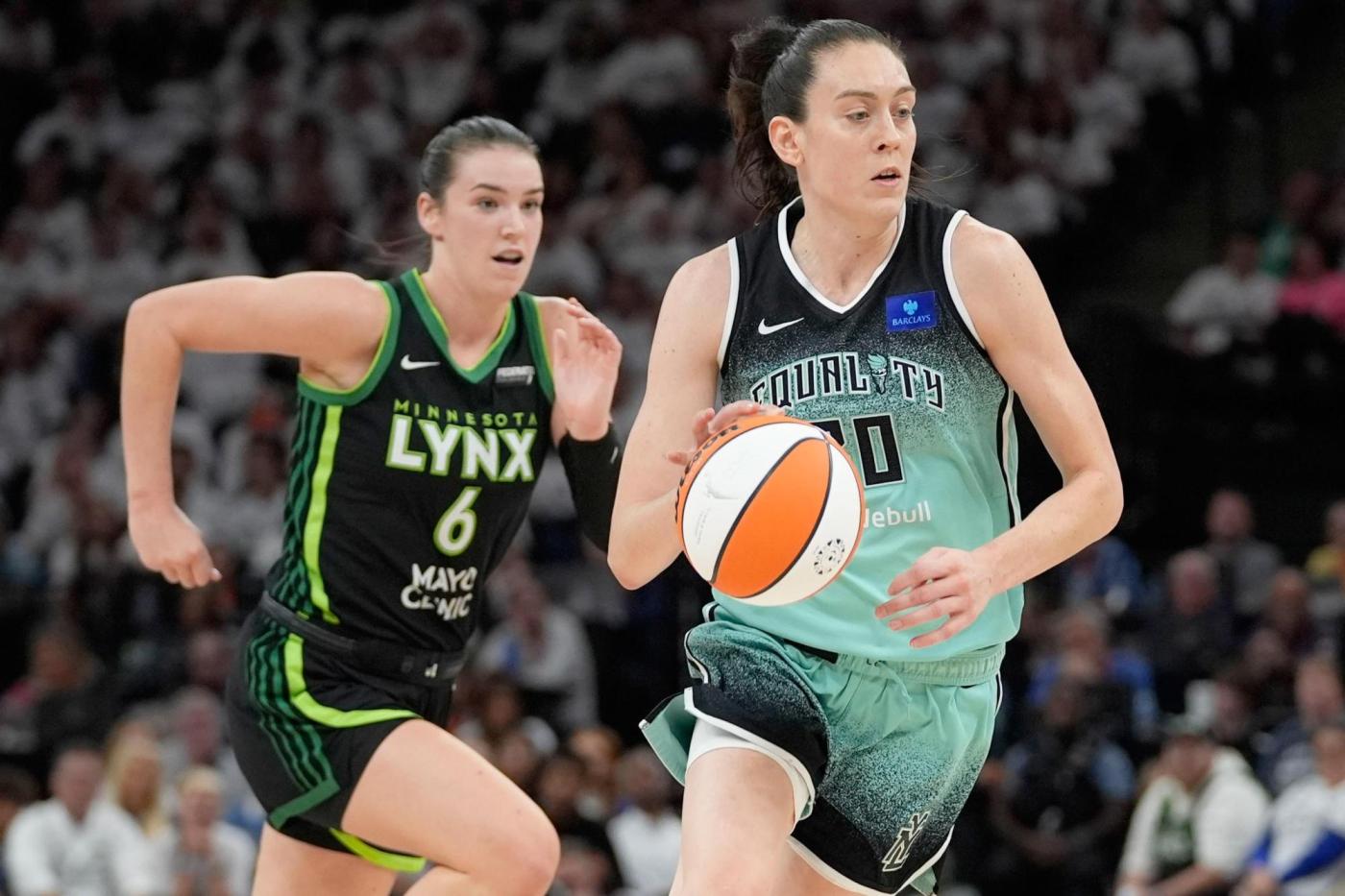
Breanna Stewart will start her ninth WNBA season in a few days. The New York Liberty All-Star and WNBA champ has been around the league long enough to watch her peers fight for visibility. She’s seen only a small uptick in player salaries over the years amid the WNBA’s meteoric rise in popularity.
Stewart has been a part of negotiations for two collective bargaining agreements as a member of the WNBA’s players union. A third round of negotiations is ongoing, perhaps the most important of Stewart’s career. By the end, she hopes to see player salaries grow to unprecedented numbers.
“It’s been going up incrementally,” Stewart said. “But hopefully with the new TV deal that’s coming, it’ll really kind of boost itself into a category of its own.”
That’s what WNBA players were hoping for when they opted out of the current CBA two years before its expiration. The WNBA is bringing in more money than ever from sponsors and ticket sales, and will bring in much more from its 11-year media rights deal, worth around $200 million per year starting in 2026.
With its expanding reach, the WNBA’s progress has come in a few areas: More teams are being added to the league, meaning more roster spots. Full-time charter flights were added last season after years of players lobbying for better travel.
But as the league booms, players are looking for a larger share in that growth. WNBA players currently earn only a small fraction of the league’s revenue share.
Player salaries have been a longstanding point of contention between the NBA — which owns about 60% of the WNBA and leads CBA negotiations — and women’s basketball players. It’s one of the biggest financial hurdles the league still faces, and players have said they’re willing to sit out games if negotiations don’t lead to a pay structure they feel is fair.
“The talent is there, the product is there,” Dallas Wings guard Arike Ogunbowale said. “Now we need to be compensated for it.”
The current WNBA CBA, which was signed before the 2020 season, boosted the maximum salaries for star players from $117,500 in 2019 to $215,000 in 2020.
FILE – Indiana Fever guard Caitlin Clark (22) plays against the Dallas Wings in the second half of a WNBA basketball game in Indianapolis, Sunday, Sept. 15, 2024. (AP Photo/Michael Conroy, File)
But that was long before the league’s recent popularity burst, before star players like Caitlin Clark and Angel Reese brought in record numbers of fans.
“The league has only soared since” 2020, said Risa Isard, an assistant sports management professor at UConn. “And so this is the chance for the players to kind of recoup all of the value that they’ve produced in the last five years that they hadn’t gotten to see themselves so directly.”
What WNBA players are paid compared to NBA players
Paige Bueckers, the No. 1 pick in last month’s WNBA draft, signed a rookie deal that will be worth just over $78,000 in base salary, which is around what Clark received as the No. 1 pick a year ago. They’ll make much more in marketing deals and performance bonuses.
Dallas Wings guard Paige Bueckers poses for photos during a WNBA basketball media day in Arlington, Texas, Wednesday, May 7, 2025. (AP Photo/LM Otero)
Both are considered generational talents. Both are regarded as franchise-altering players. Both will make significantly less in base salary than most players in other leagues who have been just as hyped for their potential to change the trajectory of their teams.
That’s true for established stars like Stewart and three-time MVP A’ja Wilson, too. Players of their caliber can make at most around $240,000.
FILE – Las Vegas Aces center A’ja Wilson (22) plays against the Seattle Storm in Game 2 of a WNBA basketball first-round playoff game Tuesday, Sept. 24, 2024, in Las Vegas. (AP Photo/John Locher, File)
The minimum salary for NBA players is $1,157,153. Victor Wembanyama, the superstar San Antonio Spurs center drafted No. 1 in 2023, earned $12.2 million as part of his $55 million rookie contract.
The NBA’s numbers are much bigger in part because of the huge difference in profit margins of both leagues. The NBA generated around $11 billion in revenue last season. The WNBA does not publicly release its revenue numbers, though Bloomberg reported the league made around $200 million in 2023.
WNBA player salaries are also significantly less than what the NBA paid its players when it last generated around $30 million — $200 million today, when adjusted for inflation — in the early 1970s, said David Berri, an economics professor at Southern Utah University. It’s top players then were making around $300,000, which today would be roughly $2 million, he said.
“They’re paying the women today so very, very little relative to what they were paying the men 50 years ago,” Berri added, “and the explanation of that to me, (is) you’re obviously just treating the women differently than the men.”
How much WNBA player salaries could increase
How much of a salary increase players receive remains to be seen. Berri said a 50% share of $200 million revenue earnings would equal an average player salary of at least $1 million, with max salaries going anywhere from $3 million to $5 million.
That’s easier said than done, he added.
Chicago Sky forward Angel Reese (5) shoots against Brazil forward Manu Alves (21) in the second half a WNBA exhibition basketball game in Baton Rouge, La., Friday, May 2, 2025. (AP Photo/Gerald Herbert)
“Is the NBA going to acknowledge how little they were paying them?” Berri said, “and suddenly just come out with an agreement and say, ‘Oh, we’re going to pay you $5 million now?”
No WNBA player has ever earned close to $1 million in salary, but Stewart said reaching that number could set an important precedent.
“There are players in this league that are valued at more than $1 million,” Stewart said. “That’s just the reality of what it is. But for everyone else, seeing that number and realizing that, OK — now by that point, the league will be probably 30 years into it — and look what we’ve done.”
Pros and cons of WNBA players sitting out games
CBA negotiations have never led to WNBA players sitting out games, and many are hoping that it doesn’t come to that point.
Related Articles
WNBA set to tipoff season with host of teams looking to challenge for title including Clark’s Fever
Wild sign Russian prospect Danila Yurov to entry-level contract
Loons vs. St. Louis City: Trends for match, projected XI and a prediction
Minnesota United’s Joaquin Pereyra touched by Lionel Messi’s ‘humility’
WNBA set for new season with Caitlin Clark and Angel Reese leading the way
Though the WNBA, which is only 29 years old, has experienced a financial boom, it is still very small in terms of revenue compared to the NBA, which has been around for 80 years. That means WNBA players’ leverage is limited if they decide to sit out games, Berri said.
“Because if you walk off the job and don’t show up, the owners, the NBA owners are like, you’re actually not costing me much money,” he added.
Berri pointed to the U.S. women’s national soccer team’s fight for equal pay as a blueprint for potential success. Many of those players constantly brought attention to the gender pay gap in soccer through the media and their own online accounts. It ended in the U.S. House passing an equal pay bill in 2022, and Berri expects WNBA players could use similar methods.
If players do decide to sit out games, Isard, the UConn professor, said it wouldn’t be surprising given their history of standing up for causes they believe in.
“Often, they’re really selfless in what those causes are,” Isard said, “and they’re looking out for everyone and anyone else and the community, and what is happening in the Senate race, and what’s happening in reproductive justice and what’s happening in gun legislation — so many ways that they stand up for so many populations across this country.
“And I guess when I hear them say, ‘We would consider that,’ What I hear them say is, ‘Why wouldn’t we stand up for ourselves? We stand up for everyone. So us, too.’”
AP Basketball Writer Doug Feinberg and AP Sports Writer Stephen Hawkins contributed to this report.