Democrats are deeply pessimistic about the future of their party, an AP-NORC poll finds

posted in: All news | 0

By STEVE PEOPLES and LINLEY SANDERS

NEW YORK (AP) — Six months after Donald Trump’s presidential victory, Democrats remain deeply pessimistic about the future of their party, although neither the Democratic Party nor the Republican Party is viewed favorably by a majority of U.S. adults.

Related Articles


Democratic congressman pushes articles of impeachment against Trump, but colleagues criticize it


Funds from migrants sent back home help fuel some towns’ economies. A GOP plan targets that


EPA announces rollback for some Biden-era limits on so-called forever chemicals in drinking water


Trump’s Middle East visit comes as his family deepens its business, crypto ties in the region


Trump administration rescinds curbs on AI chip exports to foreign markets

A new poll conducted earlier this month by The Associated Press-NORC Center for Public Affairs Research found that only about one-third of Democrats are “very optimistic” or even “somewhat optimistic” about their party’s future. That’s down sharply from July 2024, when about 6 in 10 Democrats said they had a positive outlook.

“I’m not real high on Democrats right now,” said poll respondent Damien Williams, a 48-year-old Democrat from Cahokia Heights, Illinois. “To me, they’re not doing enough to push back against Trump.”

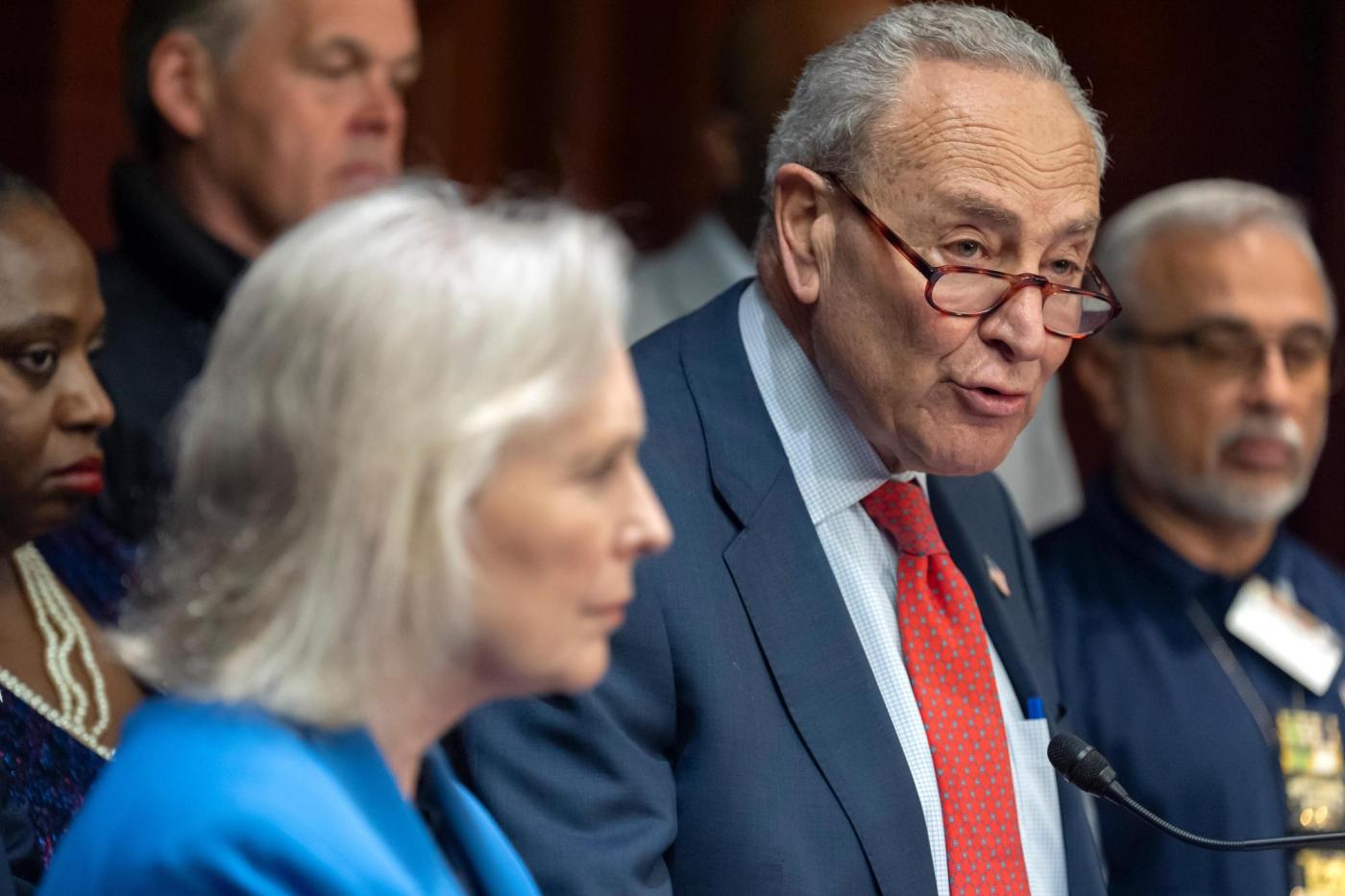
The poll comes at a critical moment for the Democratic Party, which is desperately seeking momentum after losing the White House and both chambers of Congress in last fall’s general election. In the survey, Democrats offer mixed reviews for some of their party’s best-known elected officials — including Senate Democratic leader Chuck Schumer and Rep. Alexandria Ocasio-Cortez, both of New York — while reporting significant concerns about how leaders are chosen in the U.S. political system.

Williams, a member of the Teamsters union, said he likely won’t feel good about his party again “until somebody steps up in terms of being a leader that can bring positive change — an Obama-like figure.”

Republicans, meanwhile, are slightly more optimistic about the future of the GOP than they were last year.

The poll finds that about half of Republicans, 55%, are very or somewhat optimistic about their party’s future, up from 47% last summer. Still, only about 3 in 10 Republicans are optimistic about the state of U.S. politics, up from about 1 in 10 last summer.

Patrick Reynolds, a 50-year-old Republican community activist and pastor from Fort Worth, Texas, says he has conflicting feelings about Trump’s leadership and the future of his party.

He worries that too many Republicans in Congress are falling in line behind the Republican president and his chief ally and adviser, Elon Musk, who has led Trump’s push to slash the size of the federal government. Reynolds also says he’s concerned that Trump’s aggressive moves to combat illegal immigration may be violating the Constitution.

“How can we be the party of the rule of law when we’re violating constitutional principles?” Reynolds said. “I think there could be a (political) backlash.”

Neither political party is especially popular right now.

Overall, about 4 in 10 U.S. adults have a favorable view of the Republican Party while about one-third have a positive view of the Democratic Party.

This relatively weak support extends to some of each party’s most prominent officials.

Roughly 4 in 10 Americans have a favorable view of Bernie Sanders, a Vermont independent who has twice run for the Democratic presidential nomination and has toured the nation in recent months rallying anti-Trump resistance. Among self-described Democrats, about three-quarters view Sanders favorably.

About half of Democrats have a favorable view of Ocasio-Cortez, who has joined Sanders on the “Fighting Oligarchy” tour. She is less popular among U.S. adults overall — about 3 in 10 have a favorable opinion of the 35-year-old representative, who is sometimes mentioned as a potential presidential candidate in 2028.

Rep. Alexandra Ocasio-Cortez, D-N.Y., holds hands with Sen. Bernie Sanders, I-Vt., during a “Fighting Oligarchy” event at the Ford Idaho Center in Nampa, Idaho, Monday, April 14, 2025. (AP Photo/Kyle Green)

Schumer, the top Senate Democrat, is less popular than Sanders or Ocasio-Cortez.

Just about one-third of Democrats have a somewhat or very favorable view of the 74-year-old senator, who took a hit from many liberals for acceding to a Republican-led funding bill that kept the government open. The share of Democrats who view Schumer positively has fallen since December 2024, when about half had a somewhat or very favorable view. Among all adults, his favorability stands at 21%.

“I just feel like the majority of the old Democratic Party needs to go,” said Democrat Monica Brown, a 61-year-old social worker from Knoxville, Tennessee. “They’re not in tune with the new generation. They’re not in tune with the new world. We’ve got such division within the party.”

On the GOP side, Secretary of State Marco Rubio, a former Florida senator, is more popular than several other high-profile Republicans.

About 6 in 10 Republicans view Rubio favorably, although that number falls to about one-third among all adults. About half of Republicans have a positive opinion of House Speaker Mike Johnson of Louisiana, while around one-quarter of U.S. adults feel the same. That’s roughly the same level of support for Defense Secretary Pete Hegseth, a former Fox News Channel host who earns favorable ratings from 44% of Republicans and about one-quarter of Americans overall.

Beyond their negative outlook on the future of their party, 55% of Democrats are also pessimistic about the way leaders are chosen in the U.S. The figure is up slightly from 46% last summer, when President Joe Biden was still in the White House.

Ethan Jackline, sits next to a flag planted by a friend as they attend a ‘Fighting Oligarchy’ rally with Sen. Bernie Sanders (I-VT) and Rep. Alexandria Ocasio-Cortez (D-NY) in Folsom, Calif., Tuesday, April 15, 2025. (Stephen Lam/San Francisco Chronicle via AP)

Linda Sleet, a 69-year-old retiree who lives in Venice, Florida, raised specific concerns about the way congressional districts are drawn and the Electoral College that is used to determine presidential contests instead of the popular vote.

“I don’t have confidence in the system,” Sleet said. “I think it served a purpose way back when. It does not now.”

Williams, the Teamster from Illinois, said he’s unhappy with just about everything to do with U.S. politics.

“I’m going to need to see some wins for America, for humanity, before I can be optimistic right now,” he said. “Every day is just a constant barrage of negative feelings and news politically. It’s all screwed up right now.”

Sanders reported from Washington.

The AP-NORC poll of 1,175 adults was conducted May 1-5, using a sample drawn from NORC’s probability-based AmeriSpeak Panel, which is designed to be representative of the U.S. population. The margin of sampling error for adults overall is plus or minus 4 percentage points.


A still-unfolding diplomatic road seeking peace in Ukraine has had many twists and turns

posted in: All news | 0

By KATIE MARIE DAVIES

It was a weekend of diplomatic announcements on the war in Ukraine.

First, European leaders assembled in Kyiv on Saturday with President Volodymyr Zelenskyy to put pressure on Russian President Vladimir Putin for a ceasefire. Then, after midnight, the Kremlin leader surfaced in Moscow to unveil a proposal for talks in Istanbul, Turkey.

If both Putin and Zelenskyy sit down with each other, it would be a first in the 3-year-old war.

Key events that have shaped efforts to end the war since Russia invaded Ukraine on Feb. 24, 2022:

Feb. 28, 2022: Ukrainian and Russian delegations meet in neighboring Belarus for the first time after the invasion. Talks continue over the next two weeks, but no apparent agreements emerge other than a decision to set up humanitarian corridors for civilians.

March 21, 2022: Zelenskyy calls for direct talks with Putin but is rebuffed by Russian Foreign Minister Sergey Lavrov. A day later, Zelenskyy says he is prepared to discuss a commitment for Ukraine to not to seek NATO membership in exchange for a ceasefire, the withdrawal of Russian troops and a guarantee of Ukraine’s security.

March 29, 2022: Talks begin in Istanbul, Turkey, with Moscow saying it’s willing to “fundamentally cut back” military activity near Kyiv and the northern city of Chernihiv, while Ukraine said it was open to discussing neutral status for Ukraine if its security is backed by other nations.

April 7, 2022: Lavrov rejects a Ukrainian peace proposal as “unacceptable. ” He says Kyiv has walked back on an agreement to exempt the Crimean Peninsula from wider Ukrainian security guarantees. Russia illegally annexed Crimea in 2014.

April 26, 2022: U.N. Secretary-General António Guterres visits Russia to discuss ending the war.

May 13, 2022: U.S. Defense Secretary Lloyd Austin calls his Russian counterpart, Sergei Shoigu, in their first contact since before the start of the war.

July 22, 2022: Russia and Ukraine, with mediation by Turkey and the U.N., agree on a deal to unblock supplies of grain stuck in Ukraine’s Black Sea ports, ending a standoff that threatened global food security. The deal expires a year later.

Sept. 22, 2022: Zelenskyy addresses the U.N. General Assembly, laying out five “nonnegotiable” conditions, including a “just punishment” for Russia.

Sept. 30, 2022: Russia illegally annexes the Ukrainian regions of Donetsk, Luhansk, Zaporizhzhia and Kherson, even though it doesn’t fully control any of them. Ukraine responds by applying to join NATO and by enacting a decree that declares negotiations with Putin “impossible”.

Nov. 15, 2022: Zelenskyy unveils a 10-point peace plan at the G20 summit in Bali.

June 25, 2023: Officials from 15 countries, including the U.S., the European Union, India, Brazil, South Africa, Saudi Arabia, and Turkey meet in Copenhagen, Denmark, to discuss Zelenskyy’s peace plan.

Aug. 5, 2023: Two days of discussions on the war begin in Saudi Arabia with delegates from 40 countries, but not Russia. No joint statements are issued.

Oct. 28, 2023: Delegates from 65 countries meet in Malta to continue talks on Zelenskyy’s peace plan. Russia, which has dismissed the talks, was not invited.

June 15, 2024: Representatives of 92 nations meet in Nidwalden, Switzerland, to discuss Ukraine’s peace plan. Despite the growing number of delegates, a consensus remains elusive. The summit’s final statement is backed by most – although not all – participants.

Dec. 7, 2024: U.S. President-elect Donald Trump travels to Paris and meets Zelenskyy and other European leaders.

Feb 12. 2025: Trump and Putin speak directly via telephone and agree to begin negotiations on ending Ukraine war in a phone call that abruptly ended a three-year U.S.-led effort to isolate Putin over Ukraine.

Feb. 18, 2025: Russian and U.S. officials, including Lavrov and U.S. Secretary of State Marco Rubio, meet in Saudi Arabia and agree to work toward ending the war, as well as restoring bilateral ties. Ukrainian officials are not invited.

Feb. 28, 2025: Zelenskyy meets with Trump, Rubio and Vice President JD Vance in the White House but tensions break out in the Oval Office and a proposed minerals deal between the countries is left unsigned.

March 11, 2025: U.S. and Ukrainian officials meet in Saudi Arabia, with American officials putting forward a plan for a 30-day ceasefire. Kyiv agrees to the proposed truce.

March 13, 2025: Putin effectively rejects the ceasefire plan, stating certain issues still must be resolved. He also meets with U.S. envoy Steve Witkoff in Moscow. Witkoff would travel to Russia two more times in April to meet Putin.

March 18, 2025: A proposal is put forward for a temporary halt on strikes on energy infrastructure. Both sides agree to the plan, but soon accuse each other of violations, and the measure later expires.

April 19, 2025: Putin announces a 30-hour ceasefire to mark the Easter holiday, although attacks continue across Ukraine.

April 28, 2025: The Kremlin declares a unilateral 72-hour ceasefire starting May 8 to mark Russia’s Victory Day celebrating the defeat of Nazi Germany in World War II. Kyiv does not agree, preferring a 30-day truce proposed by U.S. officials. Both sides accuse each other of violating it.

May 10, 2025: French President Emmanuel Macron, British Prime Minister Keir Starmer, German Chancellor Friedrich Merz and Polish Prime Minister Donald Tusk meet with Zelenskyy in Kyiv and urge Russia to enact a 30-day truce starting May 12.

May 11, 2025: Putin proposes restarting direct talks with Ukraine in Istanbul on May 15, “without preconditions,” but does not agree to the 30-day ceasefire Zelenskyy challenges Putin to meet personally in Turkey.

May 12, 2025: Trump says he is “thinking about flying over” to Turkey for the talks after his visit to Qatar and the United Arab Emirates but later says Rubio and other U.S. officials will go.

May 13, 2025: Ukrainian presidential adviser Mykhailo Podolyak says Zelenskyy won’t meet with any representative of Russia in Turkey except for Putin. Zelenskyy says he and Turkish President Recep Tayyip Erdogan will wait for Putin in Ankara, adding: “If Putin does not arrive and plays games, it is the final point that he does not want to end the war.”

Newark problems and recent crashes put focus on air traffic controller shortage and aging equipment

posted in: All news | 0

By JOSH FUNK

The recent chronic delays and cancellations at New Jersey’s largest airport have highlighted the shortage of air traffic controllers and the aging equipment they use, which President Donald Trump’s administration wants to replace.

The Federal Aviation Administration is working on a short-term fix to the problems at the Newark airport that includes technical repairs and cutting flights to keep traffic manageable while dealing with a shortage of controllers. Officials are meeting with all the airlines that fly out of Newark starting Wednesday to discuss the plan.

But even before those problems, aviation was already in the spotlight ever since the deadly midair collision of a passenger jet and a U.S. Army helicopter above Washington, D.C., in January, and a string of other crashes and mishaps since then. The investigations into those crashes continue while the U.S. Department of Transportation tries to make progress on the long-standing issues of not having enough air traffic controllers and relying on outdated equipment. A U.S. Senate hearing Wednesday morning will focus on the FAA’s efforts.

What happened in Newark?

Twice in the past two-and-a-half weeks, the radar and communications systems that air traffic controllers in Philadelphia who direct planes in and out of Newark rely on failed for a short time. That happened because the lines that carry the radar signal down from another FAA facility in New York failed, and the backup system didn’t work immediately.

So the controllers were left unable to see or talk to the planes around Newark Liberty International Airport for as long as 90 seconds on April 28 and May 9. The lines — some of which were old copper wires — failed a third time on Sunday, but that time the backup system worked and the radar stayed online.

But the first one of those stressful situations prompted five to seven controllers to take a 45-day trauma leave, and that worsened the existing staff shortage at the Philadelphia control facility, prompting the FAA to limit the number of flights in Newark each day.

The FAA currently has 22 fully certified air traffic controllers and five supervisors assigned to Newark in the Philadelphia facility, but the agency wants to have 38 controllers there. Another 21 controllers are in training there, and 10 of them are certified on at least part of the area.

What has been done in Newark?

The FAA quickly limited the number of flights in Newark to between 24 and 28 arrivals and the same number of departures every hour to make sure the remaining controllers could handle them safely. At times when controller staffing is especially lean, like Monday, the FAA is limiting traffic even further. Before the problems, 38 or 39 flights would take off and land every hour in Newark.

The meetings FAA officials are having with all the airlines starting Wednesday are focused on a plan that continues limiting takeoffs and landings to no more than 28 apiece an hour until at least mid-June. By then, a runway construction project should be wrapped up, and the controllers who took trauma leave would be scheduled to return. After that, the FAA has said it might be able to bump up the limit to 34 arrivals and 34 departures an hour.

Meanwhile, the number of flights a day must be cut because the airport can’t handle everyone on the schedule. That’s why Newark has generally led the nation in cancellations and delays in recent weeks. After the FAA meets with the airlines, it will give them a couple of weeks to submit information in writing, so it won’t issue a decision before May 28.

The FAA has been able to install new fiber optic lines at Newark airport and the two other major airports in the New York area — Kennedy International and LaGuardia — but those are still being tested and won’t come online until the end of the month. Officials were able to update some computer software last week that kept the radar from going offline a third time on Sunday when the primary line failed yet again.

Longer-term, the FAA is also planning to build a new radar system in Philadelphia, so that controllers there won’t have to rely on the signal piped down from New York anymore. But that might not be done for months, although officials are working with contractors to speed up that project.

Why not hire more controllers?

The FAA has been working for a long time to hire more air traffic controllers to replace retiring workers and handle the growing air traffic. But it can be hard to find good candidates for the stressful positions, and it takes years to train controllers to do the job.

Transportation Secretary Sean Duffy has made several moves to try to hire more controllers. The FAA is trying to shorten the time it takes between when someone applies to the air traffic controller academy in Oklahoma City and when they start, and the agency is also trying to improve the graduation rate there by offering more support to the students. The candidates with the highest scores on the entrance exam are also getting top priority.

The FAA is also offering bonuses to experienced controllers if they opt not to retire early and continue working to help ease the shortage.

More high-tech simulators are also being used at airports across the country, including Newark, to train air traffic controllers. The FAA said Tuesday that controllers tend to complete training more quickly when they use one of the 111 simulators it has.

“These new simulators give air traffic control trainees a high-tech space to learn, develop and practice their skills,” said acting FAA Administrator Chris Rocheleau.

What about the outdated equipment?

The Transportation Department plans to ask Congress for billions and billions of dollars to pay for an overhaul of the air traffic control system nationwide to replace the 618 radars, install 4,600 new high-speed connections and upgrade all the computers controllers use. The exact price tag hasn’t been determined.

Chris Rocheleau, acting administrator of the Federal Aviation Administration, left, and Transportation Secretary Sean Duffy, right, speak about a new air traffic control infrastructure plan, Thursday, May 8, 2025, in Washington. (AP Photo/Julia Demaree Nikhinson)

Duffy blames former President Joe Biden’s administration for failing to upgrade the air traffic control system, but Congress first recognized the system was struggling to keep up with the growing number of flights as far back as the 1990s, so the problems go back decades — long before the Biden or first Trump administrations. Biden’s former Transportation Secretary Pete Buttigieg has defended their efforts to upgrade some of the technology and expand air traffic controller hiring.

Some of the decades-old computer equipment that controllers rely on was on display at last week’s news conference about the plan, which has drawn broad support from more than 50 groups across the industry. Duffy has used an assortment of colorful metaphors to emphasize how old the equipment is, saying the gear looks like it came off the set of the movie “Apollo 13” and comparing it to a 1967 Volkswagen Beetle.

2-year-old girl reunites with her mother in Venezuela after US deportation

posted in: All news | 0

CARACAS, Venezuela (AP) — A 2-year-old girl arrived Wednesday in Caracas to reunite with her mother after she was separated from her parents when they were deported from the U.S. in what Venezuela denounced as a kidnapping.

Related Articles


A pregnant Cuban emigre worries about her baby’s citizenship as Supreme Court weighs a Trump order


Funds from migrants sent back home help fuel some towns’ economies. A GOP plan targets that


Federal grand jury indicts Wisconsin judge in immigration case, allowing charges to continue


Federal judge OKs use of Alien Enemies Act to deport Venezuelans who are labeled gang members


Family of US-born child deported to Honduras drops lawsuit against Trump administration

Maikelys Espinoza arrived at an airport outside the capital, Caracas, along with more than 220 deported migrants. Footage aired by state television showed Venezuela’s first lady Cilia Flores carrying Maikelys at the airport. Later, Flores was shown handing the girl over to her mother, who had been waiting for her arrival at the presidential palace along with President Nicolás Maduro.

“Here is everyone’s beloved little girl. She is the daughter and granddaughter of all of us,” Maduro said.

The U.S. government had claimed the family separation last month was justified because the girl’s parents allegedly have ties to the Venezuelan-based Tren de Aragua gang, which U.S. President Donald Trump designated a terrorist organization earlier this year.

The girl’s mother was deported to Venezuela on April 25. Meanwhile, U.S. authorities sent her father to a maximum-security prison in El Salvador in March under Trump’s invocation of an 18th-century wartime law to deport hundreds of immigrants.

For years, the government of Maduro had mostly refused the entry of immigrants deported from the U.S. But since Trump took office this year, hundreds of Venezuelan migrants, including some 180 who spent up to 16 days at the U.S. naval base in Guantanamo Bay, Cuba, have been deported to their home country.

The Trump administration has said the Venezuelans sent to Guantanamo and El Salvador are members of the Tren de Aragua, but has offered little evidence to back up the allegation.

Maduro on Wednesday thanked Trump and his envoy for special missions, Richard Grenell, for allowing Maikelys to reunite with her mother in a “profoundly humane” act. Grenell met with Maduro in Caracas shortly after Trump took office.

“There have been and will be differences, but it is possible, with God’s blessing, to move forward and resolve many issues,” Maduro said, alluding to the deep divisions between his and Trump’s governments. “I hope and aspire that very soon we can also rescue Maikelys’ father and the 253 Venezuelans who are in El Salvador.”

Follow AP’s coverage of Latin America and the Caribbean at https://apnews.com/hub/latin-america