By Anna Claire Vollers, Stateline.org
MONTGOMERY, Ala. — Tara Campbell unlocked the front door of the Bricklayers Hall, a no-frills brick building on South Union Street in downtown Montgomery, half a mile from the white-domed Alabama Capitol.
She was dressed in leggings, a T-shirt and bright blue running shoes. It was 8 a.m. on a Saturday, and she exuded the bouncy enthusiasm of a Zumba instructor as she welcomed the handful of Black women who’d just arrived.
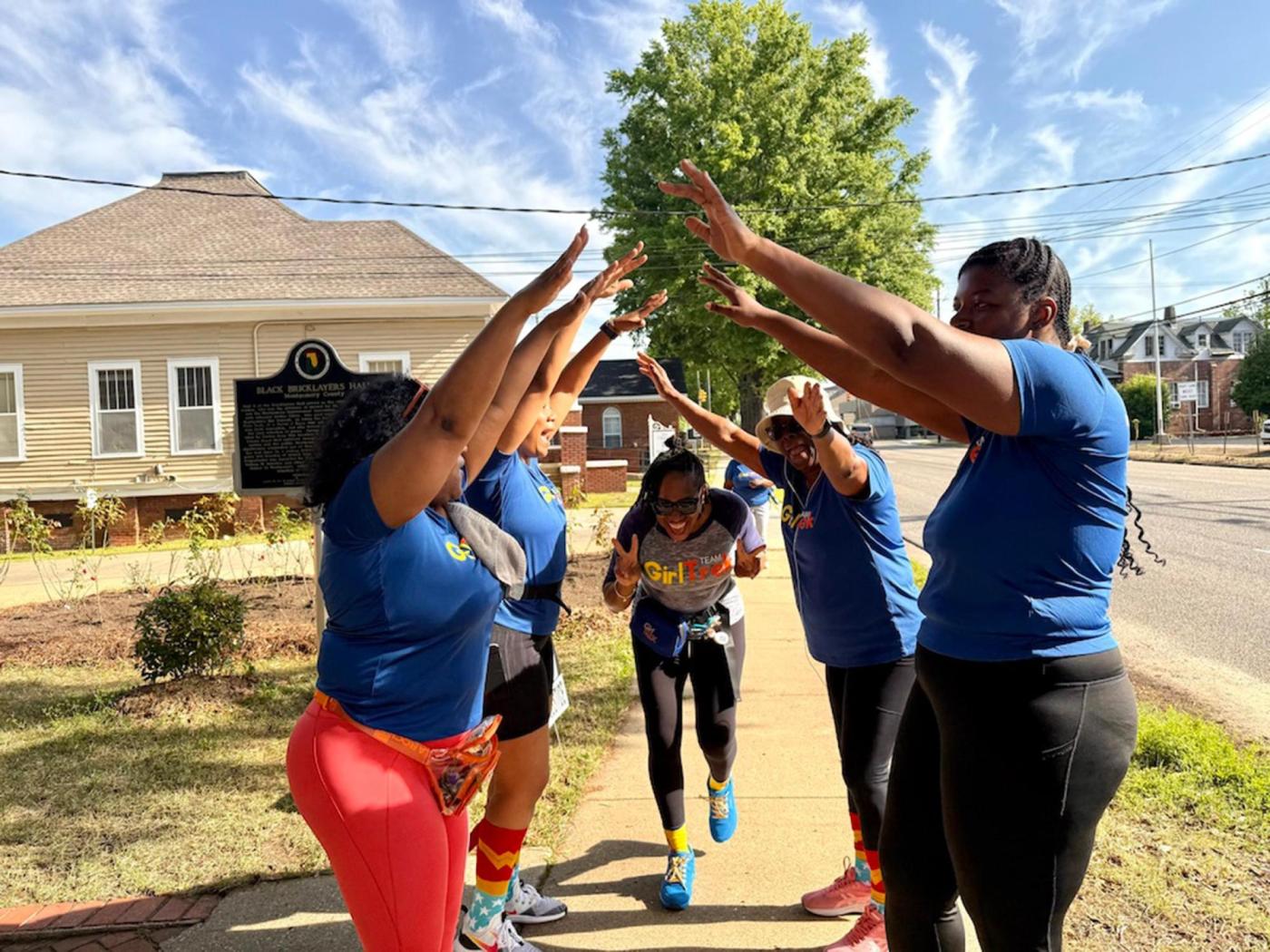
Like Campbell, they were dressed for a workout. Three of them wore Wonder Woman socks that boasted tiny capes, which earned some laughs.
The women were ready for a two-mile group walk around Montgomery’s historically Black Centennial Hill neighborhood. But Campbell wanted to give them a quick tour of the building first.
For most, it was their first time inside the new Montgomery outpost of GirlTrek, a national organization dedicated to improving the health of Black women. A veteran of the nonprofit group’s Chicago chapter, Campbell moved south three months ago to open the new office in Montgomery.
GirlTrek chose its location deliberately. The Bricklayers Hall was the nerve center of the 1955-1956 Montgomery bus boycott, which successfully desegregated the city’s public buses and became a model of nonviolent protest. The Rev. Martin Luther King Jr. and other boycott leaders strategized inside the hall, where King also kept an office.
That office is now Campbell’s office. GirlTrek’s walking teams are designed to empower Black women to improve their health, but also to encourage civil rights-inspired activism to tackle broader health disparities.
The Bricklayers Hall, located in the historically Black neighborhood of Centennial Park in Montgomery, Ala., was the nerve center for the 1955-1956 Montgomery bus boycott touched off by Rosa Parks. (Anna Claire Vollers/Stateline/TNS)
This year marks the milestone anniversaries of several civil rights victories: the 70th anniversary of the bus boycott, the 60th anniversary of the Selma-to-Montgomery marches, the landmark Voting Rights Act of 1965.
But 2025 also marks the 60th anniversary of Medicaid, the public health insurance program for people with low incomes.
The creation of Medicaid isn’t typically considered a civil rights victory. But the idea of health care as a human right was very much a part of the Civil Rights Movement, as was the belief that universal coverage could help dismantle racial inequities in health care.
“The connection between Medicare, Medicaid and the Civil Rights Movement was there from the beginning,” said Zachary Schulz, a history lecturer at Auburn University who specializes in public health history and policy. “Desegregation is often discussed in education, but there could be an argument made that it began in health care.”
Many of the Alabama communities that were home to the fiercest civil rights battles of the 20th century still grapple with systemic neglect that’s resulted in poor health outcomes, high uninsured rates and a shortage of medical providers.
In the neighborhoods around the Alabama Capitol, where nearly 50,000 people gathered in March of 1965 to meet the Selma-to-Montgomery marchers and push for voting rights, nearly a quarter of residents don’t have health insurance, according to the latest U.S. census data, for 2023. Around the Bricklayers Hall, the median household income is about$23,615, less than half of what it is statewide.
The neighborhood’s closest hospital filed for bankruptcy in February.
Statewide, 12% of Black residents under age 65 are uninsured, compared with 8.2% of white people and 10.3% for all races, according to the census.
Just as civil rights activists marched for voting rights and an end to segregation, the next generation of organizers is demanding something they see as no less essential: the right to accessible, affordable health care in a system that continues to deny it.
The women in the Saturday morning walking group come from different neighborhoods across the city. Most said they have health insurance. But everybody knows somebody who’s struggled to get the health care they need.
Campbell believes unjust policies harm the health of Black women everywhere — and wants to encourage them to continue pushing for change.
One policy change that has long been the focus of rallies, committee hearings and advocacy across the state: Alabama’s refusal to expand Medicaid to more adults under the Affordable Care Act, despite evidence that the state’s health care system is failing huge swaths of Alabamians. Alabama consistently ranks at or near the bottom in health measures, including high rates of heart disease, obesity and maternal deaths.
“We’re trying to save our own lives,” Campbell said. “We’re here in the footsteps of the Civil Rights Movement where, when they walked, things changed.”
‘The most shocking and the most inhuman’
Black medical leaders of the Civil Rights Movement, such as Dr. W. Montague Cobb, advocated for the passage of Medicaid and Medicare. Others, including King, spoke of health care as a moral imperative. “Of all the forms of inequality, injustice in health is the most shocking and the most inhuman,” he reportedly said in a 1966 speech to health care workers.
When Medicaid and Medicare launched that year, many Southern hospitals were still segregated. The feds sent teams to thousands of hospitals over the next few years to make sure they were following federal law before they could receive federal Medicare and Medicaid funding.
Pain clinic CEO faced 20 years for making patients ‘human pin cushions.’ He got 18 months
Ramsey County mental health vehicle to provide assessments, resources
FDA OKs first blood test that can help diagnose Alzheimer’s disease
Minnesota seeks to replace retiring ag mental health counselor
Gene editing helped a desperately ill baby thrive. Scientists say it could someday treat millions
“Southern states were especially resistant back then to participation because it required compliance with federal regulations, including civil rights laws,” said Schulz, of Auburn University. Alabama didn’t launch its Medicaid program until 1970.
Some see echoes in today’s debate over Medicaid expansion.
Under the Affordable Care Act, which President Barack Obama signed into law in 2010, states can extend Medicaid coverage to adults making up to 138% of the federal poverty level — currently about $21,000 a year for a single person. The feds currently cover 90% of the costs for those newly eligible enrollees.
Congressional Republicans are now considering whether to reduce the amount the federal government kicks in. But even at the 90% rate, 10 states — most of them in the South — have refused to take the deal. Many Republicans in those states say extending coverage to working-age adults would take away resources from people in greater need.
“Yet again, as in the ’60s, Southern states, including Alabama, were slow or resistant to expansion,” said Schulz. “The parallels are there: States’ rights versus federal mandates are very much the bottom line.”
‘Connect and keep moving’
Less than three miles from the Bricklayers Hall, Valtoria Jackson pastors the St. Peter African Methodist Episcopal Church. Her flock is a small but active Black congregation whose mission work often centers on health issues. Situated in a lower-income Montgomery neighborhood that’s recently seen signs of gentrifying, the church has sponsored a community garden, fitness classes and a fund to help neighbors pay their medical bills.
Jackson has also been a nurse for 41 years, most of them in Montgomery, and reckons she’s worked at every hospital in the city.
“I see myself as a connector,” she said. “I don’t like being in front. I just connect and keep moving.”
On a recent weekday morning she was in her car, delivering boxes of food to older people as part of a nutrition program funded by the U.S. Department of Agriculture. She’s also a familiar face in Montgomery’s advocacy circles. She’s spoken at rallies on the steps of the state Capitol, protesting with organizations such as the Poor People’s Campaign against poverty and for universal health care and Medicaid expansion.
“There’s no reason we shouldn’t have Medicaid expansion here in the South,” Jackson said.
Alabama’s skeletal Medicaid program does not cover able-bodied adults without children. Its income eligibility limit for parents — 18% of the federal poverty line — is among the lowest in the nation. A single parent with one child, for example, is ineligible if she makes more than $3,816 per year.
Some of Jackson’s parishioners work low-wage jobs and fall into the so-called coverage gap, earning too much to qualify for Alabama Medicaid, but not enough to afford private health insurance.
About 161,000 uninsured adults in Alabama would gain coverage if the state expanded Medicaid, according to a KFF analysis of federal data. More than half are people of color, according to the Center on Budget and Policy Priorities, a left-leaning think tank.
‘Good Sam’
In 1965, Lula Edwards was a 35-year-old nurse at Good Samaritan Hospital in Selma, Alabama. The hospital, known in the community as “Good Sam,” was the only medical center in six counties that was open to Black people.
On March 7, 1965, its hallways filled with the bleeding and injured after Alabama state troopers attacked civil rights marchers on the Edmund Pettus Bridge in what would become known as Bloody Sunday. Edwards was supposed to be off work that day, but was called in to care for the wounded.
Outside of her hospital work, she kept her Montgomery home open to people who needed treatment. For Edwards, community-based care was a human right.
“She treated people in her own home when she wasn’t at the hospital, giving people their shots, giving stitches, giving medicine,” said her grandson, Robert Stewart. “She was right there in the neighborhood and treated them for free.”
Stewart was determined to continue her legacy and that of his other grandparents, who marched in Selma during the Civil Rights Movement and helped register people to vote.
Edwards died in 2022 at age 92, a day after Stewart announced he was running for a seat in the Alabama state Senate. At her funeral, he said, mourners came up to him with campaign donations in her honor.
“My grandmother always told me I would be in politics,” he said. Stewart won his election a few months later. The Selma native now represents an eight-county district in central Alabama that has some of the poorest health outcomes in the state.
As a Democrat in a state with a Republican supermajority, his calls for Medicaid expansion go largely ignored. But he’s proud the legislature expanded Alabama’s postpartum Medicaid coverage from 60 days to a year in 2023 and eliminated Medicaid application delays for pregnant women earlier this year — significant steps for a state where Medicaid covers about half of all births.
But it’s still not enough.
“I represent eight counties, yet only two of them have pediatricians,” he said. “I have people in my district who have opted to stay out of the workforce so they can qualify for Medicaid because that’s the only way they can afford their insulin or their blood pressure medication.”
Two hospitals closed in Alabama just last year, including one in his district. Four Alabama hospitals have closed their labor and delivery units since 2023. The Alabama Hospital Association has long advocated for Medicaid expansion as a way to help financially struggling hospitals, particularly in rural areas.
Stewart and other Democrats have adapted their calls for Medicaid expansion to include the ways it could fit into Republican priorities, such as benefiting the state’s workforce.
“Expanding Medicaid needs to be a number one priority if we’re going to be serious about improving workforce participation as well as improving the overall health of Alabamians,” he said.
In recent years, conservative lawmakers in holdout states such as Alabama and Mississippi have signaled interest in expanding Medicaid. But after President Donald Trump’s reelection put federal Medicaid cuts on the table, expansion seems further away than ever.
Earlier this year, Alabama’s Republican House Speaker Nathaniel Ledbetter said expansion was no longer a priority this legislative session because Medicaid could see changes at the federal level.
“We are better off seeing what they are going to do,” he told reporters.
Sacred ground
The front office at the Bricklayers Hall is sparsely furnished. There’s a metal desk, a small filing cabinet, a tripod with a ring light for filming social media videos. Bulletin boards lean against the wall, waiting to be hung.
In the corner, a big blue sign: “Black women, you are welcome here.”
As Campbell shows the women around the space, she tells them the office once belonged to King.
“It’s like we’re walking on sacred ground,” someone says quietly.
In a back room, posters and protest signs decorate the wall:
“When Black women walk, things change”
“We walk for healthier bodies, families & communities”
Mary Mixon, 73, is retired from the Air Force and walks at least four miles every day. She began walking with GirlTrek on Saturday mornings because of the group’ s focus on joy and health. Mixon has military-provided health care but acknowledges the challenges others face in accessing health care in Montgomery, Alabama. (Anna Claire Vollers/Stateline/TNS)
Mary Mixon, 73, is retired from the Air Force and already walks up to five miles each day. But she comes to the Saturday morning GirlTrek walks, she says, “for the joy.”
She moved to Montgomery decades ago when she was assigned to nearby Maxwell Air Force Base.
“I was literally afraid to come because I’m from the Midwest, and I’d heard of so many ugly things here,” she recalled. “But as the time went on, I learned that injustice — yes, it does happen. But initiatives happen also. You can take the injustice and turn it around to justice.”
After Campbell passed out GirlTrek T-shirts to everyone, the group began its two-mile walk.
They set a speedy pace but waited at red lights for one another — no woman left behind. They chatted about kids and jobs. Some listened to music.
Their walk took them through the same neighborhood streets where, 60 years ago, Black Montgomery residents marched for justice and equal treatment.
But their route didn’t pass the Alabama State House, where lawmakers are winding down another legislative session without expanding Medicaid.
This story is part of “Uninsured in America,” a project led by Public Health Watch that focuses on life in America’s health coverage gap and the 10 states that haven’t expanded Medicaid under the Affordable Care Act. Stateline reporter Anna Claire Vollers can be reached at avollers@stateline.org.
©2025 States Newsroom. Visit at stateline.org. Distributed by Tribune Content Agency, LLC.