Two St. Paul parks renamed to reflect their sacred Dakota history

posted in: All news | 0

A pair of St. Paul parks will be renamed to reflect their sacred significance to the Dakota people.

The City Council on Wednesday voted to change the names of Bruce Vento Nature Sanctuary and Indian Mounds Regional Park to Wakáŋ Tipi and Wic̣aḣapi, respectively. Taken from the Dakota language, Wakáŋ Tipi translates to “dwelling place of the sacred,” while Wic̣aḣapi means “cemetery.”

During a news conference before the vote, Mayor Melvin Carter voiced his support for the new names, which were recommended by Minnesota’s Tribal Historic Preservation Offices and endorsed by the St. Paul Parks and Recreation Commission.

Mayor Melvin Carter talks at a press conference outside his office at City Hall in St. Paul on Wednesday, May 21, 2025. (John Autey / Pioneer Press)

“These names are not just words,” Carter said. “They’re acts of remembrance and resistance, honoring the Dakota people’s enduring presence and spiritual connection to this land. This action today is not about rewriting history, it’s about acknowledging that the land we stand on has always had Dakota names, Dakota meaning and Dakota caretakers.”

Cultural landscape

The two adjoining sites will exist as a newly designated cultural landscape called Imniżaska, which is a Dakota phrase meaning “white cliffs” and has long been used by Dakota speakers to refer to the area that is now St. Paul.

The city’s Parks and Recreation department, which will install updated signage at the sites in coming months, has been working with the Native-led nonprofit Wakáŋ Tipi Awanyankapi for several years to redesign its programming at the two parks to better reflect their spiritual significance in Dakota culture.

Maggie Lorenz, executive director of Wakáŋ Tipi Awanyankapi, said Wednesday that renaming the sites builds on “the work that generations of Dakota people have done … to hold onto our culture, to preserve our history and to advocate for our sacred places.”

Maggie Lorenz, Executive Director of Waḳaƞ Ṭípi Awaƞyaƞkapi, speaks at a news conference outside the mayor’s office at City Hall in St. Paul on Wednesday, May 21, 2025. (John Autey / Pioneer Press)

Last October, the city announced a co-management agreement for the 27-acre Wakáŋ Tipi area with Lorenz’s organization, whose 7,500-square-foot Wakáŋ Tipi Center will house an exhibit hall, classrooms, ceremonial spaces and other facilities dedicated to preserving Dakota culture when it opens in the fall.

Formerly named for the late U.S. Rep. Bruce Vento, an ardent environmentalist who helped spearhead the transformation of what was a polluted former rail yard into green space, the nature sanctuary is home to Wakáŋ Tipi cave, which is revered in Dakota culture as an ancient gathering place for Native American nations.

Vento’s widow, Susan Vento, was consulted as part of the renaming process, according to city officials. Susan Vento did not return a message seeking comment.

Carter said he believes the new name honors Bruce Vento’s legacy, adding that the congressman, who died in 2000, “was a supporter of tribal sovereignty, a supporter of treaty rights, and a champion for our environment.”

The name of the trail system that begins at Wakáŋ Tipi will remain the Bruce Vento Regional Trail.

Lt. Gov. Peggy Flanagan talks at a ness conference, joined by St. Paul mayor Melvin Carter, right, at City Hall in St. Paul on Wednesday, May 21, 2025. (John Autey / Pioneer Press)

Six burial mounds

The former Mounds Park, located on the bluffs overlooking Wakáŋ Tipi, contains six Native American burial mounds — the only such mounds known to exist within the urban Twin Cities.

Estimated to be up to 2,400 years old, the mounds are among the oldest human-made structures in Minnesota and are venerated by Dakota, Ho-Chunk and Ioway people as a burial place of their ancestors.

The city’s parks department in recent years has updated its signage around the mounds to educate visitors on its long history as a cemetery and to encourage them to treat it as such.

Lt. Gov. Peggy Flanagan, who spoke alongside Carter and Lorenz before Wednesday’s council vote, said renaming the sites “acknowledges that Dakota and Native people have always been here, are still here, and will remain here into the future.”

Related Articles


George Floyd: Minneapolis, St. Paul events mark his death, community response


Climate action group schedules first Ward 4 candidate forum for Tuesday


Wet weather continues on Wednesday


St. Paul’s parks rank fifth-best in the nation


Bruce Vento Nature Sanctuary likely to be renamed Wakan Tipi

Survivors of clergy sexual abuse turn up calls for reforms from new pope’s American hometown

posted in: All news | 0

By SOPHIA TAREEN, Associated Press

CHICAGO (AP) — Survivors of clergy sexual abuse amplified calls Tuesday for a global zero-tolerance policy from the new pope’s American hometown and raised questions about Leo XIV’s history of dealing with accused priests from Chicago to Australia.

The Archdiocese of Chicago responded by defending Leo’s record and saying he had “consistently expressed his compassion for survivors of this crime and sin.”

The cases span Robert Prevost’s previous posts. They include leading a Catholic religious order, bishop and as head of the Vatican’s office for bishops, where he was made cardinal.

The Survivors Network of those Abused by Priests, or SNAP, called out alleged abuse by Chicago priests and other clergy in Peru, Colombia, Canada and Australia where it contended the new pope should have done more.

Along with a worldwide zero-tolerance law for accused priests, SNAP has called for a global truth commission, survivor reparations and church transparency measures.

“It is our hope that Pope Leo does the right thing,” Shaun Dougherty, SNAP president, told reporters in Chicago. “It is our gut, in our experience, that says that he will need the pressure.”

Associated Press requests for comment to the Vatican media office Tuesday and its diplomatic representative to the United States didn’t receive immediate replies.

Clergy sexual abuse scandal has plagued the Catholic Church

No one has accused the new pope of any act of abuse himself or knowingly keeping confirmed abusers in public ministry, which has been the biggest scandal plaguing the Catholic Church recently.

Related Articles


Lincoln’s blood-stained gloves from the night of his assassination among 144 artifacts on auction


Fire at historic Black church in Memphis was intentionally set, investigators say


Why are more shoppers struggling to repay ‘buy now, pay later’ loans?


$365M slated for solar projects in Puerto Rico will be diverted to power grid, sparking outcry


Majority of US states now have laws banning or regulating cellphones in schools, with more to follow

Instead, victims’ advocates said he should have involved authorities earlier, been vocal about accused priests and worked to strip them of their titles. SNAP has been gathering evidence of how the church has covered for abusers and provided internal communications referencing cases, including in Chicago.

“This is the underground story of Prevost, this is the side of him and his management and decisions that we’re finally able to bring to light,” said Peter Isely with SNAP.

Some cases span the time when Prevost was based in Chicago as the Midwest regional leader of the Order of St. Augustine, a job he took in 1999. Three years later, he became worldwide leader of the Augustinians.

One priest who faced dozens of abuse allegations left the church in 1993 before landing a job as a Shedd Aquarium tour guide on a recommendation from a top Augustinian official. The priest worked at the popular tourist and school field trip destination in Chicago for nearly a decade before Shedd officials learned about the abuse claims.

“Had Shedd Aquarium received any information regarding the kind of allegations that have been brought to our attention, we would not have hired this individual,” a 2003 letter from the aquarium said.

Advocates said Prevost inherited the case when he became Augustinian provincial leader and should have stepped in earlier, considering the priest’s new job working directly with children.

Survivors of abuse want a global zero-tolerance policy

Survivors have demanded the church adopt a global policy that a priest be permanently removed from ministry for a single act of sexual abuse that is either admitted to or established according to church law. That has been the policy in the U.S. church since the height of the U.S. scandal in 2002, but the Vatican hasn’t imposed it worldwide.

SNAP also cited a case in the Diocese of Chiclayo, Peru, which then-Bishop Prevost led from 2014 to 2023. Three women came forward in 2022 to accuse two priests of sexual abuse.

The diocese forwarded information about the case to a Vatican office, which closed the case without a finding. However, the diocese later reopened the investigation after Prevost left for a Vatican post.

Critics said Prevost failed to investigate sufficiently.

The Vatican and Prevost’s successor determined Prevost acted correctly as far as church law is concerned. The Vatican noted he imposed preliminary restrictions on the accused priest pending investigation by Peruvian authorities, who concluded that the statute of limitations had expired.

Archdiocese defends pope’s record, saying he followed church regulations

The Archdiocese of Chicago issued a detailed, five-point statement responding to SNAP’s press conference and defending the pope’s record, saying that in the various cases cited, Prevost acted in accordance with the church’s regulations at the time.

It noted that the Vatican had ascertained that Prevost acted correctly in Chiclayo because “the accused was removed from ministry, the persons bringing the allegations were offered victim assistance, the charges were reported to civil authorities and they were investigated at the diocesan level and reported” to the Vatican as required, the statement said.

As a bishop in Peru and then prefect at the Vatican, Prevost was intimately involved in an investigation into an influential Catholic movement in Peru, Sodalitium Christianae Vitae, which was suppressed earlier this year by Pope Francis because of alleged abuses.

As a result, Prevost made plenty of enemies in the movement who have shared the allegations against him on social media in what some in the Vatican say was a campaign to try to discredit him.

SNAP also cited Prevost’s role from 2023 to 2025 leading the Dicastery for Bishops. It cited cases of accused bishops from Canada, Colombia and Australia who resigned amid abuse allegations but were allowed to retain their status as bishops.

While Prevost’s office would have handled investigations of accused bishops, the final decisions would have been those of Leo’s predecessor, Pope Francis, because the pontiff has ultimate authority over bishops.

Associated Press writers Peter Smith in Pittsburgh and Nicole Winfield in Rome contributed to this report.

Trio of Twins position players making progress towards their return

posted in: All news | 0

The Twins completed two games on Wednesday without three key contributors. It sounds as if they won’t have to play too much longer without all three, as each has made positive strides towards a return.

Shortstop Carlos Correa, who suffered a concussion when he collided with Byron Buxton last Thursday in Baltimore, is feeling better, with head athletic trainer Nick Paparesta calling his symptoms “basically all gone.” Buxton, also dealing with a concussion as a result of the collision, is “a little bit behind Carlos,” Paparesta said. But Buxton was expected to begin baseball activities on Wednesday.

And Matt Wallner, who has been out since mid-April with a hamstring strain, started a rehab assignment on Wednesday night in St. Paul, serving as the Saints’ designated hitter.

Paparesta said they had Wallner lined up to play in St. Paul through the weekend and then they will assess whether he will travel with the Saints to Omaha or if he is ready to returnto the Twins. While the Twins would like to see Wallner play in back-to-back games before a return — and ideally back-to-back games in the field, if possible — the path back from a concussion is a little less mapped out.

Correa has been hitting, throwing and taking ground balls. He had an evaluation scheduled with Dr. David Olson on Wednesday, Paparesta said. Before both he and Buxton come off the injured list, they will need to pass an ImPACT Test (Immediate Post-Concussion Assessment and Cognitive Testing).

When players enter the league, they are asked to take the neurological exam as a baseline test. Post-brain injury, players will take the test again and the scores will be evaluated off each other to determine if they are safe to return.

“We’re still a few, a couple days away from that just as far as the procedures and protocols that we need to get done, but from a baseball standpoint, we’re in a good spot,” Paparesta said of Correa.

Unlike Correa, who has never suffered a concussion before, Buxton has a history of concussions. He suffered one in 2019 and another a season later after being hit by a pitch. Having a history of concussions makes a person more susceptible to suffering another one or worse injuries upon getting one, Paparesta said.

“He’s taking a little bit longer to move progressively, but (Wednesday), we’re going to start some baseball stuff with him, which is a great sign,” Paparesta said. “We’ll just see every day how he responds to that.”

While Correa left Thursday’s game immediately and was placed on the seven-day concussion injured list the very next day, the Twins took a little bit longer to make a decision with Buxton, who also has a history of migraines.

“We wanted to be smart about making sure we weren’t pushing him to the IL if it was just his migraine or if it was actual symptoms from his concussion,” Paparesta said. “And we determined that, at that point in time, it was symptoms from his concussion (and) it was best to place him on the IL.”

Briefly

A day after playing U.S. Bank Stadium with Post Malone, singer Jelly Roll was at Target Field on Wednesday afternoon. He went into the Twins’ clubhouse in between games and was briefly on the field before the second game. … Mickey Gasper was brought over to serve as the 27th man for the second game on Wednesday. He did not play. … Luke Keaschall, out with a forearm fracture, is “showing some signs of calcification, which is exactly what we’re looking for,” Paparesta said. “We don’t have any bridging of that yet to show that the bones have healed and that we’re ready to start any true baseball stuff.” Keaschall was transferred to the 60-day injured list and can’t return until late June at the earliest.

Related Articles


Kody Clemens sends Twins to walk-off win in suspended game


Twins, Guardians washed out again; will attempt to play (almost) two Wednesday


Twins, Guardians game suspended; to be resumed on Tuesday, weather permitting


Kody Clemens makes most of opportunity with Twins


Walks haunt Twins early as Brewers stop Minnesota’s win streak at 13

Things to know about ‘no tax on tips,’ Trump’s tax pledge that’s included in GOP budget bill

posted in: All news | 0

By WYATTE GRANTHAM-PHILIPS and JONATHAN J. COOPER, Associated Press

NEW YORK (AP) — President Donald Trump’s “no tax on tips” pledge became a catchphrase for his 2024 campaign. Now it’s inching closer to reality.

The idea is firmly planted in the sprawling tax cuts package Republicans are hashing out in the House and aiming to pass in the coming days. And in a surprise move, the Senate voted this week to unanimously approve the idea.

The proposal has widespread support from the public, lawmakers in both parties and employers who believe such a law will bring relief to the working class. But many critics say that it would come with an enormous cost to the government while doing little to help the workers who need it most.

Here’s a look at the proposal and its potential impact:

What’s in the ‘No Tax on Tips’ provision?

It would create a new tax deduction eliminating federal income taxes on tips for people working in jobs that have traditionally received them, as long as they make less than $160,000 in 2025. The Trump administration would publish a list of qualifying occupations within 90 days of the bill’s signing.

Only tips reported to the employer and noted on a worker’s W-2, their end-of-year tax summary, would qualify. Payroll taxes, which pay for Social Security and Medicare, would still be collected.

FILE – Then-Republican presidential nominee former President Donald Trump dances at a campaign event at the Cobb Energy Performing Arts Centre, Oct. 15, 2024, in Atlanta. (AP Photo/John Bazemore, File)

If adopted, the proposed deduction is set to expire after four years. Congressional budget analysts project the provision would increase the deficit by $40 billion through 2028. The Committee for a Responsible Federal Budget, an advocacy group, projects the cost would be $120 billion over a decade if the tip exemption is made permanent.

What did Trump say during the campaign about eliminating federal taxes on tips?

Trump made the promise during a campaign stop in Las Vegas, where the service sector drives the economy, as part of his pitch to working-class voters struggling with rising costs.

Segments of his base eagerly spread the word, writing the catchphrase on their restaurant receipts or talking to their barbers about it while getting a trim.

Trump offered few details at the time, but later made similar pledges to eliminate taxes on other forms of income, including overtime wages and Social Security payments. Those ideas, along with a tax deduction for auto loan interest, are also included in the GOP’s budget bill.

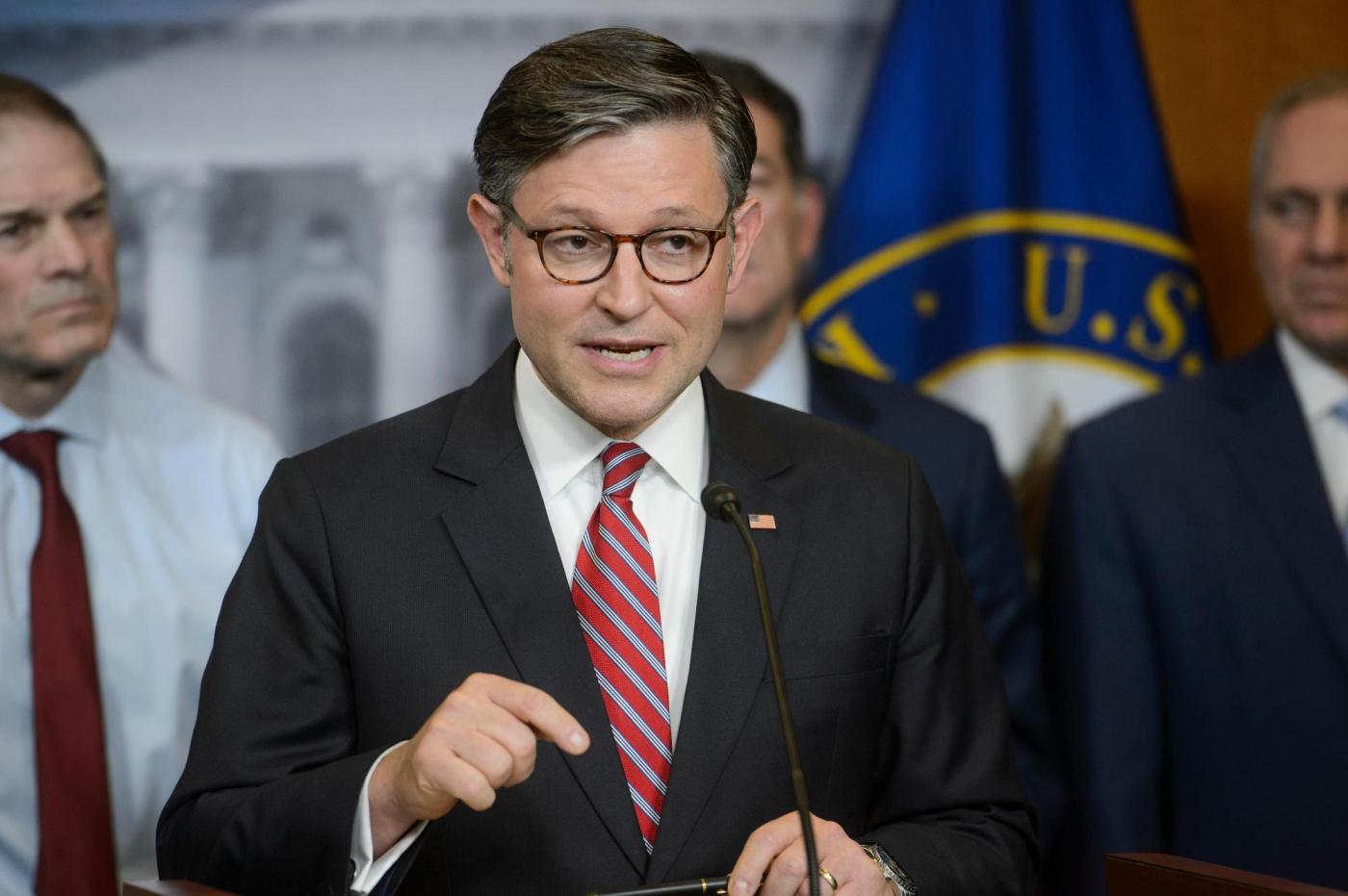
FiLE – Speaker of the House Mike Johnson, R-La., speaks during a news conference at the Capitol, May 6, 2025, in Washington. (AP Photo/Rod Lamkey, Jr., File)

“No tax on tips” was later embraced — with limits — by the influential Culinary Union, which represents Las Vegas Strip hospitality workers, Nevada’s Democratic senators and Vice President Kamala Harris, Trump’s Democratic rival.

How could it impact workers?

Experts say some middle-income service workers would benefit from a tax break but warn that it could potentially heighten inequities.

“If your goal is to help the poorest service workers, this is probably not the way to do it,” said Michael Lynn, a professor of services marketing at Cornell University whose research largely focuses on tipping and other consumer behavior.

Related Articles


Cuomo’s comeback faces a new challenger: Donald Trump’s Justice Department


Most books pulled from Naval Academy library are back on the shelves in latest DEI turn


Federal judge orders pretrial detention for man accused of stealing Kristi Noem’s purse


$365M slated for solar projects in Puerto Rico will be diverted to power grid, sparking outcry


Here’s what to expect at the Army’s 250th anniversary parade on Trump’s birthday

About a third of tipped workers make too little to owe income taxes. Those workers won’t benefit from the tax break, so its benefits will accrue to tipped workers with higher incomes, Lynn said.

“It’s overlooking non-tipped workers who need the help just as badly, and it’s giving the benefit predominantly to the least needy of the tipped workers,” Lynn said.

The median age for tipped workers is 31, a decade younger than the median non-tipped worker, and they tend to make lower wages, according to the Yale Budget Lab.

Among tipped workers who make enough to owe Uncle Sam, the average tax cut would be about $1,800, according to the Urban-Brookings Tax Policy Center.

The measure also would be complicated to enact.

What do employers say?

The National Restaurant Association is among industry groups that have been strong backers of a “No Tax on Tips” provision. When reached for comment Wednesday, a spokesperson pointed The Associated Press to a previous statement following the legislation’s introduction in January.

“Eliminating taxes on tips would put cash back in the pocket of a significant number of workers in the restaurant and food service industry and could help restaurant operators recruit industry workforce,” Sean Kennedy, executive vice president of public affairs for the association, said at the time — calling the No Tax on Tips Act “sensible legislation” that he said includes “fiscally responsible” protections.

And in Nevada, the Culinary Workers Union specifically credited the state’s two Democratic senators, Catherine Cortez Masto and Jacky Rosen, with working with Republicans to push the legislation forward — and called on the House to “get this done for working families.” The union represents about 60,000 casino and hotel workers across the state, including bartenders, food servers and cocktail servers who rely on tips.

But other groups representing workers shared criticism of the legislation.

One Fair Wage, an advocacy group made up of nearly 300,000 service workers and over 1,000 restaurant employers pushing to raise the minimum wage, said the measure would offer “moderate relief for some” but is part of a tax package that “just helps the richest while leaving the vast majority behind.”

“For all the bipartisan celebration … this bill is a distraction from the real fight,” Saru Jayaraman, president of One Fair Wage, stated — again stressing that it was time to raise the minimum wage. The nonprofit also calls for ending tip credits that allow lower base wages for tipped workers in many states.

Cooper reported from Phoenix. AP Writer Rio Yamat contributed to this report from Las Vegas.