
How is the new Gaza aid plan supposed to work — and why are so many aid groups against it?

posted in: All news | 0

By SAM MEDNICK

TEL AVIV, Israel (AP) — A U.S.-backed group approved by Israel to take over aid distribution in Gaza says it has started operations, despite opposition from the U.N. and most humanitarian groups and the unexpected resignation of its executive director.

Related Articles


At least 60 people killed by Israeli strikes in Gaza as Israel lets minimal aid in


Suspect in shooting of Israeli Embassy staffers railed against Gaza war in online posts


Mahmoud Khalil permitted to hold newborn son for the 1st time despite government objections


Gaza’s main hospital is overwhelmed with children in pain from malnutrition


Court papers say suspect in embassy killings declared ‘I did it for Palestine, I did it for Gaza’

The Gaza Humanitarian Foundation is the linchpin of a new aid system that would wrest distribution away from aid groups led by the U.N., which have carried out a massive operation moving food, medicine, fuel, tents and other supplies across Gaza since the war began in October 2023.

The new mechanism limits food distribution to a small number of hubs under guard of armed contractors, where people must go to pick it up. Currently four hubs are being set up, all close to Israeli military positions. Three are in the far south where few Palestinians are located.

GHF said it moved trucks of food to its hubs on Monday and began distribution, without giving details on how much aid was distributed. It said the flow of supplies would be “increasing each day.” It has said it plans to reach more than 1 million Palestinians by the end of the week. Gaza has a population of around 2.3 million.

Jake Wood, the American heading the effort, said Sunday night he was resigning because it was clear the organization would not be allowed to operate independently.

Israel has demanded an alternative plan because it accuses Hamas of siphoning off aid. The United Nations and aid groups deny there is significant diversion. They reject the new mechanism, saying it allows Israel to use food as a weapon, violates humanitarian principles and won’t be effective. Hamas has been designated as a terrorist organization by the United States, Canada and the European Union.

Israel blocked food, fuel, medicine and all other supplies from entering Gaza for nearly three months, pushing the territory toward famine. Last week, it allowed in a trickle of supplies, saying it would let the U.N. distribute it only until GHF was running.

The Hamas-run Interior Ministry on Monday warned Palestinians in Gaza against dealing with GHF.

How will this plan work, who’s behind it and why are aid groups pushing back?

Who’s behind GHF?

GHF publicly launched early this year and is run by a group of American security contractors, ex-military officers and humanitarian aid officials. It has the support of Israel and the United States.

Until resigning, Jake Wood was the face of the foundation. Wood is a U.S. military veteran and co-founder of a disaster relief group called Team Rubicon.

It’s unclear who will now run GHF.

A proposal circulated by the group earlier this month and obtained by the AP included several names, including the former director of the U.N. World Food Program, David Beasley. Neither Beasley nor GHF have confirmed his involvement.

It’s also unclear who is funding GHF. It claims to have more than $100 million in commitments from a European Union government but has not named the donor. The U.S. and Israel have said they are not funding it.

What’s their plan?

The GHF’s plan to centralize distribution through hubs is similar to ones designed by Israel.

It says each of its initial four hubs would serve meals for roughly 300,000 people. It has said it will eventually be able to meet the needs of 2 million people. It said it will create more hubs within 30 days, including in the north, but did not specify their exact locations.

Aid will be delivered with the help of private subcontractors transporting supplies in armored vehicles from the Gaza border to the hubs, where they will also provide security. It said the aim is to deter criminal gangs or militants from redirecting aid.

Satellite photos from May 10 obtained by The Associated Press show what appear to be construction of the hubs. The photos show one in central Gaza, close to the Netzarim Corridor, a strip of land held by Israeli troops. Three others are in the area of Rafah, south of the Morag Corridor, another military-held strip.

Almost the entire population is currently in northern Gaza — where no hub is currently located — or in central Gaza. They would have to cross through Israeli military lines to reach the hubs near Rafah.

Just before his resignation, Wood spoke of some adjustments, but it is not clear if Israel agreed to them.

In a letter to Israeli officials obtained by the AP, Wood said that until at least eight hubs are operating, the existing U.N.-led system will continue providing food in parallel to GHF. He also said the U.N.-led system would continue in the future to distribute all non-food humanitarian aid — everything from medical supplies to hygiene items and shelter materials. GHF was not capable of handling those supplies, Wood acknowledged.

In the letter, sent to Israel’s military body in charge of aid coordination in Gaza, COGAT, Wood said GHF and Israel had agreed on those terms. There was no confirmation from COGAT, however.

Why aren’t aid groups on board?

The U.N. and aid groups say that the plan would “weaponize aid” for Israel’s military and political purposes.

They say Israel would have power to determine who receives aid and to force the population to move to where it is being distributed, emptying large parts of the territory. That would potentially violate international laws against forced displacement.

“We cannot take part in a system that violates humanitarian principles and risks implicating us in serious breaches of international law,” said Shaina Low, communication adviser for the Norwegian Refugee Council, a leading aid group operating in Gaza.

Last week, Israeli Prime Minister Benjamin Netanyahu said that under the aid mechanism, Gaza’s population would eventually be moved to a “sterile zone” in Gaza’s far south. He said it was for their protection while Israeli forces fight Hamas elsewhere. He also said once the Palestinians enter the area, “they don’t necessarily go back.”

Palestinians struggle to receive cooked food distributed at a community kitchen in the Muwasi area of Khan Younis, in the Gaza Strip, Friday, May 23, 2025. (AP Photo/Abdel Kareem Hana)

Israel also says that after Hamas is defeated, it will implement a plan proposed by U.S. President Donald Trump to relocate the territory’s population outside Gaza, though it portrays migration as “voluntary.” The Palestinians, along with nearly all of the international community, have rejected the idea.

GHF said in a statement it is independent and apolitical and will not be part of any mass displacement. It said its system is fully consistent with humanitarian principles including impartiality and independence.

Israel had previously told aid groups it intends to vet aid recipients and use facial recognition technology. GHF has said food will be given according to need, without eligibility requirements. However, aid groups say recipients will have to pass close to or through Israeli military positions to reach the hubs, exposing them to vetting.

The U.N and aid groups also say the GHF plan cannot possibly meet the needs of Gaza’s large and desperate population.

Plans for distributing non-food aid remain uncertain. Also, GHF has said each meal it distributes would have 1,750 calories. That is below the 2,100-calorie per day standard for meals in emergency situations used by the U.N.’s World Health Organization, UNICEF and World Food Program.

Aid workers say the change is simply not necessary.

The U.N. and other aid groups “have shown absolutely that they can meet the needs of that population, when allowed to,” UNICEF spokesperson James Elder said. “We need to just keep reverting back to what works.”

Associated Press writers Tia Goldenberg in Tel Aviv, Israel, and Sarah El Deeb in Beirut contributed to this report.

Tesla’s monthly sales in Europe plunge by half, signaling backlash against Musk runs deep

posted in: All news | 0

By KELVIN CHAN, AP Business Writer

LONDON (AP) — Tesla sales across Europe plunged by half last month even as growth in the electric car market picked up pace, according to data released Tuesday.

Related Articles


Final boarding call for free bags at Southwest as airline abandons a cherished perk


US consumer confidence rebounds after five straight months of declines amid tariff anxiety


Northwest Minnesota newspaper closures ‘like a death in the family’


Wall Street rallies as its roller-coaster ride whips back upward after Trump pauses more tariffs


Will your credit card work abroad?

The numbers are the latest indication of how much the Tesla brand is suffering because of the backlash against billionaire CEO Elon Musk over his far-right views.

Sales of Tesla vehicles in 32 European countries tumbled 49% to 7,261 in April from 14,228 in the same month the previous year, according to the figures released by the European Automobile Manufacturers’ Association, or ACEA.

At the same time, sales of battery-electric vehicles by all manufacturers rose about 28%. Meanwhile, sales of gasoline and diesel powered cars slumped.

The figures, which cover the European Union’s 27 member countries and five other nations outside the bloc, back up early data from Sweden, the Netherlands and Denmark released at the start of this month that had pointed to a sales collapse.

Tesla has been reeling from protests and boycotts over Musk wading into politics, but it also faces other factors including an aging model lineup and intensifying competition from rival electric vehicle brands, particularly from China.

U.S. President Donald Trump’s trade war has also turned Europeans off buying American brands. In recent days, Trump threatened to impose a 50% tariff on EU goods, accusing the bloc of being “very difficult to deal with,” before agreeing to delay the duties until July.

In one sign that Tesla appears to be losing ground to cut-price Chinese brands, sales at China’s SAIC zoomed up 54% in April, according to the ACEA figures. SAIC owns a slew of auto brands including U.K.-based MG, known for its low-cost EV models.

Tesla is also suffering because it had to shut down factories for several weeks this year while upgrading its best selling Model Y sport utility vehicle, pinching supply.

For the first four months of the year, Tesla’s European sales fell roughly 39% to 61,320 while the continent’s auto market as a while showed little change during the same period, according to the data.

For April, car sales in the EU edged up 1.3% from the previous year, “showing signs of recovery despite the ongoing unpredictable global economic environment,” the group said in a press release.

Final boarding call for free bags at Southwest as airline abandons a cherished perk

posted in: All news | 0

By MICHELLE CHAPMAN, AP Business Writer

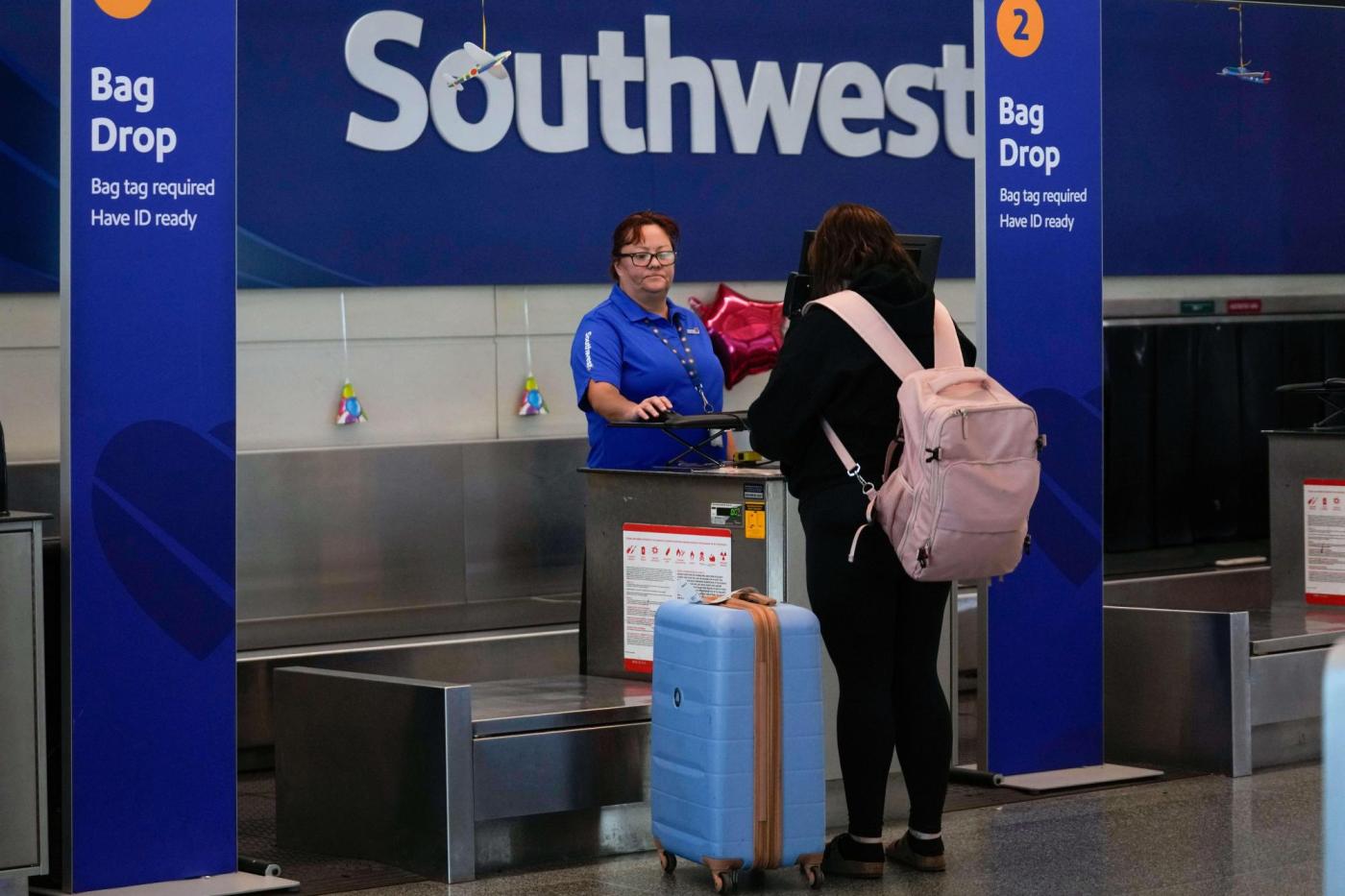
It’s the last day to book a flight on Southwest Airlines without being hit with a fee to check bags after the airline abandoned a decades-long luggage policy that executives once described as key to differentiating the budget carrier from its rivals.

Related Articles


US consumer confidence rebounds after five straight months of declines amid tariff anxiety


Northwest Minnesota newspaper closures ‘like a death in the family’


Wall Street’s roller-coaster ride whips back upward after Trump pauses more of his tariffs


Will your credit card work abroad?


Business People: Longtime NAMI Minnesota executive director to retire

The airline announced the change in March, saying at the time that the the new policy would start with flights booked on Wednesday.

Southwest said Tuesday that it will be charging $35 for a first checked bag and $45 for a second checked bag. Weight and size limits will apply for bags.

Southwest had built years of advertising campaigns around its policy of letting passengers check up to two bags for free. Under its new policy, people who haven’t either reached the upper tiers of its Rapid Rewards loyalty program, bought a business class ticket or hold the airline’s credit card will have to pay for checked bags.

Southwest will continue to offer two free checked bags to Rapid Rewards A-List preferred members and customers traveling on Business Select fares, and one free checked bag to A-List members and other select customers. Passengers with Rapid Rewards credit cards will receive a credit for one checked bag.

People who don’t qualify for those categories will get charged to check bags. The airline said in March that it also would roll out a new, basic fare on its lowest priced tickets when the change takes effect.

The airline estimated in September that charging bag fees would bring in about $1.5 billion a year but cost the airline $1.8 billion in lost business from customers who chose to fly Southwest because of its generous baggage allowance.

Another policy that will take effect on Wednesday is Southwest requiring passengers to keep their portable chargers in plain sight while using them because of concerns about the growing number of lithium-ion battery fires.

These aren’t the only changes at Southwest. The Dallas airline previously announced that it was leaving behind another Southwest tradition, the open-boarding system it has used for more than 50 years. Southwest expects to begin operating flights with passengers in assigned seats next year.

The airline also said last year that it would charge customers extra for more legroom and offer red-eye flights.

Southwest has struggled recently and is under pressure from activist investors to boost profits and revenue. The airline reached a truce in October with hedge fund Elliott Investment Management to avoid a proxy fight, but Elliott won several seats on the company’s board.

The airline announced in February that it was eliminating 1,750 jobs, or 15% of its corporate workforce, in the first major layoffs in the company’s 53-year history.

Shares of Southwest Airlines Co. rose 3% at the opening bell Tuesday along with other carriers in an up day for the sector.

US consumer confidence rebounds after five straight months of declines amid tariff anxiety

posted in: All news | 0

By MATT OTT, AP Business Writer

WASHINGTON (AP) — Americans’ views of the economy improved in May after five straight months of declines sent consumer confidence to its lowest level since the onset of the COVID-19 pandemic, largely driven by anxiety over the impact of President Donald Trump’s tariffs.

Related Articles


Northwest Minnesota newspaper closures ‘like a death in the family’


Wall Street’s roller-coaster ride whips back upward after Trump pauses more of his tariffs


Will your credit card work abroad?


Business People: Longtime NAMI Minnesota executive director to retire


Real World Economics: Pragmatism, not globalist ideology, drove U.S. trade policy

The Conference Board said Tuesday that its consumer confidence index rose 12.3 points in May to 98, up from April’s 85.7, its lowest reading since May 2020.

A measure of Americans’ short-term expectations for their income, business conditions and the job market jumped 17.4 points to 72.8, but remained below 80, which can signal a recession ahead.

The proportion of consumers surveyed saying they think a U.S. recession is coming in the next 12 months also declined from April.

Trump’s aggressive and unpredictable policies — including massive import taxes — have clouded the outlook for the economy and the job market, raising fears that the American economy is headed toward a recession.

However, Trump’s tariff pullbacks, pauses and negotiations with some trading partners may have calmed nerves for the time being.

“The rebound was already visible before the May 12 US-China trade deal but gained momentum afterwards,” said Stephanie Guichard, senior economist at The Conference Board.

Trump had initially imposed a stunning 145% tariff on most goods from China, but agreed to a 90-day pause for negotiations. The U.S. also came to an agreement with the U.K. earlier in May.

Over the Memorial Day holiday weekend, Trump and European Union leaders announced that the president’s 50% tariff on imports from the E.U., which he announced Friday, are on hold until July 9. That announcement would not have impacted the Board’s survey, which closed on May 19.

The Conference Board said the rebound in confidence this month was broad-based across all ages and income groups.

Consumers’ assessments of the present economic situation also improved, with the exception of their view on job availability, which weakened for the fifth straight month despite another strong U.S. jobs report.

However, less than 25% of respondents said they were worried about losing their jobs, compared with the 50% of respondents who said they were concerned about not being able to buy the things they need or want.

The Labor Department earlier this month reported that U.S. employers added a surprising 177,000 jobs in April and the unemployment rate remained at a low 4.2%.

Write-in responses to the survey showed that tariffs are still consumers’ biggest concern. Inflation is also still weighing on their minds, though some noted that inflation seemed to be easing, along with gas prices.

Earlier in May, the Commerce Department reported that consumer prices rose just 2.3% in March from a year earlier, down from 2.7% in February. Excluding the volatile food and energy categories, core prices rose 2.6% compared with a year ago, below February’s 3%. Economists track core prices because they typically provide a better read on where inflation is headed.

Gas prices have hovered around $3.17 per gallon this month, down from $3.59 a year ago, but up a few pennies from April.

The slowdown in inflation could be a temporary respite until the widespread duties imposed by Trump begin to push up prices in many categories. Most economists expect inflation to start ticking up in the coming months.

Robert Frick, an economist with Navy Federal Credit Union, said that while the tariff rollbacks may have boosted Americans’ confidence this month, that optimism may be fleeting.

“When prices start rising from existing tariffs in a month or two, it will be a sobering reminder that a new inflation fight has just begun,” Frick said.

The Board’s survey Tuesday also showed that Americans’ plans to spend on homes, cars and vacations also increased from April, with significant gains coming after the May 12 China tariff pause.