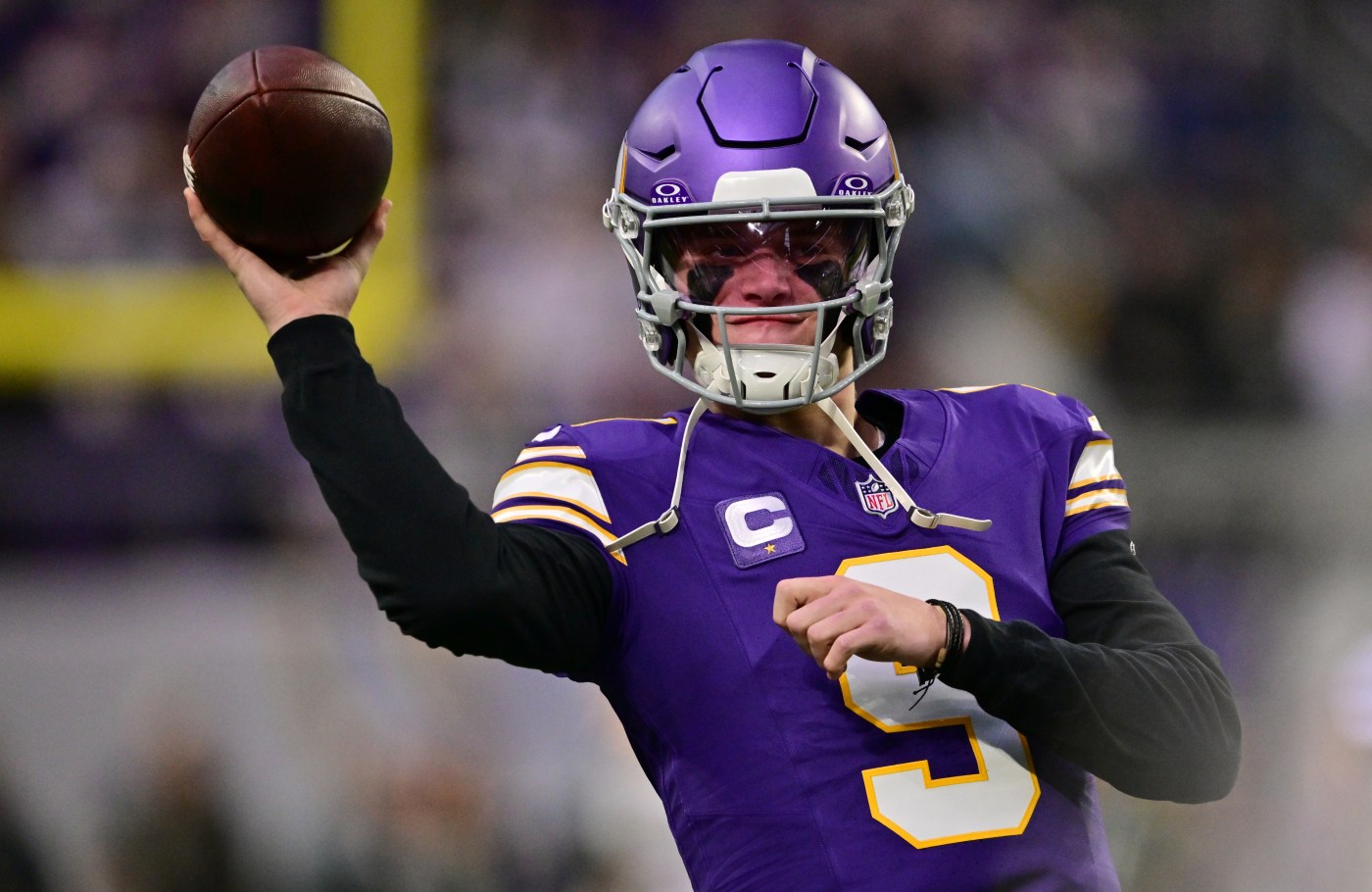
In just a few weeks, we’ll find out what Vikings head coach Kevin O’Connell really thinks of quarterback J.J. McCarthy.
The NFL trade/free agency period begins on March 11. The level of veteran QB that O’Connell brings in to compete with McCarthy for next season’s starting job will indicate the level of confidence the Vikings have in McCarthy going forward.
Kirk Cousins, Kyler Murray and Mac Jones remain the Vikings’ best bets. Trading for San Francisco’s Jones would probably cost the Vikings a second-round draft pick, a pick the Vikings cannot afford to lose.
If Cousins, 37, isn’t offered an acceptable deal — expected to be in the one-year, $20 million range with incentives and a guarantee to be the starter — chances seem good that he’ll move to national TV analysis. He’s already pretty good at it and already has made more than $300 million during 14 seasons as a player.
—There also is a chance the Vikings could end up with Jimmy Garoppolo or Geno Smith at quarterback. That would indicate the Vikings plan to ride into another season with McCarthy.
Derek Carr, 34, would seem another possibility, but he recently emphasized he’d only step back from retirement for a Super Bowl contender.
—April’s draft is considered mediocre for quarterbacks, but the 2027 draft is projected as better.
—John Schneider, the Seattle manager who signed free agent QB Sam Darnold after the Vikings opted not to franchise tag the former Viking and built the 2026 Super Bowl champions, was a 5-foot-7 running back for the University of St. Thomas under coach Vic Wallace in 1989-90.
Schneider injured both shoulders during his 1989 freshman season, forcing him to give up his playing career. He graduated from St. Thomas in 1993. Now he’s the fourth-longest currently tenured GM in the NFL.
—The Seahawks are in the process of being sold and seeking at least $9 billion. The Vikings are valued at $6.3 billion according to Forbes magazine.
It would seem prudent for the Vikings, who are without a GM, to at least seek permission to talk with Schneider, who is signed through 2031. Things can change, though, with new ownership.
Take, for instance, Derek Falvey. His recent exodus as Twins baseball-business operations president just before spring training came down to new ownership (Tom Pohlad) not having chosen Falvey to lead, and Falvey choosing not to work for new ownership.
By the way, multiple MLB teams, including major market teams, tried to convince Falvey to leave Minnesota when he was in charge. No doubt he’ll be back leading a baseball operation within a couple of years.
—There are 32 teams in the NHL. As they headed into the Olympic break, the Wild were legitimately one of the top three teams in the league with Colorado and Dallas. All three are in the same Central Division, which this season is untimely.
The Wild have 24 regular-season games left. If the Avalanche, Stars and Wild finish the way they are now, one of those teams will be knocked out in the first round of the playoffs. And by the end of the second round, two of the top three teams will be knocked out.
—The last time NHL teams played in the Olympics was 2014. Virtually every time there has been an Olympic-schedule break, some NHL teams came back way better and some teams way worse.
The Wild have eight players in the Olympics. They entered the Games in Milan having won five straight and were 6-0-1 in their past seven.
Nobody knows how the Wild will perform upon their return.
“There are two downsides to having players in the Olympics,” Wild owner Craig Leipold told the Pioneer Press. “No. 1, shutting the league down for three weeks, particularly for those teams — and I’d put us in this category — that have good momentum, are playing well. You like the camaraderie, and now all of a sudden everybody leaves for three weeks.
“I don’t like that. That bothers me.”
Leipold’s other concern, of course, is injuries. “You can’t afford to have injuries this time of the year,” he said.
—Despite the Twins’ 92-loss season last year, and a price increase for the 400-premium seat Champions Club at Target Field this year, there is a waiting list, meaning demand for a premium on-field product remains. A Twins playoff ticket just two-and-a-half years ago was the hottest ticket in town.
—As expected, Gophers football coach P.J. Fleck last week officially received another pay increase, this time in the form of what’s termed a management bonus of $700,000. That brings his annual compensation to $7.9 million.
Fleck, 45, retains his old-fashion values, which the university appreciates. No hats are allowed by players in the Gophers football building, no earrings, collared shirts are required in classes, and players must sit in the first two rows. The football team’s grade-point average is over 3.4, extremely rare for the sport, and the team hasn’t been on the front page of newspapers for doing stupid things.
—Meanwhile, it doesn’t get enough attention, but overall, Gophers athletes last year finished among the top public universities in the country with a composite grade-point average just under 3.5 and graduation rate between 93 and 97 percent.
—After next season, Vikings coach Kevin O’Connell, 40, will have three years remaining on a contract averaging $12 million a year.
—Those were St. Paul Parks and Recreation director Andy Rodriguez, local author Pat Harris and Ryder Cup producer Joe Gallagher from St. Paul lunching last week with Dave Winfield at the hall of famer’s Bel Air, Calif., home, where he was presented with a bronze miniature version of the life-size Winfield statue to be unveiled at Dunning Playground in May.
—Former Cretin-Derham Hall and University of St. Thomas star guard Sean Sweeney, who is associate head coach of the San Antonio Spurs, is a coach for the Western Conference in the NBA all-star weekend in Los Angeles.
—Faribault native Bruce Smith, the late running back who is the Gophers’ only Heisman Trophy winner (1941), would have turned 106 years old last week.
Mark Dusbabek, 61, the former Gophers-Vikings linebacker who is national TV rules analyst for CBS and NBC, is from Faribault.
“(Bruce’s) dad Lucius was a practicing attorney in Faribault when I received my scholarship offer,” Dusbabek texted former Gophers teammate Ray Hitchcock the other day. “He had me come visit him at his office and told me the responsibility I had to go to the U of M.”
Dusbabek pointed out that while Smith was in New York to accept the Heisman award, Pearl Harbor was attacked by Japan.
“He ended up rewriting his acceptance speech to reflect on the times and incident,” Dusbabek said.
—It’s unlikely because of cost, but North Dakota State’s move last week to the Mountain West Conference for football at least theoretically would seem an opportunity for the University of St. Thomas to move from the non-scholarship Pioneer Football League to the Missouri Valley Football Conference.
—The Twins again will have Securian advertising patches on their uniforms. It’ll be the second year of a four-year deal with the St. Paul financial firm.
—Kristine Reese, daughter of popular former Twins first baseman Rich Reese, is an instructor at the noted Vision 54 golf academy in Scottsdale, Ariz., and has been ranked the state’s best teacher by Golf Digest.
—After surveying 358 facilities, the Minnesota Golf Association reports municipal play in the state was up 2 percent, and private club play up 2.3 percent last year.
—It appears Twins fans will get a chance to see future hall of famer Justin Verlander, who turns 43 next week, in person a couple of times this season, first during an April 6-9 series against the Detroit Tigers. Verlander signed a one-year, $13 million deal with the Twins’ Central Division rivals last week.
Don’t print that
—The Vikings’ uncertain quarterback situation has to be concerning for wide receiver Justin Jefferson, who as the team’s star has a direct line to ownership. Going public with any concern could be extremely damaging to the team.
—That the Vikings fired general manager Kwesi Adofo-Mensah wasn’t surprising. What remains surprising was the timing. Usually, front office dismissals are done a day or so after the season, but the Vikings waited nearly a month to fire Adofo-Mensah.
There are different theories as to why the Vikings waited to let go of their four-year GM. One theory was that watching Sam Darnold brilliantly lead the Seahawks to the Super Bowl with the 31-27 NFC championship victory over the Rams was emotional for owners Zygi and Mark Wilf.
The Vikings, remember, could have retained Darnold with a one-year franchise tag of $40 million. Instead Darnold signed with Seattle for $100.5 million for three years.
No doubt Darnold leading Seattle to a Super Bowl championship has been a great public embarrassment for the Wilfs, who have dearly sought the Lombardi Trophy for 21 years. Last Sunday, Darnold had no turnovers in leading the Seahawks to their 29-13 victory over New England, and he played throughout the playoffs with zero turnovers.
—Meanwhile, what we don’t know yet is what the Wilfs are really thinking. Do they plan to bring in a general manager with stature who can lead the organization and actually push back against opinions from coach Kevin O’Connell or defensive coordinator Brian Flores? Or are the Wilfs looking for a GM who will defer to O’Connell? The head coach is now the guy with the real power.
We won’t know the answers until early May, when the new GM is expected to be hired.
—There’s buzz that the reason it took so long for the Vikings to re-sign Flores ($6 million a year) is that he wasn’t a fan of Adofo-Mensah.
—The Vikings have paid heartily for new hires Frank Smith, former Miami offensive coordinator, and Ryan Nielsen, a former Jacksonville defensive coordinator.
By the way, it wouldn’t be surprising if Adofo-Mensah ends up on the business side of some NBA team. It’s unclear what a buyout of his recent contract extension includes. When the Vikings fired coach Mike Zimmer four years ago, he had two years left on his contract for $16 million, so he essentially sat home and got paid.
—Winning the Super Bowl was worth $178,000 per Seahawks player. Sportico points out that California, which has the highest income tax of any state and where the big game was prepped for eight days and played, means Darnold’s estimated taxes for the week are $249,000.
—Darnold this season achieved a myriad of postseason bonuses, including $2.5 million for winning the Super Bowl. No doubt the Seahawks will extend Darnold’s $100.5 million, three-year contract with a deal worth about $50 million annually. He’s only 28 years old.
Darnold won 14 games for the Vikings in 2025 for a salary of $10 million before the Vikings allowed him to become a free agent.
—Despite an anticipated payroll in the $105 million range (bottom five in baseball), Twins business operations are expected to lose money this year. The Twins are not currently profitable, which is among reasons several inquiring buyers, after seeing the financials, said no thanks to the club’s $1.75 billion asking price.
Nearly half of Twins salaries will go to four players: Pablo Lopez, Byron Buxton, Ryan Jeffers and Joe Ryan.
—Major League Baseball this year has become a $12 billion industry. It’s a virtual certainty that the 2027 season will bring the game’s fifth lockout since 1973. The game’s labor agreement expires on Dec. 1 this year.
Of the pending lockout, it can be safely argued that baseball’s players union is undefeated.
—Texas Tech is ranked No. 16, and guard Nolan Groves is averaging 0.9 points and 6.4 minutes a game on a $125,000 per year NIL deal. Don’t be surprised if the former Orono star ends up with the Gophers for his sophomore season.
—Runner-up for the Twins’ managing job that Derek Shelton got last October was James Rowson, the Twins’ former hitting coach who is hitting coach for the New York Yankees. After Shelton got the job, he tried to hire Rowson as his bench coach, but the Yankees declined permission. Had he been permitted, people who know say Rowson would have accepted a Twins bench coaching offer.
—Ex-Twins manager Rocco Baldelli, in spring training with the Los Angeles Dodgers as a special assistant, was to be paid $2 million this year for the final year of his Twins deal. That will be decreased slightly, via an offset with his Dodgers’ pay.
Twins ownership couldn’t have been thrilled that Derek Falvey picked up Baldelli’s contract option for 2026 last spring, then fired him in September.
—As coach of the Patriots, Bill Belichick won six Super Bowls but was bypassed in recent Pro Football Hall of Fame voting in his first year of eligibility. As coach of the Vikings, Bud Grant, whose teams lost each of their four Super Bowls, was elected to the hall 10 years after retirement.
—Inexplicable: It took seven years for Wayzata grad James Laurinaitis, the former Ohio State star who won the Bronko Nagurski Trophy as the country’s best defensive player and Butkus Award as the nation’s best linebacker, to be elected to the College Football Hall of Fame this year.
—It looks as if either of Gophers men’s basketball commits, Nolen Anderson of Wayzata or Cedric Tomes of East Ridge, will win this season’s Minnesota Mr. Basketball Award.
—Hall of fame former Twin Bert Blyleven, after serving as pitching coach for the Netherlands for the past four World Baseball Classics, won’t be back for this year’s tournament next month.
Overheard
—ESPN’s Stephen A. Smith, on the Vikings’ decision last year not to franchise tag QB Sam Darnold for $40 million: “I would not have blamed Justin Jefferson if he had asked to be traded. That’s how disgusted he should have been.”
FILE – Minnesota Vikings wide receivers Adam Thielen, left, and Justin Jefferson (18) watch from the sideline during the second half of an NFL football game against the Detroit Lions, Sunday, Dec. 11, 2022, in Detroit. (AP Photo/Duane Burleson, File)
Pablo Lopez of the Minnesota Twins poses for a portrait at Lee Health Sports Complex during the Minnesota Twins Photo Day on Feb. 21, 2025 at the Lee County Sports Complex in Fort Myers, Florida. (Photo by Elsa/Getty Images)
Stephen A. Smith attends ESPN: The Party 2017 held on Friday, Feb. 3, 2017, in Houston, Texas. (Photo by John Salangsang/Invision/AP) (John Salangsang, John Salangsang)
Charley Walters: J.J. McCarthy will have to beat out a veteran to be the Vikings’ QB in 2026
Charley Walters: Craig Leipold could be a controlling owner Twins fans love
Charley Walters: Who will absorb blame for Vikings’ nose dive?