Elon Musk came to Washington wielding a chain saw. He leaves behind upheaval and unmet expectations

posted in: All news | 0

By CHRIS MEGERIAN

WASHINGTON (AP) — Elon Musk arrived in the nation’s capital with the chain saw-wielding swagger of a tech titan who had never met a problem he couldn’t solve with lots of money, long hours or a well-calibrated algorithm.

Related Articles


What to know about onetime Chicago gang leader Larry Hoover, whose federal sentence Trump commuted


Already numb to tariff twists, US importers see legal decisions as another price of doing business


Trump suffered ‘mental anguish’ from disputed CBS News interview with Harris, lawyer says


The US academic partnership with China, under strain for years, faces its biggest threat


White House acknowledges problems in RFK Jr.’s MAHA report

President Donald Trump was delighted to have the world’s richest person — and a top campaign donor — working in his administration, talking about how he was “a smart guy” who “really cares for our country.”

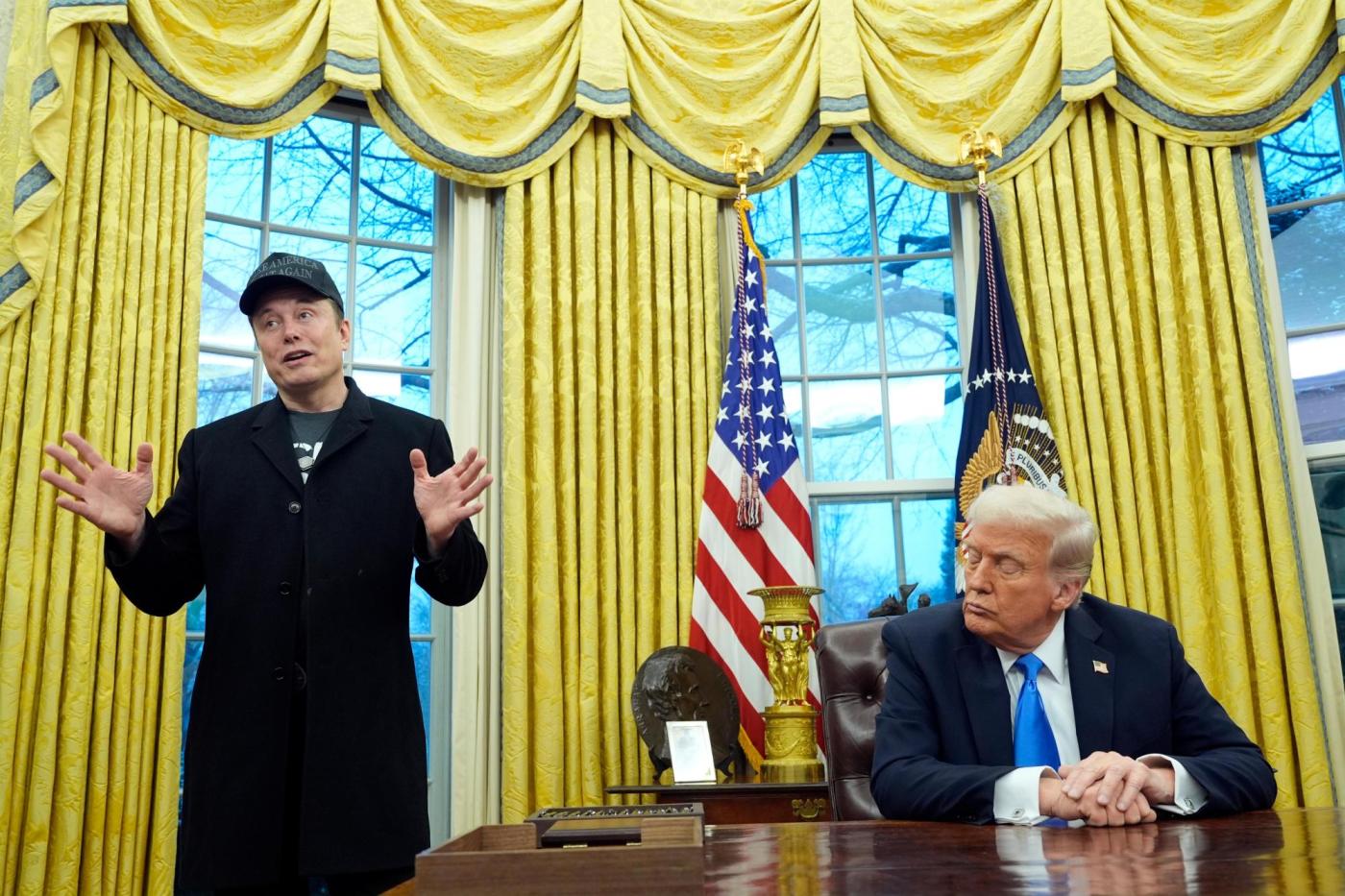
Musk was suddenly everywhere — holding forth in Cabinet meetings while wearing a “tech support” shirt and black MAGA hat, hoisting his young son on his shoulders in the Oval Office, flying aboard Air Force One, sleeping in the White House. Democrats described the billionaire entrepreneur as Trump’s “co-president,” and senior officials bristled at his imperial approach to overhauling the federal government.

After establishing Tesla as a premier electric automaker, building rockets at SpaceX and reshaping the social media landscape by buying Twitter, Musk was confident that he could bend Washington to his vision.

Now that’s over. Musk said this week that he’s leaving his job as a senior adviser, an announcement that came after he revealed his plan to curtail political donations and he criticized the centerpiece of Trump’s legislative agenda.

It’s a quiet exit after a turbulent entrance, and he’s trailed by upheaval and unmet expectations. Thousands of people were indiscriminately laid off or pushed out — hundreds of whom had to be rehired — and some federal agencies were eviscerated.

But no one has been prosecuted for the fraud that Musk and Trump said was widespread within the government. Musk reduced his target for cutting spending from $2 trillion to $1 trillion to $150 billion, and even that goal may not be reached.

In Silicon Valley, where Musk got his start as a founder of PayPal, his kind of promises are known as vaporware — a product that sounds extraordinary yet never gets shipped to market.

Trump, who once called Musk “a truly great American” and “a patriot,” said nothing about the departure. White House press secretary Karoline Leavitt said: “We thank him for his service.”

Musk’s position was always designed to be temporary, and he had previously announced his intention to dedicate more of his time to his companies. But he also told reporters last month that he was willing to work part-time for Trump “indefinitely, as long as the president wants me to do it.”

Musk got a seat at Trump’s table and put $250 million behind his campaign

It was clear that Musk wouldn’t be the typical kind of presidential adviser around the time that he showed the world his belly button.

Racing on stage at a campaign rally one month before the election, he jumped for joy next to Trump, his T-shirt rising to expose his midriff. Musk had already sold Trump on his idea for a Department of Government Efficiency while also putting at least $250 million behind his candidacy.

The plan called for a task force to hunt for waste, fraud and abuse, a timeworn idea with a new twist. Instead of putting together a blue-ribbon panel of government experts, Trump would give his top donor a desk in the White House and what appeared to be carte blanche to make changes.

Musk deployed software engineers who burrowed into sensitive databases, troubling career officials who sometimes chose to resign rather than go along. Trump brushed off concerns about Musk’s lack of experience in public service or conflicts of interest from his billions of dollars in federal contracts.

Their unlikely partnership had the potential for a generational impact on American politics and government. While Musk dictated orders for government departments from his perch in the White House, he was poised to use his wealth to enforce loyalty to the president.

His language was that of catastrophism. Excessive spending was a crisis that could only be solved by drastic measures, Musk claimed, and “if we don’t do this, America will go bankrupt.”

But even though he talked about his work in existential terms, he treated the White House like a playground. He brought his children to a meeting with the Indian prime minister. He let the president turn the driveway into a makeshift Tesla showroom to help boost sales. He installed an oversized screen in his office that he occasionally used to play video games.

Sometimes, Trump invited Musk to sleep over in the Lincoln Bedroom.

“We’ll be on Air Force One, Marine One, and he’ll be like, ‘do you want to stay over?’” Musk told reporters. The president made sure he got some caramel ice cream from the kitchen. “This stuff’s amazing,” Musk said. “I ate a whole tub of it.”

Looking back on his experience in government, he described it as a lark.

“It is funny that we’ve got DOGE,” an acronym that references an online meme featuring a surprised-looking dog from Japan. “How did we get here?”

Musk did not give federal workers the benefit of the doubt

From the beginning, Musk treated federal workers with contempt. At best, they were inefficient; at worst, they were committing fraud.

His team offered them a “fork in the road,” meaning they could get paid to quit. Probationary employees, generally people new on the job without full civil service protection, were shown the door.

Anyone who stayed faced escalating demands, such as what became known as the “five things” emails. Musk wanted every government employee to submit a list of five things they accomplished in the previous week, and he claimed that “failure to respond will be taken as a resignation.”

Some administration officials curtailed the plan, concerned that it could jeopardize security in more sensitive areas of the government, and it eventually faded, an early sign of Musk’s struggle to get traction.

But in the meantime, he continued issuing orders like thunderbolts.

One day in February, Musk posted “CFPB RIP,” plus an emoji of a tombstone. The headquarters of the Consumer Financial Protection Bureau, created after the Great Recession to protect Americans from fraud and deceptive practices, was shut down and employees were ordered to stop working.

Musk had already started gutting the U.S. Agency for International Development, a pillar of the country’s foreign policy establishment and the world’s largest provider of humanitarian assistance.

“Spent the weekend feeding USAID into a wood chipper,” he bragged.

Thousands of contacts were cut off, pleasing conservatives who disliked the agency’s progressive initiatives on climate change and gay rights.

Musk rejected concerns about the loss of a crucial lifeline for impoverished people around the globe, saying, “no one has died.” However, children who once relied on American assistance perished from malnutrition, and the death toll is expected to increase.

The lawsuits began piling up. Sometimes workers got their jobs back, only to lose them again.

The Food and Drug Administration, which is responsible for ensuring the safety of everything from baby formula to biotech drugs, planned to lay off 3,500 employees. But again and again, the agency was forced to rehire people who were initially deemed expendable, including laboratory scientists, travel bookers and document specialists.

Commissioner Marty Makary, who started his job after many of the cuts took place, told attendees at a recent conference that “it was hard and my job is to make sure we can heal from that.”

Only 1,900 layoffs took place, but another 1,200 staffers took buyouts or early retirement. Experts fear the agency has lost much of its institutional knowledge and expertise in areas like vaccines, tobacco and food.

There are also concerns about safety on public lands. The National Park Service has been bleeding staff, leaving fewer people to maintain trails, clean restrooms and guide visitors. More cuts at the Forest Service could undermine efforts to prevent and fight wildfires.

The Environmental Protection Agency faces a broad overhaul, such as gutting the Office of Research and Development, which was responsible for improving air pollution monitoring and discovering harmful chemicals in drinking water.

Not even low-profile organizations were exempt. Trump ordered the downsizing of the U.S. Institute of Peace, a nonprofit think tank created by Congress, and Musk’s team showed up to carry out his plan. The organizations’ leaders were deposed, then reinstated after a court battle.

Musk made little headway at the top sources of federal spending

The bulk of federal spending goes to health care programs like Medicaid and Medicare, plus Social Security and the military.

Unfortunately for Musk, all of those areas are politically sensitive and generally require congressional approval to make changes.

Thousands of civilian workers were pushed out at the Pentagon, and Defense Secretary Pete Hegseth is reducing the ranks of top generals and looking to consolidate various commands. A plan to downsize an office for testing and evaluating new weapons systems could save $300 million per year. Hegseth recently asked employees to submit one idea per week for cutting waste.

However, the Pentagon budget would increase by $150 billion, for a total of more than $900 billion, under Trump’s spending proposal working its way through Congress. The money includes $25 billion to lay the groundwork for Trump’s “golden dome” missile defense program and $34 billion to expand the naval fleet with more shipbuilding.

Another $45 million is expected to be spent on a military parade on June 14, which is the 250th anniversary of the Army’s founding and Trump’s 79th birthday.

Musk also faced blowback for targeting Social Security, which provides monthly benefits to retirees and some children. He suggested that the popular program was “a Ponzi scheme” and the government could save between $500 billion and $700 billion by tackling waste and fraud.

However, his estimates were inflated. Social Security’s inspector general said there was only $71.8 billion in improper payments over eight years. Nor was there any evidence that millions of dead people were receiving benefits.

Changes to Social Security phone services, pitched as a way to eliminate opportunities for fraud, were walked back after an outcry from lawmakers and beneficiaries. But the agency could still shed 7,000 workers while closing some of its offices.

Musk’s popularity cratered even though Americans often agreed with his premise that the federal government is bloated and wasteful, according to polling from The Associated Press-NORC Center for Public Affairs Research.

Just 33% of U.S. adults had a favorable view of Musk in April, down from 41% in December. In addition, 65% said Musk had too much influence over the federal government.

Musk talked of staggering savings but delivered modest results

During a campaign rally in October, Musk said he could find “at least $2 trillion” in spending cuts. In January, before Trump was inaugurated, he revised by saying, “if we try for $2 trillion, we’ve got a good shot at getting one.”

But in April, at a Cabinet meeting, Musk provided a different target. He was “excited to announce” that they could reach $150 billion in savings during the current fiscal year.

Whether that figure proves to be accurate is difficult to measure, especially because DOGE routinely inflated or mischaracterized its work. But it falls short of President Bill Clinton’s initiative three decades ago, which resulted in $136 billion in savings — the equivalent of more than $240 billion today.

Elaine Kamarck, a key figure in the Clinton administration, said they focused on making the government more responsive and updating antiquated internal procedures. The work took years.

“We went about it methodically, department by department,” she said. The effort also reduced the federal workforce by more than 400,000 employees.

However, Musk did little to seek insight from people who knew the inner workings of government.

“They made some changes without really knowing what they were doing,” said Alex Nowrasteh, vice president for economic and social policy studies for the libertarian think tank Cato Institute. He said there were “a lot of unforced errors.”

In the end, Nowrasteh said, “they set themselves up for failure.”

Associated Press writers Tom Beaumont in Des Moines and Lolita Baldor, Matthew Daly, Gary Fields, Fatima Hussein, Ellen Knickmeyer, Matthew Perrone, Michelle Price and Amelia Thomson DeVeaux in Washington contributed to this report.

Foundations donate $1.5M to help restore historic Black church in Memphis gutted by arson

posted in: All news | 0

MEMPHIS, Tenn. (AP) — Several foundations have donated $1.5 million to help rebuild after arson gutted a historic Black church in Memphis, Tennessee, that played an important role in the civil rights movement.

Related Articles


What to know about onetime Chicago gang leader Larry Hoover, whose federal sentence Trump commuted


National Spelling Bee runners-up rarely go on to win. But Faizan Zaki hopes to defy the odds


Smokey Robinson sues former housekeepers for defamation over rape allegations


Skittles removes controversial additive targeted by RFK Jr.


Judge finds man charged with stalking Jennifer Aniston is mentally incompetent to stand trial

Clayborn Temple had been undergoing a yearslong renovation when someone intentionally set a fire inside the church in the early hours of April 28, destroying almost everything but parts of the facade.

Before the fire, the Romanesque revival church was in the midst of a $25 million restoration project that included restoring a 3,000-pipe grand organ. The project also sought to help revitalize the neighborhood with a museum, cultural programing and community outreach.

Despite the extensive damage, Anasa Troutman, executive director of Historic Clayborn Temple, has said they plan to continue moving forward with the restoration. Troutman announced the new donations for that effort Wednesday. The money comes from the African American Cultural Heritage Action Fund along with the Mellon and Ford foundations.

Located just south of the iconic Beale Street, Clayborn Temple was built in 1892 as the Second Presbyterian Church and originally served an all-white congregation. In 1949, the building was sold to an African Methodist Episcopal congregation and given its current name. In 1968, the church served as the headquarters for a sanitation workers’ strike, which brought the Rev. Martin Luther King Jr. to Memphis, where he was assassinated.

Ex-Goldman Sachs banker gets 2 years in prison for plot to fleece billions from Malaysia’s 1MDB fund

posted in: All news | 0

By PHILIP MARCELO

NEW YORK (AP) — A former Goldman Sachs banker was sentenced Thursday to two years in federal prison for his role in a $4.5 billion scheme to ransack a Malaysian state investment fund.

Tim Leissner, at his sentencing in Brooklyn federal court, apologized to the people of Malaysia, who he called the “real victims” of the scheme.

“The funds raised more than a decade ago could have profoundly benefited the nation and its citizens,” he said in a statement read in court and provided by his lawyers. “Instead, due to my greed — and the greed of those involved alongside me — they were misappropriated.”

Prosecutors said Leissner and other Goldman Sachs bankers helped the Malaysian investment fund known as 1MBD, or the 1Malaysia Development Berhad state fund, raise $6.5 billion through bond sales.

But they say more than $4.5 billion of the funds were stolen and laundered through bribes and kickbacks.

The spoils bankrolled extravagant purchases, from wild parties to lavish spending on jewels, art, a superyacht and luxury real estate, prosecutors have said. They also helped finance the 2013 Martin Scorsese film “The Wolf of Wall Street” that starred Leonardo DiCaprio.

The scandal led to the fall of Malaysian Prime Minister Najib Razak’s government in 2018. Najib was later convicted by a Malaysian court of abuse of power and other crimes related to the scandal and sentenced to 12 years in prison.

“What we did was unequivocally wrong, and I take full responsibility for my role,” Leissner said Thursday. “I deeply regret my actions, and if I could turn back time, I would undo them without hesitation.”

Leissner had pleaded guilty in 2018 to bribing government officials in Malaysia and Abu Dhabi.

He served as a key government witness in the trial of Roger Ng, a fellow former Goldman Sachs banker who was sentenced in 2023 to 10 years in federal prison.

Ng’s lawyers described the looting of 1MDB as “perhaps the single largest heist in the history of the world,” but maintained prosecutors scapegoated him for crimes committed by others, including the higher-ranking Leissner.

Prosecutors declined to comment on Thursday’s sentence. They had not sought a specific prison term in filings ahead of sentencing while lawyers for Leissner had sought a sentence of time already served.

Leissner is due to report to prison Sept. 15 and his lawyers have requested that he be sent to the federal prison in Otisville, New York, according to the prosecutors.

Henry Mazurek, Leissner’s lawyer, said his client is prepared to serve his sentence. It includes two years of supervised release after prison and a forfeiture totaling $43.7 million, which already has been paid.

“Mr. Leissner cooperated not only to obtain leniency at sentencing, but to show his true remorse for his actions and tell the full story of 1MDB and Goldman Sachs,” Mazurek said in an email. “He did that and will continue to tell all who will listen about the poisonous culture at Goldman that inspired the 1MDB scheme.”

The importance of Justin Jefferson’s attendance at Vikings OTAs

posted in: All news | 0

There’s no question that superstar receiver Justin Jefferson has reached the stage in his career where his success no longer hinges on him participating in organized team activities.

Though he likely would have made headlines this week if he decided not to show up at TCO Performance Center, Jefferson would have been forgiven considering these are voluntary workouts by definition. The fact that he chose to be in attendance for the Vikings wasn’t lost on head coach Kevin O’Connell as he reflected on the importance of his presence.

“He means so much to this organization,” O’Connell said. “The guys in that locker room know, ‘If this guy is pushing himself in May and June, I sure as heck better be doing the same thing.’ ”

The intentionality of being back in the Twin Cities goes beyond setting an example for his teammates, however, as it’s also given Jefferson a chance to familiarize himself with new No. 1 quarterback J.J. McCarthy. The growing relationship between both players was on full display a couple of weeks ago when Jefferson and McCarthy went viral while sitting courtside at a playoff game between the Timberwolves and the Golden State Warriors.

“That was interesting, being mic’d up and all that,” McCarthy said. “We spend a good amount of time together.”

As close as they’re getting off the field, Jefferson and McCarthy are still a work in progress on the field.

Though the Vikings selected McCarthy with the No. 10 pick in the 2024 NFL Draft to be the future of the franchise, Jefferson spent most of his time last summer catching passes from former starting quarterback Sam Darnold. Just when it looked as if McCarthy might be pushing for some additional snaps with the starters, he suffered a torn meniscus that landed him on injured reserve.

That’s why the reps in organized team activities this spring have been so important for Jefferson and McCarthy. They are trying to get on the same page as quickly as possible. That way they can hit the ground running in training camp this summer.

The learning curve was apparent in real time this week. There was a particular play early in practice that featured McCarthy throwing an interception during 7-on-7 drills while targeting Jefferson in the middle. On the other side of the coin, there was a play late in practice that featured McCarthy throwing a touchdown during 11-on-11 drills while targeting Jefferson deep downfield.

“We’re not where we want to be,” McCarthy said. “We’re going to be there when we need to be.”

Some of the subtle moments between Jefferson and McCarthy this week also mattered in the grand scheme of things. The little interactions that otherwise go unnoticed. Like picking each other up after a bad play and dapping each other up after a good plays.

None of it would’ve have been possible if Jefferson was elsewhere.

“He’s an energy igniter of the whole building,” O’Connell said. “He’s come back with a purpose.”

The hope is that the work the Vikings are putting in now could go a long way later.

“It’s been extremely huge,” McCarthy said. “Just being able to get that chemistry building has been invaluable.”

Related Articles


J.J. McCarthy’s goal during Vikings OTAs? ‘Not being afraid to fail’


Five storylines to keep an eye on as the Vikings start OTAs


NFL teams can keep using the tush push after ban proposal fails at owners meetings


NFL owners unanimously approve player participation in Olympic flag football for 2028


NFL owners set to discuss tush push again, along with playoff seeding