Readers and writers: A sobering look at the vanishing prairie

posted in: All news | 0

A sweeping look at the vanishing American prairie and two crime novels set in Minnesota are this week’s offerings to our readers.

“Sea of Grass”: by Dave Hage and Josephine Marcotty (Random House, $32)

(Courtesy of Random House)

Agriculture has altered — and damaged — the very biological and chemical cycles that created the extraordinary prairie in the first place, from the creation of soil to the flow and purity of water, to the ebb of wildlife and the circulating of elements in and out of the atmosphere. It’s created intractable pollution problems that endanger human health and cripple other ecosystems, from its damage to insects to the dead zone in the Golf of Mexico. — from “Sea of Grass”

In this timely and important book, subtitled “The Conquest, Ruin, and Redemption of Nature on the American Prairie,” award-winning former Star Tribune writers Hage and Marcotty explore and explain the environmental crisis caused by the disappearance of thousands of acres of American prairie that once stretched from Montana to Illinois, eastern Minnesota to northern Texas.

The North American prairie, they write, is one of Earth’s four great temperate grasslands, the others being the steppes of Central Asia, the Pampas of South America, and the veld of southern Africa. It is also one of the most threatened ecosystems on Earth, home to small insects and big grazing mammals.

Before the Industrial  Revolution took hold in farming, the untouched prairie grasses created a web of roots that could grow as deep as two feet into the ground. When white settlers arrived in the 19th century they brought with them plows that tore up the prairie for the first time. These pioneers used rudimentary plows, but when steel plows became available farmers were able to plant and harvest much more food per acre to feed a growing population. This affected the prairie’s biological diversity as rivers were rerouted, synthetic nitrogen became a standard fertilizer and the delicate symbiosis of the prairie was uprooted. Over decades the prairie was converted into some of the richest farmland on Earth, but the country paid a terrible price

The authors help us understand what that price means in chapters examining river, dirt, bugs and water. For Minnesotans, the discussion about rivers might be the most important as we learn how the Mississippi picks up fertilizer runoff from rivers that flow into it, growing more polluted as it rolls through the Twin Cities southward until the pollutants create a “dead zone” of chemicals in the Gulf of Mexico.

Now industrial agriculture is plowing up the remaining grasslands at the rate of 1 million acres a year  If the sea of grass is to be saved, the authors argue, it will take cooperation between farmers who care about the land, help from the federal government and efforts by eco-conscious consumers.

Although we are losing everything from bees to oysters, “Sea of Grass” ends with hope that comes from people like South Dakota writer and buffalo rancher Dan O’Brien, who sees the great creatures that once roamed the prairie as far as the eye could see as a way to restore the animals’ ancestral home.

Books about environmental devastation are increasingly common as we watch the natural world we once knew disappear. “Sea of Grass,” written clearly and with passion, is one of the best.

The authors will introduce “Seas of Grass” during a free program at 7 p.m. Thursday at Magers & Quinn, 3038 Hennepin Ave. S., Mpls.

“Rattlesnake Bluff”: by Cary J. Griffith (Adventure Publications, $16.95)

(Courtesy of Adventure Publications)

“..they hadn’t anticipated a rattlesnake’s denning instincts, the keen skillset of a wolf dog’s nose, the remarkable aptitude of a DNR herpetologist, DNA analysis of isolated rattlesnake populations, or the use of implanted chips to track rattlesnake specimens. Or that an apparently forged confession might contain the details of what actually happened. — from “Rattlesnake Bluff”

A rattlesnake found on the seat of a Bobcat at a construction site sends U.S. Fish & Wildlife Special Agent Sam Rivers and his wolf dog Gray into investigating a 23-year-old crime in the fifth book in this appealing series. This is no ordinary rattler; it’s an eastern massasauga, an endangered species that doesn’t belong in Minnesota although it might have escaped from a Wisconsin research facility where a scientist is implanting snakes to track their movements. Rivers is joined by local DNA personnel as he tries to figure out if he needs to shut down the site where the snake was found, holding up construction of expensive homes.

When Gray tracks the scent of two bodies buried in the bluff, everything changes. The readers know how the decayed bodies of a young brother and sister got to their rocky resting place but Sam does not. Meanwhile, Sam’s boss in Denver is not happy with him staying in Minnesota and getting behind on paperwork he avoids.

The cast includes a mysterious person who called himself Der Furher as a teenager, Sam’s fiancee who just wants him to come home, and a woman contractor working hard in a business dominated by men.

Cary J. Griffith (Courtesy of the author)

“Rattlesnake Bluff” gets more complicated and dangerous as Sam and others get closer to figuring out what the snakes have to do with the building site and learn new details about the night the young siblings were killed when hit by a car.

Rivers is a smart guy who knows his flora and fauna as well as his duty to wildlife, even snakes. Readers who can’t stand the thought of snakes, even on the page, will be happy to know that the creatures are not described in great detail and one of them is dead.

The author, who also writes nature-based nonfiction, grew up roaming the woods, fields and waters of eastern Iowa, where he developed a lifelong love of wild places.

“Payne Avenue”: by M.T. Bartone (Modern Prose Press, $13.99)

Eddie laughed as he tightened his grip on O’s wrist before quickly yanking out the little screwdriver. O screamed as he pulled his mangled hand away from Eddie. He held it gingerly in his other hand, close to his chest. — from “Payne Avenue”

Set in the neighborhoods surrounding St. Paul’s Payne Avenue, this is the story of the rise and fall of Eddie Bracchio, a gangster who returns to St. Paul from Brooklyn and sees ways to build a criminal empire while betraying his powerful boss.

Related Articles


A wave of new owners brings fresh energy to independent bookselling


Readers and writers: Immersion, writing from the heart help non-Native novelist access the culture


​12 new books to send restless readers on a summer road trip


Literary calendar for week of May 18: ‘Weird, Sad and Silent’


Readers and writers: Selections for Mental Health Awareness Month

Eddie begins slowly, recruiting two teen boys to become his drug dealers. Carefully and sometimes violently, he replaces the neighborhoods’ low-level crime bosses and builds a successful illegal business, siphoning money that’s rolling in through the books of a restaurant he helps an old woman open.

What Eddie wants most, though, he can’t have — beautiful Kate De Luca, who’s married and has no idea Eddie wants to control and possess her. When Kate suffers a tragedy, the plot becomes hers as she ponders revenge.

“Payne Avenue” is long at 154 pages, which sometimes slows the plot. But the author does a fine job of giving readers a sense of place, with characters moving along the streets that surround Payne Avenue in this tale of a killer whose ambition is his ruin.

Working Strategies: Breaking the no-experience-no-job cycle – part 2

posted in: All news | 0

Amy Lindgren

In last week’s column I described a common and frustrating job search phenomenon: The no-experience-no-job cycle. That’s where a lack of experience seems to be the block to getting a job — which is where you would get the very experience employers are requesting.

Argh! Luckily, there’s a loophole in this equation. It’s not really the lack of experience that blocks opportunities, but the lack of relevant ability. That is, employers don’t care what your last job title was; they care about your work-related skills and knowledge.

Job seekers who identify the skills needed in a targeted role and then fill the gaps in their own skill set are going to be viable candidates, at least at the entry level. As noted last week, that can happen through any variety of immersive experiences, such as volunteering, internships, apprenticeships, part-time jobs, side hustles, certificate programs, and even self-training / self-employment.

That’s where we pick up the trail: Choosing what to learn, learning it, and communicating that.

• 1. What to learn. This one is easy — learn anything needed in your targeted job. Sticking with last week’s example of a nonprofit communications wannabe, and using information gleaned from postings for these roles, we can build a list of what to learn: social media, newsletter and blog writing, grant writing, website management, and building external relationships.

• 2. How to learn what you’ve chosen. In addition to ideas listed earlier (volunteering, etc.), don’t forget about DIY options. Even a concentrated day spent with a college textbook or perusing online YouTube videos can expand your skills and knowledge in surprising ways. You still need to prove and communicate your abilities, but any starting point is better than none.

• 3. Communicating what you’ve learned. Not counting interviews, there are only a few ways to communicate skills in job search: In your online media (specifically LinkedIn), in your application materials (résumé, letter, application), and with a portfolio or demonstration.

Starting with LinkedIn, our nonprofit communications hopeful would create a headline that includes the words “Nonprofit Communications,” while also adding key skills to the summary statement and crafting sentences for past jobs to ensure they feature communications.

For example, a summer restaurant job can be described as “Building relationships with diners to encourage repeat business; helping non-English speakers understand the menu; training new co-workers in effective ways to communicate with customers … ” As long as it doesn’t go overboard, this level of directed description is always better than “Served customers and trained new staff.”

The same concept applies to résumés. The point of choosing a job target (nonprofit communications) is that you can build as strong a résumé as possible and not just alter a few words. In this case, the résumé would feature a headline, a profile statement, a skills section, and possibly a section for “Notable Achievements” or “Representative Communications Projects” — all on page one, ahead of the job experience.

The strategy is to frontload as many relevant items as possible, rather than leading with whatever non-relevant job experience would otherwise open the résumé.

As for the skills section — this is a key piece of real estate on a targeted résumé. Based on the related job postings, our nonprofit communications candidate might use bold, left-margin subheads for these categories: Writing / Editing; Social Media; Websites. Following each of the subheads would be a list of items in plain text. For example:

Writing/Editing: Newsletter articles – blog posts – reports – correspondence – press releases

Even if your experience in these areas is DIY, remember that the section is called “Skills,” not “Experience.” You’re not claiming years of background; you’re only saying you can do these things. It’s up to employers to decide how well.

To get them hooked, consider a final subhead to describe yourself. For example:

Personal: Outgoing – deadline-oriented – accurate and thorough – quick on project turnaround

Once you’ve revised your résumé and drafted a letter that can be templated, you’ll want to ensure your portfolio is in order. For most work, an inexpensive or free website can be used to showcase relevant samples. In the case of non-experienced workers, the samples could come from classes, volunteering or DIY efforts. The point is to demonstrate your skill level, and to generate conversation about what you can do for the employer.

Nothing is guaranteed, but if you follow at least some of the strategies above, you have a decent chance of breaking the no-experience-no-job cycle.

Related Articles


Working Strategies: Breaking the no-experience-no-job cycle


Working Strategies: 17 tips for getting unstuck in your job search


Working Strategies: Making the case for real human writers


Working Strategies: Communicating more powerfully at work


Working Strategies: The Power of Yes in job search

Amy Lindgren owns a career consulting firm in St. Paul. She can be reached at alindgren@prototypecareerservice.com.

Reopenings, renovations, new arrivals — in downtown St. Paul

posted in: All news | 0

Despite its well-documented challenges, some business advocates call reports of the fall of downtown St. Paul premature, if not entirely off base, given ongoing investment in office-to-residential building conversions, new eateries and other fresh offerings.

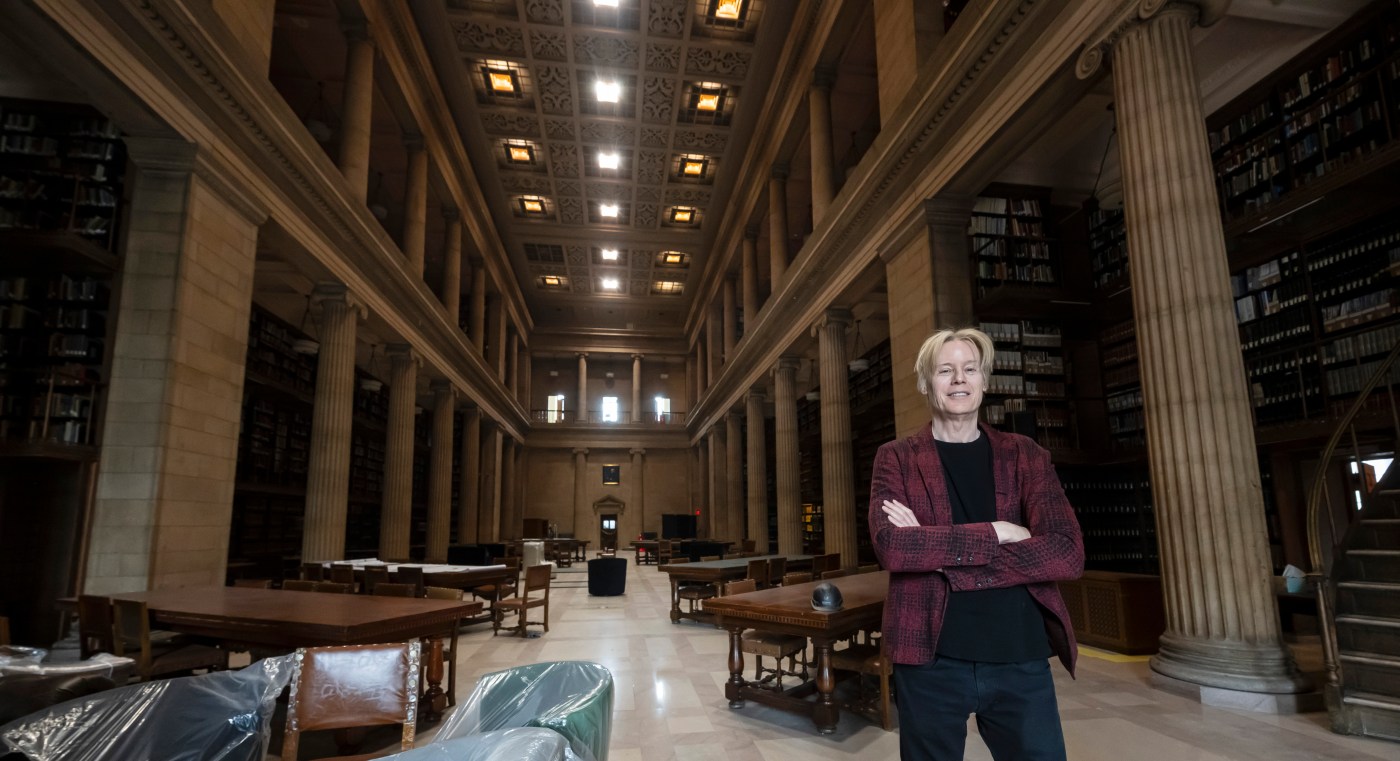
Construction is underway on the Avalon, a new event hall within the long-dormant James J. Hill Center overlooking Rice Park. The former business research center, which opened in 1921, closed in 2019 amid growing maintenance needs. The Avalon could throw open the doors to weddings, cultural events and musical performances amidst its 14 Romanesque interior columns by late fall, according to developer Peter Remes of First & First Creative Real Estate in Minneapolis.

Developer Peter Remes looks over blueprints for the remodel and renovations of the James J. Hill Center in downtown St. Paul on Tuesday, May 27, 2025. (John Autey / Pioneer Press)

“I was born and raised in St. Paul,” said Remes, who chafed at the idea of a century-old historic library sitting idle. “It was very important to me. Having this building shuttered was not a benefit to anyone.”

Remes, who is perhaps best known in St. Paul for reviving the Vandalia Tower business center, said it’s taken four years to obtain permitting, secure state and federal historic tax credits and work through other obstacles for the site, which is getting a $3.5 million upgrade. That includes new bathrooms and heating, air conditioning and ventilation systems, as well as a new interior stairway to a new basement egress door.

The James J. Hill Center overlooks Rice Park in downtown St. Paul on Tuesday, May 27, 2025. (John Autey / Pioneer Press)

Despite the hefty price tag, “much of it is stuff that you won’t even see,” he acknowledged.

Despite the well-chronicled foreclosures and other property setbacks downtown associated with major property owner Madison Equities, “there’s a lot of great things happening here,” Remes said. “It’s not widely talked about. The bad news gets the attention. But there are people who are really dedicated to St. Paul.”

Bright spots elsewhere

On Wabasha Street, chef Terry John Zila has relaunched the former Gallery Kitchen in the basement of the Osborn 370 building into a softly-lit event center geared toward private gatherings, cooking classes and musical performances.

Terry John Zila, owner of HepCat Coffee makes a cup of coffee in his new downtown St. Paul eatery, which is seeing renewed signs of life after two years of the pandemic, March 3, 2022. (Scott Takushi / Pioneer Press)

In addition to pop-up dinners to “test the waters” on his catering menus, Zila plans to expand his HepCat Coffee space on the ground level, reorienting it toward the lobby of the former Ecolab building with the help of a city STAR grant.

“People are still discovering us,” said Zila, who moved his catering operation and coffee shop into Osborn 370 in February 2022. “Two or three times a week, (customers) say, ‘I didn’t even know you were here.’”

Zila hopes to become a bit of a commissary for the 174 new market-rate apartments under construction next door within the Stella, the former Ecolab tower at Sixth and Wabasha streets.

Those apartments may be online by early next year, adding to the foot traffic already evident at Osborn 370, the former Ecolab Corporate Center, which has drawn a wide range of both young and established planning and financial firms, including Bridgewater Bank and the Greater MSP Partnership, since its repositioning under PAK Properties.

‘Coming soon’

A “Coming Soon!” sign advertises the imminent arrival of Six Mears, a new Sixth Street restaurant where Barrio once opened its doors onto Mears Park. (John Autey / Pioneer Press)

Meanwhile, across downtown, a “Coming Soon!” sign advertises the imminent arrival of Six Mears, a new Sixth Street restaurant where Barrio once opened its doors onto Mears Park.

Another event center, Le Venere — a new addition to the A’Bulae event center — will host a Roaring 1920s-themed grand opening celebration toward the end of the month within the Gilbert Building on Wacouta Street.

Prince Coal Fired Pizza is expected to open in July within the former Black Sheep Pizza space at the Rossmor Building on Robert Street.

Palace Pub will be opening soon on Seventh Place in the space previously occupied by Wrecktangle Pizza’s Wrestaurant at the Palace.

Recent arrivals

Sherman Associates has completed its $80 million to $100 million conversion of Landmark Towers on St. Peter Street from a 26-story office building. It’s now home to 187 new luxury apartments, with each layout named after 1980s icons like “The Bruce” and “The Axl.” The converted structure welcomed its first new tenants around the start of May.

Related Articles


Homebuying options remain slim for middle-income earners


St. Paul Planning Commission deals setback to Hamm’s Brewery apartments


Asked on Reddit: How to stop obsessing about money


Trump tells US steelworkers he’s going to double tariffs on foreign steel to 50%


Taylor Swift has regained control of her music, buys back first 6 albums

Phe Coffee opened within the Market House on Fifth Street in Lowertown this past January. SoYen Desserts, which opened in March 2024, continues to draw a sell-out crowd every weekend down the street in the Northwestern Building at 275 E. Fourth St.

The Union Depot’s retail spaces are now fully leased with the recent additions of Story Line Books and the 1881 Eating House, which debuted its new outdoor summer patio on Thursday.

Global Storage Partners, of Carlsbad, Calif., was unable to install mini-storage in the Allen Building so it recently purchased four of the six floors in the annex building to the Custom House Apartments on Kellogg Boulevard. They’ve installed Extra Space Storage as manager, with large illuminated signage that has irked some neighbors.

Relocations, reopenings and new acquisitions

On Wabasha Street, Afro Deli is moving across the street from its current location and prepping a new food counter where Slice Pizza briefly served up pies within Treasure Island Center, a former Macy’s department store.

In July, St. Paul Brewing and Can Can Wonderland plan to reopen the recently-shuttered Dark Horse bar on East Seventh Street, with a new chef, decor and menu.

The Town Square food court and skyway has drawn several former tenants from Alliance Bank Center, including B’s Barbershop, Greenwolf Hemp and Organics and Paul Hartquist Jewelers.

Other reopenings over the past year include Mickey’s Diner, Ruam Mit Thai and Alary’s — now home to Pete’s BBQ. Two temporarily-shuttered downtown storefronts — La Noire Bridal and Garso Mini-Mart — also plan to reopen in new downtown locations this summer.

In April, Exchange Ventures LLC of Lake Forest, Calif., purchased the Gallery Professional Building, a former medical office building at 17 W. Exchange St., from the Salvation Army for $199,000. Despite the rock-bottom sales price for the vacant eight-story structure, property taxes based on its assessed market value are high, as are maintenance costs, and parking is limited, said the buyer, who did not disclose his full name when reached by phone May 20. He said he’s hoping to get some leeway from the city and county before renovating, likely for office and retail uses, he said.

Parks

Following an $8 million planning and construction effort, the long-awaited Pedro Park will open by late summer at 10th and Robert streets.

Along Kellogg Boulevard, Kellogg Mall Park will soon host a publicly available restroom and a designated “park ambassador” to keep the park clean and amenities fresh, according to St. Paul Parks and Recreation. A full schedule of summer events is online at kelloggmallpark.com.

Osborn Plaza, the city-owned plaza along Wabasha Street, will be reconstructed this summer and fall.

Related Articles


City of St. Paul hosts downtown block party


Ellison drops objection to appointment of Otto Bremer Trust trustee’s daughter


Christopher Harrington: Experiencing the arts transforms the way we see the world


Frost championship celebration livens up Xcel Energy Center


Judicial cookout for the homeless renamed for late founder Jim Randall

St. Paul Parks and Rec will soon replace a retaining wall in Mears Park, a $98,000 project. The free summer concert series “Lowertown Sounds” returns this summer with the New Standards, Salsa Del Soul, Yam Haus, Kiss the Tiger and the Flamin’ Ohs. A complete schedule is online at LowertownSounds.com.

A downtown block party was scheduled at Mears Park from 5 to 7 p.m. May 30, with live music, as well as food and drinks provided by Barrel Theory, the Bulldog and Lost Fox.

Vandals uprooted 60 freshly-planted trees along Shepard Road last November. St. Paul Parks and Rec replanted them on May 16.

Not far outside downtown, the Victorian-style Irvine Park fountain has returned home following an eight-month, $120,000 restoration effort.

A full schedule of downtown park events is online at stpaul.gov/downtownparks.

It’s not a reprint. Why Sacred Harp singers are revamping an iconic pre-Civil War hymnal

posted in: All news | 0

By HOLLY MEYER

BREMEN, Ga. (AP) — Singers at Holly Springs Primitive Baptist Church in West Georgia treat their red hymnals like extensions of themselves, never straying far from their copies of “The Sacred Harp” and its music notes shaped like triangles, ovals, squares and diamonds.

Related Articles


Taylor Swift has regained control of her music, buys back first 6 albums


Music Review: Miley Cyrus’ ‘Something Beautiful’ is a return to form. ‘Hannah Montana’ fans, rejoice


Billy Joel cancels all future shows due to brain disorder


Column: AC/DC and the underrated art of doing the same thing forever


Concert review: Post Malone fills U.S. Bank Stadium with help from Jelly Roll

In four-part harmony, they sing together for hours, carrying on a more than 180-year-old American folk tradition that is as much about the community as it is the music.

It’s no accident “The Sacred Harp” is still in use today, and a new edition — the first in 34 years — is on its way.

Since the Christian songbook’s pre-Civil War publication, groups of Sacred Harp singers have periodically worked together to revise it, preserving its history and breathing new life into it. It’s a renewal, not a reprint, said David Ivey, a lifelong singer and chair of the Sacred Harp Publishing Company’s revision and music committee.

“That’s credited for keeping our book vibrant and alive,” said Ivey.

First published in 1844 by West Georgia editors and compilers Benjamin F. White and Elisha J. King, revisions of the shape-note hymnal make space for songs by living composers, said Jesse P. Karlsberg, a committee member and expert on the tradition.

A 1911 edition of “The Sacred Harp,” a shape-note hymnal from the 1800s, opened to song No. 43, “Primerose Hill,” at the Sacred Harp Publishing Company and Museum in Carrollton, Ga., on Friday, March 21, 2025. (AP Photo/Jessie Wardarski)

“This is a book that was published before my great-grandparents were born and I think people will be singing from it long after I’m dead,” said Karlsberg, who met his wife through the a cappella group practice, which is central to his academic career. It’s also his spiritual community.

“It’s changed my life to become a Sacred Harp singer.”

Cuts, additions and other weighty decision making

The nine-member revision committee feels tremendous responsibility, said Ivey, who also worked on the most recent 1991 edition.

Sacred Harp singers are not historical reenactors, he said. They use their hymnals week after week. Some treat them like scrapbooks or family Bibles, tucking mementos between pages, taking notes in the margins and passing them down. Memories and emotions get attached to specific songs, and favorites in life can become memorials in death.

“The book is precious to people,” said Ivey, on a March afternoon surrounded by songbooks and related materials at the nonprofit publishing company’s museum in Carrollton, Georgia.

Sacred Harp singing is a remarkably well-documented tradition. The small, unassuming museum — about 50 miles west of Atlanta near the Alabama state line — stewards a trove of recordings and meeting minutes of singing events.

Sarah George, who met her husband through Sacred Harp singing, holds their son while leading a song from the hollow square at a Sacred Harp gathering in Bremen, Ga., at Holly Springs Primitive Baptist Church on Saturday, March 22, 2025. (AP Photo/Jessie Wardarski)

The upcoming edition is years in the making. The revision, authorized by the publishing company’s board of directors in October 2018, was delayed by the COVID-19 pandemic. It now will be released in September at the annual convention of the United Sacred Harp Musical Association in Atlanta.

Ivey hopes singers fall in love with it, though he knows there is nervousness in the Sacred Harp community. For now, many of the changes are under wraps.

Assembled to be representative of the community, the committee is being methodical and making decisions through consensus, Ivey said. Though most will remain, some old songs will be cut and new ones added. They invited singer input, holding community meetings and singing events to help evaluate the more than 1,100 new songs submitted for consideration.

Singing unites generations of family and friends

Sarah George, who met her husband through Sacred Harp and included it in their Episcopal wedding, hopes his compositions make the 2025 edition and their son grows up seeing his dad’s name in the songbook they will sing out of most weekends.

More so, George is wishing for a revival.

Her hope for “the revision is that it reminds people and reminds singers that we’re not doing something antiquated and folksy. We’re doing something that is a living, breathing worship tradition and music tradition,” said George, during a weekend of singing at Holly Springs.

Dozens gathered at the church for the Georgia State Sacred Harp Convention. Its back-to-back days of singing were interrupted by little other than potluck lunches and fellowship.

Sharing a pew with her daughter and granddaughter, Sheri Taylor explained that her family has sung from “The Sacred Harp” for generations. Her grandfather built a church specifically for singing events.

Sheri Taylor, left, sits with her daughter, Laura Wood, and granddaughter, Riley McKibbin, 11, while singing from “The Sacred Harp” in the tenor section at Holly Springs Primitive Baptist Church in Bremen, Ga., on Saturday, March 22, 2025. (AP Photo/Jessie Wardarski)

“I was raised in it,” said Taylor.

They’ve also known songwriters. Her daughter Laura Wood has fond childhood memories of singing with the late Hugh McGraw, a torchbearer of the tradition who oversaw the 1991 edition. While her mother is wary of the upcoming revision, knowing some songs won’t be included, Wood is excited for it.

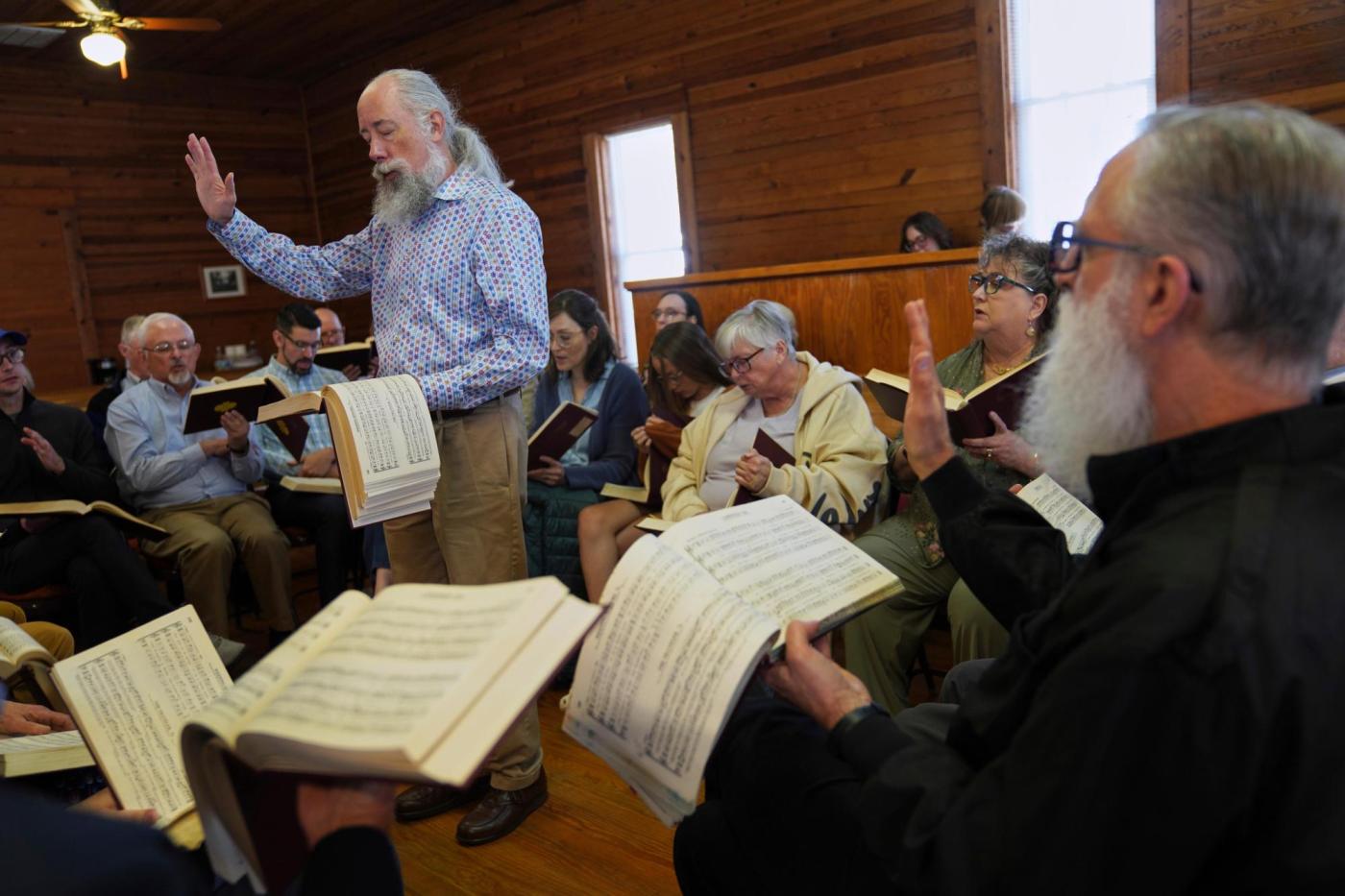
At Holly Springs, they joined the chorus of voices bouncing off the church’s floor-to-ceiling wood planks and followed along in their songbooks. Wood felt connected to her family, especially her late grandmother.

“I can feel them with me,” she said.

Fa, sol, la, mi and other peculiarities of shape-note singing

Like all Sacred Harp events, it was not a performance. “The Sacred Harp” is meant to be sung by everyone — loudly.

Anyone can lead a song of their choosing from the hymnal’s 554 options, but a song can only be sung once per event with few exceptions. Also called fa-sol-la singing, the group sight-reads the songs using the book’s unique musical notations, sounding first its shape notes — fa, sol, la and mi — and then its lyrics.

“The whole idea is to make singing accessible to anyone,” said Karlsberg. “For many of us, it’s a moving and spiritual experience. It’s also a chance to see our dear friends.”

The shape-note tradition emerged from New England’s 18th century singing school movement that aimed to improve Protestant church music and expanded into a social activity. Over time, “The Sacred Harp” became synonymous with this choral tradition.

“The Sacred Harp” was designed to be neither denominational nor doctrinal, Karlsberg said. Many of its lyrics were composed by Christian reformers from England, such as Isaac Watts and Charles Wesley, he said. It was rarely used during church services.

Instead, the hymnal was part of the social fabric of the rural South, though racially segregated, Karlsberg said. Before emancipation, enslaved singers were part of white-run Sacred Harp events; post-Reconstruction, Black singers founded their own conventions, he said. “The Sacred Harp” eventually expanded to cities and beyond the South, including other countries.

“The Sacred Harp” is still sung in its hollow square formation. Singers organize into four voice parts: treble, alto, tenor and bass. Each group takes a side, facing an opening in the center where a rotating song leader guides the group and keeps time as dozens of voices come from all sides.

Christian or not, all singers are welcome

“It’s a high. I mean it’s just an almost indescribable feeling,” said Karen Rollins, a longtime singer and committee member.

At the museum, Rollins carefully turned the pages of her first edition copy of “The Sacred Harp,” and explained how the tradition is part of her fiber and faith. She often picks a Sunday singing over church.

“I like the fact that we can all sing — no matter who we are, what color, what religion, whatever — that we can sing with these people and never, never get upset talking about anything that might divide us,” she said.

Though many are Christian, Sacred Harp singers include people of other faiths and no faith, including LGBTQ+ community members who found church uncomfortable but miss congregational singing.

Trees encircle Holly Springs Primitive Baptist Church, which has been a historical meeting site for Sacred Harp singers for generations, in Bremen, Ga., on Sunday, March 23, 2025. (AP Photo/Jessie Wardarski)

“It’s the good part of church for the people who grew up with it,” said Sam Kleinman, who stepped into the opening at Holly Springs to lead song No. 564 “Zion.” He is part of the vibrant shape-note singing community in New York City, that meets at St. John’s Lutheran Church near the historic Stonewall Inn.

Kleinman, who is Jewish but not observant, said he doesn’t have a religious connection to the lyrics and finds singing in a group cathartic.

Whereas Nathan Rees, a committee member and Sacred Harp museum curator, finds spiritual depth in the often-somber words.

“It just seems transcendent sometimes when you’re singing this, and you’re thinking about the history of the people who wrote these texts, the bigger history of just Christian devotion, and then also the history of music and this community,” he said.

Matt Hinton, a shape-note singer, leads a song at a Sacred Harp singing event held at Holly Springs Primitive Baptist Church in Bremen, Ga., on Saturday, March 22, 2025. (AP Photo/Jessie Wardarski)

At Holly Springs, Rees took his turn as song leader, choosing No. 374, “Oh, Sing with Me!” The group did as the 1895 song directed — loudly and in harmony like so many Sacred Harp singers before them.

“There’s no other experience to me that feels as elevating,” he said, “like you’re just escaping the world for a little while.”

Associated Press religion coverage receives support through the AP’s collaboration with The Conversation US, with funding from Lilly Endowment Inc. The AP is solely responsible for this content.