Daniel J. Stone: Biden’s cancer diagnosis should be a teaching moment

posted in: All news | 0

Former President Joe Biden’s metastatic cancer diagnosis brings together two controversial issues: PSA testing for prostate cancer and presidential politics.

To understand what is at stake Americans need basic information about PSA testing, and a frank discussion of the reasoning behind the prostate cancer screening decisions in the former president’s case. The dribble of information we’ve gotten only creates more uncomfortable questions for Biden and his family. The absence of adequate explanation also fails to contribute to public appreciation of these important medical issues.

The prostate, a walnut-shaped gland at the base of the bladder, produces “prostate specific antigen,” or PSA. Chemically classed as a glycoprotein, a sugar/protein aggregate, it leaks from the prostate into the blood, where its level can be measured with routine blood testing.

As men age, the prostate enlarges, increasing PSA levels. Screening tests take advantage of the fact that prostate cancer usually leaks more PSA than normal prostate tissue. And in the case of prostate cancer, the PSA typically rises relatively fast.

Beyond these basic facts, the PSA story becomes hazy. Although an elevated PSA may signal cancer, most men with an elevated PSA have benign prostate enlargement, not prostate cancer. Worse yet for screening, many men with prostate cancer have a mild and slow-moving disease that requires no treatment. They coexist with their disease rather than dying of it. This fact leads to the old adage that prostate cancer is the disease of long-lived popes and Supreme Court justices.

Medical advisory panels view PSA screening with skepticism partly due to the challenges of distinguishing benign PSA elevations from those related to cancer. Confirming a suspected cancer diagnosis requires prostate biopsies that can be painful and can produce side effects. Additionally, once a diagnosis is made, patients who might have coexisted with their disease may needlessly be subject to the harms of treatment, such as radiation and surgery. Finally, the benefits of early treatment of prostate cancer have been difficult to prove in clinical studies.

For all these reasons medical advisory panels have discouraged widespread testing or recommend a nuanced approach with careful discussion of risk and benefits between patients and their physicians.

Despite these concerns, the pendulum has swung toward more PSA testing in recent years. One reason is that improvements in radiographic imaging, such as MRI, allow for “active surveillance” that can track early lesions for signs of spread, allowing doctors to distinguish between relatively benign cases of prostate cancer and those likely to progress. Interventions can then be directed more specifically to those at high risk.

In my medical practice, I have generally been an advocate for prostate cancer screening despite the controversy surrounding the clinical benefits. My experience leads me to believe that early diagnosis improves prognosis. But even without improved medical outcomes, patients and their families still benefit from early diagnosis for the purposes of planning. No one wants to be sideswiped by a late-stage symptomatic disease that limits both clinical and life choices.

In Biden’s case, after some initial delay a spokesperson revealed on May 20 that there had been no PSA testing since 2014, during Biden’s vice presidency. The reasons were not revealed.

Such a decision might have been justified based on questions about the benefits and risks of PSA testing. However, given the importance of the health of a vice president and potential future president one might have expected doctors to err on the side of more information. The omission invites speculation that the political implications of a borderline or increasing PSA might have played a decisive role. More information regarding his last PSA and the basis for the decision not to continue screening might put such speculation to rest.

Related Articles


Sarah McLaughlin: Once, international students feared Beijing’s wrath. Now Trump is the threat


Allison Schrager: Break up Columbia? Maybe, and the rest of the Ivy League, too


Bruce Yandle: Trump’s policy reversals — a new way to govern?


David French: Why Trump is mad at ‘sleasebag’ Leonard Leo


Cory Franklin: The lessons of ‘Shoeless’ Joe Jackson and the MLB’s rewriting of history

In the past, the public has gained insight into important medical conditions from the unfortunate maladies affecting the first families. Colon cancer screening received increased attention after President Reagan’s diagnosis in 1985. Betty Ford’s public disclosure of her struggles with alcoholism and prescription drug dependency helped de-stigmatize treatment for substance use disorders.

Biden’s illness also offers an opportunity. Consider that prostate cancer poses the greatest cancer mortality risk faced by non-smoking American men. Transparency in dealing with the former president’s condition would serve the public interest by increasing awareness and understanding of the important, nuanced care decisions faced by so many men.

Daniel J. Stone is an internist and geriatrician in Beverly Hills. He wrote this column for the Los Angeles Times.

Sarah McLaughlin: Once, international students feared Beijing’s wrath. Now Trump is the threat

posted in: All news | 0

American universities have long feared that the Chinese government will restrict its country’s students from attending institutions that cross Beijing’s sensitive political lines.

Universities still fear that consequence today, but the most immediate threat is no longer posed by the Chinese government. Now, as the latest punishment meted out to the Trump administration’s preeminent academic scapegoat shows, it’s our own government posing the threat.

In a May 22 letter, Homeland Security Secretary Kristi Noem announced she revoked Harvard University’s Student and Exchange Visitor Program certification, meaning the university’s thousands of international students must transfer immediately or lose their legal status. Harvard can no longer enroll future international students either.

Noem cited Harvard’s failure to hand over international student disciplinary records in response to a prior letter and, disturbingly, the Trump administration’s desire to “root out the evils of anti-Americanism” on campus. Among the most alarming demands in this latest missive was that Harvard supply all video of “any protest activity” by any international student within the last five years.

Harvard immediately sued Noem and her department and other agencies, rightfully calling the revocation “a blatant violation of the First Amendment,” and within hours a judge issued a temporary restraining order against the revocation.

“Let this serve as a warning to all universities and academic institutions across the country,” Noem wrote on X about the punishment. And on Tuesday, the administration halted interviews for all new student visas.

This is not how a free country treats its schools — or the international visitors who attend them.

Noem’s warning will, no doubt, be heard loud and clear. That’s because universities — which depend on international students’ tuition dollars — have already had reason to worry that they will lose access to international students for displeasing censorial government officials.

In 2010, Beijing revoked recognition of the University of Calgary’s accreditation in China, meaning Chinese students at the Canadian school suddenly risked paying for a degree worth little at home. The reason? The university’s granting of an honorary degree to the Dalai Lama the year before. “We have offended our Chinese partners by the very fact of bringing in the Dalai Lama, and we have work to resolve that issue,” a spokesperson said.

Beijing restored recognition over a year later, but many Chinese students had already left. Damage done.

Similarly, when UC San Diego hosted the Dalai Lama as commencement speaker in 2017, punishment followed. The China Scholarship Council suspended funding for academics intending to study at UCSD, and an article in the state media outlet Global Times recommended that Chinese authorities “not recognize diplomas or degree certificates issued by the university.”

This kind of direct punishment doesn’t happen very frequently. But the threat always exists, and it creates fear that administrators take into account when deciding how their universities operate.

American universities now must fear that they will suffer this penalty too, but at an even greater scale: revocation of access not just to students from China, but all international students. That’s a huge potential loss. At Harvard, for example, international students make up a whopping 27% of total enrollment.

Whether they publicly acknowledge it or not, university leaders probably are considering whether they need to adjust their behavior to avoid seeing international student tuition funds dry up.

Will our colleges and universities increase censorship and surveillance of international students? Avoid inviting commencement speakers disfavored by the Trump administration? Pressure academic departments against hiring any professors whose social media comments or areas of research will catch the eye of mercurial government officials?

And, equally disturbing, will they be willing to admit that they are now making these calculations at all? Unlike direct punishments by the Trump administration or Beijing, this chilling effect is likely to be largely invisible.

Harvard might be able to survive without international students’ tuition. But a vast number of other universities could not. The nation as a whole would feel their loss too: In the 2023-24 academic year, international students contributed a record-breaking $43.8 billion to the American economy.

Related Articles


Allison Schrager: Break up Columbia? Maybe, and the rest of the Ivy League, too


Bruce Yandle: Trump’s policy reversals — a new way to govern?


David French: Why Trump is mad at ‘sleasebag’ Leonard Leo


Cory Franklin: The lessons of ‘Shoeless’ Joe Jackson and the MLB’s rewriting of history


Clive Crook: The US is about to discover if deficits don’t matter

And these students — who have uprooted their lives for the promise of what American education offers — are the ones who will suffer the most, as they experience weeks or months of panic and upheaval while being used as pawns in this campaign to punish higher ed.

If the Trump administration is seeking to root out “anti-Americanism,” it can begin by surveying its own behavior in recent months. Freedom of expression is one of our country’s most cherished values. Censorship, surveillance and punishment of government critics do not belong here.

Sarah McLaughlin is senior scholar on global expression at the Foundation for Individual Rights and Expression and author of the forthcoming book “Authoritarians in the Academy: How the Internationalization of Higher Education and Borderless Censorship Threaten Free Speech.” She wrote this column for the Los Angeles Times.

Steak salad with carrot-ginger vinaigrette a savory sensation

posted in: All news | 0

For meat lovers, there’s nothing better on a spring day than firing up the grill and making yourself a really great steak.

But what if the weather doesn’t cooperate, or worse, your budget doesn’t allow for those fat New York strips or marbled rib-eyes you just know would fill your family’s savory hankerings with their rich, buttery flavor?

How about a steak salad instead?

Since the meat gets sliced thin against the grain into bite-sized pieces, you’ll need less of it to fill multiple dinner plates. And if you serve it with fresh, readily available (and economical) veggies like crisp greens and cucumbers, it will still feel substantial while offering a variety of textures, flavors and nutritional benefits.

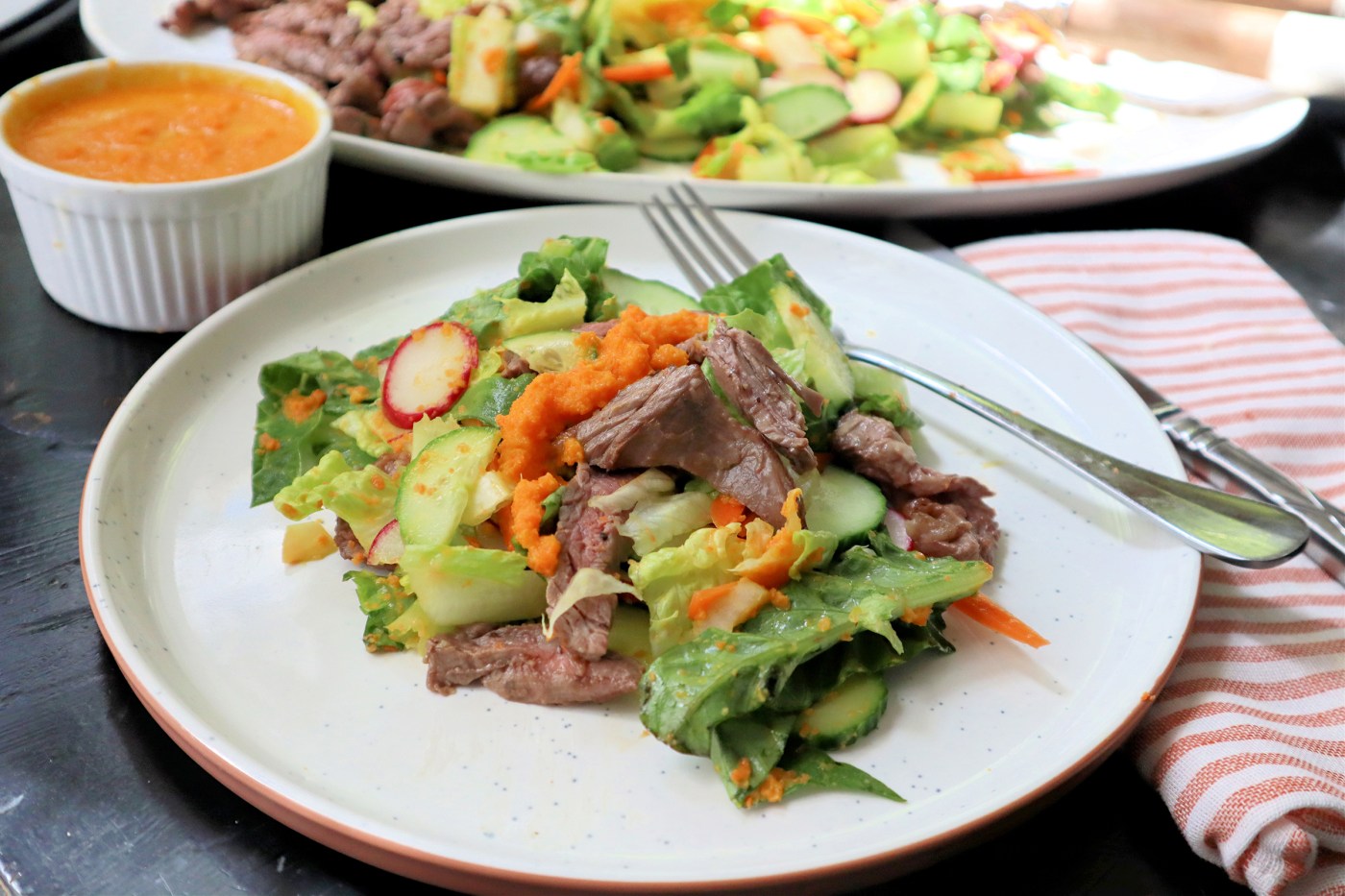
This flavorful salad marries pan-seared skirt steak — a budget-friendly cut with a rich, beefy flavor — with a bright and gingery carrot vinaigrette you make in a blender. They’re tossed with crisp disks of spicy radish, paper-thin slices of cucumber and the sweet and crunchy inner hearts of romaine lettuce.

Carrots can sometimes be almost an afterthought in salad because they’re one of those vegetables you feel obliged to include. (They’re cheap and plentiful year-round.) But here, they’re actually the star of the dish, adding color and earthiness to every bite.

While any store-bought variety of seasoned rice vinegar will work in this recipe (it’s enhanced with sugar and salt), the cookbook authors don’t suggest substituting regular rice vinegar in its place because you want that sweet-and-salty flavor.

Rather use homemade? Simply combine 1/2 cup unseasoned rice vinegar with 1/4 cup sugar and 1 tablespoon salt. Let sit for 5 minutes, then whisk constantly until the sugar and salt dissolve. (It can be stored in an airtight container at room temperature for up to 1 week.)

I cooked the steak per instructions in a cast-iron pan on the stovetop, but am looking forward to also trying it on the grill for a more smoky, charred flavor.

Steak Salad with Carrot-Ginger Vinaigrette

INGREDIENTS

For vinaigrette:

2 carrots, peeled and chopped
1/4 cup seasoned rice vinegar
3 tablespoons water
1 1/2 -inch piece ginger, peeled and chopped coarse
1 teaspoon toasted sesame oil
1/2 teaspoon salt
1/4 cup vegetable oil

For salad:

1 1/2 pounds skirt steak, trimmed and cut with grain into 4-inch lengths
1/2 teaspoon salt
1/4 teaspoon pepper
2 tablespoon vegetable oil, divided
3 romaine lettuce hearts, quarters and sliced thin
1/2 English cucumber, halved lengthwise and sliced thin
4 radishes, trimmed and sliced thin
2 carrots, peeled and cut into 2-inch matchsticks

DIRECTIONS

1. Make vinaigrette: Process carrots, vinegar, water, ginger, sesame oil and salt in blender until finely ground, about 30 seconds.

2. With blended running slowly add vegetable oil and process until incorporated and smooth, about 20 seconds. Set aside.

3. Prepare salad: Pat steak dry with paper towels and sprinkle with salt and pepper.

4. Heat 1 tablespoon oil in 12-inch skillet over medium-high heat until just smoking. Add half of steak and cook until well browned and meat registers 125 degrees (medium-rare), about 2 minutes per side.

5. Repeat with remaining 1 tablespoon oil and remaining steak. Let rest 5 minutes.

6. Toss lettuce, cucumber, radishes, carrots and 1/2 cup vinaigrette together in bowl. Divide salad among 4 plates.

7. Slice steak thin against grain. Top individual salad portions with steak.

8. Serve, passing remaining vinaigrette separately.

Serves 4.

— “The Complete Salad Cookbook” by America’s Test Kitchen

Related Articles


Quick Fix: Grilled Cheese Sandwich Supper with Spinach and Tomato Salad


Tangy cherry preserves bring balance to this ancient ricotta tart


7 easy ways to make your herbs last so much longer


Recipes: Use blackberries to make a pie, tiny cakes and even a salad


Light and breezy: Five easy weeknight dishes that won’t weigh you down

Snappy summer fare: Quick and easy weeknight meals for busy days

posted in: All news | 0

Oh, the beauty of a modular dinner: a meal you can put out on the table in several bowls — a base plus toppings — and let everyone assemble to their liking. This kind of food is easy to make, fun to eat and particularly useful for big groups and families, with their divergent, all-ages tastes. Baked potatoes, noodle bowls, black beans and rice (top with bacon, fried eggs, avocado), all great.

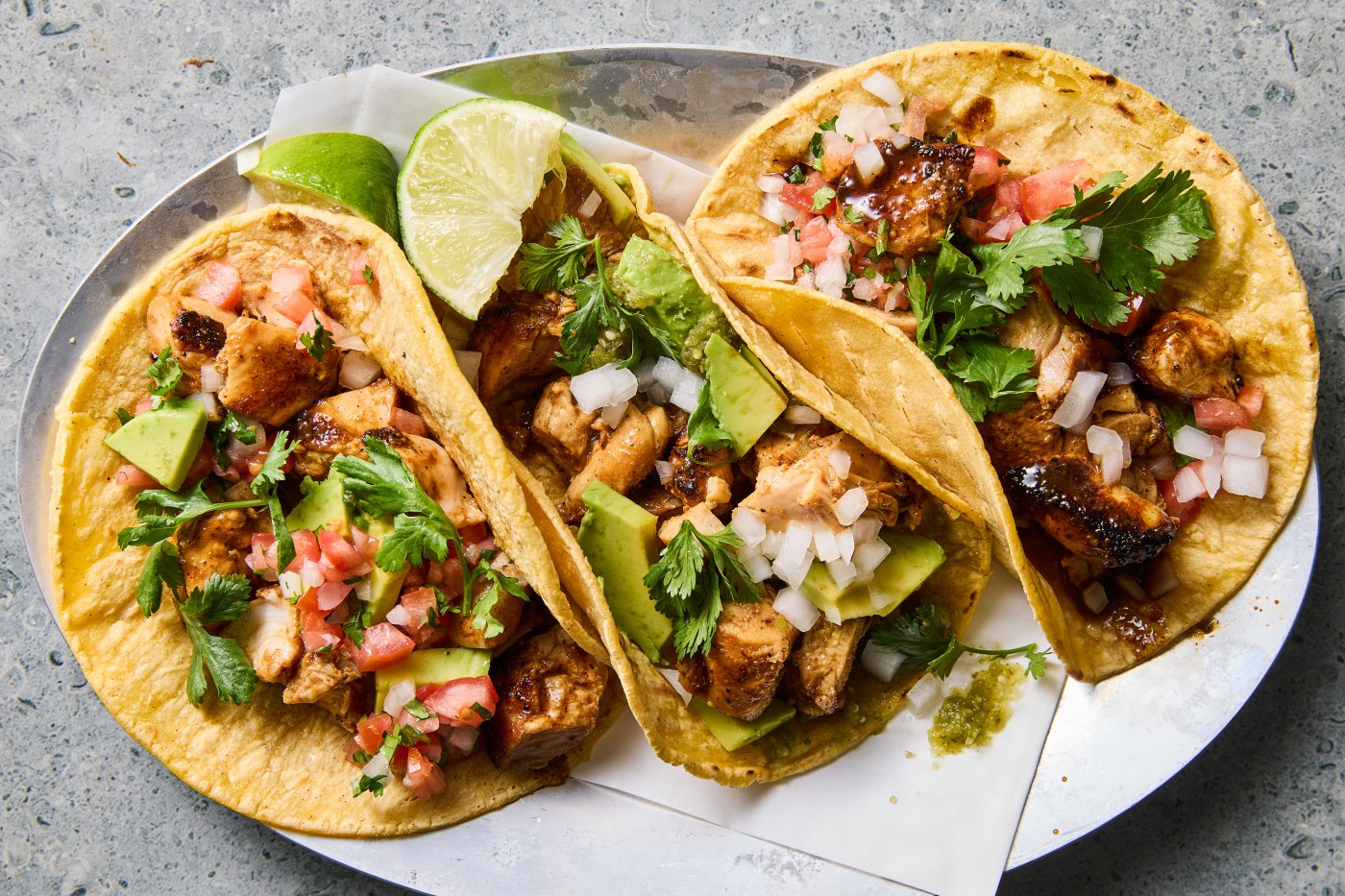
Tacos reign supreme in this do-it-yourself world, and we have a new recipe for easy chicken tacos; simply set them out and let people have at them. Just keep those soft tortillas warm, please! (After heating them on the stove, I wrap them in a dish towel; dampening the dish towel first works well.)

1. Easy Chicken Tacos

Tender chicken tacos using boneless, skinless thighs make a flavorful weeknight meal that, if you warm up your tortillas while the chicken cooks, will be ready in about half an hour. After browning the chicken, add water to release the browned bits from the bottom of the pan, then chop the meat into bite-sized pieces. Return the chicken to the pan, letting it simmer in the rich gravy that forms, then serve directly from the pan for easier cleanup. The marinade works with any vinegar-based hot sauce, which you can also offer as a topping. Serve taqueria-style with minced onion, cilantro, lime wedges and hot sauce, or if you have more time, add guacamole, salsa verde or pico de gallo to your spread. For a heartier meal, serve alongside rice or beans, or both.

By Kristina Felix

Yield: 8 tacos

Total time: 30 minutes

INGREDIENTS

4 boneless, skinless chicken thighs, about 1 1/2 pounds
3 garlic cloves, grated
1 lime, juiced, plus lime wedges for serving
1 tablespoon vinegar-based hot sauce (such as Crystal, Tabasco or Louisiana brands), plus more if desired for serving
1 teaspoon onion powder
4 tablespoons vegetable or avocado oil, divided
Salt and black pepper
8 corn or flour tortillas, warmed
Minced onion and cilantro, for serving
Guacamole, salsa verde, pico de gallo or pickled vegetables, for serving (optional)

DIRECTIONS

1. Mix the chicken, garlic, lime juice, hot sauce, onion powder, 2 tablespoons oil, 1 teaspoon salt and 1/2 teaspoon cracked black pepper in a bowl and toss to combine, making sure the chicken is thoroughly coated in the mixture.

2. Heat remaining 2 tablespoons oil in a 12-inch cast-iron skillet or other large heavy-bottomed pan over medium-high. Add chicken in a single layer and cook until browned and edges begin to crisp, 6 to 8 minutes per side. Using tongs or a fork, move the chicken from the pan to a cutting board. Adjust heat to medium-low, carefully add 1/2 cup water and scrape up the browned bits with a wooden spoon or spatula. Keep the skillet over medium-low while you proceed with the next step.

3. Cut the chicken into bite-sized pieces and return to the skillet. Toss to coat in the pan sauce and cook, stirring frequently, for 3 more minutes; turn off heat. Serve straight from the skillet with warm tortillas, onions and cilantro and your choice of additional toppings.

2. Peppery Beef and Shishito Stir-Fry

Peppery beef and shishito stir-fry. This new recipe from Zainab Shah is electrified by two kinds of pepper: green shishito peppers and coarsely ground black pepper. Food styled by Barrett Washburne. (Ryan Liebe/The New York Times)

This stir-fry is doubly peppery, thanks to a combination of shishito peppers and plenty of coarsely ground black pepper. Though most of the shishitos are mild, the occasional one packs a punch, adding a delightful unpredictability to any meal. The peppers are fried on high heat until they blister, bringing smoky depth and texture. Soy sauce and toasted sesame oil make a fine (and quick!) marinade for steak strips that are seared in the same wok. Ginger and garlic enhance an umami-rich sauce that makes the steak and peppers shine. Serve with white rice for a formidable weeknight meal in under 30 minutes.

By Zainab Shah

Yield: 4 servings

Total time: 25 minutes

INGREDIENTS

2 tablespoons plus 2 teaspoons cornstarch
1/4 cup plus 4 teaspoons low-sodium soy sauce
1 tablespoon toasted sesame oil
1 pound sirloin or other steak, sliced into 1-inch-wide strips
2 tablespoons vegetable or other neutral oil, plus more as needed
12 to 14 shishito peppers (about 4 ounces), stems removed
1 tablespoon garlic paste or freshly grated garlic
1 tablespoon ginger paste or freshly grated ginger
2 teaspoons coarsely ground black pepper, plus more for serving if desired
Salt
2 tablespoons rice vinegar
White rice, for serving

DIRECTIONS

1. In a medium bowl, mix 2 tablespoons of the cornstarch, 4 teaspoons of the soy sauce and all the sesame oil until smooth. Add the steak strips and mix until thoroughly coated.

2. In a separate small bowl or measuring cup, stir the remaining 2 teaspoons cornstarch into 1/3 cup cool water; set aside.

3. In a 10-inch wok or wide pot, heat the vegetable oil on high until hot, 30 seconds to 1 minute. Add the shishito peppers and cook, stirring, until they start to blister. Transfer peppers to a plate and set aside.

4. Working in batches and adding more oil if necessary between batches, add the steak strips to the wok in a single layer and cook, undisturbed, until the strips start to develop a char, about 1 minute per side. Transfer to the plate with the peppers.

5. Add the garlic and ginger to the wok and adjust heat to medium. Cook for 30 seconds, until the smell of raw garlic and ginger dissipates. Add the black pepper and season with about 1/2 teaspoon salt. Return the steak and peppers to the wok.

6. Stir in the vinegar and remaining 1/4 cup soy sauce, then the cornstarch mixture, and continue to cook, stirring constantly, until the sauce looks shiny and sticks to the back of a spoon. Taste the dish and season with more salt and pepper, if you like. Serve with rice.

3. Cheesy Baked Gnocchi With Spicy Tomato Sauce

Cheesy baked gnocchi with spicy tomato sauce. You can customize this saucy, molten dinner from Yossy Arefi. Food styled by Yossy Arefi. (Linda Xiao/The New York Times)

A stellar weeknight meal starter, shelf-stable or refrigerated gnocchi is combined with a zippy tomato sauce to make this deeply comforting one-pot meal. Stir in as much crushed red pepper as your family and friends can handle, then top the whole thing with a blanket of melty mozzarella, umami-packed Parmesan and bright basil. If you keep Calabrian chile paste on hand, it makes a great substitute for the crushed red pepper, as does harissa.

By Yossy Arefi

Yield: 4 to 6 servings

Total time: 45 minutes

INGREDIENTS

2 (28-ounce) cans whole peeled tomatoes
2 tablespoons unsalted butter
2 tablespoons extra-virgin olive oil
4 garlic cloves, thinly sliced
1 teaspoon crushed red pepper, or more to taste
Salt
2 (16- to 18-ounce) packages shelf-stable or refrigerated potato gnocchi
2 cups/8 ounces shredded low-moisture mozzarella
1/2 cup finely grated Parmesan
1/4 cup torn basil leaves

DIRECTIONS

1. Use kitchen shears to cut the tomatoes in each can into small pieces, or crush them with your hands.

2. Heat a large (12-inch), high-sided, oven-safe skillet over medium. Add the butter and olive oil. Swirl the pan until the butter melts, then add the garlic and crushed red pepper. Cook for about 30 seconds, stirring constantly, until sizzling and fragrant, taking care to not let the garlic brown.

3. Add the tomatoes and their juices to the skillet. Bring to a simmer and cook for about 15 minutes, stirring occasionally, until the sauce reduces and thickens slightly. Taste, then season with salt and more red pepper if desired. While the sauce is simmering, heat the broiler.

4. Stir the gnocchi into the simmering tomato sauce and cook for 3 minutes. Sprinkle mozzarella evenly over the top, then slide the pan under the broiler to melt and brown the cheese slightly, 2 to 5 minutes more. Keep a close eye on the pan, as all broilers vary.

5. Let the gnocchi cool in the pan for 10 minutes, then top with Parmesan and basil to serve.

4. Broiled Salmon With Chile, Orange and Mint

Broiled salmon with chile, orange and mint. Fresh mint and orange zest make this utterly simple Colu Henry recipe come to life. (Linda Xiao/The New York Times)

A butter-flavored sauce with vibrant citrus and herbs brings an easy elegance to your weeknight salmon. Red-pepper flakes give off a subtle heat — feel free to add more if you like — while orange zest and fresh mint cut the richness of this superbly fatty fish. A crisp green salad or sautéed asparagus would work well alongside, as would a glass of rosé.

By Colu Henry

Yield: 4 servings

Total time: 15 minutes

INGREDIENTS

4 tablespoons unsalted butter
1/2 teaspoon red-pepper flakes
1 1/2 teaspoons orange zest
3 tablespoons finely chopped mint
Kosher salt and black pepper
4 (5- to 6-ounce) salmon fillets
Flaky salt, for serving (optional)

DIRECTIONS

1. Turn on the broiler and position the oven rack to sit about 6 inches below it.

2. In a small saucepan, melt butter over medium-low heat. Add red-pepper flakes, and cook for about 1 minute. Remove butter from heat, and stir in orange zest and 2 tablespoons mint. Set aside.

3. Season salmon well with salt and pepper and place skin-side down on a rimmed baking sheet lined with foil. Spoon butter mixture evenly over the top of each fillet.

4. Broil salmon for 4 to 6 minutes until the skin becomes opaque and the fish appears flaky. It should be medium-rare in the thickest part of the fillet. If you prefer your salmon a bit more cooked, leave it in for another minute or so, moving it to a lower rack if the tops get too dark. Serve, and scatter with remaining mint. Season with flaky salt, if desired.

5. Eggplant Adobo

Eggplant adobo. Both tangy and silky (from a touch of coconut milk), this one-pot vegetarian riff on chicken adobo comes from Kay Chun. Food styled by Samantha Seneviratne. (Julia Gartland/The New York Times)

This superpunchy, one-skillet vegetarian meal is inspired by chicken adobo, a beloved Filipino dish. Here, eggplant cooks in rich, tangy adobo sauce — a blend of soy sauce, vinegar, garlic, black pepper and bay leaf — absorbing the savory flavors as it simmers. Coconut milk is added in some versions of adobo, creating a rich, silky texture to balance out the sauce’s tart notes. This recipe includes a shower of fragrant basil, which brings a fresh hit that lifts the dish. (Thinly sliced scallions would also be great.) Serve the eggplant over rice to catch all of its flavorful drippings.

By Kay Chun

Yield: 4 servings

Total time: 40 minutes

INGREDIENTS

5 tablespoons neutral oil, such as canola or safflower
1 1/2 pounds eggplant (preferably small Italian eggplant), cut into 1-inch cubes (about 8 cups)
Kosher salt and pepper
1/4 cup low-sodium soy sauce
1/4 cup unsweetened coconut milk
2 tablespoons distilled white vinegar
1 tablespoon turbinado or light brown sugar
1/2 white onion, thinly sliced
3 garlic cloves, minced
1 fresh or dried bay leaf
1/4 cup chopped basil, plus additional small leaves for garnish
Steamed jasmine rice, for serving

DIRECTIONS

1. In a 12-inch nonstick skillet, heat 2 tablespoons of the oil over medium. Add half of the eggplant, season with salt and pepper and cook, stirring occasionally, until golden, 5 minutes. Transfer to a plate and repeat with 2 tablespoons of the oil and the remaining eggplant.

2. Meanwhile, in a small bowl, combine soy sauce, coconut milk, vinegar, sugar, 1/2 teaspoon pepper and 2 tablespoons of water; mix well.

3. Add the remaining 1 tablespoon oil and the onion to the skillet and cook, stirring occasionally, until lightly golden, 3 minutes. Add garlic and stir until fragrant, 1 minute.

4. Add the browned eggplant, soy sauce mixture and bay leaf and toss to evenly coat. Cover, reduce heat to low and cook, stirring every 5 minutes, until the eggplant is tender but still has structure, about 10 minutes. Uncover and cook over medium heat, stirring occasionally, until the sauce thickens and nicely coats the eggplant, about 2 minutes longer. Season with salt and pepper and stir in the chopped basil.

5. Divide the eggplant mixture over rice among bowls. Garnish with basil leaves and serve warm.

Related Articles


Quick Fix: Grilled Cheese Sandwich Supper with Spinach and Tomato Salad


Tangy cherry preserves bring balance to this ancient ricotta tart


7 easy ways to make your herbs last so much longer


Recipes: Use blackberries to make a pie, tiny cakes and even a salad


Light and breezy: Five easy weeknight dishes that won’t weigh you down