By Gretchen McKay, Pittsburgh Post-Gazette
Tortellini is a winner when it comes to easy weeknight meals because it’s quick to prepare and lends itself to so many different dishes.
Related Articles
How Italian home cooks make their pasta taste so good
Budget-friendly bites: Rotisserie chicken and other cheap ingredients, elevated
Saffron brings a golden hue to this fresh combination of zucchini and pasta
This steak salad is a trattoria staple and the perfect summer lunch
Quick Fix: Pesto Chicken Burger on Ciabatta Bread with Quick Coleslaw
You can toss it with red sauce or pesto, or use the tiny dumplings to bulk up a savory broth. For heartier appetites, you can bake the pasta in a casserole dish in a creamy cheese sauce topped with breadcrumbs for an Italian take on mac ‘n’ cheese.
Tortellini also works wonderfully in a warm or cold salad because the tiny pillows filled with meat, cheese or greens like spinach go nicely with crisp, seasonal vegetables and creamy or tangy dressings.
Plus, it’s relatively inexpensive if you buy bagged, dried tortellini instead of the fresh pasta you find in the refrigerated section.
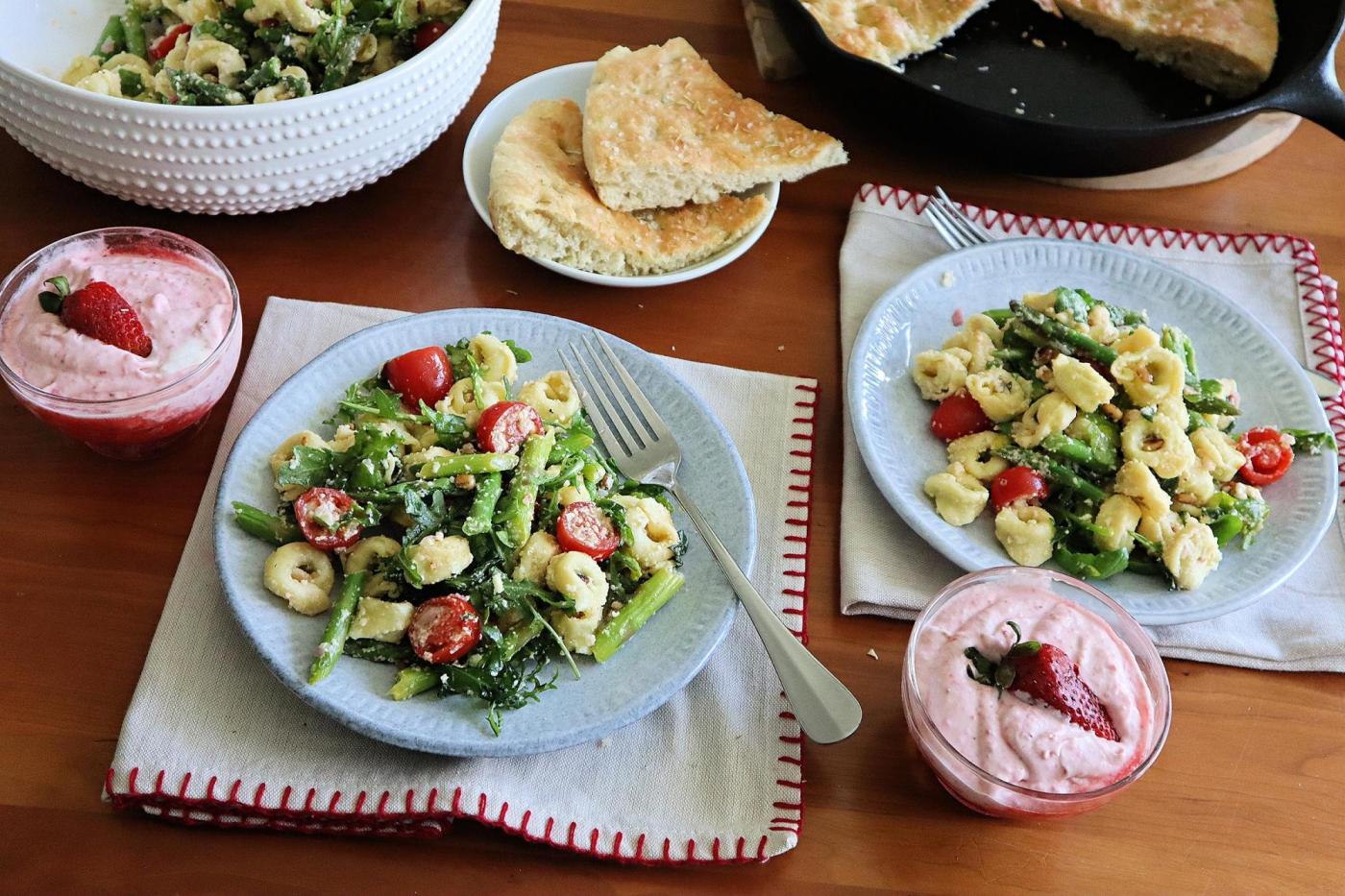
For our latest installment of our bi-monthly budget meal series, we do just that — toss bagged tortellini with bite-sized pieces of asparagus and juicy cherry tomatoes in an entree salad with a lemony, Parmesan-heavy dressing that literally takes seconds to whisk together.
Bookending the dinner is homemade focaccia dusted with salt and rosemary (it’s easier than you think!) and a fluffy strawberry mousse that requires just three ingredients: sugar, cream and berries.
The bread takes a few hours to prepare because the dough has to rise twice, but it only has to bake for around 20 minutes — about the same time it takes to toss together the pasta and veggies. Even better is the final tally — just $14. 22 for two with leftovers, or a budget-loving $7.11 per diner.
Before we get into the menu, we need a little bit of backstory on tortellini, which is one of the most beloved pasta types in Northern Italy.
Some say Castelfranco Emilia in the Emilia-Romagna region of Italy gave birth to this tender pasta stuffed with everything from ground beef to prosciutto to a mix of cheeses (the city holds an annual festival on the second Sunday in September). But Modena to the west and Bologna to the east also claim it as their own.
Whatever its geographical origins, tortellini (which means “little cake” or “little ring” in Italian) have been feeding the masses for centuries. In 1570, a rich pasta dish called tortelletti — made with capon breast, cow udder, beef marrow, fresh ricotta and warm spices like cinnamon — appeared in Italian Renaissance chef Bartolomeo Scappi’s cookbook, “Opera.”
The curved shape of the pasta also is open to a couple different interpretations. One of the most popular is that it was inspired by the contours of a beautiful woman — perhaps Venus, the Roman goddess of love and beauty — who a peeping tom-innkeeper saw when he peered through a keyhole as she undressed.
‘The recipe that follows is much easier than Scappi’s tortelletti to rustle up after work, and a whole lot cheaper.
The biggest expense (no surprise) was the tortellini, which cost $4.98 for 12 ounces. But since I was only serving two, I needed only 2/3 of the bag, bringing the price to just $3.35.
Taking advantage of what was on sale, I paid $1.50 for a half-pound of asparagus and $2.38 for a 1-pound container of strawberries.
The focaccia, which produced eight servings, was almost ridiculously cheap as it required only a small amount of all-purpose flour, a single teaspoon of active dried yeast and just a couple tablespoons of olive oil. Sprinkled with salt and dried rosemary, it was so delicious that I actually made it twice to make sure my initial try wasn’t a fluke.
While I didn’t calculate the cost of the olive oil (which I buy by the gallon) or the basil (always growing on my window sill), neither would have added much to the total tally, especially if you substitute vegetable oil and parsley. (Tip: Those potted basil plants you see in the produce department are always cheaper than the tiny plastic herb containers, and if you plant it in a small pot, you can keep clipping the leaves as needed.)
I also used a shallot and handful of arugula I found in my crisper, along with a clove of garlic that’s always, always on hand.
At the last minute, I threw in some toasted pine nuts for extra crunch, but they’re so expensive these days (especially Italian), it’s totally fine to go without.
While I designed this menu for a weeknight dinner, it works just as well for a summer picnic or cookout since everything travels well and doesn’t have to be reheated. (Though you will want to keep the strawberry mousse chilled in a cooler.)
No-Knead Pan Focaccia
PG tested
Breadmaking can be intimidating for many home cooks. This recipe for homemade focaccia, a flat Italian baked bread, should chase those fears away. Both the ingredient list and the process is simple, making it a great recipe for bread beginners.
I made the dough twice — once in a food processor and again in my KitchenAid mixer using the paddle attachment. They worked equally well.
I used dried rosemary and coarse sea salt to top it because that’s what I had in my spice cabinet.
2 cups all-purpose flour
1/2 teaspoon salt
1 teaspoon dry instant yeast
3/4 cup lukewarm water
3 tablespoons plus 3 teaspoons extra-virgin olive oil, divided
2 teaspoons coarsely chopped fresh or dried rosemary leaves
1/4 teaspoon flaky sea salt
Place flour, salt and yeast in a food processor fitted with the blade attachment and pulse to combine.
Add water and 2 tablespoons of olive oil. Pulse until a rough ball of dough forms, about 15 (2-second) pulses.
Drizzle 2 teaspoons of olive oil in a large bowl. Flour your hands, scoop the dough out of the food processor and form into a smooth ball. Place the dough in the oiled bowl and turn it so it’s coated on all sides.
Cover with plastic wrap or a kitchen towel and let it sit at warm room temperature until doubled in size, 2-3 hours.
Drizzle 1 teaspoon of olive oil in a 10-inch cast-iron or other ovenproof skillet and rub it over the bottom and sides. Punch down the dough and place in the skillet.
Using your fingertips, coax and stretch the dough to cover the bottom of the skillet and reach all the way to the edges.
Cover with plastic wrap or a kitchen towel and let rest at warm room temperature until puffed and slightly risen, 30-40 minutes. Meanwhile, arrange a rack in the middle of the oven and heat to 450 degrees.
Use your fingertips to gently dimple the surface of the dough. Drizzle the remaining 1 tablespoon of olive oil over the dough so that it pools in some of the indentations. Sprinkle with rosemary and flaky salt.
Place in the oven and immediately turn the heat down to 400 degrees. Bake until lightly golden-brown, 20-25 minutes.
Remove from the oven and cool for at least 15 minutes before slicing and serving. Focaccia is best eaten when warm, but is also good at room temperature. If the crust gets too soft, reheat in a 350-degree oven to crisp it up.
Ingredients for a budget tortellini salad for two. (Gretchen McKay/Pittsburgh Post-Gazette/TNS)
Tortellini Salad with Spring Veggies
PG tested
Pasta is always a good choice when you’re trying to keep costs down. This recipe has dried spinach tortellini, fresh asparagus, cherry tomatoes and a handful of baby arugula for a super-easy and filling spring meal.
Be sure to plunge the asparagus into an ice bath after it’s been blanched so it doesn’t overcook and stays bright green. If you happen to have pine nuts in your pantry, toast a few tablespoons and use as a garnish; if not, no worries — they’re an expensive add-on!
1/2 pound thin asparagus, trimmed and cut into bite-sized pieces
8 ounces packaged dried cheese or spinach tortellini
1/2 cup vegetable or olive oil
Juice of 1 lemon, plus more for serving
1 shallot, minced
1 clove garlic, minced
Handful of cherry or grape tomatoes, halved
Handful of fresh arugula or spinach, optional
Handful of chopped fresh basil or parsley, or combination
1/2 cup grated Parmesan cheese
1/4 cup toasted pine nuts, optional
Red pepper flakes, for garnish, optional
Bring a large pot of salted water to a boil. Fill a bowl with ice water.
Add asparagus to boiling water and cook until it’s crisp-tender, about 60-90 seconds, depending on thickness. Remove with a slotted spoon and immediately transfer to the ice bath.
Let cool, then dry with a paper towel and set aside.
Return water to a boil and add dried tortellini. Cook according to package instructions (about 10 minutes), stirring often. Drain tortellini and rinse with cold water. (This will prevent it from clumping together.) Drain again, leaving it just the tiniest bit damp.
Make vinaigrette: Whisk oil, lemon juice, shallot and garlic together. Season to taste with salt and pepper.
Prepare salad: Place cooked tortellini in a large serving bowl. Add vinaigrette and toss well to combine.
Add tomatoes, arugula or spinach, basil, grated Parmesan, pine nuts and cooled asparagus. Toss to combine, then season again with salt and pepper and extra lemon juice if you want some additional zing. You also can add a few pinches of dried red pepper, if desired,
Serve warm, chilled or at room temperature.
Serves 2, with leftovers.
— Gretchen McKay, Post-Gazette
Fresh Strawberry Mousse
PG tested
This seasonal, three-ingredient dessert comes together in less than 10 minutes. It’s fresh and fantastic.
1-pound container of strawberries
1/2 cup granulated sugar
1 cup whole whipping cream, cold
Rinse strawberries under running cold water, reserving 3 or 4 for garnish.
Slice remaining strawberries, then place in a blender or food processor along with the sugar. Process until it is a smooth puree.
Remove 1/2 cup of puree and set aside.
In a cold bowl, add cream and beat until stiff peaks form. (I used a KitchenAid mixer.) Gently (gently!) fold in remaining puree.
Divide reserved 1/2 cup of puree between 4 small glasses or serving dishes. Spoon the strawberry mousse on top, then refrigerate for 1 hour or up to over night, if desired.
Top with reserved strawberries (sliced or halved) and serve.
Serves 4.
— Gretchen McKay, Post-Gazette
©2025 PG Publishing Co. Visit at post-gazette.com. Distributed by Tribune Content Agency, LLC.