Trump is expected to sign a measure blocking California’s nation-leading vehicle emissions rules

posted in: All news | 0

By MICHELLE L. PRICE and SOPHIE AUSTIN

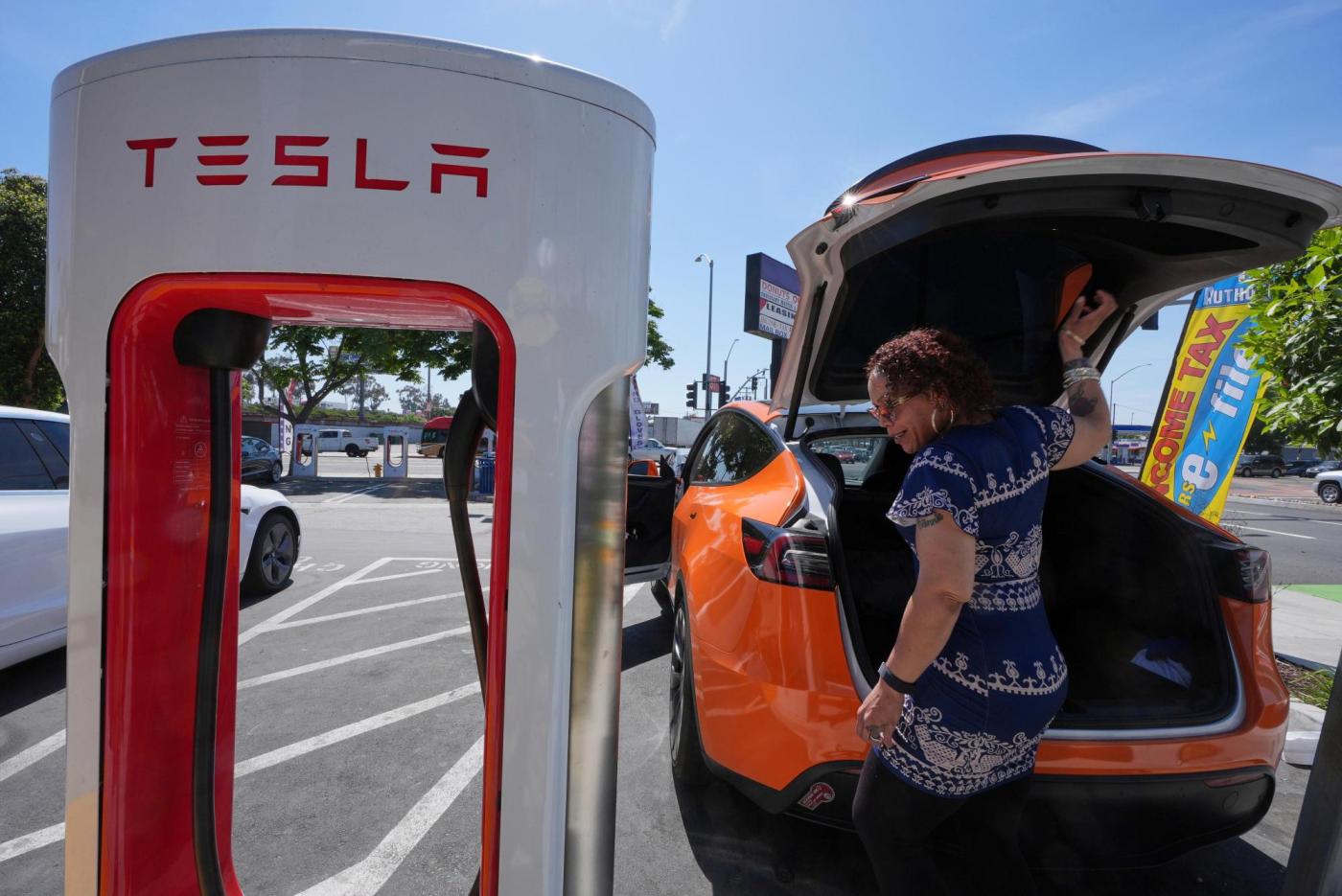
WASHINGTON (AP) — President Donald Trump is expected to sign a measure Thursday that blocks California’s first-in-the-nation rule banning the sale of new gas-powered cars by 2035, a White House official told The Associated Press.

Related Articles


Senate rejects effort to block arms sales over Trump’s dealings with Qatar and UAE


Iowa governor rejects GOP bill to increase regulations of Summit’s carbon dioxide pipeline


Consultant on trial for AI-generated robocalls mimicking Biden says he has no regrets


Kennedy’s new CDC panel includes members who have criticized vaccines and spread misinformation


Judge says government must release Columbia University protester Mahmoud Khalil

The resolution Trump plans to sign, which Congress approved last month, aims to quash the country’s most aggressive attempt to phase out gas-powered cars. He also plans to approve measures to overturn state policies curbing tailpipe emissions in certain vehicles and smog-forming nitrogen oxide pollution from trucks.

The timing of the signing was confirmed Wednesday by a White House official who spoke on condition of anonymity to share plans not yet public.

The development comes as the Republican president is mired in a clash with California’s Democratic governor, Gavin Newsom, over Trump’s move to deploy troops to Los Angeles in response to immigration protests. It’s the latest in an ongoing battle between the Trump administration and heavily Democratic California over everything from tariffs to the rights of LGBTQ+ youth and funding for electric vehicle chargers.

“If it’s a day ending in Y, it’s another day of Trump’s war on California,” Newsom spokesperson Daniel Villaseñor said in an email. “We’re fighting back.”

According to the White House official, Trump is expected to sign resolutions that block California’s rule phasing out gas-powered cars and ending the sale of new ones by 2035. He will also kill rules that phase out the sale of medium- and heavy-duty diesel vehicles and cut tailpipe emissions from trucks.

The president is scheduled to sign the measures and make remarks during an event at the White House on Thursday morning.

Newsom, who is considered a likely 2028 Democratic presidential candidate, and California officials contend that what the federal government is doing is illegal and said the state plans to sue.

Transportation Secretary Sean Duffy, Energy Secretary Chris Wright and Environmental Protection Agency Administrator Lee Zeldin are expected to attend, along with members of Congress and representatives from the energy, trucking and gas station industries.

The signings come as Trump has pledged to revive American auto manufacturing and boost oil and gas drilling.

The move will also come a day after the Environmental Protection Agency proposed repealing rules that limit greenhouse gas emissions from power plants fueled by coal and natural gas. Zeldin said it would remove billions of dollars in costs for industry and help “unleash” American energy.

California, which has some of the nation’s worst air pollution, has been able to seek waivers for decades from the EPA, allowing it to adopt stricter emissions standards than the federal government.

In his first term, Trump revoked California’s ability to enforce its standards, but President Joe Biden reinstated it in 2022. Trump has not yet sought to revoke it again.

Republicans have long criticized those waivers and earlier this year opted to use the Congressional Review Act, a law aimed at improving congressional oversight of actions by federal agencies, to try to block the rules.

That’s despite a finding from the U.S. Government Accountability Office, a nonpartisan congressional watchdog, that California’s standards cannot legally be blocked using the Congressional Review Act. The Senate parliamentarian agreed with that finding.

California, which makes up roughly 11% of the U.S. car market, has significant power to sway trends in the auto industry. About a dozen states signed on to adopt California’s rule phasing out the sale of new gas-powered cars.

The National Automobile Dealers Association supported the federal government’s move to block California’s ban on gas-powered cars, saying Congress should decide on such a national issue, not the state.

The American Trucking Associations said the rules were not feasible and celebrated Congress’ move to block them.

Chris Spear, the CEO of the American Trucking Associations, said in a statement Wednesday: “This is not the United States of California.”

It was also applauded by Detroit automaker General Motors, which said it will “help align emissions standards with today’s market realities.”

“We have long advocated for one national standard that will allow us to stay competitive, continue to invest in U.S. innovation, and offer customer choice across the broadest lineup of gas-powered and electric vehicles,” the company said in a statement.

Dan Becker with the Center for Biological Diversity, in anticipation of the president signing the measures, said earlier Thursday that the move would be “Trump’s latest betrayal of democracy.”

“Signing this bill is a flagrant abuse of the law to reward Big Oil and Big Auto corporations at the expense of everyday people’s health and their wallets,” Becker said in a statement.

Austin reported from Sacramento, Calif.

With velocity down, Twins starter Bailey Ober working on mechanical fixes

posted in: All news | 0

Take away his first start of the season, one during which Bailey Ober was pitching through an illness, and by and large, the starter has been decent this season.

He has a 2.85 earned-run average since that point and has given up three earned runs or less in every start but his last. But behind the scenes, Ober has felt mechanically off for parts of the season, something that he noted during spring training and again after his last two starts when his velocity dipped.

Ober, who is scheduled to start in the series finale against the Texas Rangers on Thursday, said his Tuesday bullpen felt good, and he believes he’s moving in the right direction — it’s just a matter of time.

“It’s harder to change patterns that are ingrained in how you’ve been throwing,” Ober said. “It’s all about just getting reps and moving the right way. Eventually, it’ll be muscle memory kind of (taking) over. But if you’re throwing for an extended period of time kind of the wrong way, your body is going to revert to that. So now it’s just time to get the reps in throughout the weeks.”

After his last start, Ober said his mechanics felt “not smooth and disjointed,” and he had been putting the work in to try to get his velocity back up. The average velocity on his four-seam fastball is currently 90.4 miles per hour this season, down from 91.7 mph last year.

The issues initially started this spring, Ober said, when he was dealing with a knee, hip issue. Nothing, he said, that would put him on the injured list, but still something that bothered him.

Now, he said, he is doing maintenance to keep his lower half healthy every day this season, and he physically “would like to be better,” but it’s “nothing I haven’t pitched through.”

“I was able to kind of figure it out for a little while at the beginning of the season. Up until mainly the last two or three starts ago,” Ober said. “But the stuff just kind of kicks back to, when something is off, you revert back to the way you were throwing. And that’s unfortunately the way I’ve been throwing. It hasn’t been the most efficient movement-wise. That’s why we’re seeing the lower velos. Just trying to work through it and stay healthy.”

Twins claim Wentz

The Twins claimed reliever Joey Wentz off waivers from the Pittsburgh Pirates on Wednesday and expect him to arrive for Thursday’s game.

Wentz, a 27-year-old lefty, had been designated for assignment over the weekend after posting a 4.15 ERA across 26 innings this season with the Pirates. He initially came up as a starter with the Detroit Tigers before shifting to relief.

“We’re excited to have him,” manager Rocco Baldelli said. “He’s a guy … that can give you length if you need i. But he also has good stuff so it gives you an opportunity to make good adjustments and maybe even help him go beyond even anything that he has been doing to this point.”

To make room on the 40-man roster, the Twins moved Pablo López to the 60-day injured list. López landed on the injured list last week with a teres major strain in his shoulder, and the Twins have said he will be out for eight to 12 weeks.

They are expected to make a move to add Wentz to the 26-man roster on Thursday. That move could be for Jorge Alcala, who currently has an 8.88 ERA and gave up six runs (five earned) on Tuesday.

Briefly

The Twins will cap their homestand today with a game against the Texas Rangers that begins at 12:10 p.m. Ober will be opposed by left-hander Patrick Corbin. After that, they will head out on a road trip that will take them to Houston and Cincinnati.

Bailey Ober #17 of the Minnesota Twins poses for a portrait at Lee Health Sports Complex during the Minnesota Twins Photo Day on Feb. 21, 2025 at the Lee County Sports Complex in Fort Myers, Florida. (Photo by Elsa/Getty Images)
Joey Wentz #43 of the Detroit Tigers poses for a portrait during photo day at Publix Field at Joker Marchant Stadium on Feb. 23, 2024 in Lakeland, Florida. (Photo by Kevin C. Cox/Getty Images)

Hamline grad Ethan Mundt, aka Utica Queen, to compete on ‘Project Runway’

posted in: All news | 0

A familiar face to Twin Cities drag fans is returning to reality TV competition.

Ethan Mundt, who performs as Utica Queen, is one of 12 contestants competing on the upcoming 21st season of “Project Runway,” which debuts July 31 on Freeform, Hulu and Disney+.

Minnesota native and Hamline graduate Ethan Mundt, whose drag name is Utica Queen, is a contestant on the upcoming 21st season of “Project Runway,” which debuts July 31, 2025 on Freeform, Hulu and Disney+. (Heidi Gutman / Disney)

“Walking into the ‘Project Runway’ workroom felt like stepping into a dream, but even more surreal was walking in wearing something that carries the spirit of Drag with me,” Mundt wrote on Instagram. “This is for every artist who dares to blur the lines, stitch the seams between worlds, and wear their truth like armor.”

Mundt made his television debut in 2021, when he placed sixth on the 13th season of “RuPaul’s Drag Race.” He earned praise on the show for the intricate costumes he created for himself. In the years since, Mundt has designed looks for numerous “Drag Race” contestants and judges.

Mundt took his drag name from his hometown of Utica, located about two hours southeast of St. Paul. “It’s a tiny, tiny town of 291 people,” he said during a January 2019 interview with the Pioneer Press. “We don’t even have a school or a gas station, but we do have four bars. And one gay who escaped.”

He first tried his hand at drag in kindergarten, when he dressed as Mary Poppins for Halloween. In high school, he joined a teenage improv troupe in Rochester that did a drag scene at the end of every show. After high school, Mundt went on to earn a double major in fine art and theater production from Hamline University: “I basically went to school to become a drag queen and it’s awesome.”

Mundt started doing shows as an amateur while studying at Hamline and eventually befriended some veteran queens who helped him refine his approach and look. He got more serious about drag after he graduated in 2017. He had firmly established himself in the Twin Cities when he relocated to Chicago as his season of “Drag Race” was airing.

“Project Runway” producers have rebooted the show, which debuted on Bravo in 2004, moved to Lifetime in 2009 and returned to Bravo in 2019. Original host and judge Heidi Klum, who left “Project Runway” after its stint on Lifetime, has returned to the show and will be joined by judges Nina Garcia and Law Roach. Fourth season winner Christian Siriano will return as the contestants’ mentor.

Related Articles


‘The Better Sister’ review: Estranged sisters reunite after a husband is murdered. Cue the intrigue


BET Awards to celebrate 25th anniversary with major star power from Kendrick Lamar to Mariah Carey


ABC’s Terry Moran is suspended following his social media post calling Trump and Miller haters


Australian reporter hit by nonlethal round during live report from LA immigration protests


Movie review: ‘John Wick’ spinoff ‘Ballerina’ twirls beautifully but aimlessly

Iowa governor rejects GOP bill to increase regulations of Summit’s carbon dioxide pipeline

posted in: All news | 0

By HANNAH FINGERHUT

DES MOINES, Iowa (AP) — Iowa Gov. Kim Reynolds on Wednesday rejected a bill that could have introduced more complications for a massive carbon-capture pipeline project routed across several Midwestern states, issuing a rare veto in the Republican-controlled statehouse.

Related Articles


Kennedy names 8 vaccine committee replacements, including COVID shot critic


Judge says government must release Columbia University protester Mahmoud Khalil


Hundreds of laid-off CDC employees are being reinstated


Members of the Fulbright scholarship board resign, accusing Trump of meddling


US reduces the presence of staffers not deemed essential in the Middle East as tensions rise

The legislation was designed by Iowa House Republicans to increase regulations of Summit Carbon Solutions’ estimated $8.9 billion, 2,500-mile project that cuts across Iowa and already has an approved permit in the state.

But the bill provoked loud opposition from members of Iowa’s powerful ethanol industry, which argued the project is essential for Iowa’s agricultural dominance, for farmers and for construction jobs. And it exposed a rift within the party over how to protect property rights.

“While I shared the bill’s goal of protecting landowners, good policy should draw clear, careful lines. This bill doesn’t,” said Reynolds, a Republican, in the explanation of her veto. “It combines valid concerns with vague legal standards and sweeping mandates that reach far beyond their intended targets.”

Despite her veto, Reynolds said she was “committed to working with the legislature to strengthen landowner protections, modernize permitting, and respect private property.”

Iowa state Rep. Bobby Kaufmann, a Republican who supported the bill in the House, said Wednesday that her commitment is too little, too late.

“If she was willing to work with us on this, where in the world has she been the last three years?” Kaufmann said. “She is clearly not siding with the constitutional rights of landowners but rather she’s siding with special interests.”

Summit faces obstacles in several states

Summit has said it has invested nearly $175 million to enter into voluntary agreements with landowners in Iowa and more than $1 billion on the project overall. In a statement, Summit thanked the governor for a thoughtful review of the bill and said their goal is to proceed with voluntary agreements with landowners.

Even with the relief from Reynolds’ veto, Summit will likely have to readjust plans after South Dakota’s governor signed a ban on the use of eminent domain — the government seizure of private property with compensation — to acquire land for carbon dioxide pipelines. Summit’s permit application was also rejected in South Dakota.

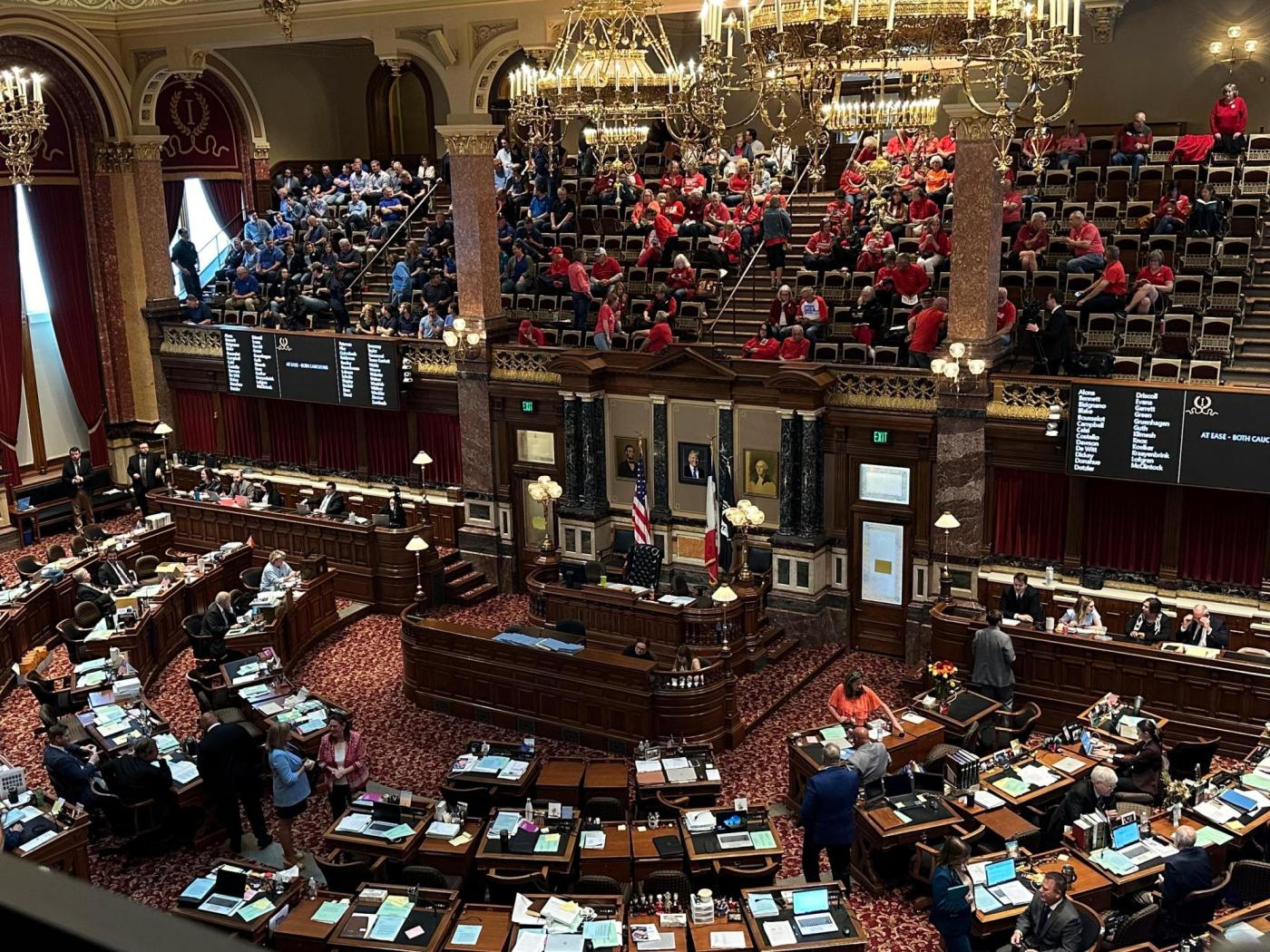
Iowans that rely on the state’s ethanol industry rally at the statehouse in Des Moines on Friday, May 9, 2025 to voice support for a massive carbon-capture pipeline project routed across several Midwest states. (AP Photo/Hannah Fingerhut)

The project has permit approvals in Iowa, Minnesota and North Dakota but faces various court challenges.

The Iowa bill would have prohibited the renewal of permits for a carbon dioxide pipeline, limited the use of such a pipeline to 25 years and significantly increased the insurance coverage requirements for the pipeline company.

Those provisions would likely have made it less financially feasible for a company to build a carbon dioxide pipeline.

“We look forward to continued discussions with state leaders as we advance this important project,” Summit said Wednesday. “At a time when farmers are facing increasing pressures, this project opens the door to new markets and helps strengthen America’s energy dominance for the long term.”

Rift in Republican-controlled statehouse

Republican House Speaker Pat Grassley said after Reynolds’ veto that he would pursue a special session to vote on an override, saying in a statement that the veto “is a major setback for Iowa.”

The Iowa Constitution states that a request for special session from two-thirds of both chambers, or the governor, can bring lawmakers back to Des Moines. Two-thirds of both chambers would need to vote for an override for the bill to become law without the governor’s approval.

“We will not stop fighting and stand firm on our commitment until landowners’ in Iowa are protected against Eminent Domain for private gain,” Grassley said.

Senate Majority Leader Jack Whitver suggested that would be unlikely in his chamber. Thirteen Republican senators had joined with 14 Democrats in voting in favor of the bill, but 21 Republicans and one Democrat voted against it.

“Based on the votes on that bill in the Iowa Senate, a significant majority of our caucus supports a better policy to protect landowner rights. I expect that majority of our caucus would not be interested in any attempt to override her veto,” he said.

As the legislative session wound down, a dozen Republican senators insisted their leaders bring the House-approved bill to the floor for a vote after several years of inaction. The stalemate ended in a long and divisive debate among the Iowa Senate’s Republican supermajority, with senators openly criticizing one another and exposing the closed-door discussions that got them there.

Summit’s project and its critics

The Summit pipeline was proposed to carry carbon emissions from ethanol plants in Iowa, Minnesota, Nebraska, North Dakota and South Dakota to be stored underground permanently in North Dakota.

By lowering carbon emissions from the plants, the pipeline would lower their carbon intensity scores and make them more competitive in the renewable fuels market.

The project would also allow ethanol producers and Summit to tap into federal tax credits.

Iowans in red shirts speak to reporters at the statehouse in Des Moines, Iowa, Friday, May 9, 2025 to reiterate their opposition to a massive carbon-capture pipeline project routed across several Midwest states. (AP Photo/Hannah Fingerhut)

The pipeline’s many critics have for years begged lawmakers for action. They accuse Summit of stepping on their property rights and downplaying the safety risks of building the pipeline alongside family homes, near schools and across ranches.

Lee Enterprises and The Associated Press reviewed hundreds of cases that reveal the great legal lengths the company went to to get the project built. In South Dakota, in particular, a slew of eminent domain legal actions to obtain land sparked a groundswell of opposition that was closely watched by lawmakers in Iowa as well.

A group of landowners released a statement Wednesday calling the veto a slap in the face.

“Big money, greed & self interest won the day,” said Jan Norris, a landowner in southwest Iowa whose neighbor is in the pipeline’s route. “Our property rights are for sale to the highest bidder.”