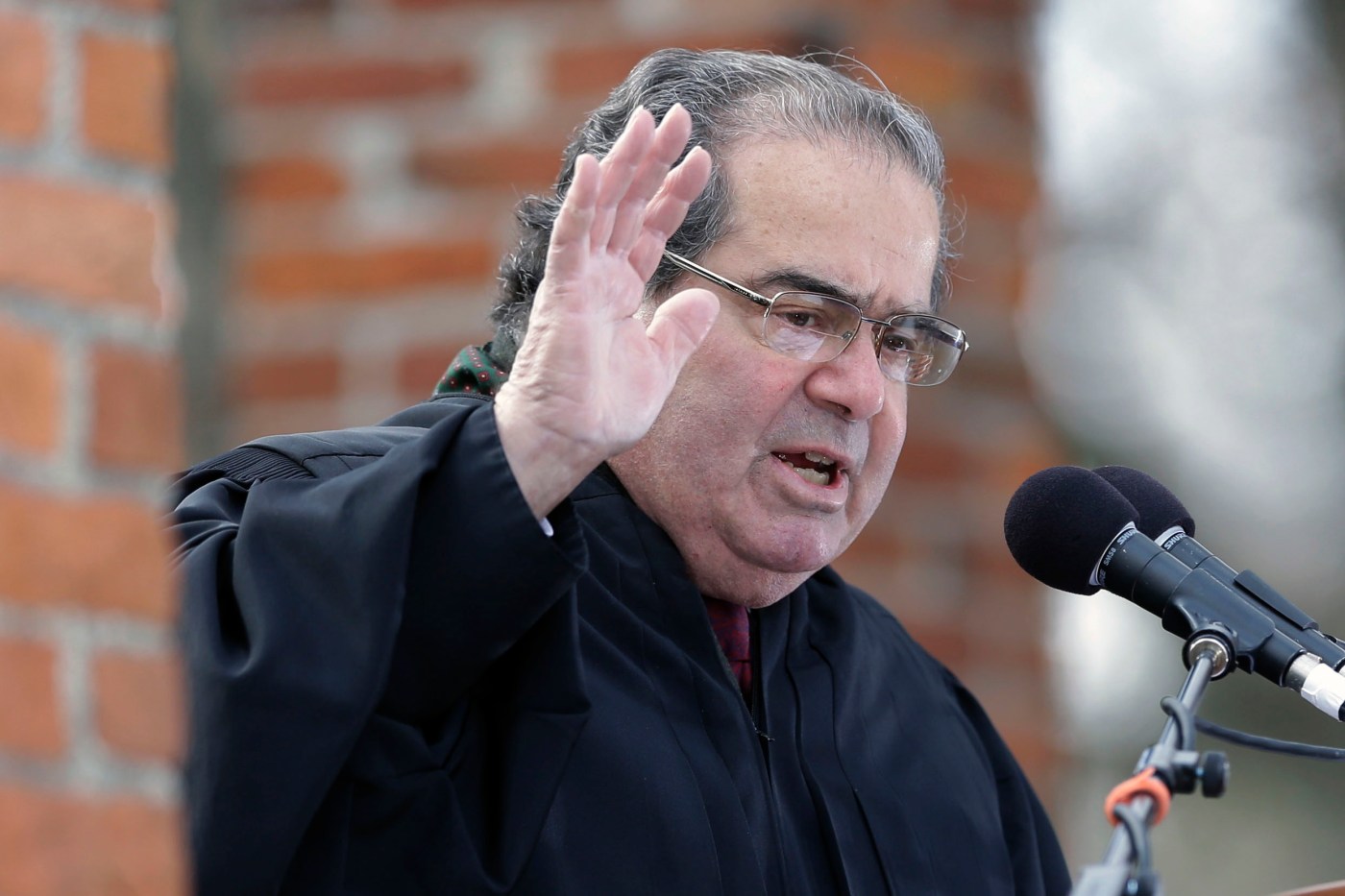
Virginia Supreme Court rules US Marine’s adoption of an Afghan war orphan will stand

posted in: All news | 0

By JULIET LINDERMAN and CLAIRE GALOFARO, Associated Press

The Virginia Supreme Court ruled Thursday that a U.S. Marine and his wife will keep an Afghan orphan they brought home in defiance of a U.S. government decision to reunite her with her Afghan family. The decision likely ends a bitter, yearslong legal battle over the girl’s fate.

In 2020, a judge in Fluvanna County, Virginia, granted Joshua and Stephanie Mast an adoption of the child, who was then 7,000 miles away in Afghanistan living with a family the Afghan government decided were her relatives.

Four justices on the Virginia Supreme Court on Thursday signed onto an opinion reversing two lower courts’ rulings that found the adoption was so flawed it was void from the moment it was issued.

FILE – U.S. Marine Corp Major Joshua Mast, center, talks with his attorneys during a break in the hearing of an ongoing custody battle over an Afghan orphan, March 30, 2023, at the Circuit Courthouse in Charlottesville, Va. (AP Photo/Cliff Owen, File)

The justices wrote that a Virginia law that cements adoption orders after six months bars the child’s Afghan relatives from challenging the court, no matter how flawed its orders and even if the adoption was obtained by fraud.

Three justices issued a scathing dissent, calling what happened in this court “wrong,” “cancerous” and “like a house built on a rotten foundation.”

An attorney for the Masts declined to comment, citing an order from the circuit court not to discuss the details of the case publicly. Lawyers representing the Afghan family said they were not yet prepared to comment.

The child was injured on the battlefield in Afghanistan in September 2019 when U.S. soldiers raided a rural compound. The child’s parents and siblings were killed. Soldiers brought her to a hospital at an American military base.

FILE – Marine Maj. Joshua Mast and his wife, Stephanie, arrive at Circuit Court, Thursday, March 30, 2023, in Charlottesville, Va. (AP Photo/Cliff Owen, File)

The raid was targeting terrorists who had come into Afghanistan from a neighboring country; some believed she was not Afghan and tried to make a case for bringing her to the U.S. But the State Department, under President Donald Trump’s first administration, insisted the U.S. was obligated under international law to work with the Afghan government and the International Committee of the Red Cross to unite the child with her closest surviving relatives.

The Afghan government determined she was Afghan and vetted a man who claimed to be her uncle. The U.S. government agreed and brought her to the family. The uncle chose to give her to his son and his new wife, who raised her for 18 months in Afghanistan.

Meanwhile, Mast and his wife convinced courts in rural Fluvanna County, Virginia, to grant them custody and then a series of adoption orders, continuing to claim she was the “stateless” daughter of foreign fighters.

Judge Richard Moore granted them a final adoption in December 2020. When the six-month statute of limitations ran out, the child was still in Afghanistan living with her relatives, who testified they had no idea a judge was giving the girl to another family. Mast contacted them through intermediaries and tried to get them to send the girl to the U.S. for medical treatment but they refused to let her go alone.

Related Articles


Lawyers say access to Everglades detention center is still hard to get as a judge weighs the case


Everyday lifestyle choices can add up to significant climate change impact


Camp Mystic parents seek stronger camp regulations in other states


Judge blocks Pentagon from punishing Sen. Mark Kelly for call to resist unlawful orders


2 US Navy ships collide in the Caribbean, leaving 2 sailors with minor injuries

When the U.S. military withdrew from Afghanistan and the Taliban took over, the family agreed to leave and Mast worked his military contacts to get them on an evacuation flight. Mast then took the baby from them at a refugee resettlement center in Virginia, and they haven’t seen her since.

The Afghans challenged the adoption, claiming the court had no authority over a foreign child and the adoption orders were based on Mast repeatedly misleading the judge.

The Virginia Supreme Court on Thursday wrote that the law prohibiting challenges to an adoption after six months is designed to create permanency, so a child is not bounced from one home to another. The only way to undercut it is to argue that a parent’s constitutional rights were violated.

The lower courts had found that the Afghan couple had a right to challenge the adoption because they were the girl’s “de facto” parents when they came to the United States.

Four of the Supreme Court judges — D. Arthur Kelsey, Stephen R. McCullough, Teresa M. Chafin, Wesley G. Russell Jr. — disagreed.

“We find no legal merit” in the argument that “that they were ‘de facto’ parents of the child and that no American court could constitutionally sever that relationship,” they wrote. They pointed to Fluvanna County Circuit Court Judge Richard Moore’s findings that the Afghan couple “are not and never were parents” of the child, because they had no order from an Afghan court and had not proven any biological relationship to her.

The Afghans had refused DNA testing, saying it could not reliably prove a familial connection between opposite-gender half-cousins. They insisted that it didn’t matter, because Afghanistan claimed the girl as its citizen and got to determine her next-of-kin.

The Supreme Court leaned heavily on a 38-page document written by Judge Moore, who granted the adoption, then presided over a dozen hearings after the Afghans challenged it. He wrote that he trusted the Masts more than the Afghans, and believed that Masts’ motivations were noble while the Afghans were misrepresenting their relationship to the child.

The Supreme Court also dismissed the federal government’s long insistence that Trump’s first administration had made a foreign policy decision to unite her with her Afghan relatives, and a court in Virginia has no authority to undo it. The government submitted filings in court predicting dire outcomes if the baby was allowed to remain with the Marine: it could be viewed as “endorsing an act of international child abduction,” threaten international security pacts and be used as propaganda by Islamic extremists — potentially endangering U.S soldiers overseas.

But the Justice Department in Trump’s second administration abruptly changed course.

The Supreme Court noted in its opinion that the Justice Department had been granted permission to make arguments in the case, but withdrew its request to do so on the morning of oral arguments last year, saying it “has now had an opportunity to reevaluate its position in this case.”

The Supreme Court returned repeatedly to Moore’s finding that giving the girl to the family “was not a decision the United States initiated, but rather consented to or acquiesced in.”

The three judges who dissented were unsparing in their criticism of both the Masts and the circuit court that granted him the adoption.

“A dispassionate review of this case reveals a scenario suffused with arrogance and privilege. Worse, it appears to have worked,” begins the dissent, written by Justice Thomas P. Mann, and signed by Chief Justice Cleo E. Powell and LeRoy F. Millette, Jr.

A Virginia court never had the right to give the child to the Masts, the dissent said.

They castigated the Masts for “brazenly” misleading the courts during their quest to adopt the girl.

“We must recognize what an adoption really is: the severance and termination of the rights naturally flowing to an otherwise legitimate claimant to parental authority. Of course, the process must be impeccable. An evolved society could not sanction anything less than that. And here, it was less,” Mann wrote. “If this process was represented by a straight line, (the Masts) went above it, under it, around it, and then blasted right through it until there was no line at all — just fragments collapsing into a cavity.”

Homeland Security shutdown seems certain as funding talks between White House and Democrats stall

posted in: All news | 0

By MARY CLARE JALONICK and KEVIN FREKING, Associated Press

WASHINGTON (AP) — A shutdown for the Department of Homeland Security appeared certain Thursday as lawmakers in the House and Senate were set to leave Washington for a 10-day break and negotiations with the White House over Democrats’ demands for new restrictions had stalled.

The White House and Democrats have traded offers in recent days as the Democrats have said they want curbs on President Donald Trump’s broad campaign of immigration enforcement. They have demanded better identification for U.S. Immigration and Customs Enforcement and other federal law enforcement officers, a new code of conduct for those agencies and more use of judicial warrants, among other requests.

The White House sent its most recent offer late Wednesday, including what Senate Majority Leader John Thune, R-S.D., said were “concessions” on the part of the Republican administration.

Thune would not say what those concessions were, though, and he acknowledged the sides were “a long ways toward a solution” even as the Senate is scheduled to vote again on the DHS funding.

Democrats did not respond publicly to the White House offer, but Democratic senators voted against a funding bill for the department before leaving town, meaning the funding will expire Saturday without further action. The bill was rejected, 52-47, short of the 60 votes needed for passage.

Lawmakers in both chambers were on notice to return to Washington if the two sides struck a deal to end the expected shutdown. But for now, Democrats say they need to see real changes before they will support DHS funding.

Americans want accountability and “an end to the chaos,” Senate Democratic leader Chuck Schumer of New York said Thursday before the vote. “The White House and congressional Republicans must listen and deliver.”

Schumer said it was not enough that the administration had announced an end to the immigration crackdown in Minnesota that led to thousands of arrests and the fatal shootings of two protesters.

“We need legislation to rein in ICE and end the violence,” Schumer said, or the actions of the administration “could be reversed tomorrow on a whim.”

Senate Minority Leader Chuck Schumer, D-N.Y., speaks during the Senate Democrat policy luncheon news conference at the Capitol, Tuesday, Feb., 10, 2026, in Washington. (AP Photo/Rod Lamkey, Jr.)

Judicial warrants a sticking point

Democrats made the demands for new restrictions on ICE and other federal law enforcement after ICU nurse Alex Pretti was shot and killed by a U.S. Border Patrol officer in Minneapolis on Jan. 24, Some Republicans suggested that new restrictions were necessary. Renee Good was shot by ICE agents on Jan. 7.

Thune, who has urged Democrats and the White House to work together, indicated that one sticking point is the Democratic request for more judicial warrants.

“The issue of warrants is going to be very hard for the White House or for Republicans,” Thune said. “But I think there are a lot of other areas where there has been give, and progress.”

In a list of demands they sent to the White House last week, Schumer and House Democratic leader Hakeem Jeffries of New York said DHS officers should not be able to enter private property without a judicial warrant and that warrant procedures and standards should be improved. They have said they want an end to “roving patrols” of agents who are targeting people in the streets and in their homes.

Most immigration arrests are carried out under administrative warrants. Those are internal documents issued by immigration authorities that authorize the arrest of a specific person but do not permit officers to forcibly enter private homes or other nonpublic spaces without consent. Traditionally, only warrants signed by judges carry that authority.

But an internal ICE memo obtained by The Associated Press last month authorizes ICE officers to use force to enter a residence based solely on a more narrow administrative warrant to arrest someone with a final order of removal, a move that advocates say collides with Fourth Amendment protections.

President Donald Trump listens as Environmental Protection Agency director Lee Zeldin speaks during an event announcing that the EPA will no longer regulate greenhouse gases, in the Roosevelt Room of the White House, Thursday, Feb. 12, 2026, in Washington. (AP Photo/Evan Vucci)

White House silence

Congress is trying to renegotiate the DHS spending bill after Trump agreed to a Democratic request that it be separated from a larger spending measure that became law last week. That package extended homeland security funding at current levels only through Friday.

Schumer and Jeffries have said they want immigration officers to remove their masks, to show identification and to better coordinate with local authorities. They have also demanded a stricter use-of-force policy for the federal officers, legal safeguards at detention centers and a prohibition on tracking protesters with body-worn cameras.

Democrats also say Congress should end indiscriminate arrests and require that before a person can be detained, authorities have verified that the person is not a U.S. citizen.

Republicans have been largely opposed to most of the items on Democrats’ list. But Trump has remained relatively silent about the talks.

Related Articles


Trump’s EPA revokes scientific finding that underpinned US fight against climate change


RFK Jr. pledged more transparency. Here’s what the public doesn’t know anymore


Judge blocks Pentagon from punishing Sen. Mark Kelly for call to resist unlawful orders


Democratic-led states sue to stop Trump from withholding $600M in health grants


RFK Jr. promised to restore trust in US health agencies. One year later, it’s eroding

Impact of a shutdown

Republicans tried to temporarily extend the funding, but Democrats blocked that bill as well.

“We will not support an extension of the status quo,” Schumer said.

The impact of a DHS shutdown is likely to be minimal at first. It would not likely block any of the immigration enforcement operations, as Trump’s tax and spending cut bill passed last year gave ICE about $75 billion to expand detention capacity and bolster enforcement operations.

But the other agencies in the department — including the Transportation Security Administration, the Federal Emergency Management Agency, the Secret Service and the Coast Guard — could take a bigger hit over time.

Gregg Phillips, an associate administrator at FEMA, said at a hearing this week that its disaster relief fund has sufficient balances to continue emergency response activities during a shutdown, but would become seriously strained in the event of a catastrophic disaster.

Phillips said that while the agency continues to respond to threats like flooding and winter storms, long-term planning and coordination with state and local partners is “irrevocably impacted.”

Associated Press writers Seung Min Kim and Rebecca Santana contributed to this report.

Pop-up poster show, at Can Can Wonderland through Feb. 19, highlights anti-ICE protest art

posted in: All news | 0

Some posters blare slogans like “ICE out of Minneapolis” and “We love our immigrant neighbors.” Others center imagery: fists crushing ice cubes; a dog peeing on a snowman dressed as a federal immigration agent.

A collection of around 50 posters protesting the current Immigration and Customs Enforcement crackdown is on view in a pop-up exhibition at Can Can Wonderland in St. Paul through Feb. 19, organized by the art collective Art You Heart.

A public celebration of the art will take place from 6 to 10 p.m. Saturday, Feb. 14. Poster designers will showcase their work; snow sculptor Dusty Thune is projecting images of anti-ICE snow sculptures including his own; and the muralist and graffiti artist Biafra will be painting live. Can Can Wonderland plans to donate proceeds from the evening’s regular admission ticket sales to charities of the poster artists’ choice.

“Artists are angry, we’re exhausted, but we have resolve,” said Nicki McCracken, a graphic designer who co-founded Art You Heart and co-curated the Can Can show. “Everybody is rising up and everybody is joining in, and the artists are documenting this moment in time.”

A show of this scale and scope would typically take around six months to organize, she said, but this protest poster show came together within the past two weeks. Posters in the show include designs by local studios Burlesque of North America and Little Dipper Art that have since become iconic around the Twin Cities, plus other works by printmaker Sean Lim, Native visual artist Jearica Fountain, St. Paul illustrator Alxndr Jones and letterpress shop Lunalux.

“It was important for us to also find those pieces that have already become part of the public community,” said Art You Heart co-founder Eddie Hofmeister Porter. “You go around the Twin Cities and see them everywhere, which means they’ve made an impact.”

McCracken and Hofmeister Porter are creating an online companion gallery of all the posters in the show, which they plan to launch on Feb. 14 at artyouheart.com. Copies of nearly all posters in the show are able to be purchased or obtained in some manner: Many posters will be available for purchase through the Art You Heart website, with proceeds split among ACLU of Minnesota, the Immigrant Law Center of Minnesota and the International Institute of Minnesota. Other artists have either opted to make their designs available free to download or are handling sales and mutual aid donations directly, so links will be available online.

The current exhibition is also just the “first chapter” of what the duo has planned, McCracken said. They’re looking for a venue for a second iteration of the show in South Minneapolis, to respond more directly to the shooting deaths of Renee Good and Alex Pretti, and they’re also hoping to launch a wider public call for submissions to curate a broader body of local and national Minnesota-focused protest artwork.

“We want to make sure that there’s a place for this art to live beyond a single night,” McCracken said. “We don’t want this work to disappear into social media feeds.”

Related Articles


Review: Bad Bunny brought Puerto Rico’s history and culture to a revolutionary Super Bowl show


Theater review: Latte Da shifts to classic drama for an involving ‘Glass Menagerie’


Theater review: Guthrie’s ‘Macbeth’ an impeccably executed examination of evil


Amid immigration enforcement escalation, St. Paul artists respond with surge of creativity


Stillwater chamber officials apologize for response regarding snow sculpture’s removal

The beloved Olympic mascots are color-changing critters that are vulnerable to climate change

posted in: All news | 0

By JENNIFER McDERMOTT and BRITTANY PETERSON

CORTINA D’AMPEZZO, Italy (AP) — The pair of animals chosen as mascots of the Olympic and Paralympic Winter Games are stoats — weasel-like creatures that are at risk because of climate change. One of them is brown and the other is white, because in cold climates, the tiny animals’ fur changes from brown to white for winter, to blend in with the landscape.

Related Articles


Olympic pin mania has collectors running between landmarks and swarming a trading center


His helmet honors Ukrainian athletes killed in war. The IOC barred him from competing


Jessie Diggins adds another medal to Olympics haul


Will American ‘Quad God’ Ilia Malinin try hardest quad of all in his last skate at the Olympics?


Ukraine’s Vladyslav Heraskevych out of Winter Olympics over banned helmet honoring war dead

However, stoats are increasingly turning white before there is any snow on the ground, leaving them vulnerable to predators — their snow-white coats amid dirt and rocks is like a target on their backs for sharp-eyed raptors.

Olympic organizers haven’t talked about that, at least not so far.

They say the mascots are meant to welcome people and communicate that these Games are infused with Italian spirit.

The white stoat mascot is Tina — short for Cortina, after Cortina d’Ampezzo, one of the two cities hosting the Winter Olympics. Her younger, darker-furred brother, Milo — after the city of Milan — was born without one paw and is the mascot for the Paralympics in March.

Their images are on magnets, bags and pins. But since stores sold out in the Games’ first days, it’s been nearly impossible to find a plush toy of the stoat siblings in Milan and Cortina d’Ampezzo.

Still, every medalist receives a toy on the podium, though, which means they stay in the public eye. And a costumed Tina is a regular at competition venues, spreading joy, greeting giddy spectators and posing for photos.

Embodying the ‘dynamic Italian spirit’

Marco Granata, a doctoral student who researches stoats at the University of Turin in Italy, thinks the organizers are missing out on an opportunity to educate people a bit more and help this animal.

“It’s ironic because everyone now is talking about stoats, looking for stoats, but no one knows about real stoats, mostly because the Olympic committee didn’t inform the population about it,” he told The Associated Press.

When asked by the AP in Milan on Thursday why no one is talking about the stoat and climate change, Olympic Games Executive Director Christophe Dubi said: “I’m glad you raised it and we should include that in our narrative.”

If the mascot speaks to the changing environment, and that message can be conveyed to the younger generation, “let’s use it,” Dubi also said.

An Olympic mascot dances near the finish line of an alpine ski women’s downhill training, at the 2026 Winter Olympics, in Cortina d’Ampezzo, Italy, Saturday, Feb. 7, 2026. (AP Photo/Robert F. Bukaty)

The Olympics’ website describes stoats as naturally curious — animals that “love sports and the outdoor life but they also want to have fun. They represent the contemporary, vibrant and dynamic Italian spirit.”

Raffaella Paniè leads the branding for the 2026 Milan Cortina Games and oversaw the mascot’s creation, crowd-sourced from young Italian students.

She told the AP she doesn’t think talking about the implications of climate change is within the scope of the organizing committee. There were so many options for messaging, and the committee needed a focus, she added.

They put a lot of effort into making the mascots very friendly. “That’s how the mascot comes to life really, makes it very special, more than what it is as an animal,” she said.

“We are organizing a sport event so we need to promote the culture of the country,” she added.

Needing ‘the right wardrobe’ to avoid predators

As climate change shortens winters globally, the stoat and about 20 other color-changing species are more frequently mismatched, said L. Scott Mills, an emeritus professor at the University of Montana.

Their seasonal molting is triggered by shortening day length — a cue that the seasons are changing — so it happens around the same time each year, even when there’s no snow, Mills added.

In this photo provided by Eduoardo Pelazza, a white stoat, known as an ermine, holds prey on Dec. 10, 2011, in Ormea, Italy. (Eduoardo Pelazza via AP)

“Most of their survival depends on avoiding predation and that depends on camouflage — having the right wardrobe when it’s snowing and when it’s not,” Mills said.

While stoats are not endangered, studies have shown that predators attack mismatched decoy weasels more than matching ones, Mills said.

Owls, hawks, coyotes and foxes all hunt for stoats.

Mills connected the camouflage mismatch phenomenon to climate change while studying snowshoe hares some 13 years ago. That was a “eureka moment,” he said.

Doctoral student Marco Granata reviews footage he captured of stoats, Wednesday, Feb. 11, 2026, in Turin, Italy. (AP Photo/Brittany Peterson)

Hope for the stoat

Granata, the doctoral student, tracks stoat populations in the Italian Alps, where they live at high altitudes. They were once hunted for their fur, for coats, but that is now prohibited in Italy.

He says the stoat faces a much more important threat, just like sports that rely on snow. Researchers say the list of places that could host Winter Games will shrink substantially in the coming years.

“I think that the Olympic committee came up with the perfect mascot for these Winter Games,” Granata said. “Both the stoat and the Winter Games share the same destiny. They look fine now, but they are increasingly impacted by climate change.”

A woman poses next to Milo, the mascot of the Paralympic Winter games in Cortina d’Ampezzo, Italy, Wednesday, Feb. 11, 2026. (AP Photo/Robert F. Bukaty)

Mills said stoats, which live across the Northern Hemisphere, may eventually be able to evolve to stay brown year-round if there is no snow. Conservation efforts help, along with steps to reduce emissions and slow warming, so stoat populations don’t decrease too much, he added.

Projections show that if stoats don’t adapt, the color-changing species will decline in numbers over the next couple of decades as the snow is reduced, Mills added.

“This is an example of the challenges of climate change, but also the potential for hope,” he said. “We have a way to prevent them from being lost.”

Peterson reported from Turin, Italy.

AP Winter Olympics coverage: https://apnews.com/hub/milan-cortina-2026-winter-olympics

The Associated Press’ climate and environmental coverage receives financial support from multiple private foundations. AP is solely responsible for all content. Find AP’s standards for working with philanthropies, a list of supporters and funded coverage areas at AP.org.