Today is Tuesday, Feb. 17, the 48th day of 2026. There are 317 days left in the year.
Today in history:
On Feb. 17, 2013, Danica Patrick won the Daytona 500 pole, becoming the first woman to secure the top spot for any Sprint Cup race.
Also on this date:
In 1801, the U.S. House of Representatives broke an electoral tie between Thomas Jefferson and Aaron Burr, electing Jefferson president; Burr became vice president.
Related Articles
Trump administration ordered to restore George Washington slavery exhibit it removed in Philadelphia
Opening statements held in the trial of a Georgia high school shooting suspect’s father
Al Pacino, Jamie Lee Curtis and others pay tribute to Robert Duvall, who died at age 95
3 killed, including suspect, in shooting during Rhode Island youth hockey game
More third-country nationals have been deported by the US to Cameroon, lawyers tell AP
In 1863, five appointees of the Public Welfare Society of Geneva announced the formation of an “International Committee for the Relief of Wounded Combatants,” which would later be renamed the International Committee of the Red Cross.
In 1864, during the Civil War, the Union ship USS Housatonic was rammed and sank in Charleston Harbor, South Carolina, by the Confederate hand-cranked submarine HL Hunley, in the first naval attack of its kind; the Hunley also sank.
In 1897, the National Congress of Mothers, the forerunner of the National Parent Teacher Association, convened its first meeting in Washington with over 2,000 attendees.
In 1964, the U.S. Supreme Court, in Wesberry v. Sanders, ruled that congressional districts within each state must be roughly equal in population.
In 1992, serial killer Jeffrey Dahmer was sentenced to life imprisonment after being found guilty of 15 counts of first-degree murder.
In 1995, Colin Ferguson was convicted of six counts of murder in the December 1993 Long Island Rail Road shootings; he was later sentenced to 315 years in prison.
In 2008, Kosovo declared its independence from Serbia.
In 2014, Jimmy Fallon made his debut as host of NBC’s “Tonight Show,” taking over from Jay Leno.
Today’s Birthdays:
Actor Brenda Fricker is 81.
Actor Rene Russo is 72.
Actor Richard Karn is 70.
Olympic swimming gold medalist and television commentator Rowdy Gaines is 67.
Actor Lou Diamond Phillips is 64.
Basketball Hall of Famer Michael Jordan is 63.
Film director Michael Bay is 61.
Hockey Hall of Famer Luc Robitaille is 60.
Olympic skiing gold medalist Tommy Moe is 56.
Actor Denise Richards is 55.
Musician Billie Joe Armstrong (Green Day) is 54.
Actor Jerry O’Connell is 52.
Actor Jason Ritter is 46.
Media personality Paris Hilton is 45.
Actor Joseph Gordon-Levitt is 45.
Singer-songwriter Ed Sheeran is 35.
Actor Jeremy Allen White is 35.
Tennis player Madison Keys is 31.
Actor Sasha Pieterse is 30.
HAVANA, Cuba (AP) — Drivers in Cuba are facing the prospects of waiting several months to refuel their cars, as fuel shortages caused by a U.S. oil siege intensify.
To avoid chaos outside gas stations, Cuba’s government last week made it obligatory for drivers to use an app known as Ticket to get refueling appointments.
But drivers in Havana told The Associated Press on Monday that the app is only awarding them appointments several weeks or months from now.
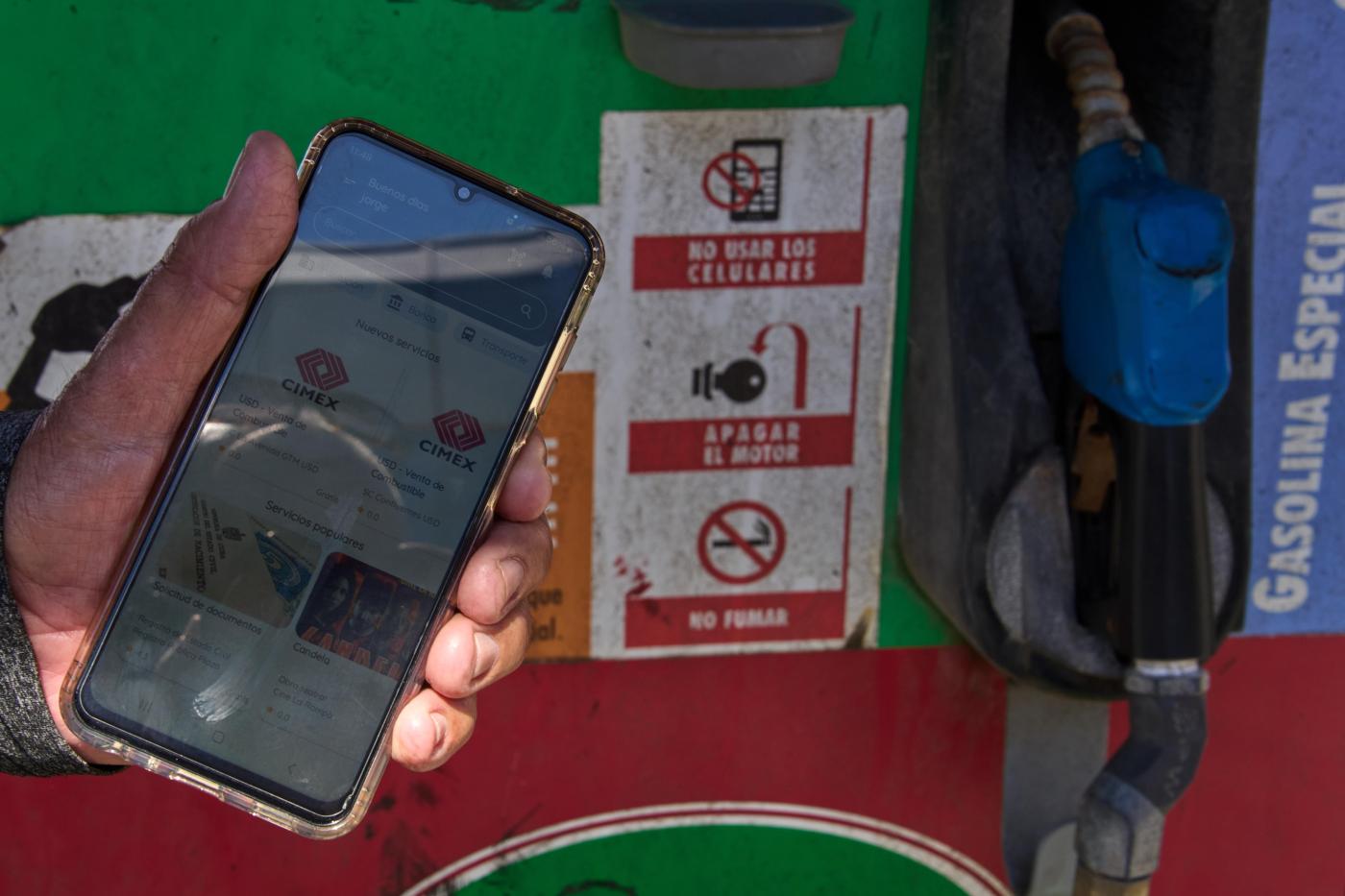
“I have (appointment) number seven thousand and something,” said Jorge Reyes, a 65-year-old who downloaded the app on Monday.
Reyes signed up to refuel at a gas station in Havana that is only awarding 50 appointments per day. “When will I be able to buy gas again?” he said.
Retiree Jorge Reyes pushes his motorcycle to refuel as it’s his turn in line at a gasoline station in Havana, Cuba, Monday, Feb. 16, 2026. (AP Photo/Ramon Espinosa)
A driver steers his bicycle taxi decorated with U.S. and Cuban flags in Havana, Cuba, Monday, Feb. 16, 2026. (AP Photo/Ramon Espinosa)
Tourists travel in a classic American car next to a line of drivers waiting to buy fuel for their cars in Havana, Cuba, Monday, Feb. 16, 2026. (AP Photo/Ramon Espinosa)
Retiree Jorge Reyes shows his phone with the app “El Ticket” which is used to reserve a place in line to buy rationed gasoline in Havana, Cuba, Monday, Feb. 16, 2026. (AP Photo/Ramon Espinosa)
1 of 4
Retiree Jorge Reyes pushes his motorcycle to refuel as it’s his turn in line at a gasoline station in Havana, Cuba, Monday, Feb. 16, 2026. (AP Photo/Ramon Espinosa)
The app only allows drivers to sign up for appointments at one gas station at a time. So, on WhatsApp groups some drivers are sharing information on which places might be less crowded or which gas stations have a greater capacity to serve customers, noting that some locations are awarding up to 90 appointments per day.
But that is of little comfort to those who have downloaded the app, only to find out there are up to 10,000 appointments ahead of theirs.
The Cuban government has also stopped selling gasoline in local currency at subsidized rates of about 25 cents per liter, and is now only selling more expensive fuel, priced in U.S. dollars.
A liter of gasoline currently sells for $1.30 at gas stations and can cost up to six dollars in the growing black market for gasoline. Government workers in Cuba are earn less than $20 a month, when their earnings in Cuban pesos are converted to U.S. dollars using market rates.
Related Articles
Injured seabird desperately pecks at hospital door for help
More third-country nationals have been deported by the US to Cameroon, lawyers tell AP
She was denied a legal abortion and sent to prison over an illegal one. Now she tells her story
Photos of Lunar New Year celebrations for the Year of the Horse
Taylor Swift concert attack plot leads to terrorism charges against 21-year-old man
When drivers can finally refuel at service stations, they are only allowed to buy 20 liters of gasoline, or about 5.2 gallons.
“This will not last me long,” said Ariel Alonso, a businessman who refueled Monday at the El Riviera gas station.
“I have to leave a reserve of five liters in case anyone gets sick at home,” and has to be taken to the hospital, he said.
The Ticket app is run by XETID, a state owned software firm. Last week, the company’s commercial director Saumel Tejada, told news site Cuba Debate that more than 90,000 drivers had sought refueling appointments using the app.
Ticket has been around for three years, and was previously used by Cubans to secure appointments at notaries and at gas stations where they could pay for fuel in local currency. But now it is almost the only way for drivers to get their cars refueled — without going to the black market.
Vehicles used for the island’s tourism industry are the exception. Those cars have special license plates and are allowed to refuel at 44 service stations around the island, where long lines have formed. As with regular vehicles, tourism cars can only purchase 20 liters of fuel.
Crisis intensifies
Fuels shortages and blackouts have been intensifying in Cuba this month, as the nation struggles to import oil for its power plants and refineries.
In late January, U.S. President Donald Trump threatened any nation that sold oil to Cuba with tariffs, as Washington steps up efforts to pressure the island’s communist government to make economic and political reforms.
Cuba’s president Miguel Díaz-Canel has said that he is willing to negotiate with the U.S. “as equals” and without relinquishing his nations sovereignty. Díaz-Canel has accused the U.S. of staging an “energy blockade.”
Venezuela, one of Cuba’s main oil suppliers, stopped selling crude to the island in January after the U.S. captured then president Nicolás Maduro in a pre-dawn raid and flew him to New York to face drug trafficking charges.
Banks on the island have reduced their working hours in a bid to save electricity and earlier this month the Cuban government said that it will not provide fuel to planes that land on the island, prompting three Canadian airlines to cancel flights to Cuba. Other airlines will continue to fly to the island but will make refueling stops in the Dominican Republic.
A book fair and an annual cigar trade fair have also been postponed as officials look for ways to reduce fuel and electricity consumption.
Last week a group of United Nations human rights experts condemned the U.S oil siege, saying that it has “no basis on collective security and constitutes a unilateral act that is incompatible with international law.”
An exhibit about nine people enslaved by George Washington must be restored at his former home in Philadelphia after President Donald Trump’s administration took it down last month, a federal judge ruled on Presidents Day, the federal holiday honoring Washington’s legacy.
The city of Philadelphia sued in January after the National Park Service removed the explanatory panels from Independence National Historical Park, the site where George and Martha Washington lived with nine of their slaves in the 1790s, when Philadelphia was briefly the nation’s capital.
The removal came in response to a Trump executive order “restoring truth and sanity to American history” at the nation’s museums, parks and landmarks. It directed the Interior Department to ensure those sites do not display elements that “inappropriately disparage Americans past or living.”
FILE – People walk past an informational panel at President’s House Site Tuesday, Aug. 19, 2025, in Philadelphia. (AP Photo/Matt Rourke, File)
FILE – Demonstrators gather to protest removal of explanatory panels that were part of an exhibit on slavery at the President’s House Site in Philadelphia, Feb. 10, 2026. (AP Photo/Matt Rourke, file)
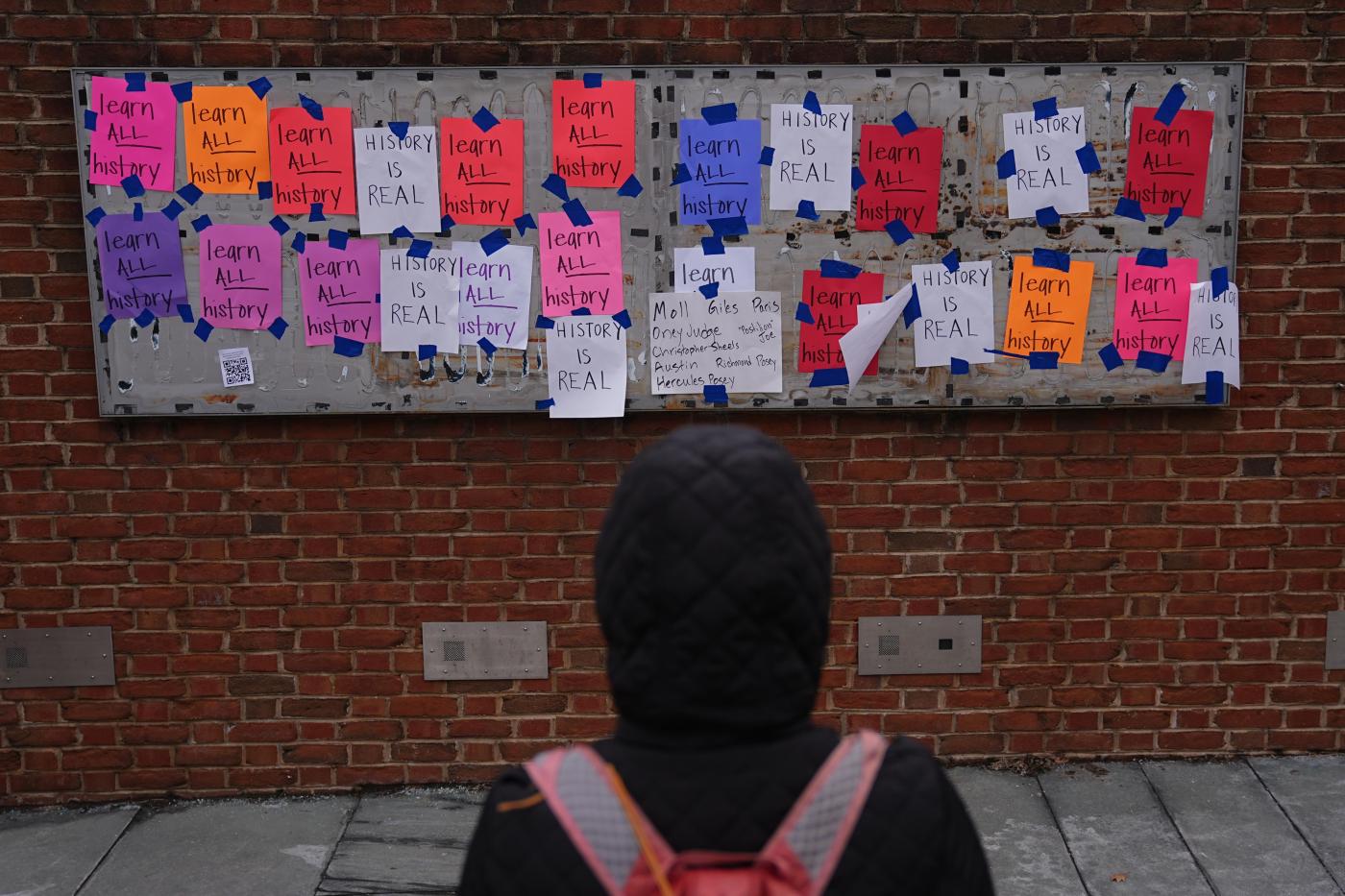
FILE – A person views posted signs on the locations of the now removed explanatory panels that were part of an exhibit on slavery at President’s House Site in Philadelphia, Jan. 23, 2026. (AP Photo/Matt Rourke, file)
1 of 3
FILE – People walk past an informational panel at President’s House Site Tuesday, Aug. 19, 2025, in Philadelphia. (AP Photo/Matt Rourke, File)
U.S. District Judge Cynthia Rufe ruled Monday that all materials must be restored in their original condition while a lawsuit challenging the removal’s legality plays out. She prohibited Trump officials from installing replacements that explain the history differently.
Rufe, an appointee of Republican President George W. Bush, began her written order with a quote from George Orwell’s dystopian novel “1984” and compared the Trump administration to the book’s totalitarian regime called the Ministry of Truth, which revised historical records to align with its own narrative.
“As if the Ministry of Truth in George Orwell’s 1984 now existed, with its motto ‘Ignorance is Strength,’ this Court is now asked to determine whether the federal government has the power it claims — to dissemble and disassemble historical truths when it has some domain over historical facts,” Rufe wrote. “It does not.”
She had warned Justice Department lawyers during a January hearing that they were making “dangerous” and “horrifying” statements when they said Trump officials can choose which parts of U.S. history to display at National Park Service sites.
The Interior Department did not immediately respond to a request for comment on the ruling, which came while government offices were closed for the federal holiday.
The judge did not provide a timeline for when the exhibit must be restored. Federal officials can appeal the ruling.
The historical site is among several where the administration has quietly removed content about the history of enslaved people, LGBTQ+ people and Native Americans.
Signage that has disappeared from Grand Canyon National Park said settlers pushed Native American tribes “off their land” for the park to be established and “exploited” the landscape for mining and grazing.
Related Articles
NAACP asks judge to protect against ‘misuse’ of voter data seized by FBI in Georgia’s Fulton County
Rubio plugs Orbán’s bid for another term after April elections during a visit to Budapest
What to know about the homeland security shutdown
Sick detainees describe poor care at facilities run by ICE contractor
The high-stakes fight over masked federal agents
Last week, a rainbow flag was taken down at the Stonewall National Monument, where bar patrons rebelled against a police raid and catalyzed the modern LGBTQ+ rights movement. The administration has also removed references to transgender people from its webpage about the monument, despite several trans women of color being key figures in the uprising.
The Philadelphia exhibit, created two decades ago in a partnership between the city and federal officials, included biographical details about each of the nine people enslaved by the Washingtons at the home, including two who escaped.
Among them was Oney Judge, who was born into slavery at the family’s plantation in Mount Vernon, Virginia, and later escaped from their Philadelphia house in 1796. Judge fled north to New Hampshire, a free state, while Washington had her declared a fugitive and published advertisements seeking her return.
Because Judge had escaped from the Philadelphia house, the park service in 2022 supported the site’s inclusion in a national network of Underground Railroad sites where they would teach about abolitionists and escaped slaves. Rufe noted that materials about Judge were among those removed, which she said “conceals crucial information linking the site to the Network to Freedom.”
Only the names of Judge and the other eight enslaved people — Austin, Paris, Hercules, Richmond, Giles, Moll and Joe, who each had a single name, and Christopher Sheels — remained engraved in a cement wall after park service employees took a crowbar to the plaques on Jan. 22.
Hercules also escaped in 1797 after he was brought to Mount Vernon, where the Washingtons had many other slaves. He reached New York City despite being declared a fugitive slave and lived under the name Hercules Posey.
Several local politicians and Black community leaders celebrated the ruling, which came while many were out rallying at the site for its restoration.
State Rep. Malcolm Kenyatta, a Philadelphia Democrat, said the community prevailed against an attempt by the Trump administration to “whitewash our history.”
“Philadelphians fought back, and I could not be more proud of how we stood together,” he said.
A man whose teenage son is accused of killing two students and two teachers at a Georgia high school should be held responsible for providing the weapon despite warnings about alleged threats his son made, a prosecutor said Monday.
Related Articles
Trump administration ordered to restore George Washington slavery exhibit it removed in Philadelphia
Al Pacino, Jamie Lee Curtis and others pay tribute to Robert Duvall, who died at age 95
3 killed, including suspect, in shooting during Rhode Island youth hockey game
More third-country nationals have been deported by the US to Cameroon, lawyers tell AP
Nancy Guthrie kidnapping investigators work with Walmart after identifying suspect’s backpack
The trial of Colin Gray began Monday in one of several cases around the country where prosecutors are trying to hold parents responsible after their children are accused in fatal shootings.
Gray faces 29 counts, including two counts of second-degree murder, two counts of involuntary manslaughter and numerous counts of second-degree cruelty to children related to the September 2024 shooting at Apalachee High School in Winder.
“This is not a case about holding parents accountable for what their children do,” Barrow County District Attorney Brad Smith said in his opening statement. “This case is about this defendant and his actions in allowing a child that he has custody over access to a firearm and ammunition after being warned that that child was going to harm others.”
Prosecutors argue that amounts to cruelty to children, and second-degree murder is defined in Georgia law as causing the death of a child by committing the crime of cruelty to children.
Investigators have said Colt Gray, who was 14 at the time, carefully planned the Sept. 4, 2024, shooting at the school northeast of Atlanta that is attended by 1,900 students.
But Brian Hobbs, an attorney for Colin Gray, said the shooting’s planning and timing “were hidden by Colt Gray from his father. That’s the difference between tragedy and criminal liability. You cannot hold someone criminally responsible for failing to predict what was intentionally hidden from them.”
District Attorney Brad Smith points to the defendant Colin Gray, the father of Apalachee High School shooting suspect Colt Gray, during Smith’s opening statements in the courtroom at the Barrow County courthouse, Monday, Feb. 16, 2026, in Winder, Ga. (Jason Getz/Atlanta Journal-Constitution via AP)
District Attorney Brad Smith, left, points to a weapon that was displayed on the screen during the first day of the trial of Colin Gray, the father of Apalachee High School shooting suspect Colt Gray, in the courtroom at the Barrow County courthouse, Monday, Feb. 16, 2026, in Winder, Ga. (Jason Getz/Atlanta Journal-Constitution via AP)
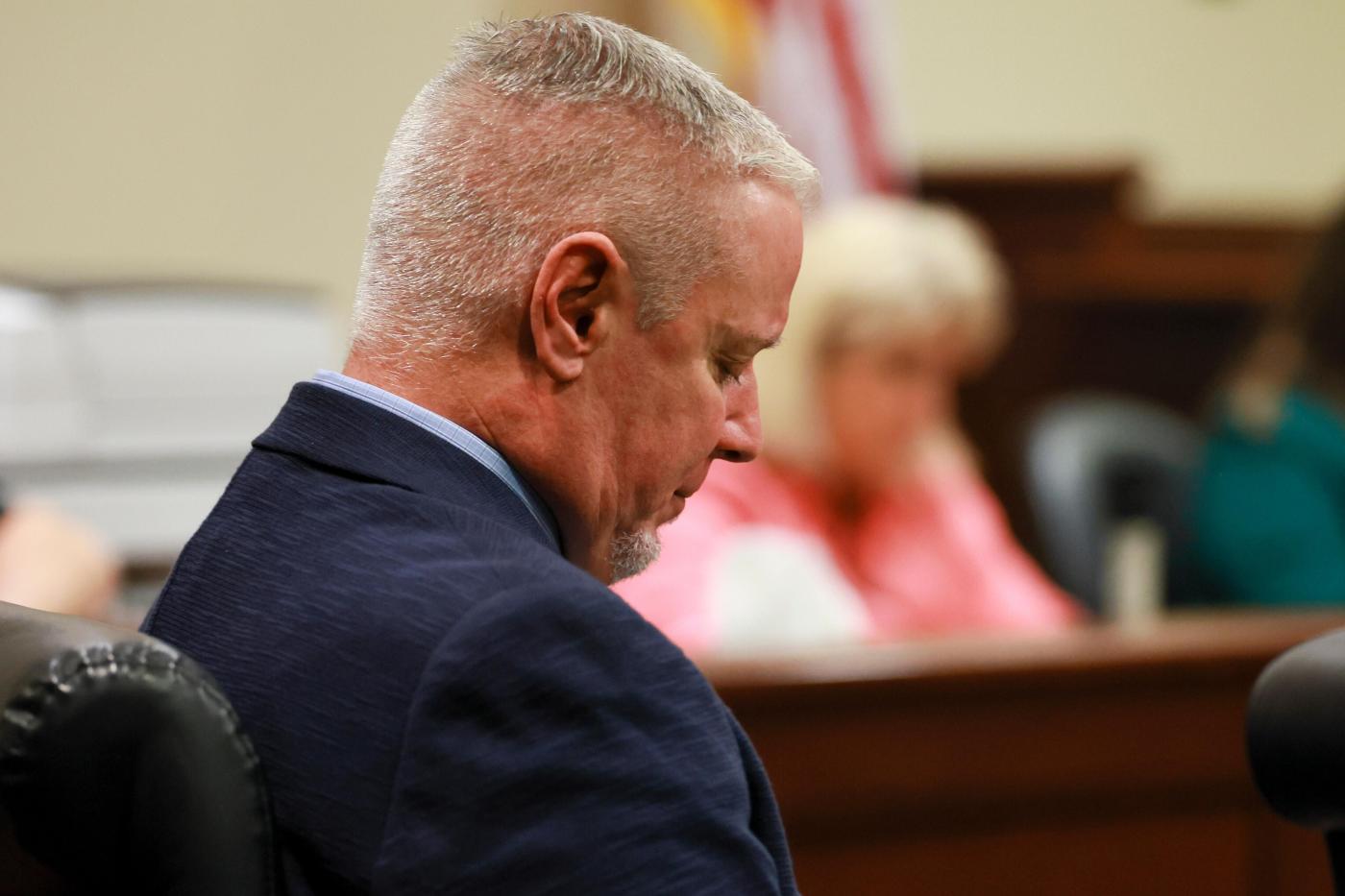
Colin Gray, the father of Apalachee High School shooting suspect Colt Gray, looks down as his attorney gives his opening statement in the courtroom at the Barrow County courthouse, Monday, Feb. 16, 2026, in Winder, Ga. (Jason Getz/Atlanta Journal-Constitution via AP)
1 of 3
District Attorney Brad Smith points to the defendant Colin Gray, the father of Apalachee High School shooting suspect Colt Gray, during Smith’s opening statements in the courtroom at the Barrow County courthouse, Monday, Feb. 16, 2026, in Winder, Ga. (Jason Getz/Atlanta Journal-Constitution via AP)
With a semiautomatic rifle in his book bag, the barrel sticking out and wrapped in poster board, Colt Gray boarded the school bus, investigators said. He left his second-period class and emerged from a bathroom with the gun and then shot people in a classroom and hallways, they said.
Smith told the jury that Colin Gray’s daughter was in lockdown at her middle school and texted her father that there had been a shooting at the high school. When law enforcement arrived at Gray’s home, he met them in the garage and “without any prompting, he blurts out, ‘I knew it,’” Smith said.
Smith said that in September 2021, Colt Gray used a school computer to search the phrase, “how to kill your dad.” School resource officers were then sent to the home, but it was determined to be a “misunderstanding,” Smith said.
Sixteen months before the shooting, in May 2023, law enforcement acted on a tip from the FBI after a shooting threat was made online concerning an elementary school. The threat was traced to a computer at Gray’s home, Smith said.
Colin Gray was told about the threat and was asked whether his son had access to guns. Gray replied that he and his son “take this school shooting stuff very seriously,” according to Smith. Colt Gray denied that he made the threat and said that his online account had been hacked, Smith said.
That Christmas, Colin Gray gave his son the gun as a gift and continued to buy accessories after that, including “a lot of ammunition,” Smith said.
Colin Gray knew his son was obsessed with school shooters, even having a shrine in his bedroom to Nikolas Cruz, the shooter in the 2018 massacre at Marjory Stoneman Douglas High School in Parkland, Florida, prosecutors have said. A Georgia Bureau of Investigation agent had testified that the teen’s parents had discussed their son’s fascination with school shooters but decided that it was in a joking context and not a serious issue.
Three weeks before the shooting, Gray received a chilling text from his son: “Whenever something happens, just know the blood is on your hands,” according to Smith.
Colin Gray was also aware his son’s mental health had deteriorated and had sought help from a counseling service weeks before the shooting, an investigator testified.
“We have had a very difficult past couple of years and he needs help. Anger, anxiety, quick to be volatile. I don’t know what to do,” Colin Gray wrote about his son.
But Smith said Colin Gray never followed through on concerns about getting his son admitted to an in-patient facility.
The trial is being held in Winder, in Barrow County, where the shooting happened. The defense asked for a change of venue because of pretrial publicity, and prosecutors agreed. The judge kept the trial in Winder but decided to bring in jurors from nearby Hall County to hear the case. Jurors were selected last week.