Doctors and public health organizations sue Kennedy over vaccine policy changes

posted in: All news | 0

By MIKE STOBBE, AP Medical Writer

NEW YORK (AP) — A coalition of doctors groups and public health organizations sued the U.S. government on Monday over the decision to stop recommending COVID-19 vaccinations for most children and pregnant women.

Related Articles


Wegovy and Zepbound prices fall, but access to the obesity drugs still isn’t guaranteed


American kids have become increasingly unhealthy over nearly two decades, new study finds


How to protect yourself from ticks year-round


Essentia hospital nurses in Duluth, Superior avoid strike


Thinking about taking a stab at IV therapy? Ask some questions first

The American Academy of Pediatrics, American Public Health Association and four other groups — along with an unnamed pregnant doctor who works in a hospital — filed the lawsuit in federal court in Boston.

U.S. health officials, following infectious disease experts’ guidance, previously urged annual COVID-19 shots for all Americans ages 6 months and older. But in late May, Health Secretary Robert F. Kennedy Jr. announced he was removing COVID-19 shots from the Centers for Disease Control and Prevention’s recommendations for healthy children and pregnant women.

A number of health experts decried the move as confusing and accused Kennedy of disregarding the scientific review process that has been in place for decades — in which experts publicly review current medical evidence and hash out the pros and cons of policy changes.

The new lawsuit repeats those concerns, alleging that Kennedy and other political appointees at the U.S. Department of Health and Human Services have flouted federal procedures and systematically attempted to mislead the public.

“This administration is an existential threat to vaccination in America, and those in charge are only just getting started,” said Richard H. Hughes IV, the lead attorney for the plaintiffs. “If left unchecked, Secretary Kennedy will accomplish his goal of ridding the United States of vaccines, which would unleash a wave of preventable harm on our nation’s children.”

HHS officials did not immediately respond to a request for comment.

Also joining the suit are the American College of Physicians, the Infectious Diseases Society of America, the Massachusetts Public Health Association and the Society for Maternal-Fetal Medicine.

The Associated Press Health and Science Department receives support from the Howard Hughes Medical Institute’s Department of Science Education and the Robert Wood Johnson Foundation. The AP is solely responsible for all content.

Epstein ‘client list’ doesn’t exist, Justice Department says, walking back theory Bondi had promoted

posted in: All news | 0

By ERIC TUCKER and ALANNA DURKIN RICHER

WASHINGTON (AP) — Jeffrey Epstein did not maintain a “client list,” the Justice Department acknowledged Monday as it said no more files related to the wealthy financier’s sex trafficking investigation would be made public despite promises from Attorney General Pam Bondi that had raised the expectations of conservative influencers and conspiracy theorists.

The acknowledgment that the well-connected Epstein did not have a list of clients to whom underage girls were trafficked represents a public walk-back of a theory that the Trump administration had helped promote, with Bondi suggesting in a Fox News interview earlier this year that such a document was “sitting on my desk” in preparation for release.

Even as it released video from inside a New York jail meant to definitively prove that Epstein committed suicide, the department also said in a memo that it was refusing to release other evidence investigators had collected. Bondi for weeks had suggested that more material was going to be revealed — “It’s a new administration and everything is going to come out to the public,” she said at one point — after a first document dump she had hyped angered President Donald Trump’s base by failing to deliver revelations.

That episode, in which conservative internet personalities were invited to the White House in February and provided with binders marked “The Epstein Files: Phase 1” and “Declassified” that contained documents that had largely already been in the public domain, has spurred far-right influencers to lambast and deride Bondi.

After the first release fell flat, Bondi said officials were pouring over a “truckload” of previously withheld evidence she said had been handed over by the FBI. In a March TV interview, she claimed the Biden administration “sat on these documents, no one did anything with them,” adding: “Sadly these people don’t believe in transparency, but I think more unfortunately, I think a lot of them don’t believe in honesty.”

But after a months-long review of evidence in the government’s possession, the Justice Department determined that no “further disclosure would be appropriate or warranted,” the memo says. The department noted that much of the material was placed under seal by a court to protect victims and “only a fraction” of it “would have been aired publicly had Epstein gone to trial.”

The two-page memo bore the logos of the Justice Department and the FBI but was not signed by any individual official.

“One of our highest priorities is combatting child exploitation and bringing justice to victims,” the memo says. Perpetuating unfounded theories about Epstein serves neither of those ends.”

Conservatives who have sought proof of a government coverup of Epstein’s activities and death expressed outrage Monday over the department’s position. Far-right influencer Jack Posobiec posted: “We were all told more was coming. That answers were out there and would be provided. Incredible how utterly mismanaged this Epstein mess has been. And it didn’t have to be.”

Conspiracy theorist Alex Jones wrote that “next the DOJ will say ‘Actually, Jeffrey Epstein never even existed,’ calling it “over the top sickening.” Elon Musk shared a series of photos of a clown applying makeup appearing to mock Bondi for saying the client list doesn’t exist after suggesting months ago that it was on her desk.

Among the evidence that the Justice Department says it has in its possession are photographs and more than 10,000 videos and images that officials said depicted child sex abuse material or “other pornography.” Bondi had earlier suggested that part of the reason for the delay in releasing additional Epstein materials was because the FBI needed to review “tens of thousands” of recordings that she said showed Epstein “with children or child porn.”

The Associated Press published a story last week about the unanswered questions surrounding those videos.

Related Articles


Doctors and public health organizations sue Kennedy over vaccine policy changes


Violent crime was down nationally in 2024, according to half-year FBI snapshot


Wegovy and Zepbound prices fall, but access to the obesity drugs still isn’t guaranteed


Man killed after shooting at a US Border Patrol facility in southern Texas


American kids have become increasingly unhealthy over nearly two decades, new study finds

Multiple people who participated in the criminal cases of Epstein and former British socialite girlfriend Ghislaine Maxwell told AP that they had not seen and did not know of a trove of recordings along the lines of what Bondi had referenced. Indictments and detention memos also don’t allege the existence of video recordings and neither Epstein nor Maxwell were charged with possession of child sex abuse material even though that would have been easier for prosecutors to prove than the sex trafficking counts they faced.

The AP did find reference in a filing in a civil lawsuit to the discovery by the Epstein estate of videos and pictures that could constitute child sex abuse material, but lawyers involved in that case said a protective order prevents them from discovering the specifics of that evidence.

The Justice Department did not respond to a detailed list of questions from AP about the videos Bondi was referencing.

Monday’s memo does not explain when or where they were located, what they depict and whether they were newly found as investigators scoured their collection of evidence or were known for some time to have been in the government’s possession.

Epstein was found dead in his jail cell in August 2019, weeks after his arrest on sex trafficking charges, in a suicide that foreclosed the possibility of a trial.

The department’s disclosure that Epstein took his own life is hardly a revelation even though conspiracy theorists have continued to challenge that conclusion.

In 2019, for instance, then-Attorney General William Barr told the AP in an interview that he had personally reviewed security footage that revealed that no one entered the area where Epstein was housed on the night he died and Barr had concluded that Epstein’s suicide was the result of “a perfect storm of screw-ups.”

More recently, FBI Director Kash Patel and Deputy Director Dan Bongino have insisted in television and podcast interviews that the evidence was clear that Epstein had killed himself.

Deals made by Trump since pausing his ‘Liberation Day’ tariffs remain sparse

posted in: All news | 0

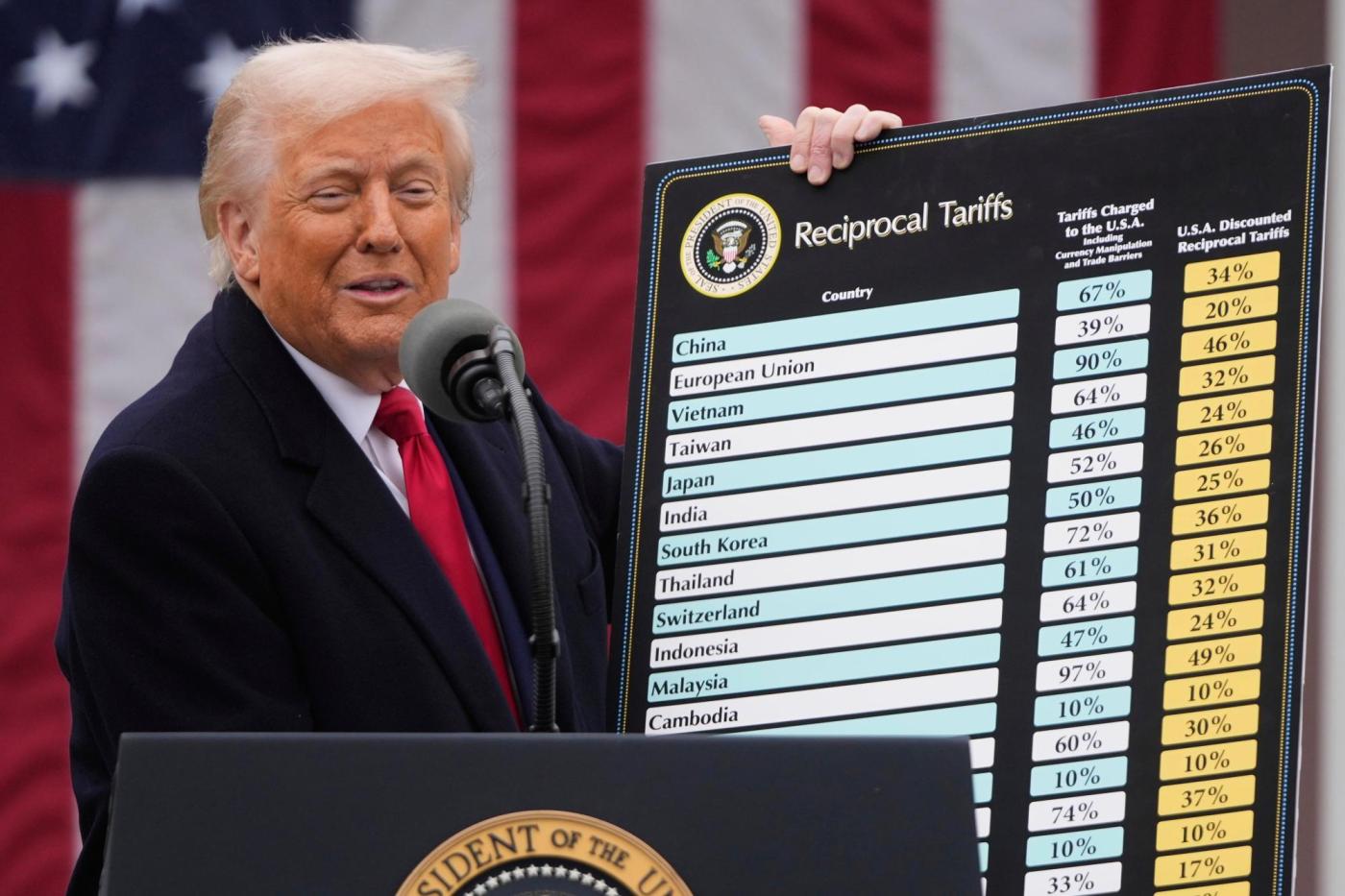
NEW YORK — Just over three months ago, President Donald Trump unveiled his most sweeping volley of tariffs yet — holding up large charts from the White House Rose Garden to outline new import taxes that the U.S. would soon slap on goods from nearly every country in the world.

Related Articles


Debate erupts over role job cuts played in weather forecasts ahead of deadly Texas floods


Trump to put 25% tariffs on allies Japan and South Korea


Trump administration’s crackdown on pro-Palestinian campus activists faces federal trial


Trump and Netanyahu may take a victory lap on Iran, but the Gaza war looms over their meeting


Pressure from Trump for trade deals before Wednesday deadline, but hints of more time for talks

But in line with much of Trump’s on-again, off-again trade policy playbook, the bulk of those “Liberation Day” levies in April were postponed just hours after they took effect — in a 90-day suspension that arrived in an apparent effort to quell global market panic and facilitate country-by-country negotiations. At that time, the administration set a lofty goal of reaching 90 trade deals in 90 days.

Now, with the July 9 deadline looming, the U.S. has only announced pacts with the United Kingdom and Vietnam — as well as a “framework″ agreement with China in a separate trade dispute. News of these deals often trickled through social media posts from the president and, even when countries on both sides of a negotiation table made more official announcements, many key details — including timing — were sparse.

The Trump administration has since hinted that some trading partners might get more time for talks. Over the July 4th holiday weekend, Trump said that the U.S. would start sending letters to certain countries warning that higher tariffs could kick in Aug. 1. Trump took to Truth Social on Monday to share letters he sent to the leaders of Japan and South Korea, declaring that both countries would see 25% tariffs on goods entering the U.S. starting Aug. 1.

Even with negotiations ongoing, most countries have still faced a minimum 10% levy on goods entering the U.S. over the past three months, on top of punishing new taxes targeting foreign steel and aluminum as well as auto imports. The 90-day pause pushed back additional steeper rates, which Trump calls “reciprocal” tariffs, for dozens of nations.

Here’s what we know about the trade deals announced since April.

Vietnam

On July 2, Trump announced a trade deal with Vietnam that he said would allow U.S. goods to enter the country duty-free. Vietnamese exports to the United States, by contrast, would face a 20% levy.

That’s less than half the 46% “reciprocal” rate Trump proposed for Vietnamese goods back in April. But in addition to the new 20% tariff rate, Trump said the U.S. would impose a 40% tax on “transshipping’’ — targeting goods from another country that stop in Vietnam on their way to the United States. Washington complains that Chinese goods have been dodging higher U.S. tariffs by transiting through Vietnam.

It wasn’t immediately clear when these new rates would go into effect or whether they would come on top of any other previously-imposed levies. Like most other countries, Vietnam has faced Trump’s 10% baseline tariff for the last three months.

United Kingdom

On May 8, Trump agreed to cut tariffs on British autos, steel and aluminum, among other trade pledges — while the U.K. promised to reduce levies on U.S. products like olive oil, wine and sports equipment. The deal was announced in grandiose terms by both countries, but some key details remained unknown for weeks.

When the deal was announced, for example, the British government notably said that the U.S. agreed to exempt the U.K. from its then-universal 25% duties on foreign steel and aluminum — which would have effectively allowed both metals from the country to come into the U.S. duty-free.

But the timing for when those cuts would actually take effect stayed up in the air for almost a month. It wasn’t until early June, when Trump hiked his steel and aluminum tariffs to a punishing 50% worldwide, that the U.S. acknowledged it was time to implement the agreement. And even then, U.S. tariffs on British steel and aluminum did not go to zero. The U.K. was the only country spared from Trump’s new 50% levies, but still faces 25% import taxes on the metals — and Trump said that rate could also go up on or after Wednesday.

The U.K. did not receive a higher “reciprocal” rate on April 2, but continues to face the 10% baseline tax.

China

At its peak, Trump’s new tariffs on Chinese goods totaled 145% — and China’s countertariffs on American products reached 125%. But on May 12, the countries agreed to their own 90-day truce to roll back those levies to 30% and 10%, respectively. And last month, details began trickling in about a tentative trade agreement.

On June 11, following talks in London, Trump announced a “framework” for a deal. And late last month, the U.S. and China both acknowledged that some sort of agreement had been reached. U.S. Treasury Secretary Scott Bessent said that China had agreed to make it easier for American firms to acquire Chinese magnets and rare earth minerals critical for manufacturing and microchip production. Meanwhile, without explicitly mentioning U.S. access to rare earths, the Chinese Commerce Ministry said that it would “review and approve eligible export applications for controlled items” and that the U.S. would “lift a series of restrictive measures it had imposed on China.”

More specifics about those measures — and when they would actually go into effect — were not immediately clear. But on Friday, the Ministry of Commerce acknowledged that the U.S. was resuming exports of airplane parts, ethane and other items to China. And when Trump first announced the framework on June 11, the U.S. had said it agreed to stop seeking to revoke the visas of Chinese students on U.S. college campuses.

AP Reporters Aniruddha Ghosal in Hanoi, Paul Wiseman and Fu Ting in Washington, D.C., and Huizhong Wu in Bangkok contributed to this report.

Trump to put 25% tariffs on allies Japan and South Korea

posted in: All news | 0

By JOSH BOAK

WASHINGTON (AP) — President Donald Trump on Monday placed a 25% tax on goods imported from Japan and South Korea, citing persistent trade imbalances with the two crucial U.S. allies in Asia.

Related Articles


Wall Street moves lower as Trump’s tariff deadline nears


Business People: New Brighton Mayor Kari Niedfeldt-Thomas to lead regional BBB


Real World Economics: Looming farm crisis, by the numbers


Your Money: The pursuit of happiness


Working Strategies: Random thoughts: ‘Office,’ not ‘work;’ on-the-job training

Trump provided notice of the tariffs to begin on Aug. 1 by posting letters on Truth Social that were addressed to the leaders of both countries. The letters warned both countries to not retaliate by increasing their own import taxes, or else the Trump administration would further increase tariffs.

“If for any reason you decide to raise your Tariffs, then, whatever the number you choose to raise them by, will be added onto the 25% that we charge,” Trump wrote in the letters to Japanese Prime Minister Shigeru Ishiba and South Korean President Lee Jae-myung.

The letters were not the final word from Trump on tariffs, so much as another episode in a global economic drama in which the U.S. president has placed himself at the center.

Trump has declared an economic emergency to unilaterally impose the taxes, suggesting they are remedies for past trade deficits even though many U.S. consumers have come to value autos, electronics and other goods from Japan and South Korea. But it’s unclear what he gains strategically against China — another stated reason for the tariffs — by challenging two crucial partners in Asia who could counter China’s economic heft.

“These tariffs may be modified, upward or downward, depending on our relationship with your Country,” Trump wrote in both letters.

Because the new tariff rates go into effect in roughly three weeks, Trump is setting up a period of possibly tempestuous talks among the U.S. and its trade partners to reach new frameworks.

Trump initially sparked hysteria in the financial markets by announcing tariff rates on dozens of countries, including 24% on Japan and 25% on South Korea. In order to calm the markets, Trump unveiled a 90-day negotiating period during which goods from most countries were taxed at a baseline 10%.

The 90-day negotiating period technically ends before Wednesday, even as multiple administration officials and Trump himself suggested the three-week period before implementation is akin to overtime for additional talks.

Trump is relying on tariff revenues to help offset the tax cuts he signed into law on July 4, a move that could shift a greater share of the federal tax burden onto the middle class and poor as importers would pass along much of the cost of the tariffs.

His trade framework with Vietnam is clearly designed to box out China from routing its America-bound goods through that country, while the quotas in the United Kingdom framework would spare that nation from the higher tariff rates being charged on steel, aluminum and autos.

The United States ran a $69.4 billion trade imbalance in goods with Japan in 2024 and a $66 billion imbalance with South Korea, according to the Census Bureau.